On air · 1 of 3 networks
INTEC ROTORS
- intecrotors.com
- Industry & Manufacturing
- IT
- 15 employees
INTEC ROTORS’s ads on LinkedIn, Meta and Google, recorded by adsrunning. Browse the latest here for free. Sign up free to see all 24. Watch INTEC ROTORS with Starter to get each new one in your feed.
Watchlist with Starter · $49/mo
| Network | Status | Live ads | Nov 2025LinkedIn activity · 52 weeksOct 2026 | Checked | Next step |
|---|---|---|---|---|---|
| Running | 12 | Checked 29 Oct 2026 | See all 24 ads → | ||
| Meta | Not checked | — | |||
| None recorded | 0 | No ads found on the Google Ads Transparency Center | Checked 1 Oct 2026 | Collect them with the API → |
INTEC ROTORS has 12 live LinkedIn ads. We recorded no Google ads on 1 Oct 2026.
Latest ads
- LINKEDIN · IMAGESince 16 Sept 2026
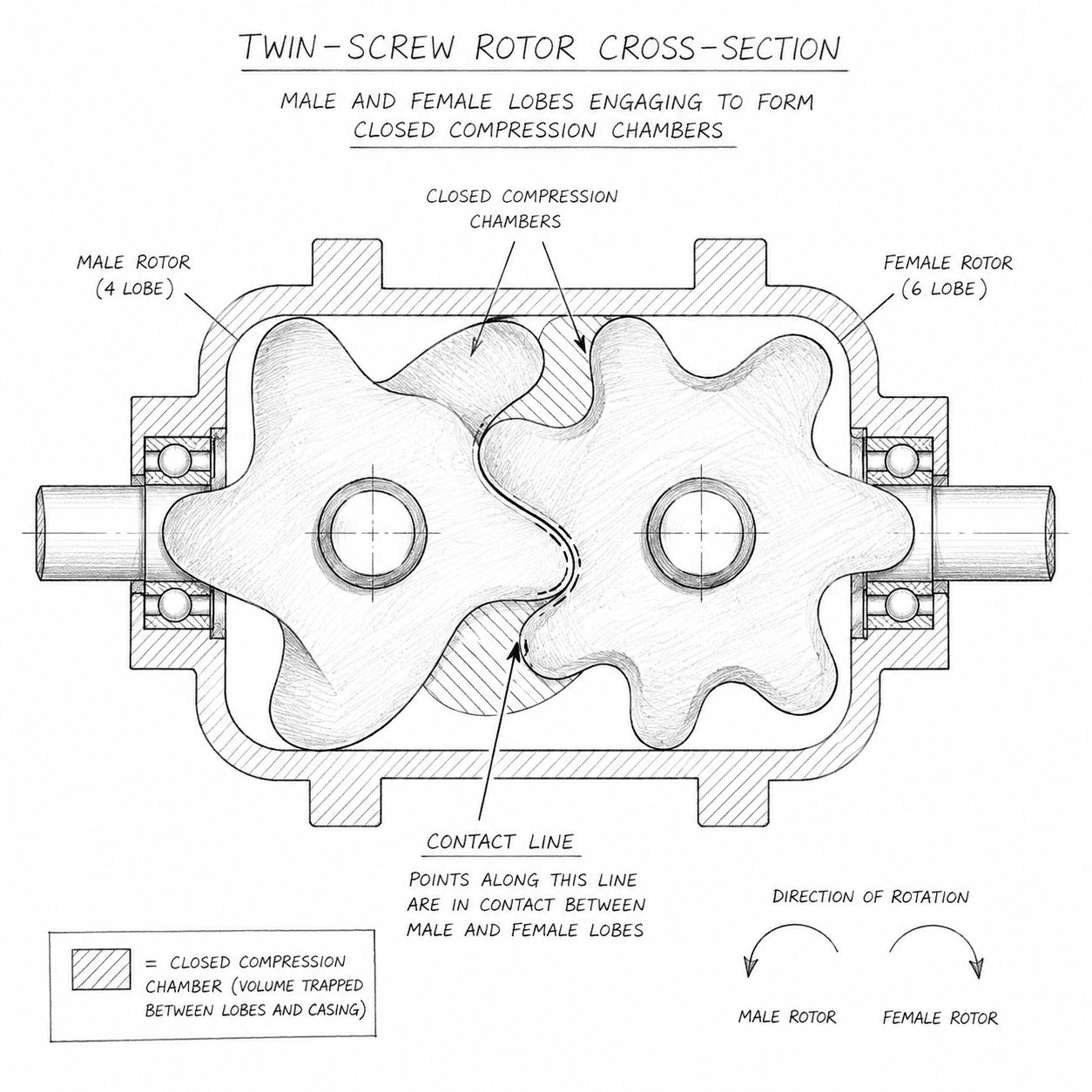
𝗥𝗼𝘁𝗼𝗿 𝗴𝗲𝗼𝗺𝗲𝘁𝗿𝘆 𝗳𝗼𝗿 𝗻𝗲𝘄𝗯𝗶𝗲𝘀, 𝗲𝗽. 𝟯 A screw rotor on its own does not compress anything. Compression starts when two rotors mesh and create closed volumes that move along the axis and gradually shrink. So what you are really designing is not a rotor. You are designing an interaction. And that interaction has to solve four things at once: 🔹 Create well-defined chambers 🔹 Keep them closed long enough 🔹 Trap the gas inside 🔹 Limit how much escapes along the way Each of these depends on specific geometric choices. 🔹 Wrap angle Controls how far the profile develops around the rotor. More wrap means the chamber stays closed longer, which directly affects how much compression actually happens before the port opens. 🔹 Contact line development This is where the two rotors meet along the meshing path. A well-developed contact line separates one chamber from the next, and keeps them isolated from each other during the process. 🔹 Displacement volume The theoretical volume is just a starting point. What matters is how much of it remains useful once leakage paths enter the picture. Geometry that looks good on paper can lose a significant portion of its effective volume in practice. 🔹 Flank manufacturability A profile that cannot be machined consistently will not behave like the one you designed. The gap between nominal geometry and real geometry is where performance quietly disappears. These are not independent parameters. They interact the same way the two rotors do. Good rotor geometry is about finding the combination that creates useful volume, keeps it sealed, and survives the transition from design to physical hardware.
- LINKEDIN · IMAGESince 16 Sept 2026
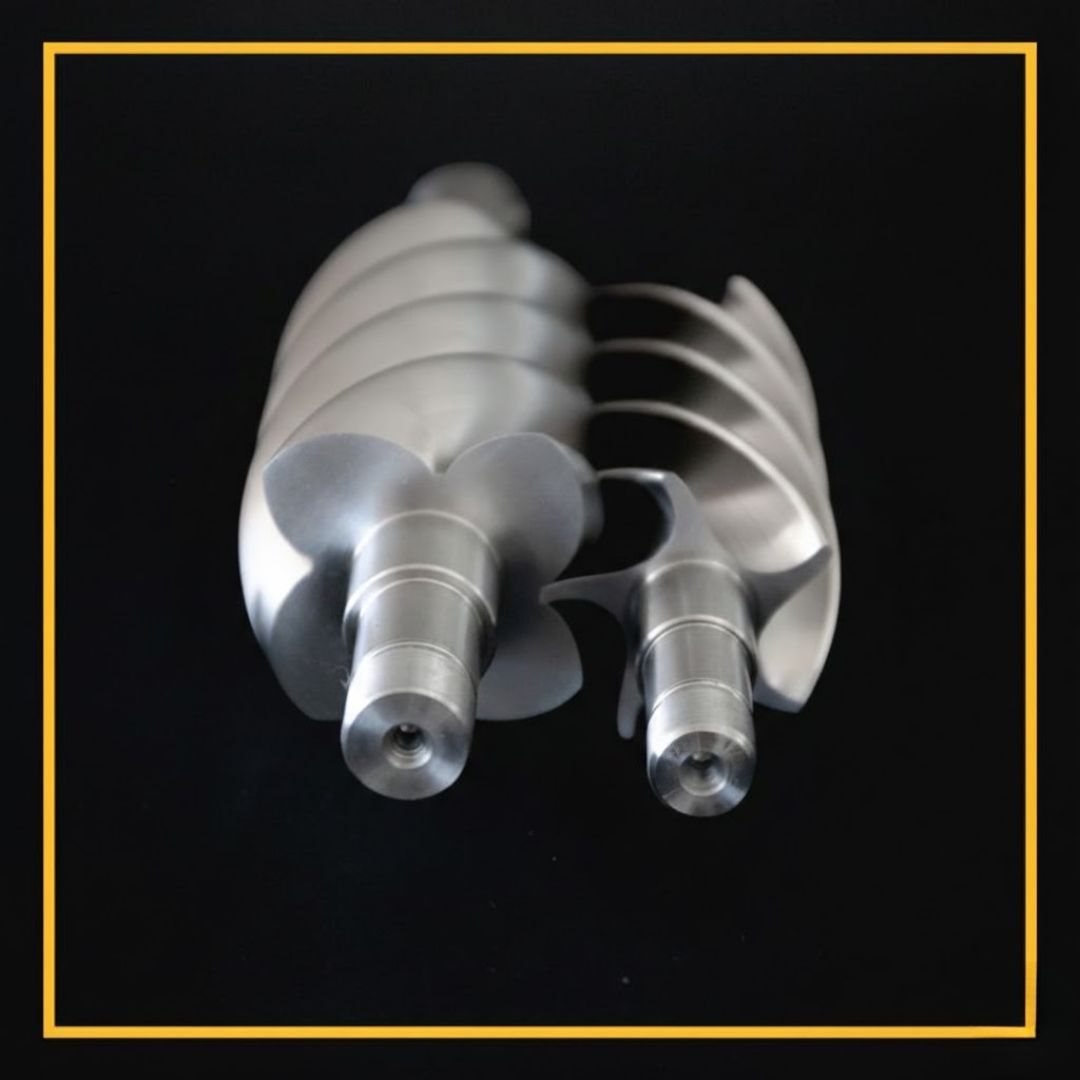
"Should I go standard or custom?" It’s the million-dollar question (often literally, in terms of maintenance costs) that I hear most. Standard is often perfectly fine. There’s no need to over-engineer if the application doesn't demand it. However, the decision should be done according to the Rotor Configuration. Think of the configuration as the "DNA" of your system: a complex interaction between the number of lobes, rotor size, and the conceptual "Rack" used to generate the conjugate surfaces. Most modern profiles are rack-generated to ensure perfect meshing, but the lobe combination must be perfectly tuned to your specific speed and pressure. If your application sits right at the edge of a standard profile’s limits, you’re looking at a TCO (Total Cost of Ownership) disaster. While the application (fluid, heat, load) drives the initial configuration, the mechanical limits of that configuration will, in turn, dictate your system’s final performance. My take: Sometimes a standard profile is a safe bet; other times, a slight tweak in the rack generation is the only thing preventing premature wear and vibration.
- LINKEDIN · IMAGESince 16 Sept 2026
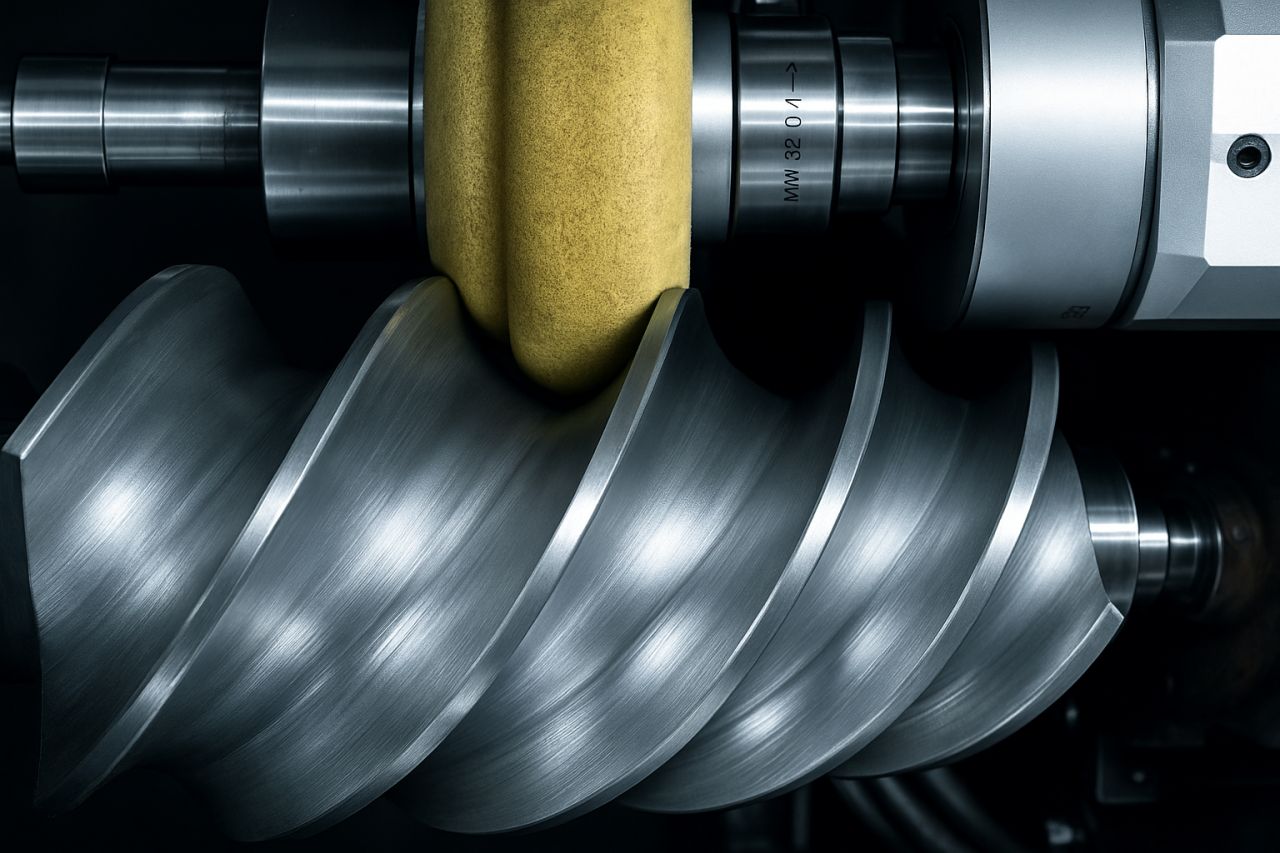
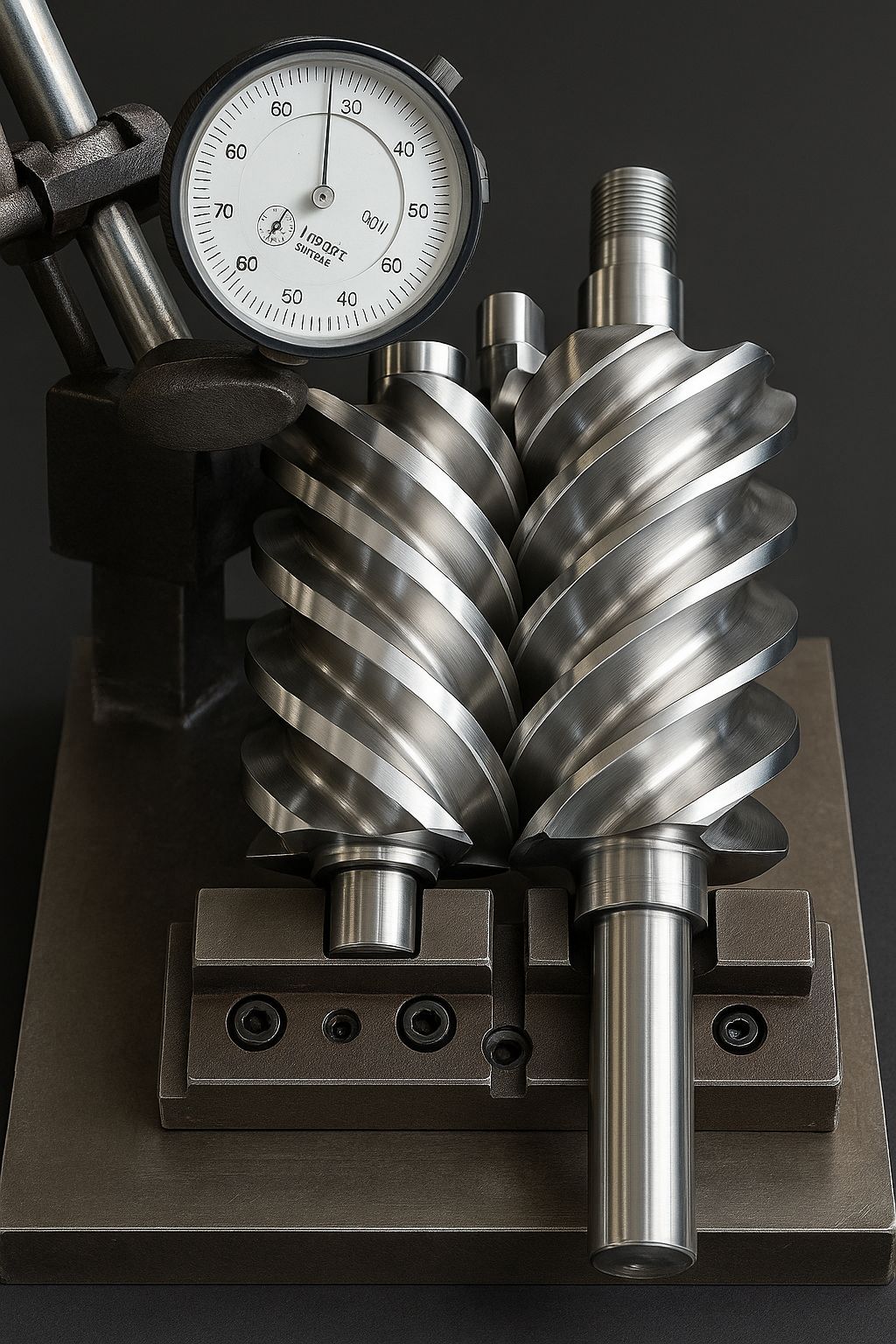
One thousandth of a millimetre sounds harmless. Like something you’d ignore. Until your twin-screw airend starts vibrating like a washing machine on spin cycle. Bearings run hot, energy bills spike — and suddenly, your finance team knows your name a little too well. That’s why we obsess over the profile. We grind. We measure. We blue-check. We measure again. All to keep those flanks hugging the CAD curve your engineer drew, as close as physics (and reality) allow. 0.000 mm? Dreamland. ±3 µm? That’s more bearable. But sometimes the CAD isn’t as precise as expected. Bad math, stacked tolerances, thermal expansion nobody accounted for (oops). So we go full detective: Rev 1, 1-bis, 2… whatever it takes until that screw rotor hums like it should.
- LINKEDIN · IMAGESince 8 Jul 2026
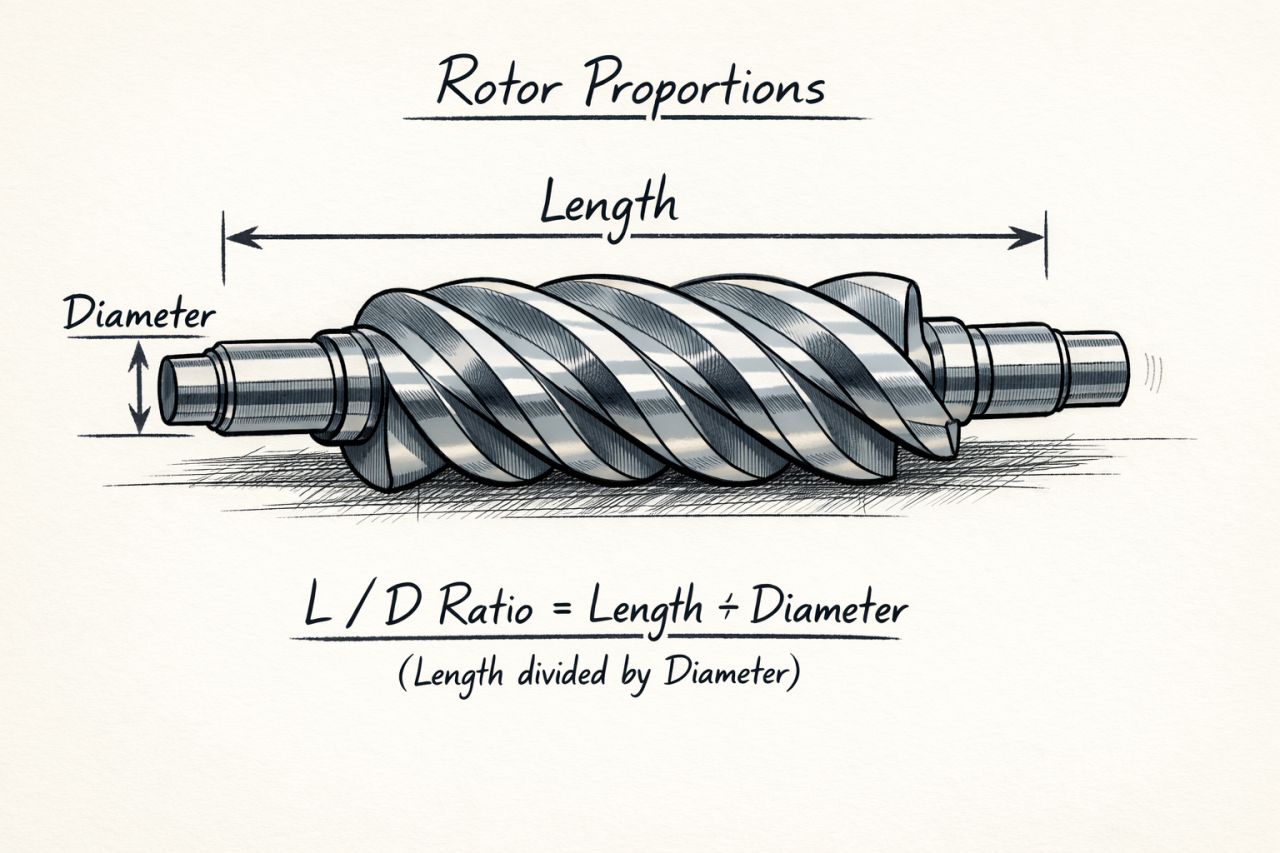
Let me inaugurate a new series: Rotor geometry for newbies - ep. 1. A slightly irreverent title, but I want to come back to the basics, or rather, from the first thing that is never really “basic” at all: Rotor proportions. When we say rotor proportions, we are mainly talking about three things: > Length > Diameter > L/D ratio And from these, a lot of other consequences follow. 🔹 Length A longer rotor gives more axial space for compression. That can help make pressure build-up smoother, but it also makes the rotor more prone to deflection under load. 🔹 Diameter Diameter affects the size of the compression chamber and the swept volume. In simple terms, it has a big impact on capacity, but it also changes tip speed and mechanical loading. 🔹 L/D ratio (length-to-diameter ratio) - A high L/D ratio usually means a more slender rotor, which may support the compression process better, but can be less stiff. - A lower L/D ratio usually means a stiffer rotor, but with different geometric and layout constraints. And from these proportions, we can already get a first idea of how the machine will behave. They influence how much gas can be handled, how the compression develops along the rotor, and how the overall layout needs to be designed. They are the starting point for understanding capacity and general performance.
- LINKEDIN · IMAGESince 8 Jul 2026
Feeler gauges or test bench? Feeler gauges can be useful — if you’re tuning your kid’s bike. But when you’re working with a twin-screw rotor spinning at 8,000 rpm inside a high-efficiency compressor, precision matters. A small variation can have a big impact. That’s why we measure backlash on a test bench during production. Not una tantum. Every. Single. Time. Here’s our process: 🔹 We test a male master rotor against every female in the batch. 🔹 Then we reverse the setup — female master, tested with every male. It’s a thorough method. Not always the most common, but essential when consistency and accuracy are the goal — and for us, they are.
- LINKEDIN · IMAGESince 8 Jul 2026
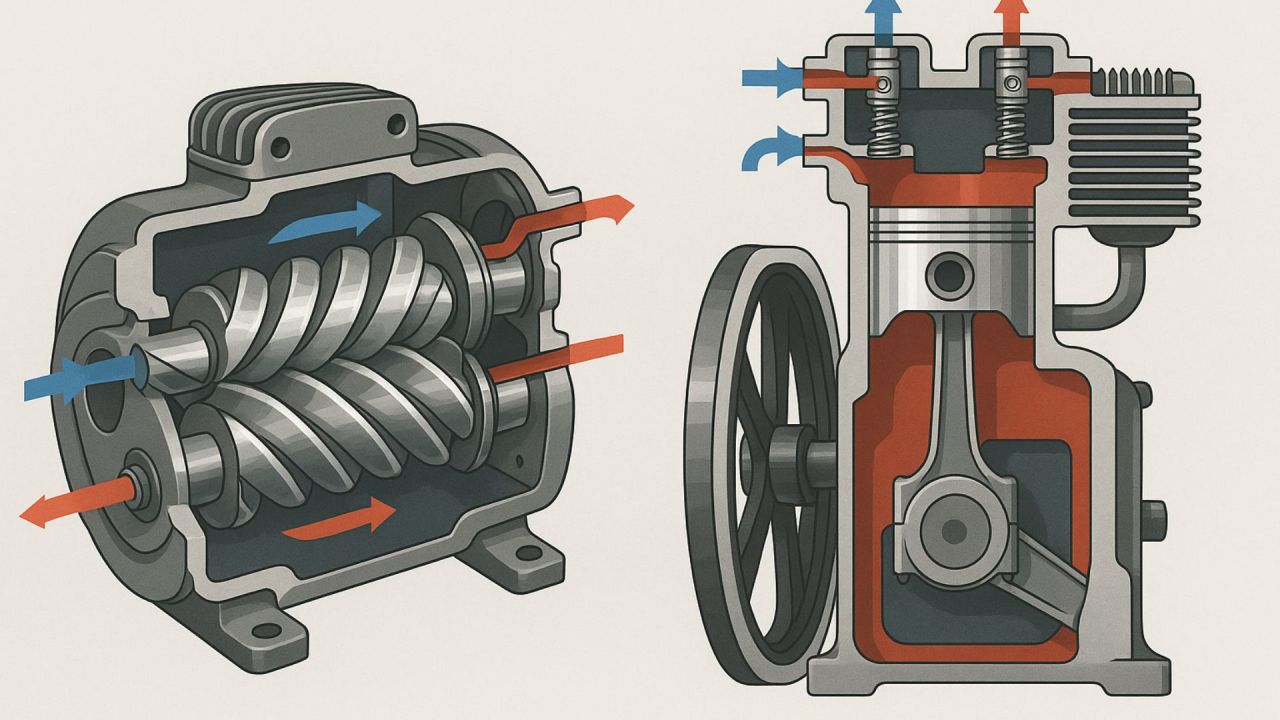
I was chatting with one of our clients the other day, and—surprise surprise—the age-old debate came up: screw compressors vs. piston compressors. Classic. Now, I’m not an expert on this (and I don’t pretend to be), but I’ve heard enough of these conversations to know the answer is never as simple as picking a winner. Let’s talk piston compressors first. Powerful. Reliable. They’ve been the go-to for heavy-duty applications for years—especially in industries where power is the top priority. But then screw compressors enter the scene... and things get interesting. 👉 They’re quieter. 👉 They’re more compact—often matching the performance of bulkier piston units 👉 And some claim they’re more energy-efficient... I’ll leave that one open. The data’s still rolling in. Here’s what is clear: The market’s shifting. More and more industries are leaning towards screw compressors—not necessarily because they’re "better" in the absolute sense, but because they’re more in tune with what is needed. Like any good engineering decision, this one deserves though and the right tool for the job.
6 of 24 adsSign up to see every INTEC ROTORS ad, filter by format and date, and get alerts on new ones.
See all 24 adsWatch the companies you care about.
Filter every ad by industry, country, format and network, and get alerts when a company you watch starts running new ads.