Not on air · 2 of 3 networks checked
Infodesk
- infodesk.com
- Data
- US
- 196 employees
Infodesk’s ads on LinkedIn, Meta and Google, recorded by adsrunning. Browse the latest here for free. Sign up free to see all 352. Watch Infodesk with Starter to get each new one in your feed.
Watchlist with Starter · $49/mo
| Network | Status | Live ads | Nov 2025LinkedIn activity · 52 weeksOct 2026 | Checked | Next step |
|---|---|---|---|---|---|
| None recorded | 0 | Checked 29 Oct 2026 | See all 352 ads → | ||
| Meta | Not checked | — | |||
| Recently | 17 | Ads on the Google Ads Transparency Center | Checked 1 Oct 2026 | Collect them with the API → |
Infodesk has no live LinkedIn ads. We recorded 17 Google ads on 1 Oct 2026.
Latest ads
- LINKEDIN · VIDEOSince 22 Oct 2026
The thinking isn't the slow part of an impact assessment. It's the chasing, the reminders, the handoffs, the wondering where a case got to and who has it now. Our Workflow Solution automates that coordination. Each case runs on a visual workflow you can see, edit, and control, with AI agents moving it from one stage to the next so the work doesn't stall between people. You review the agents' settings and set the controls, so the automation runs the process the way your team works, and you keep the final say. Regulatory updates land ready to assess, cases carry their own owners and due dates, and the whole thing stays in one place. Instead of managing the process, your team spends its time on the impact assessment itself. Assessments move faster, and the manual chase disappears. See where the Workflow Solution gives your team its time back.
- LINKEDIN · IMAGESince 10 Oct 2026
Most organizations don’t have an information problem anymore. They have a decision problem. There’s no shortage of dashboards, alerts, reports, summaries, feeds, or AI-generated outputs inside regulated industries today. In fact, most teams are overwhelmed by the volume of information coming at them. But information alone doesn’t create value. Decisions do. And that’s where I think the conversation around “decision intelligence” becomes important, especially in life sciences and regulated environments. Because in these industries, the challenge isn’t simply identifying a regulatory signal or detecting a market change. The real challenge is: ➡️ understanding what it means ➡️ determining who is impacted ➡️ coordinating the right response ➡️ documenting decisions clearly and defensibly ➡️ ensuring actions happen That’s a very different capability than monitoring. What’s becoming increasingly clear is that organizations need systems designed not just to surface intelligence, but to operationalize it. That’s the shift from information management → decision intelligence. And in practice, the companies doing this well tend to focus on a few things: 1️⃣ Connecting intelligence directly to workflows: The most mature organizations are embedding intelligence into operational processes instead of leaving it trapped inside dashboards or inboxes. 2️⃣ Maintaining traceability from signal to action: In regulated industries, every major decision may eventually need to be explained, audited, or defended. Traceability matters. 3️⃣ Combining AI with human expertise: AI can dramatically reduce the manual burden of monitoring, summarization, categorization, and search. But human expertise remains critical for interpretation, prioritization, and accountability. The strongest models aren’t AI-only. They’re human-first systems enhanced by AI. 4️⃣ Creating organizational alignment: Decision intelligence is ultimately about helping teams move faster together, regulatory, quality, safety, compliance, operations, leadership, all working from shared context and trusted information. That alignment is becoming a competitive advantage. One point I think is often overlooked: The future of AI in regulated industries probably won’t belong to generic copilots alone. It will belong to organizations that successfully integrate trusted intelligence, governance, workflows, and human judgment into a repeatable operational system. That’s where a measurable impact starts to happen. We recently explored this topic in more detail, including how decision intelligence is evolving across pharma and life sciences: https://lnkd.in/egXtZ2Eq Curious how others are thinking about this shift. Are you seeing organizations move beyond monitoring toward true intelligence activation and decision support? Or are most teams still stuck at the “information overload” stage?
- LINKEDIN · IMAGESince 30 Sept 2026
Quality intelligence in life sciences is going through a major shift! Earlier this week I shared a article relating to our thoughts surrounding this above statement. As several of you asked for a Post Summary here you go. Historically, most quality intelligence programs were heavily focused on inspection readiness, enforcement monitoring, and reactive compliance activities. Important work, of course. But that definition is starting to feel too narrow for the complexity organizations are managing today. What’s emerging instead is a broader view of quality intelligence as a strategic operational capability, one that connects regulatory signals directly to risk management, governance, and enterprise decision-making. And I think that evolution matters. Because regulatory change only creates value when organizations can actually operationalize it. Not just monitor it. At a recent industry discussion with leaders including UCB, one theme came up repeatedly: The organizations building mature quality intelligence programs are moving beyond surveillance toward full lifecycle management of regulatory change. That includes: ➡️ Monitoring signals ➡️ Assessing impact ➡️ Assigning ownership ➡️ Coordinating implementation ➡️ Tracking decisions and outcomes In other words, intelligence is becoming tightly connected to execution. A few other observations stood out: • Quality intelligence and regulatory intelligence are increasingly converging, even if they still serve different operational purposes. • Governance and cross-functional coordination are becoming critical differentiators. • AI is helping reduce noise and accelerate monitoring, but human expertise remains central for interpretation and risk assessment. • Many organizations are still operating with surprisingly lean teams, which makes structured workflows and strong SME networks even more important. One point I found especially relevant: The biggest risk often isn’t the signal itself. It’s the organizational handoff failures that happen afterward. Missed ownership. Delayed assessments. Lack of accountability. Disconnected workflows. That’s where strong intelligence activation processes become essential. We explored this evolution in more detail here, including key takeaways from leaders actively building modern quality intelligence programs: https://hubs.li/Q04yjx7B0 Curious how others are seeing this evolve inside their organizations. Is quality intelligence still primarily reactive and inspection-focused? Or is it becoming more integrated into strategic decision-making and operational governance? #QualityIntelligence #RegulatoryIntelligence #LifeSciences #Compliance #AI #Pharma #QualityAssurance
- LINKEDIN · IMAGESince 29 Sept 2026
Infodesk already handles your monitoring. The slow part is what comes after, the chasing, the reminders, the handoffs, the wondering where a case got to and who has it now. Our Workflow Solution automates that coordination. Each case runs on a visual workflow you can see, edit, and control, with AI agents moving it from one stage to the next so the work doesn't stall between people. The updates you already track in Infodesk land ready to assess, cases carry their own owners and due dates, and the whole thing stays in one place. Instead of managing the process, your team spends its time on the impact assessment itself. Assessments move faster, and the manual chase disappears. See where the Workflow Solution gives your team time back.
- LINKEDIN · IMAGESince 29 Sept 2026
Infodesk tracks every regulatory change. And our Workflow Solution turns that into an impact assessment you can prove, months later, without the scramble. It runs each impact assessment on a structured workflow, with every decision linked back to the intelligence that prompted it and every supporting document held against the case. Nothing is captured after the fact or reconstructed from memory. The audit trail builds itself as the work happens, so when the questions come, the answer is already there. So when an auditor asks what was decided, when, and why, you don't go digging through inboxes and folders. You open the case and show them, step by step, from the first regulatory signal to the closed outcome. See how the Workflow Solution adds audit-ready action to Infodesk.
- LINKEDIN · IMAGESince 29 Sept 2026
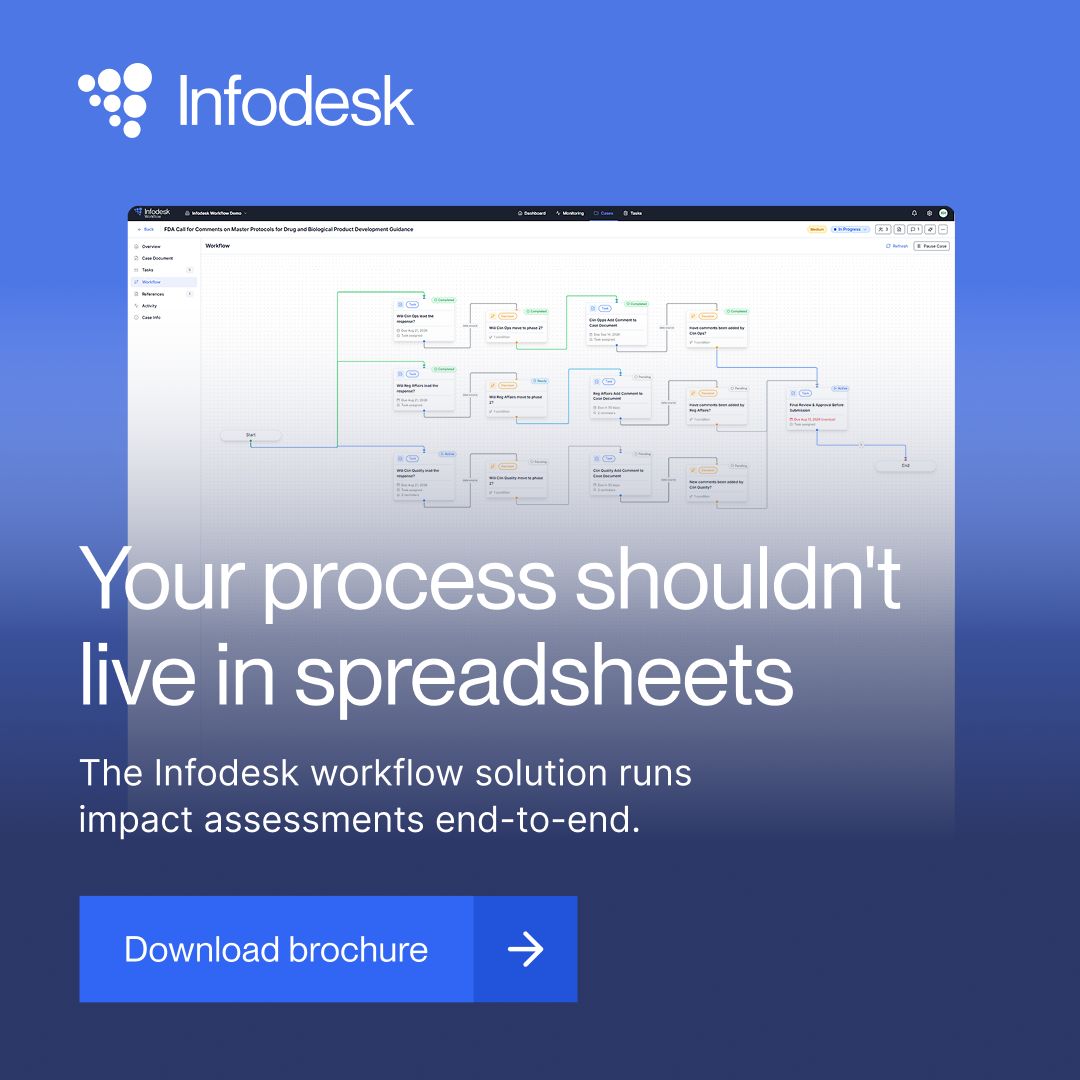
Infodesk keeps you ahead of regulatory change. But if your impact assessments still run on spreadsheets, email, and shared folders, our Workflow Solution is the piece that connects the two. It runs the whole process in one place, from the first regulatory update to a closed outcome. Here's what that adds to what you have: A visual workflow for every case, editable by drag and drop to match how your team works Automation at each stage, with AI agents moving cases along under controls you set Monitoring, triage, cases, and tasks connected in one continuous flow An audit trail that builds itself, with every decision linked back to the intelligence that prompted it The updates you already track in Infodesk feed the process directly, so nothing gets missed between the first update and a closed case. See how the Workflow Solution pulls the whole process together.


6 of 352 adsSign up to see every Infodesk ad, filter by format and date, and get alerts on new ones.
See all 352 adsWatch the companies you care about.
Filter every ad by industry, country, format and network, and get alerts when a company you watch starts running new ads.