On air · 1 of 3 networks
Influent Social
- influent.co
- Marketing & Advertising
- US
- 14 employees
Influent Social’s ads on LinkedIn, Meta and Google, recorded by adsrunning. Browse the latest here for free. Sign up free to see all 39. Watch Influent Social with Starter to get each new one in your feed.
Watchlist with Starter · $49/mo
| Network | Status | Live ads | Nov 2025LinkedIn activity · 52 weeksOct 2026 | Checked | Next step |
|---|---|---|---|---|---|
| Running | 39 | Checked 29 Oct 2026 | See all 39 ads → | ||
| Meta | Not checked | — | |||
| Not checked | — |
Influent Social has 39 live LinkedIn ads. We recorded 2 Google ads on 1 Oct 2026.
Latest ads
- LINKEDIN · IMAGERecorded 23 Sept 2026
I'm calling my shot... the next big thing on LinkedIn is CPG brands doing trade marketing. In the last three months alone, I have talked to a 10+ consumer brands who are coming onto the platform to do UPPER FUNNEL TRADE MARKETING... something that has never existed before. They are using LinkedIn content and thought leader ads to influence a very small but powerful list of category managers and buyers. FOR EXAMPLE: Say you run a beverage brand trying to get into 500 more retail locations. You have one 60 minute meeting per year to convince the buyer you deserve shelf space. That's MILLIONS of dollars, riding one a person's opinion in a 60 minute meeting. Now imagine that category manager has spent the previous six months seeing your LinkedIn content about consumer data, category shifts, and how your products are capitalizing on those shifts. That is now a VERY different meeting. The buyer goes in knowing your company, your products, how you are capturing customer attention, etc. --- B2B companies figured this out a long time ago. Upper funnel awareness allows your to accumulate familiarity before you enter a sales conversation. Consumer brands can now use LinkedIn to do the same thing with category managers, distributors, brokers and food service operators. Very few of them are currently. I doubt that lasts.
- LINKEDIN · IMAGERecorded 23 Sept 2026
I can say confidently that 9/10 of content marketers on LinkedIn are measuring the WRONG things. The organic metrics LinkedIn surfaces (impressions, likes, etc.) are the ones that reward the broadest content, so upper funnel posts will always produce the highest impressions and the fastest follower growth. Those numbers will tell you the strategy is working... while producing no pipeline. (womp womp) Mid and low funnel content on the other hand (eg. playbooks, frameworks) will underperform relative to total impressions and likes because it is reaching a smaller and more qualified subset of your audience. But they will outperform when it comes to driving ICP Followers, ICP Engagement, Website Clicks... the stuff people actually want. If your goal is credibility and broad market visibility, then sure, impressions are a reasonable proxy. But if your goal is pipeline or target account pressure, the only measure that matters is ICP-qualified metrics like ICP Followers, ICP Engagement, etc.
- LINKEDIN · IMAGERecorded 23 Sept 2026
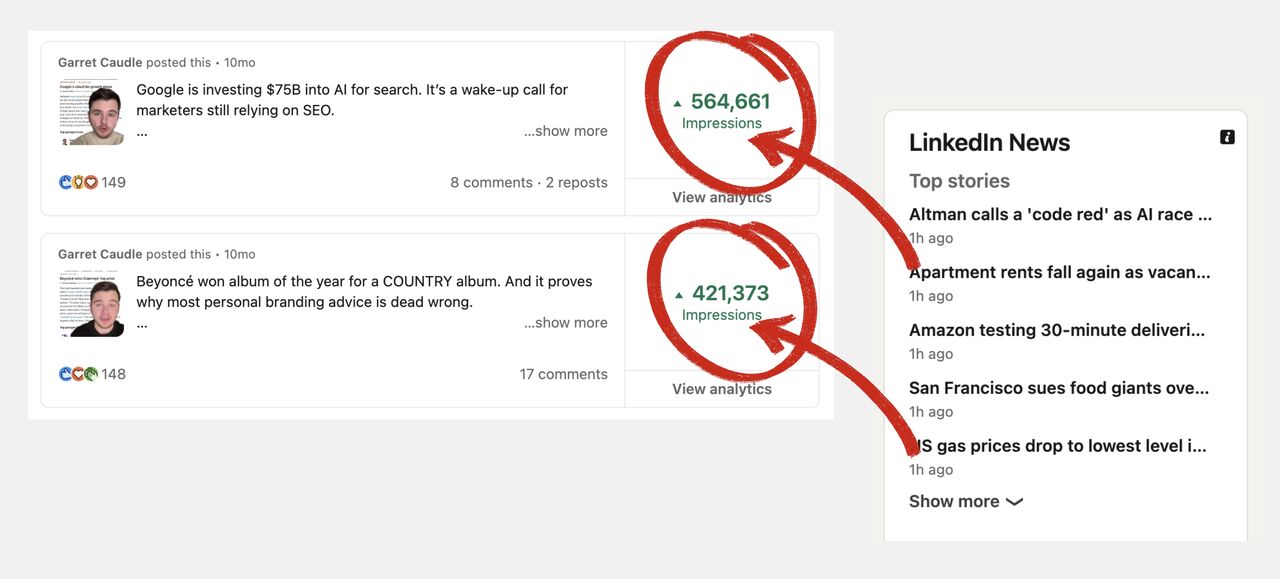
I drove ~1M impressions with just two posts. All thanks to LinkedIn's newsfeed. Both posts were featured in a LinkedIn news story (those links on the top right of your screen) and subsequently distributed out to hundreds of thousands of users. LinkedIn has been telling the market for YEARS that they want to be where every industry gets its news. They're essentially building a community-based news aggregation alternative to trade publications and traditional business media. The value prop is that real insights come from real practitioners, not reporters. After the big Twitter exodus, this focus has only accelerated. So much so that LinkedIn now has an editorial team (a team of actual humans) that is curating the news feed and hand-selecting thought leaders to represent each industry vertical. For thought leaders, this creates a HUGE opportunity. The job of news commentator is totally up for grabs. Execs that can put together a quick content motion that identifies industry news and pumps out genuine informed insight have a chance to become defacto authoritative voices in their space. That means TONS of impressions, followers, and of course ICP engagement (if you select the right stories).
- LINKEDIN · IMAGERecorded 23 Sept 2026
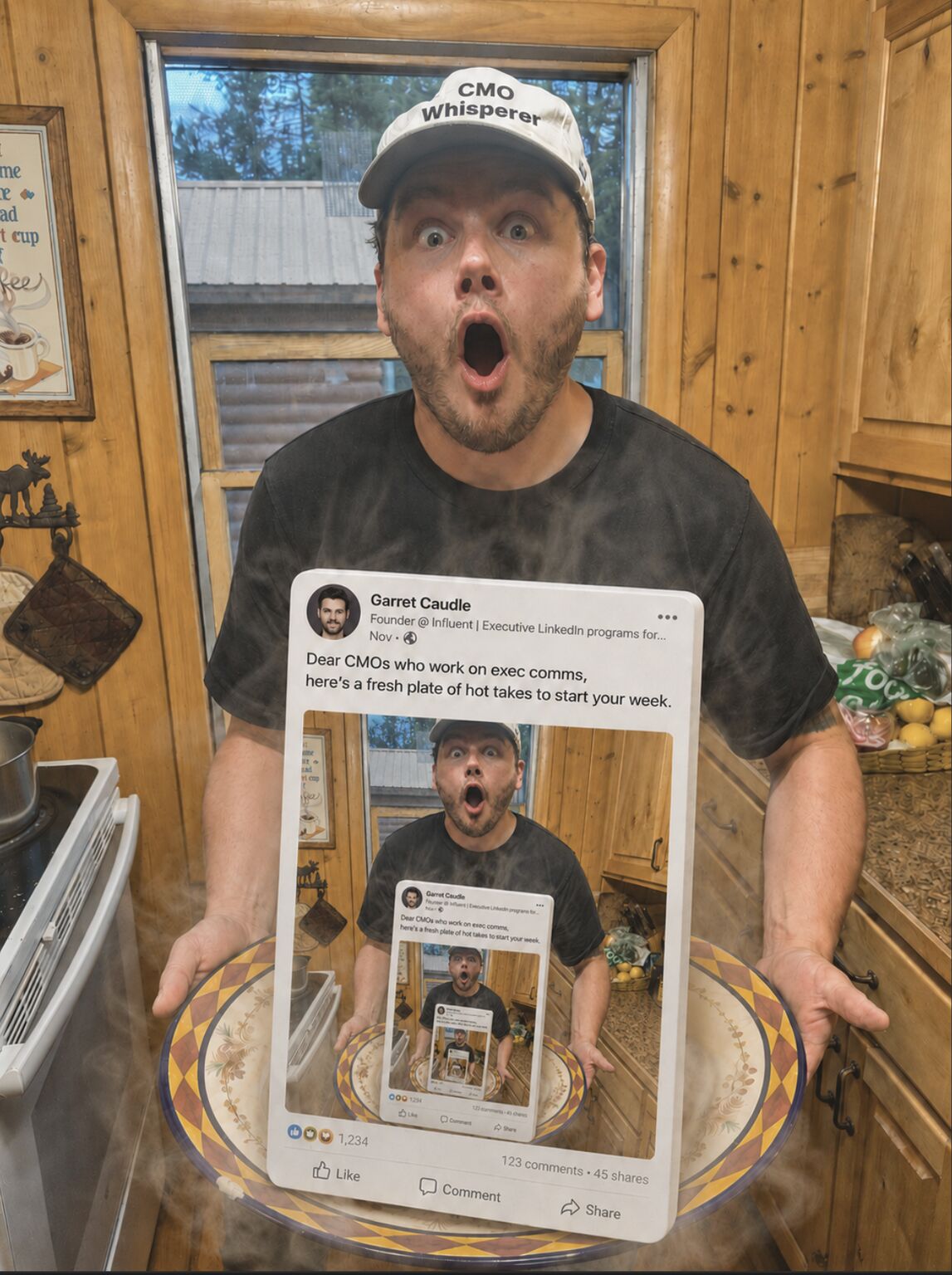
Dear CMOs who work on exec comms, here's a fresh plate of hot takes to start your week. (1) Every CEO wants to have their own podcast. Less than 5% actually should. (2) Execs will say they don't care about vanity metrics like impressions and only care about engagement from the "right" people. Don't believe them. They care about both. which leads me to... (3) Managing the egos of the execs that you support is 100% part of the job, and the moment you forget that, you will lose the ability to be productive. (4) If you want to create great thought leadership content, you need to challenge the POVs of your execs, not just write down their unedited thoughts. (5) The inherent contradiction between (3) and (4) is exactly why exec comms is an art form. (6) Anyone who claims to "understand the secrets of the LinkedIn algorithm" is a charlatan who wants to sell you a course. (7) You're probably overvaluing organic social and undervaluing paid social. The former is a shotgun (imprecise + ineffective). The latter is a sniper (precise + lethal). related... (8) If you're not running thought leader ads on your exec content, you're missing the biggest opportunity in all of exec comms right now. (9) If you're not using those same thought leader ads to also push your exec content to journalists, podcast hosts, and other important industry folks, you're missing the second biggest opportunity in all of exec comms right now. (10) You need to leave behind "brand" and embrace "performance brand," or you will not survive the next round of budget cuts. That's it for today. If you liked those, I'll be back next Monday with another fresh batch, so make sure to drop me a follow. 🔔
- LINKEDIN · IMAGERecorded 23 Sept 2026
If I woke up as a VP of Comms, I'd immediately go all in on LinkedIn. Here are 5 semi-controversial things I'd do... (1) Build a list of ALL journalists, podcasts hosts, LinkedIn editorial staff, and non-competitive industry voices who are active on LinkedIn (2) Study what the people on that list post about and use it as the basis for an executive content strategy (entire bench of execs, not just our CEO) (3) Blitz the list with our executives through connections, messages, and comments. (4) Self publish press releases through our CEO's LinkedIn and run thought leader ads to push them to journalists, podcasts hosts, and industry voices. (5) Every time we get a placement, post about it, and run a thought leader ad to push that placement to everyone on our target account list. The future of comms is on LinkedIn. Comms leaders who want to meet the moment have no choice but to put something like the above into place. --- This is what we're rolling out for our clients at Influent Social. Interested in how? Send me a DM.
- LINKEDIN · IMAGERecorded 23 Sept 2026
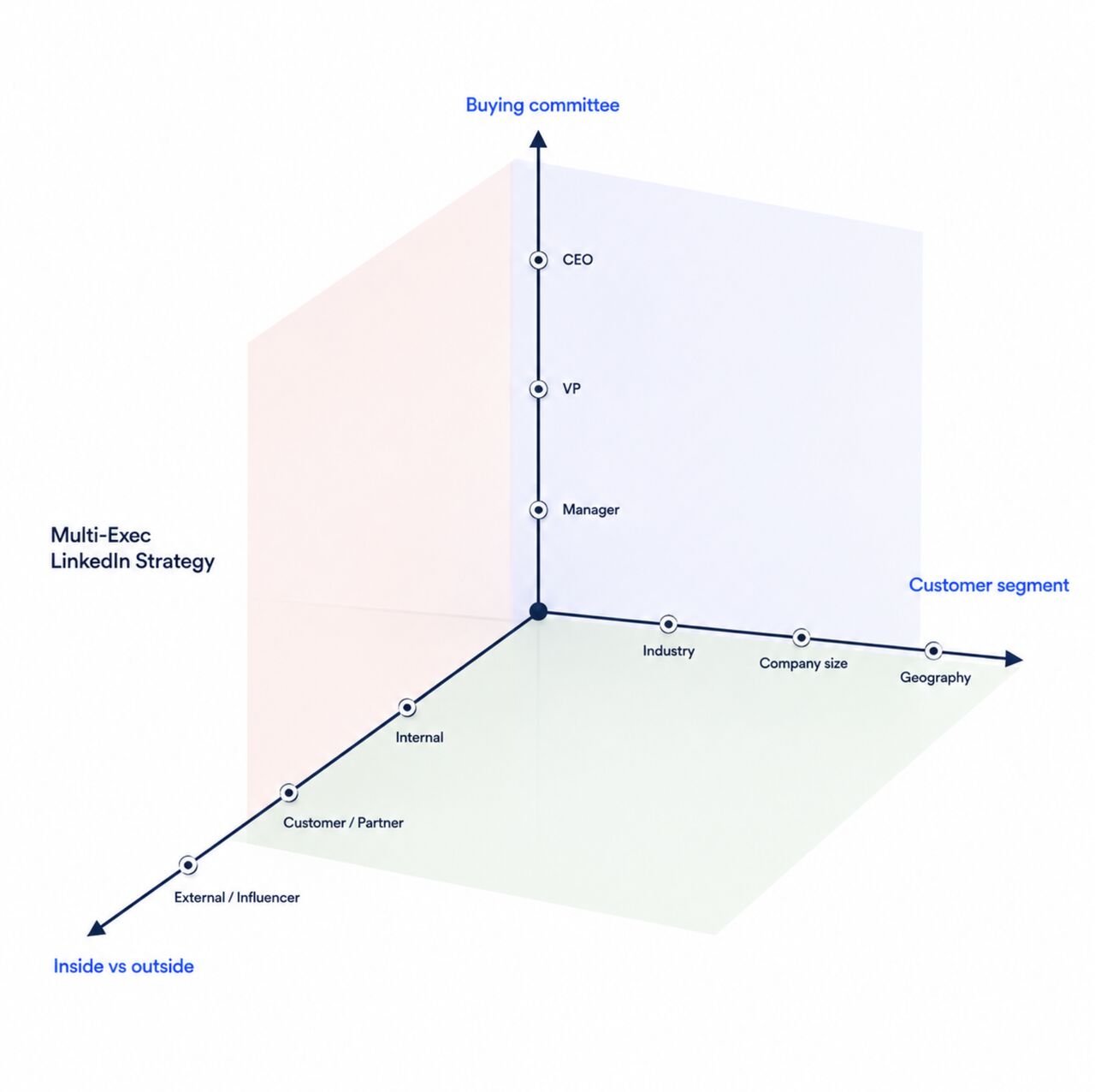
I get a lot of q's about building multi-exec LinkedIn strategies. I always point to this great 3 vector chart as a starting point. Basically, when you go to select your executives, try to strategically place them within this space based on your goals. ➡️ Vector 1 - Buying committee Each major role in the buying committee has different priorities, challenges, and levels of responsibility. Your executive lineup should represent those differences. Match executives to the audience at roughly the same level: - CEOs speak to CEOs. - VPs speak to VPs. - Managers speak to managers. Peer alignment matters because people tend to trust and identify with others who operate at a similar altitude. The content should also reflect whether the audience is tactical or strategic. Managers may get more value from practical playbooks and execution guidance. Senior executives are more likely to engage with strategic points of view, market shifts, and business implications. When you cannot cover the entire buying committee, group roles with similar identities and needs. VPs may identify more closely with the C-suite than managers do, while managers may share similar tactical concerns across functions. ➡️ Vector 2 - Customer segment Different executives can own different customer segments, especially when the product creates distinct value for each one. This is commonly divided by: - Industry - Company size - Geography - Use case - Customer maturity ➡️ Vector 3 - Inside vs outside the company Internal executives provide company expertise, operating experience, and direct credibility. External participants can include customers, partners, advisors, investors, industry experts, and other influential voices. These people can expand the range and credibility of the program without requiring every point of view to come directly from the company. Once these three vectors are mapped, each participant can be assigned a clear role within the strategy. Then each will plug into a single operating infrstructure that is owned by the markteing team. That includes: - Strategy - Content production - Paid amplification - ICP engagement tracking - Sales activation The system should connect into the broader marketing system as well as sales activation workflows if your company has them.



6 of 39 adsSign up to see every Influent Social ad, filter by format and date, and get alerts on new ones.
See all 39 adsWatch the companies you care about.
Filter every ad by industry, country, format and network, and get alerts when a company you watch starts running new ads.