On air · 1 of 3 networks
Impactable - B2B LinkedIn Agency
- impactable.com
- Marketing & Advertising
- US
- 67 employees
Impactable - B2B LinkedIn Agency’s ads on LinkedIn, Meta and Google, recorded by adsrunning. Browse the latest here for free. Sign up free to see all 871. Watch Impactable - B2B LinkedIn Agency with Starter to get each new one in your feed.
Watchlist with Starter · $49/mo
| Network | Status | Live ads | Nov 2025LinkedIn activity · 52 weeksOct 2026 | Checked | Next step |
|---|---|---|---|---|---|
| Running | 180 | Checked 29 Oct 2026 | See all 871 ads → | ||
| Meta | Not checked | — | |||
| Recently | 20 | Ads on the Google Ads Transparency Center | Checked 1 Oct 2026 | Collect them with the API → |
Impactable - B2B LinkedIn Agency has 180 live LinkedIn ads. We recorded 20 Google ads on 1 Oct 2026.
Latest ads
- LINKEDIN · IMAGESince 26 Oct 2026
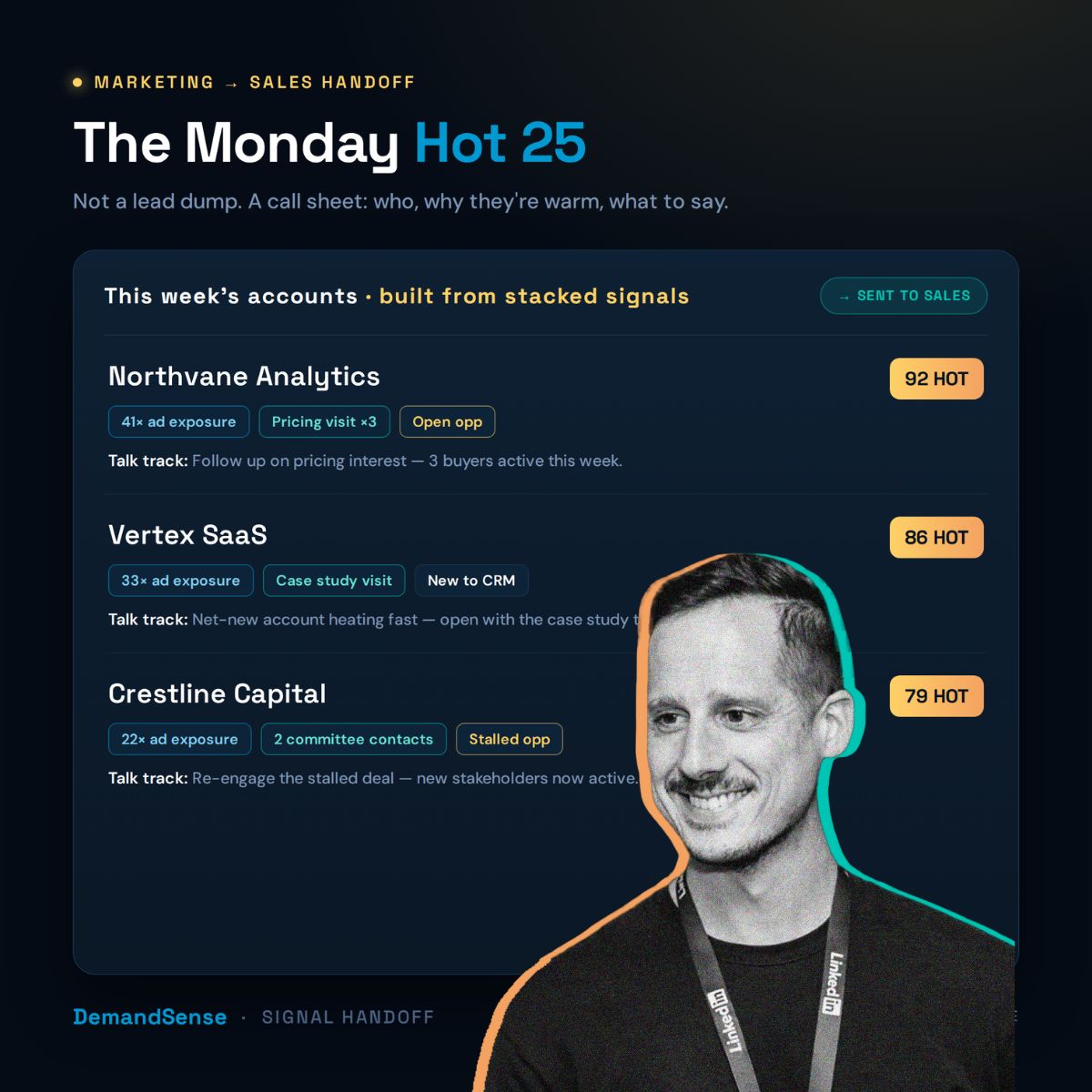
My favorite Marketing to Sales handoff play using CRM + LInkedIN Ads API + Web ID data all from 1 MCP Marketing runs ads. Sales runs outbound. Most don't connect the two...so reps cold-call accounts that just watched 5 of your videos, and ignore accounts that are three visits deep on your pricing page. Waste on both sides. Here's the weekly play we run to actually close that gap. Steal it. Start with the signals you already have but never combine: Which accounts your LinkedIn ads reached (and how heavily) Which accounts hit your site - down to the page and the person Where those accounts already sit in your CRM Individually, each one is noise. STACKED together, they tell you exactly who to hand sales. The play: Detect - find accounts lighting up across MORE than one signal. Heavy ad exposure is a maybe. Heavy ad exposure + a pricing page visit + an already-open opp? That's a hot account. Reveal - pull the actual buying committee contacts at those accounts. Names, not "a company was interested." Hand off - every Monday sales gets a "Hot 25" list. Who the account is, what they engaged with, last touch, and a one-line talk track. Not a data dump. A call sheet. Close the loop - what sales does with it (booked, dead, not-yet) flows back and sharpens next week's targeting. What makes this actually runnable now: all three signal sources live in DemandSense, and it's wired into AI - so instead of you stitching spreadsheets every Monday, you ask for the Hot 25 and it builds the sheet. A handoff isn't "here's a lead." It's "here's a named account, here's why they're warm, here's what to say." Do that every week and marketing stops being the cost center sales complains about. What does your handoff look like right now - a call sheet, or a shrug? Tomorrow I'm running an event going over this exact flow of how I use DemandSense MCP to pull in sales ready handoffs and make marketing leaders look like heroes - https://lnkd.in/gf9uisr9
- LINKEDIN · IMAGESince 26 Oct 2026
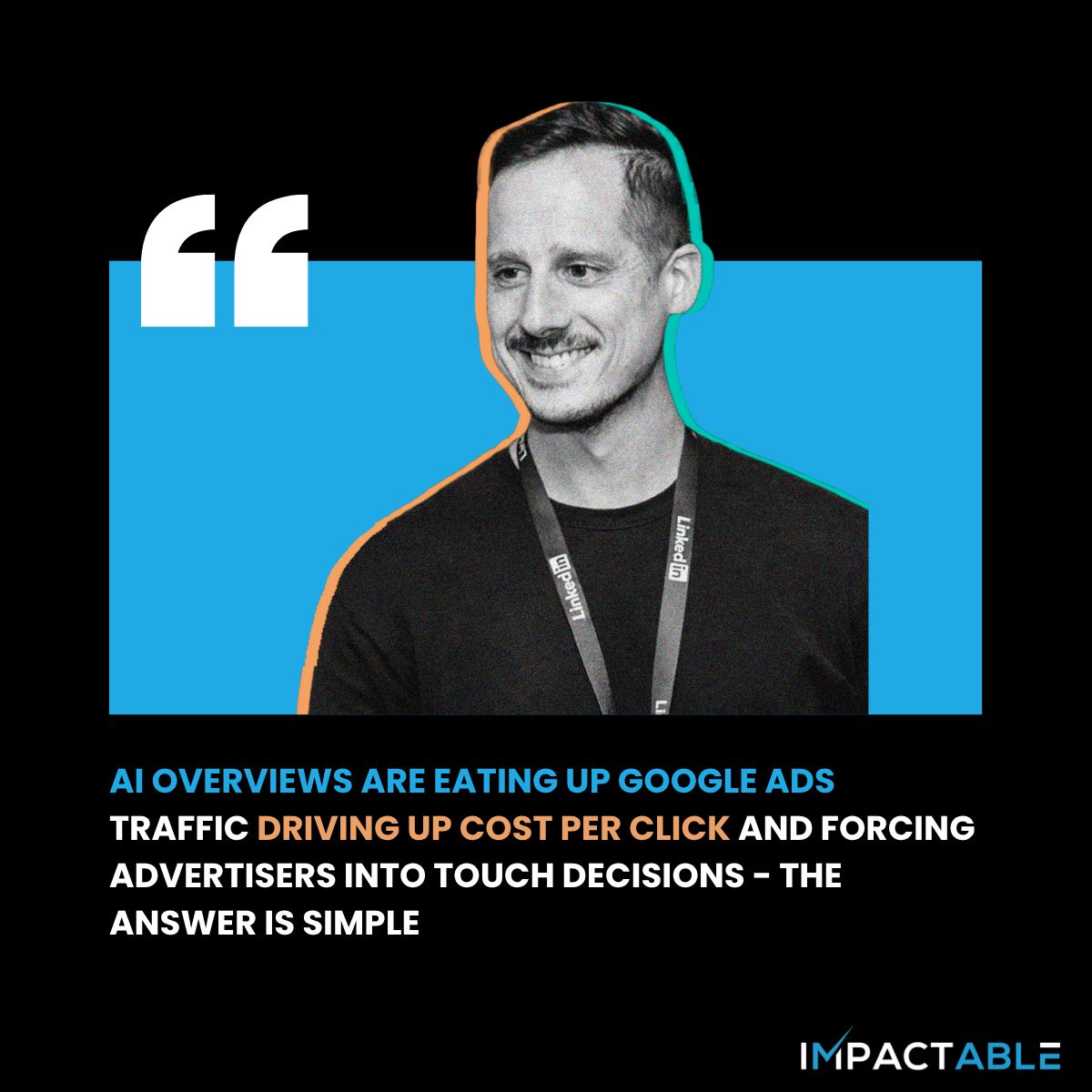
SMB + Mid-Market B2B orgs are moving money out of Google ads/Paid Search - Here's why and what I'd recommend instead. Here's what's happening. AI...it's all AI's fault 😂 But seriously the AI overviews are taking over more and more which means more people are getting information without having to click into links and view websites. Great for people, but bad for google advertisers because less clickers means more competition for the smaller pool of clicks that do exist. Now one thing to realize right away that is a flawed way of viewing this. 1. Those who can get their info via AI summary are usually in research mode and net yet buying mode...so theoretically this is mostly taking out lower-intent search traffic which means yes cost per click goes up..but so does quality which could be an ok offset. I wouldn't just assume that rising CPC is inherently bad. Typically in the world of b2b, I've learned higher cost per click/lead/deal means higher value. But the overall read from many is that cost per clicks are rising and yes it does take out a chunk of the pool that was still good to build awareness in and convert later but one thing that is very very clear....the days of Paid Search operating successfuly in a silo is over and sooo many feel it. So much so they are moving big chunks of budget to new channels such as Linkedin, meta, and programmatic. 2. The smart move - Double down on Paid Search but leverage a solid qualify + retargeting framework to squeeze max ROI from the efforts. You don't need fancy tools like DemandBase or 6sense to do this either. This is literally the thing that LinkedIn Ads does better than any other platform out there in the world right out of the box. The LinkedIn insight tag installed on your website can see all website traffic including paid search traffic, SEO traffic, and organic/direct traffic. Then LinkedIn can layer on qualifying filters to pick out the ICP fit prospects out of that warm traffic where we can nurture, build trust, and convert. This gives you the ability to stay in the bidding on paid search with higher cpc knowing you have a better chance to convert it on the backend vs your competitors who rely on that click and landing page to do the job. You can even set up LinkedIn retargeting audiences to collect and hone in on specifcally google ads traffic by setting up website audience such as utm contains source=adwords which would allow you to specifically segment out search traffic and you could even select a specific campaign if you have a hero one. This all comes down to better connected marketing ecosystems where no channel is on it's own..it's flowing in and out of others and each new channel builds on the last vs siloed experiments. I've been driving this idea of marketing ecosystems for years now and more and more it seems siloed channels are collapsing and more and more are looking for the answers. Any one else seeing this?
- LINKEDIN · IMAGESince 26 Oct 2026
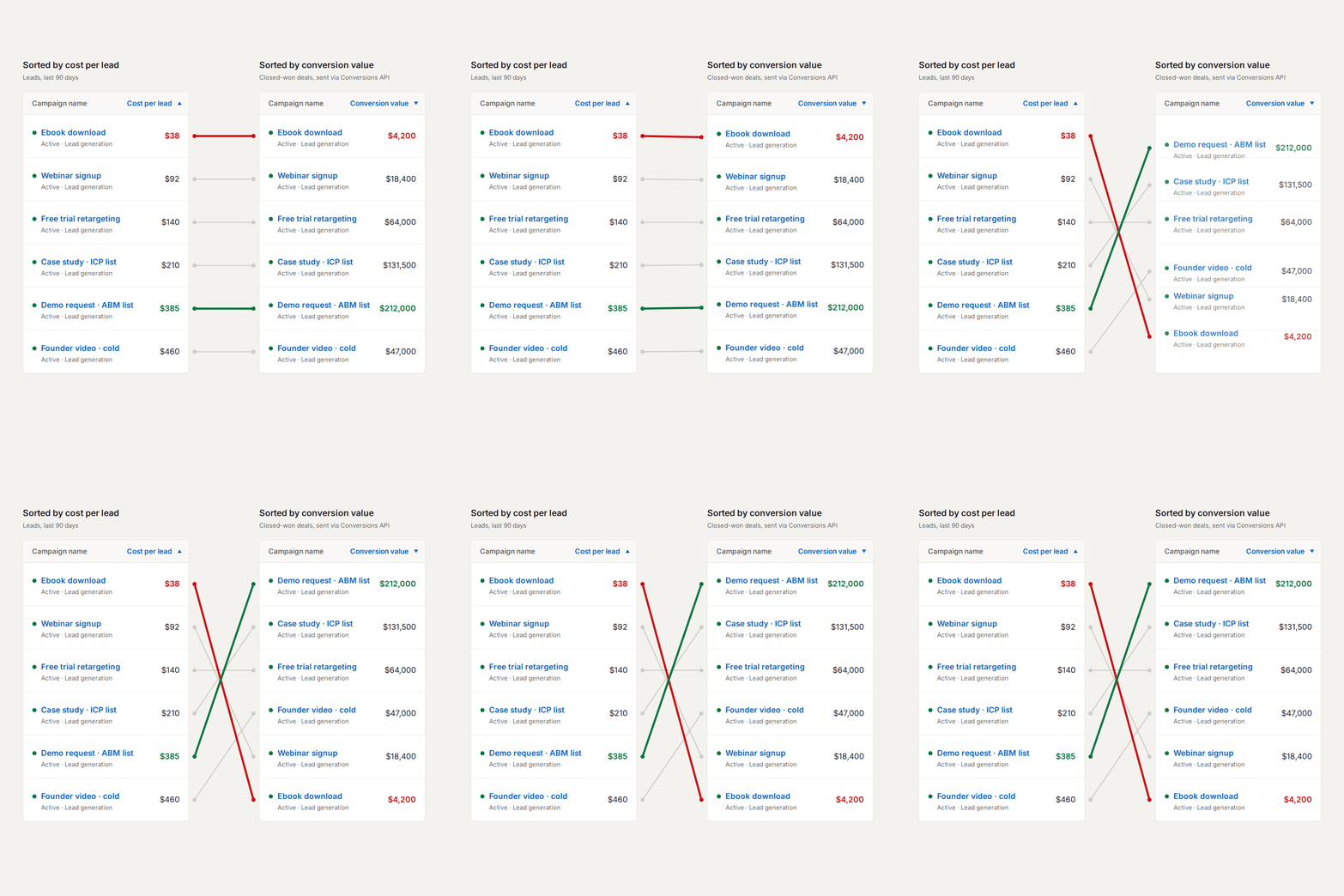
Send your closed deals back into LinkedIn and the first thing that happens is uncomfortable. Your best campaign stops being your best campaign. Because youve been ranking them on cost per lead this whole time. And cost per lead has almost nothing to do with which campaign produced revenue. The cheap one was cheap because it found people who like filling in forms. Plenty of them were never going to buy anything. Meanwhile the expensive campaign, the one somebody on your team keeps asking you to pause, has been quietly producing the deals that closed. You cant see any of that until the deals go back in. Heres the bit I actually like though. Its two separate events, not one. Qualified pipeline goes back as its own conversion. Closed won goes back on its own, with the deal amount attached to it. Which matters more than it sounds like, because those two arrive on completely different clocks. Pipeline shows up in weeks. Closed won can take months. So the fast signal keeps your campaigns learning while the slow one tells you the truth about revenue. And because the won deal carries its value, the reporting stops counting events and starts counting money. DemandSense pushes both from your CRM into LinkedIn with LinkedIns Conversions API. 30 day trial, no card. Link in the comments.
- LINKEDIN · IMAGESince 26 Oct 2026
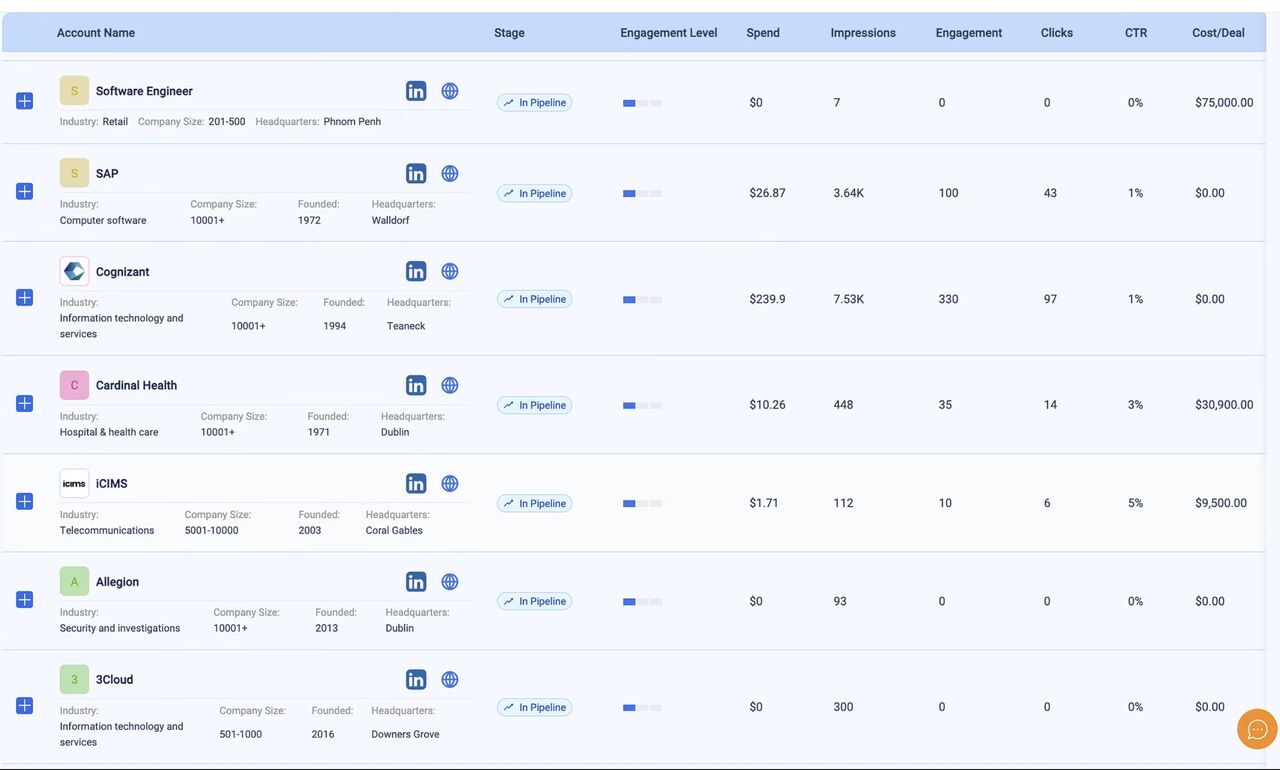
For B2B LinkedIn Ads, If you're just reporting on clicks and impressions to leadership... you don't have job security. You're not running the business. You're running the spreadsheet. The marketers who are irreplaceable right now are the ones who can walk into a board meeting and say: "Here are the 14 accounts that engaged with our ads last month. Here's their industry, seniority, company size. Here's which ones just visited our pricing page. Here's the 3 deals in pipeline we can directly tie to this spend." That's a different conversation than CTR. And honestly? It's a different job. When I'm looking at our own campaigns now I can see demographic breakdowns by segment, exact account names clicking through, companies visiting our website from LinkedIn, and how all of that maps to actual pipeline. I pull that data into Claude and it spits out a board-ready report in minutes. No agency. No analyst. No "we'll follow up with the data next week." The tool I use for this is DemandSense but honestly the bigger point is this: The marketers who know their target audience better than sales... those people don't get cut. They get promoted. What are you actually reporting to leadership right now?
- LINKEDIN · IMAGESince 26 Oct 2026
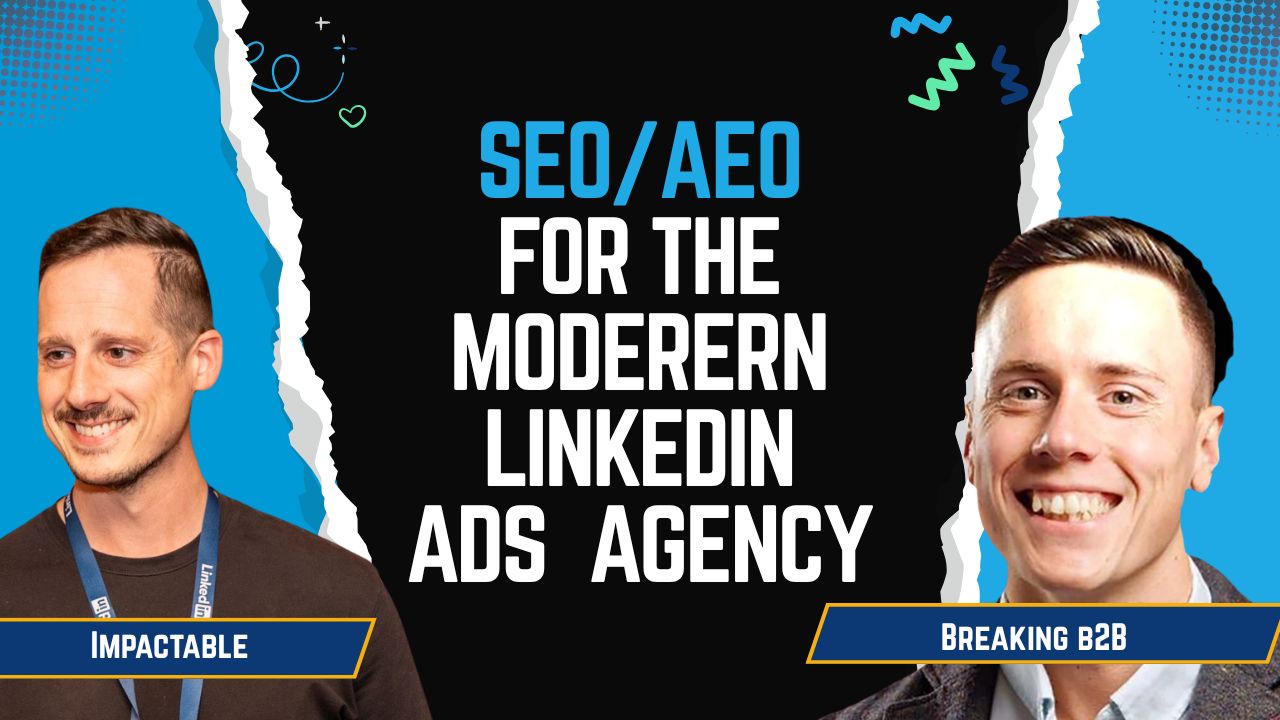
Here's how I'm thinking about SEO + AI visibility in 2026 and 2027 and why we've partnered with the best in the biz Sam Dunning and team at Breaking B2B. First off, AEO and SEO are not all that different. All the talk about SEO being dead is garbage...and Google ads isn't dead either but the game has changed. The way pages are read and indexed and the way B2B buyers are doing research mode has changed dramatically. Here's 3 reasons/logic I came to. 1. There are less clicks in the google world in general due to AI overviews and LLMs. More people getting their answers from AI means less clicks for SEO and Google ads which means much higher competition and more need for connected strategies. It's important to build the foundation for both SEO and AEO and connect it to something bigger so that you get max ROI from your efforts. 2. Focus on the money keywords - this is something Sam has been preaching for years and one of the main reasons I appreciate his approach and why it aligns with my views. My top advice to business owners and marketers is always to start with warmest audiences and highest intent. This is why I love paid search, SEO, and AEO..there are people out there searching for exactly what you offer and asking the types of questions that identify themselves as ripe in-market prospects which is 10x better than almost any signal/intent created account list or native platform targeting. 3. We honestly are tripling down on SEO/AEO - we are building internally for blog creation, page optimization and wider distribution of our thought leadership efforts publishing content accross LInkedin, newsletters, blogs, youtube and more...all of these help feed into rankings and authority. There is only so much capacity and expertise most teams have in-house so it's a great idea even if you think you have it "handled" to get with real experts in the area to ensure you're really laying the right foundations that will compound. Just getting started but will be looping back to show progress/results as we go. Highly recommend the team at Breaking B2B if you're feeling like you might not be doing enough here.
- LINKEDIN · IMAGESince 26 Oct 2026
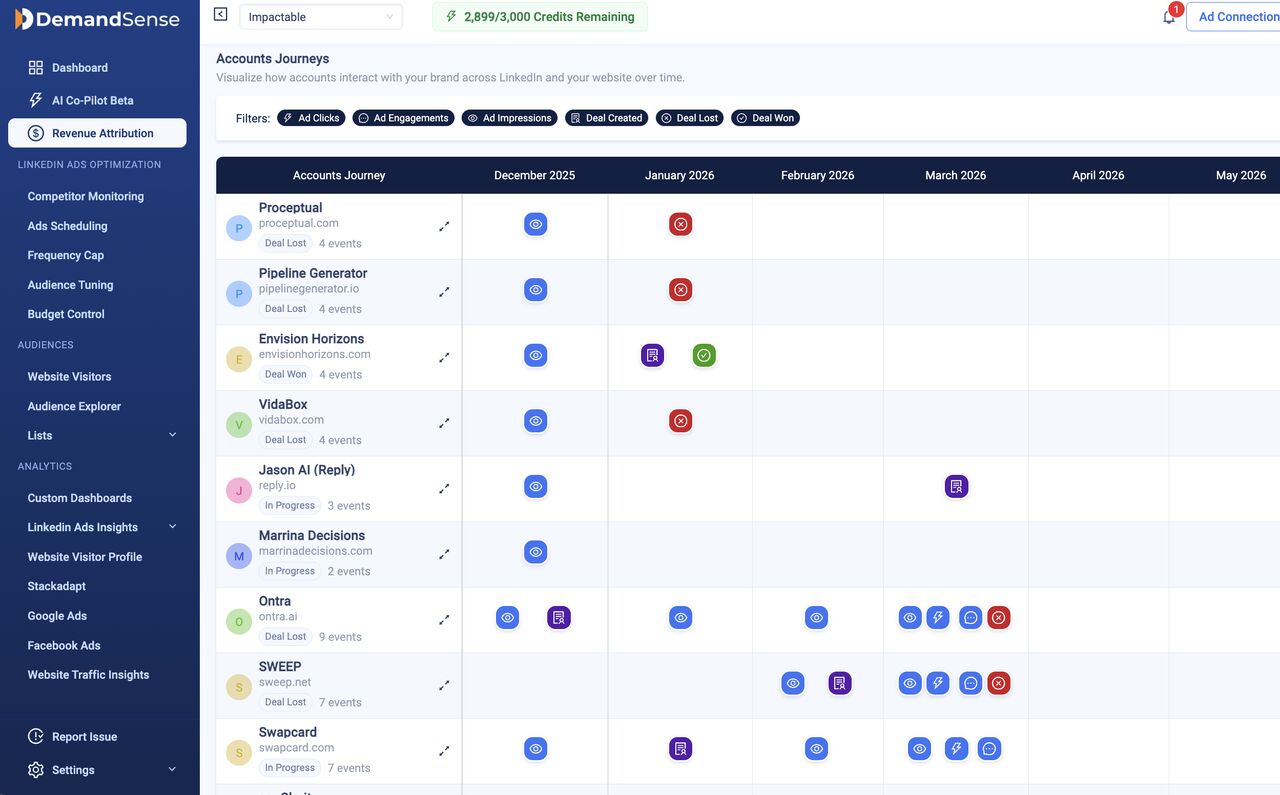
Shout out to DemandSense for the new LinkedIn Ads Attribution Views It's called Account Journeys. Every company that interacts with your LinkedIn Ads, your website, or your pipeline. Laid out on a timeline. Month by month. You can see when a company first saw an ad. When they clicked. When they hit the website. When a proposal was sent. When the deal closed or didn't. One account in here had 9 touchpoints over 4 months before the deal closed. Another had 7 touchpoints and is still progressing. That context changes everything about how you evaluate LinkedIn Ads. Because the campaign dashboard only shows you what happened today. It doesn't show you that a company first engaged in December, went quiet in January, came back in February through a different campaign, and is now sitting in your pipeline in March. Most advertisers look at last month's results in isolation and decide what's working. But B2B deals take 3-6 months. If you're only looking at a 30-day window, you're making decisions based on incomplete data. This is what we mean by demand intelligence. Not just knowing someone clicked. Knowing the full arc of how a company moved from stranger to pipeline to revenue. We use this across every client account we manage. It's one of the reasons we can have honest conversations about what's actually working vs. what just looks good in a dashboard. If you're running LinkedIn Ads for B2B and you've never seen your data this way, it's worth exploring. DemandSense has a free tier - https://lnkd.in/gnqjNNve..
6 of 871 adsSign up to see every Impactable - B2B LinkedIn Agency ad, filter by format and date, and get alerts on new ones.
See all 871 adsWatch the companies you care about.
Filter every ad by industry, country, format and network, and get alerts when a company you watch starts running new ads.