On air · 1 of 3 networks
Gratefully AI
- gratefully.io
- Government & Non-profit
- US
- 9 employees
Gratefully AI’s ads on LinkedIn, Meta and Google, recorded by adsrunning. Browse the latest here for free. Sign up free to see all 60. Watch Gratefully AI with Starter to get each new one in your feed.
Watchlist with Starter · $49/mo
| Network | Status | Live ads | Nov 2025LinkedIn activity · 52 weeksOct 2026 | Checked | Next step |
|---|---|---|---|---|---|
| Running | 60 | Checked 29 Oct 2026 | See all 60 ads → | ||
| Meta | Not checked | — | |||
| None recorded | 0 | No ads found on the Google Ads Transparency Center | Checked 30 Oct 2026 | Collect them with the API → |
Gratefully AI has 60 live LinkedIn ads. We recorded no Google ads on 30 Oct 2026.
Latest ads
- LINKEDIN · IMAGERecorded 21 Sept 2026
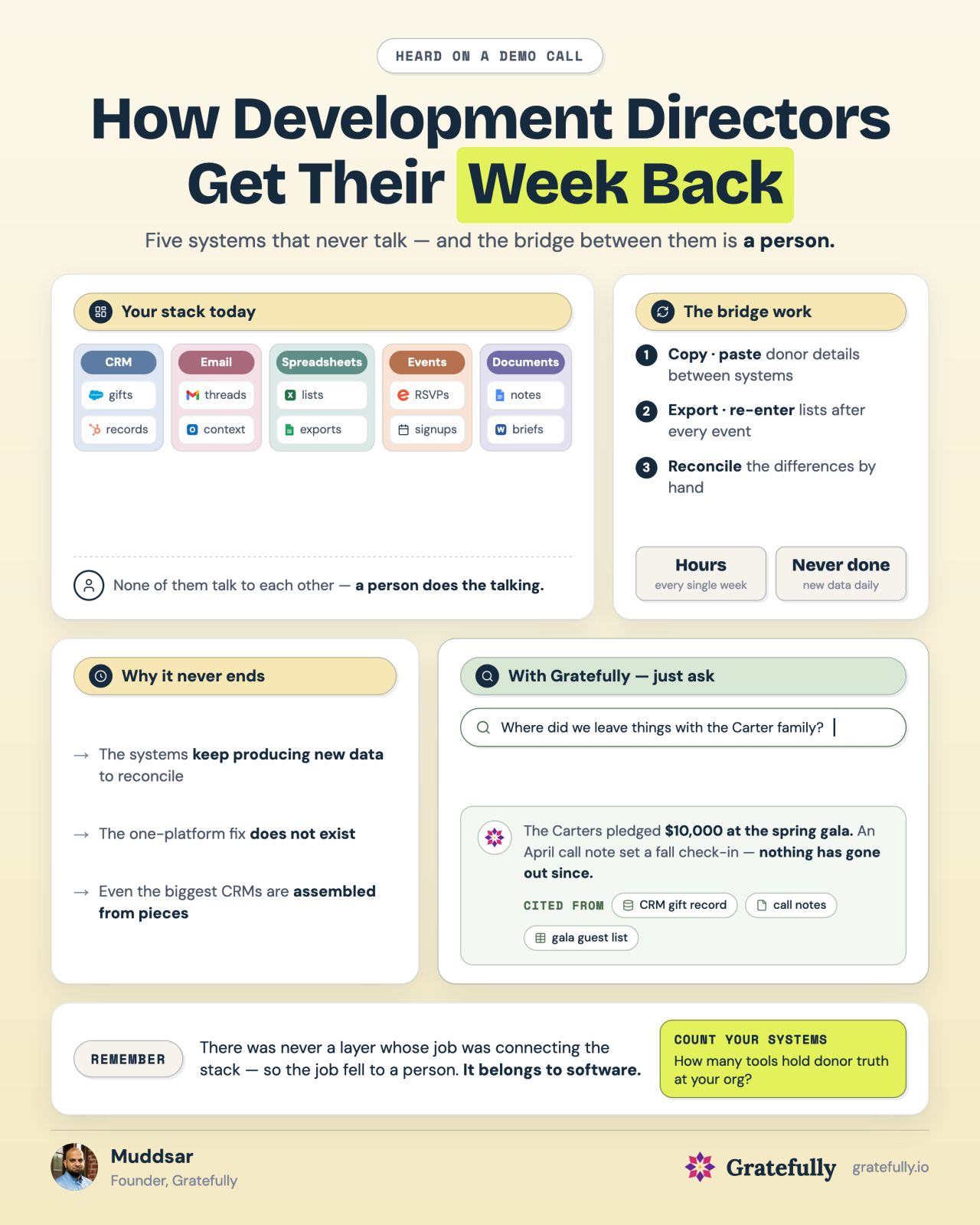
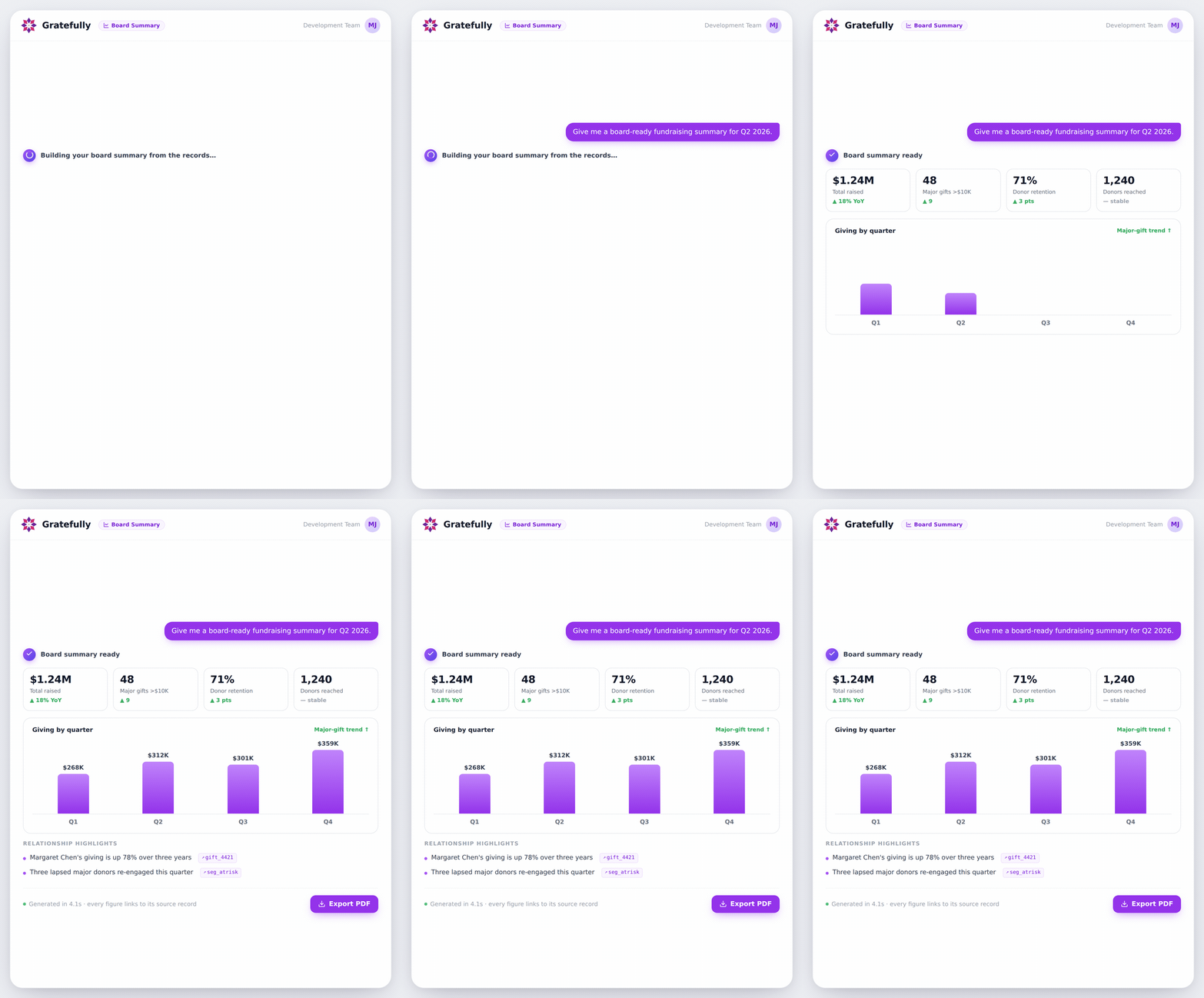
A development director described his job to us on a demo call with one word, a bridge. He meant that his CRM holds the gift history while the rest of what he needs lives in spreadsheets, email threads, and the event platform. None of those systems talk to each other. So he does the talking, moving information between them by hand and reconciling the differences. Every nonprofit we met this month runs some version of his stack, a CRM plus four or five other tools, each bought to do its own job well. There was never a layer whose job was connecting them, so a person ends up doing the connecting. That work never finishes either, because the systems keep producing new data to reconcile. Hours from a senior fundraiser's week go into it, every week. Consolidating onto one platform would end it, and that platform does not exist. Even the biggest CRMs cover their gaps by bolting on acquisitions, so every stack ends up assembled from pieces. Gratefully is built to be the layer those pieces never had. It pulls the CRM, the spreadsheets, and the documents into one donor model, and a question about any donor draws on all of it at once, cited back to where each piece came from. The bridge work moves to software. The person gets to go back to being a fundraiser. See how the connecting layer works at gratefully.io
- LINKEDIN · IMAGERecorded 21 Sept 2026
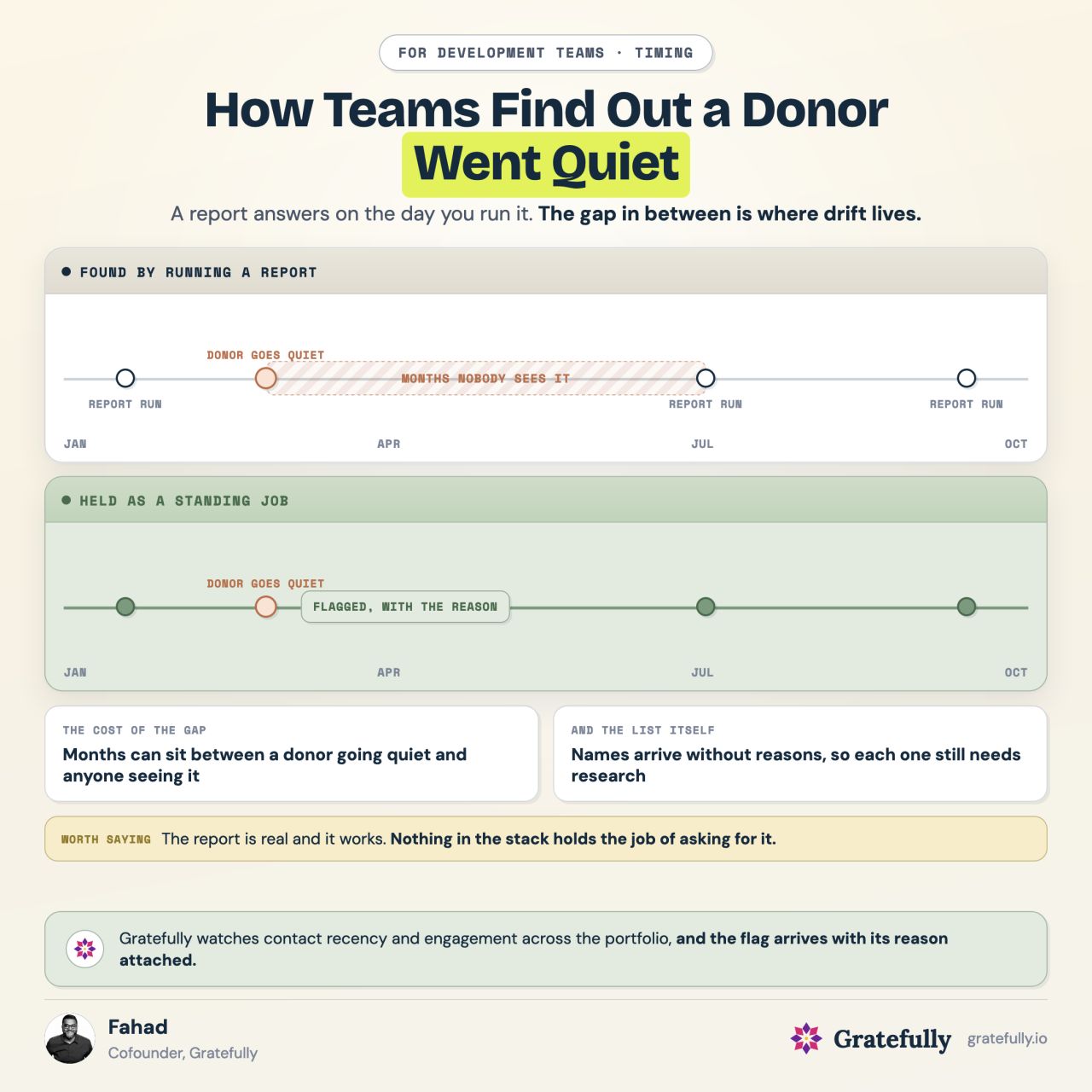
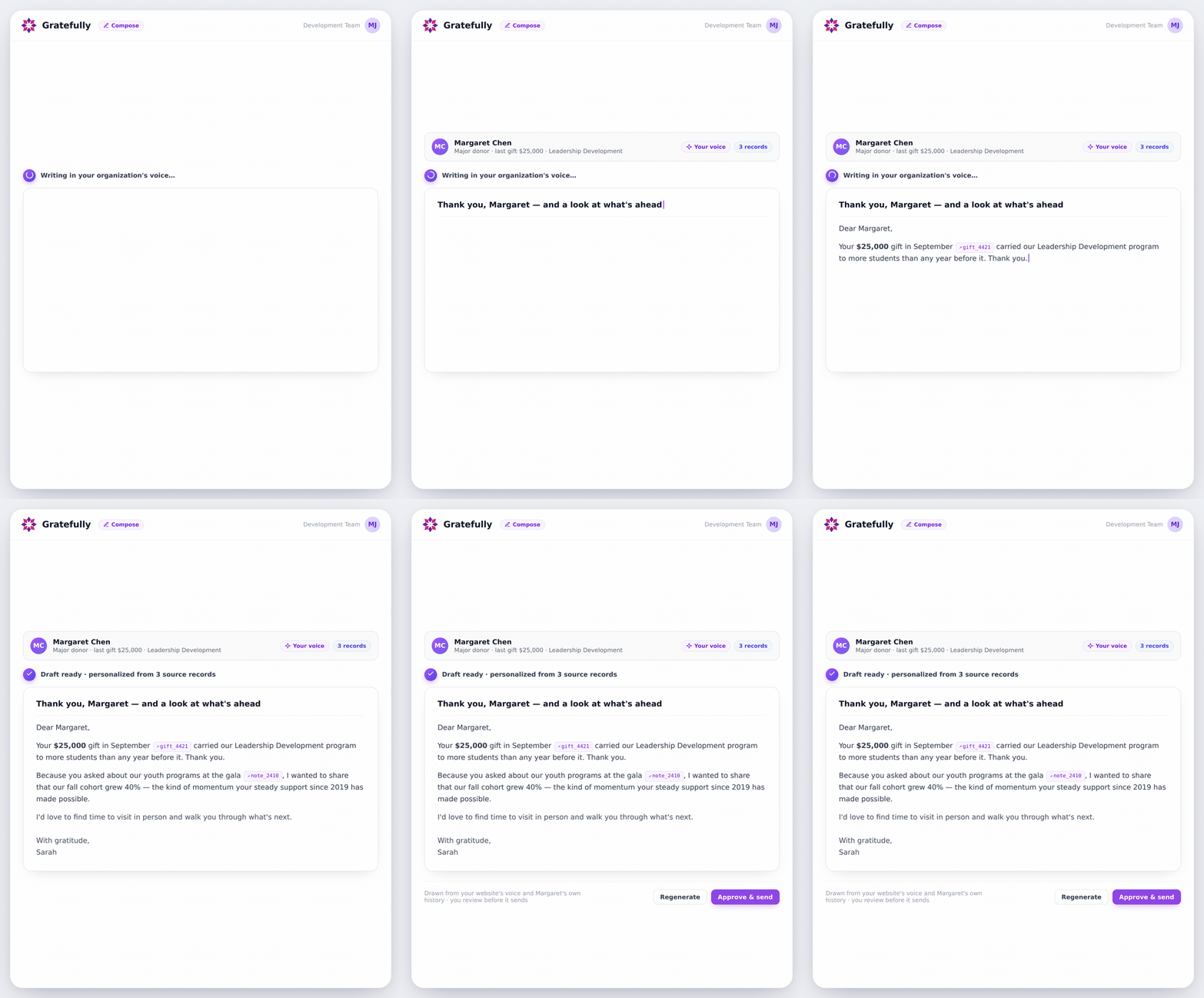
Ask a development team how they find out a donor has lapsed and the answer is usually the same. There is a report for that. The report is real, and it works. Nothing in the stack holds the job of asking for it though. A lapsed-donor list exists on the days someone remembers to request one, and on every other day the same information just sits there. So drift gets discovered on the reporting schedule instead of when it starts. Months can sit between a donor going quiet and anyone seeing it, and that is not carelessness. The noticing job was never assigned to anything. A standing reminder to run the report weekly is the cheap fix, and it hands you names without reasons, so each name still needs research before anyone can act on it. Gratefully holds the job itself. It watches contact recency and engagement across the whole portfolio, and when a relationship starts cooling it comes to you with the reason attached, like the stalled next step or the appeal that never went out. The flag lands in your inbox digest and links straight to the donor, so finding out no longer depends on thinking to ask. Nobody should have to remember to check whether something went wrong. That is a job software can hold. See what the signals look like at gratefully.io
- LINKEDIN · IMAGERecorded 21 Sept 2026
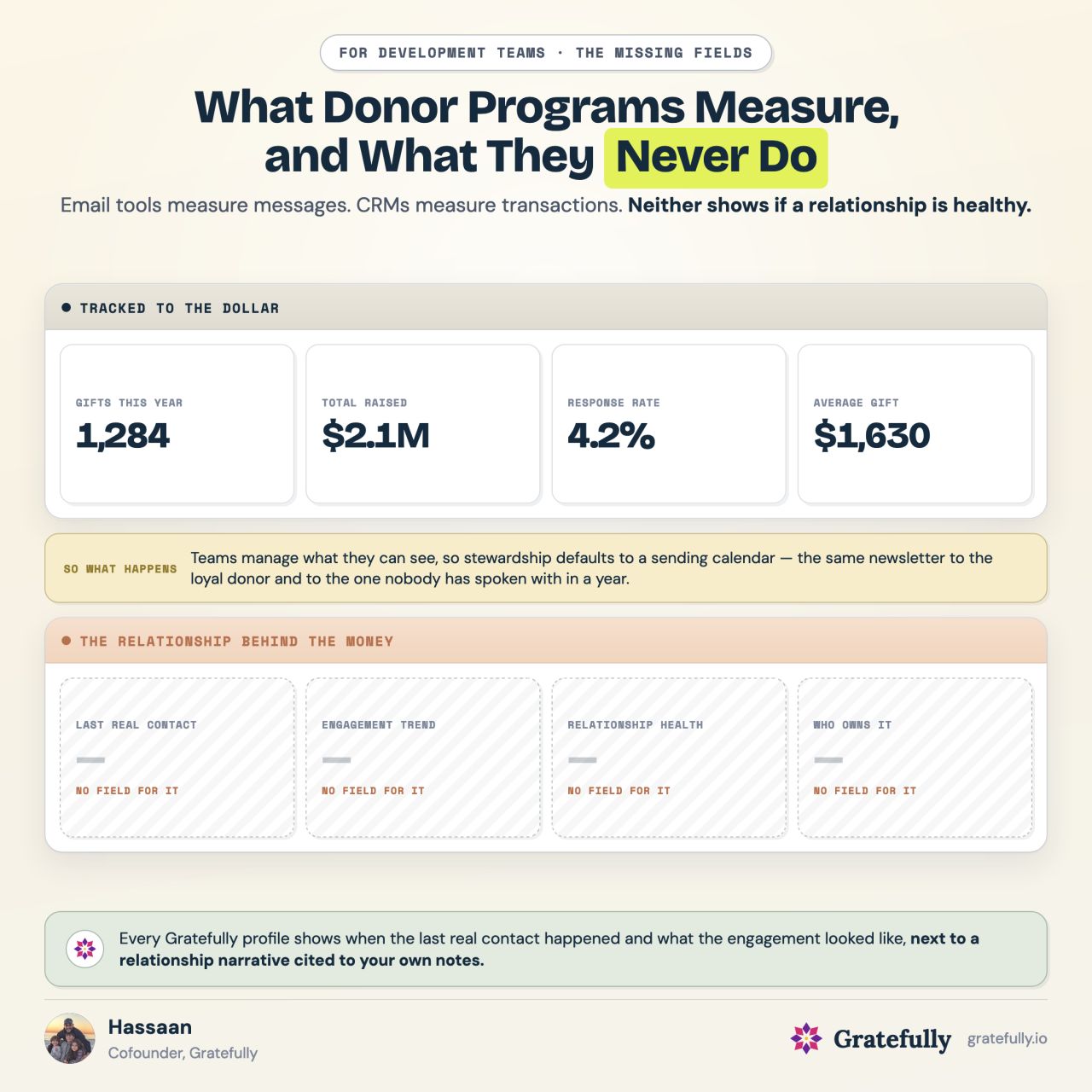
A senior nonprofit executive told us his organization's donor communications look transactional, and that what his team actually needs is a way to steward relationships and measure their strength. He was pointing at a real gap. Most donor programs measure money precisely. Gifts, totals, and response rates are tracked to the dollar. The relationships behind that money have no measure at all. That is not a criticism of any team. There has simply never been a field for it. Email tools measure messages and CRMs measure transactions, and neither one shows whether an actual relationship is healthy or has gone quiet. Teams manage what they can see. So stewardship defaults to a sending calendar, with the same newsletter going to the loyal donor and to the one nobody has spoken with in a year, because nothing distinguishes them at a glance. Gratefully makes the relationship itself visible. Every donor profile shows when the last real contact happened and what the engagement has actually looked like. Next to that sits a relationship narrative drawn from your own notes, with every claim cited to its source. With that in front of the team, the follow-up changes on its own. A donor nobody has spoken with in a year becomes an obvious call to make, and a loyal donor gets a thank you instead of another ask. You cannot steward what you cannot see. That visibility is what we built. Look at a live donor profile at gratefully.io
- LINKEDIN · IMAGERecorded 21 Sept 2026
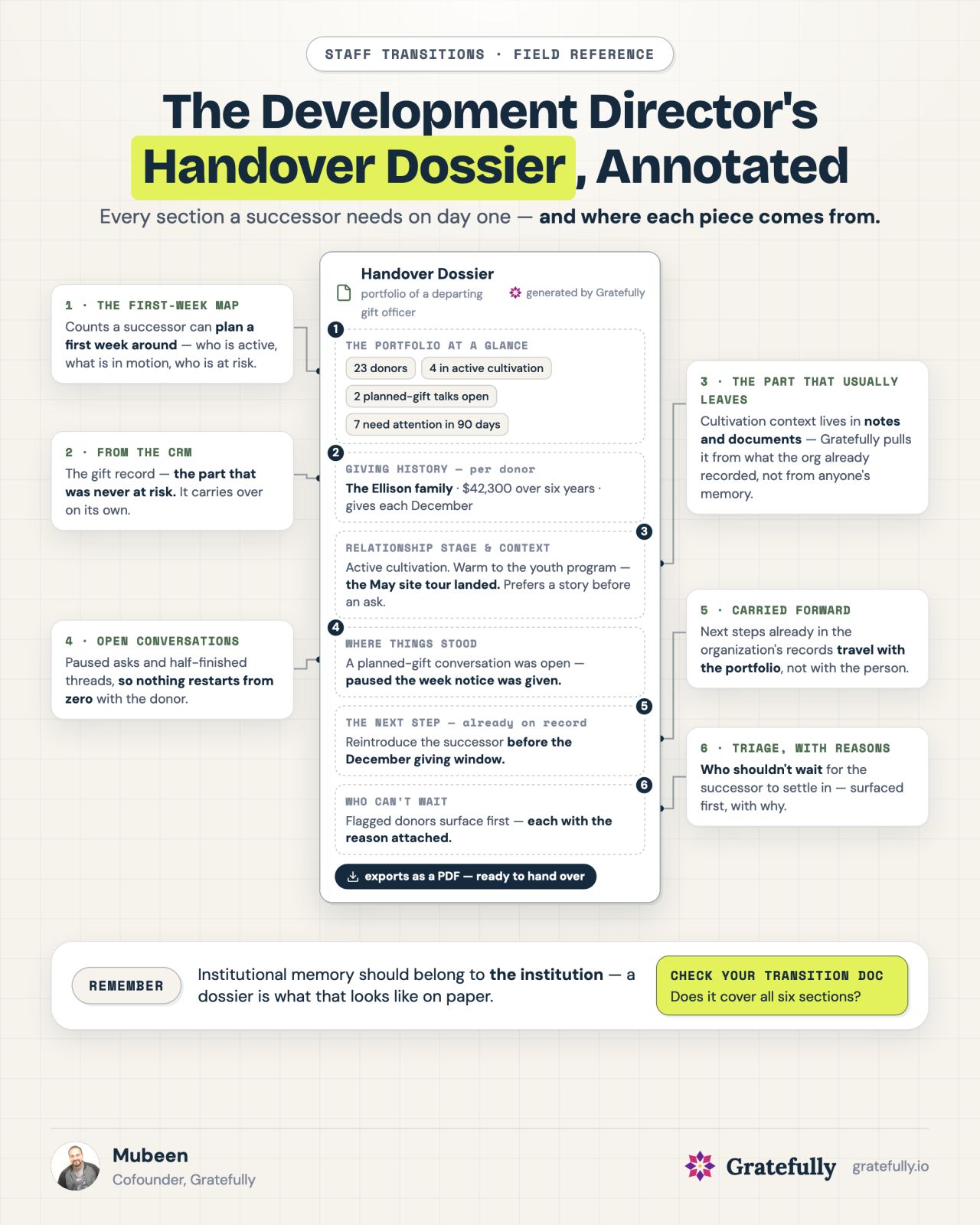
When a fundraiser resigns, the vacancy gets attention right away. The harder part is transferring what that person knew about their portfolio. The CRM gives the successor the recorded giving history, and that is an important part of the handover. The harder context is what was happening inside each relationship: open conversations, cultivation history, commitments already discussed, and next steps captured outside the gift record. Much of that sits in notes, documents, and one person's memory. An outgoing officer may write some of it down before leaving, but a notice period is not much time to reconstruct years of relationship context. We built the handover dossier for this gap. When someone gives notice, Gratefully assembles the package from what the organization already recorded: every donor in the portfolio, with giving history, relationship context, where things stood, and the next step on record. It exports as a PDF the incoming person can hold on day one. The successor still has to earn their own trust with every donor. They just no longer start as a stranger to their own portfolio. See what a full dossier looks like at gratefully.io
- LINKEDIN · IMAGERecorded 21 Sept 2026
Brand consistency becomes harder when several people write donor communications. A website may use one set of terms for the mission and programs. Appeals, stewardship letters, and summaries may use different language depending on who prepared them. A style guide can help. Each writer still has to interpret the guidance and apply it under deadline. During setup, Gratefully analyzes the organization's website to learn its mission, program language, voice, and tone. It applies that language to letters and summaries drawn from donor history. The fundraiser still reviews and approves every draft. The team starts from a more consistent version of the organization's voice without forcing every communication into the same template. Compare three recent donor communications written by different people and note where the language changes. #nonprofittech #nonprofits
- LINKEDIN · IMAGERecorded 21 Sept 2026
Unassigned donors are difficult to see without a coverage review. Coverage gaps can appear when staff change or portfolios are rebalanced. New donors can also enter between planning cycles. The team may not discover the gap until it compares donor records with staff assignments. When responsibility is unclear, follow-up can be delayed because no one owns the next step. Gratefully reports staff portfolio coverage and gaps directly. A development leader can ask which donors have no assignment and review the donor-level detail behind the result. The team can then rebalance from a defined list. Coverage becomes manageable once the team can see exactly where it is missing. Compare your staff assignments with your donor list this week and count how many donors have no clear owner. #nonprofitleadership #fundraising
6 of 60 adsSign up to see every Gratefully AI ad, filter by format and date, and get alerts on new ones.
See all 60 adsWatch the companies you care about.
Filter every ad by industry, country, format and network, and get alerts when a company you watch starts running new ads.