On air · 2 of 3 networks
Gifford Bioscience Limited
- giffordbioscience.com
- Healthcare & Life Sciences
- GB
- 12 employees
Gifford Bioscience Limited’s ads on LinkedIn, Meta and Google, recorded by adsrunning. Browse the latest here for free. Sign up free to see all 69. Watch Gifford Bioscience Limited with Starter to get each new one in your feed.
Watchlist with Starter · $49/mo
| Network | Status | Live ads | Nov 2025LinkedIn activity · 52 weeksOct 2026 | Checked | Next step |
|---|---|---|---|---|---|
| Running | 35 | Checked 29 Oct 2026 | See all 69 ads → | ||
| Meta | Not checked | — | |||
| Running | 32 | Ads on the Google Ads Transparency Center | Checked 30 Oct 2026 | Collect them with the API → |
Gifford Bioscience Limited has 35 live LinkedIn ads. We recorded 32 Google ads on 30 Oct 2026.
Latest ads
- LINKEDIN · IMAGESince 24 Sept 2026
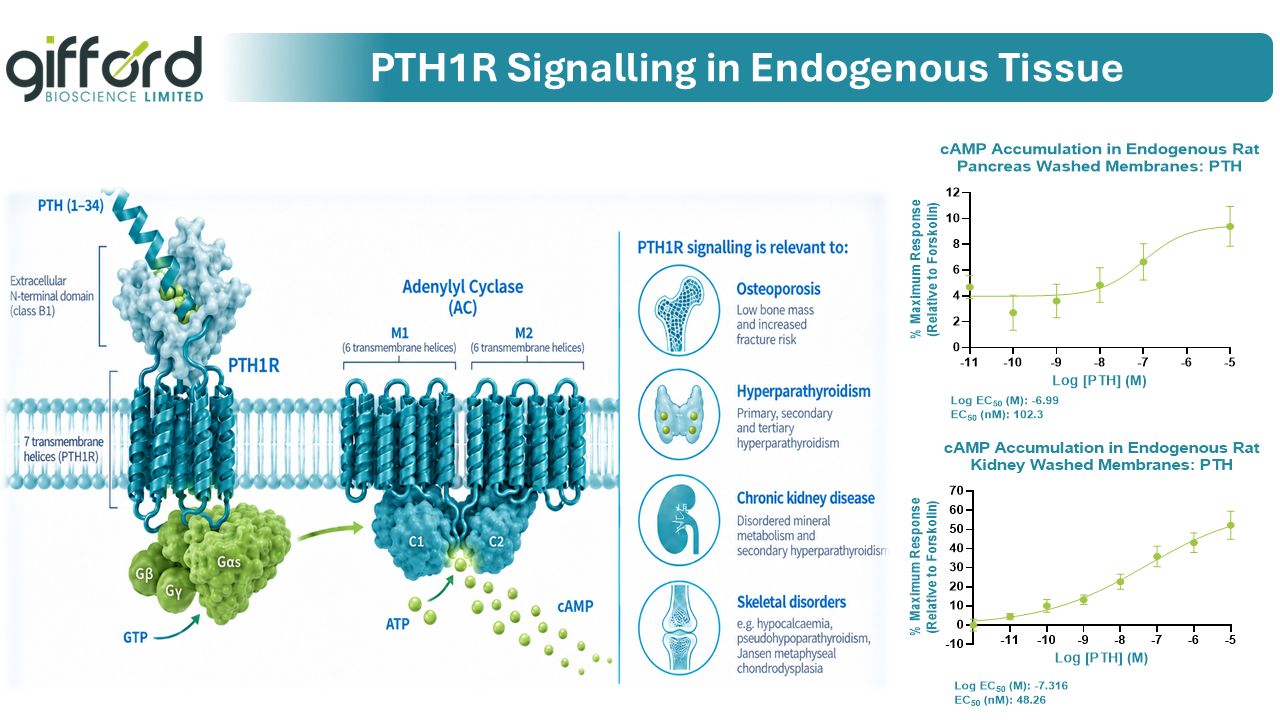
What happens when you take a GPCR assay out of a recombinant system and into endogenous tissue? Most cAMP pharmacology is generated in recombinant cells overexpressing the receptor. These systems are ideal for screening, but receptor overexpression, receptor reserve and a non-native signalling environment can shift both apparent potency and efficacy. Using TR-FRET, we measured PTH(1-34)-stimulated cAMP accumulation directly in washed membrane preparations from rat kidney and pancreas. In kidney, PTH produced a concentration-dependent response reaching approximately 50% of the forskolin maximum, with a log EC50 of -7.32 (48 nM). A smaller but clear concentration-dependent response was also detected in pancreas, with a log EC50 of -6.99 (102 nM). The important difference is that the receptor is present at its endogenous expression level, within its native tissue membrane and coupled to endogenous Gs and adenylyl cyclase. That gives us a direct way of asking whether pharmacology observed in an engineered system is maintained when the same receptor is studied in a native tissue membrane environment. This is particularly relevant for PTH1R, where cAMP signalling remains central to both established and emerging therapeutics, from teriparatide and abaloparatide in osteoporosis to palopegteriparatide in hypoparathyroidism and oral small-molecule PTH1R agonists now entering clinical development. If you want to understand how your compounds behave in an endogenous system, get in touch. #GPCR #Pharmacology #cAMP #DrugDiscovery #ReceptorPharmacology #Biotechnology #Biotech #Pharma #LifeSciences #ReceptorPharmacology #cAMP #GPCRSignalling #MolecularPharmacology #TranslationalScience #DrugDevelopment #PreclinicalDevelopment #AssayDevelopment #InVitroPharmacology #EndogenousReceptors #PTH1R
- LINKEDIN · IMAGESince 11 Sept 2026
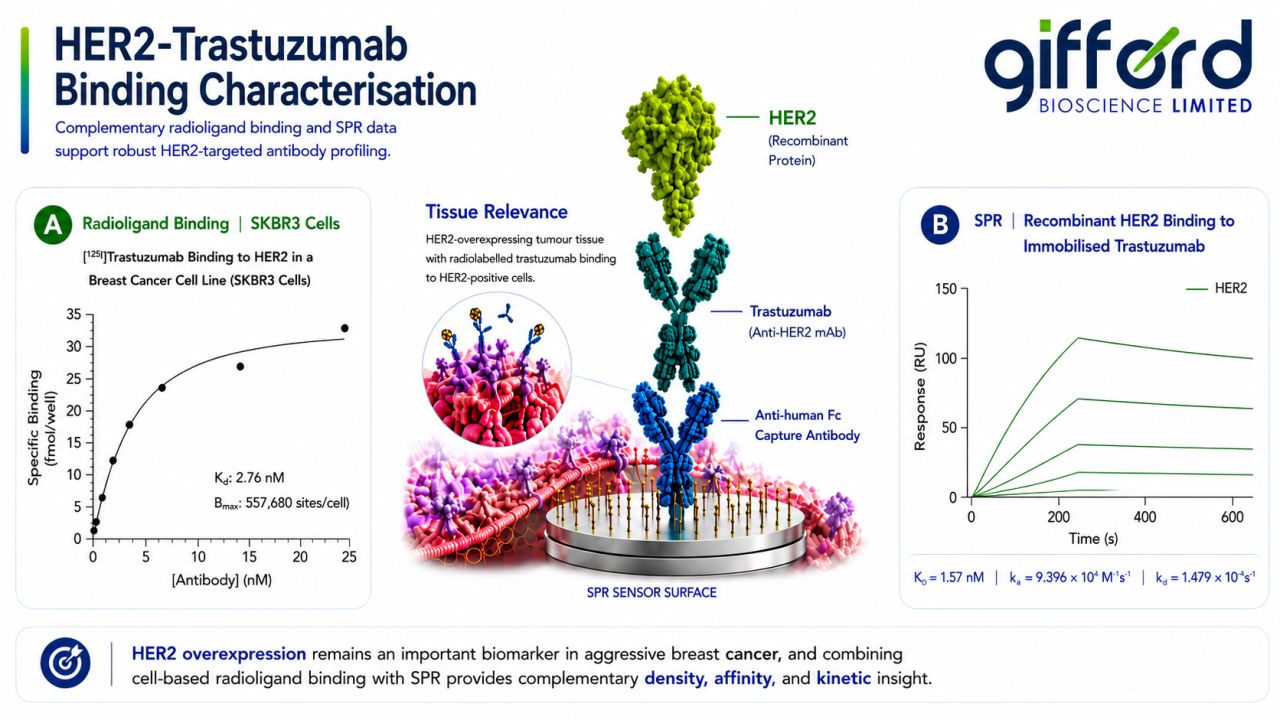
1.57 nM by SPR. 2.76 nM on SKBR3 cells. 557,680 HER2 binding sites per cell. Three measurements that together give a much more complete view of trastuzumab binding to HER2. For SPR, trastuzumab was captured through its Fc region and recombinant HER2 flowed across the antibody. This gave a binding affinity (KD) of 1.57 nM, with kinetics constants of ka 9.4 × 10⁴ M⁻¹s⁻¹ and kd 1.5 × 10⁻⁴ s⁻¹; corresponding to a dissociation half-life of 77 minutes. Using [¹²⁵I]trastuzumab on SKBR3 cells, we measured a Kd of 2.76 nM and 557,680 HER2 binding sites per cell. The affinity measurements agree across two very different assay formats, supporting comparable HER2 recognition and showing that iodination has not materially altered trastuzumab binding. Each technique adds something different. SPR gives the kinetics. Radioligand binding adds cellular affinity and receptor density. And it does not have to stop at cells. At Gifford Bioscience, we can iodinate antibodies in-house and take the same radiolabelled antibody into tissue autoradiography, adding target distribution and binding within native tissue architecture. Recombinant protein, cells and tissue. Complementary techniques within the same antibody characterisation programme. Where does your antibody characterisation currently stop? 📧[email protected] 💻 www.giffordbioscience.com #DrugDiscovery #HER2 #ADC #Pharmacology #RadioligandBinding #Iodination
- LINKEDIN · IMAGESince 11 Sept 2026
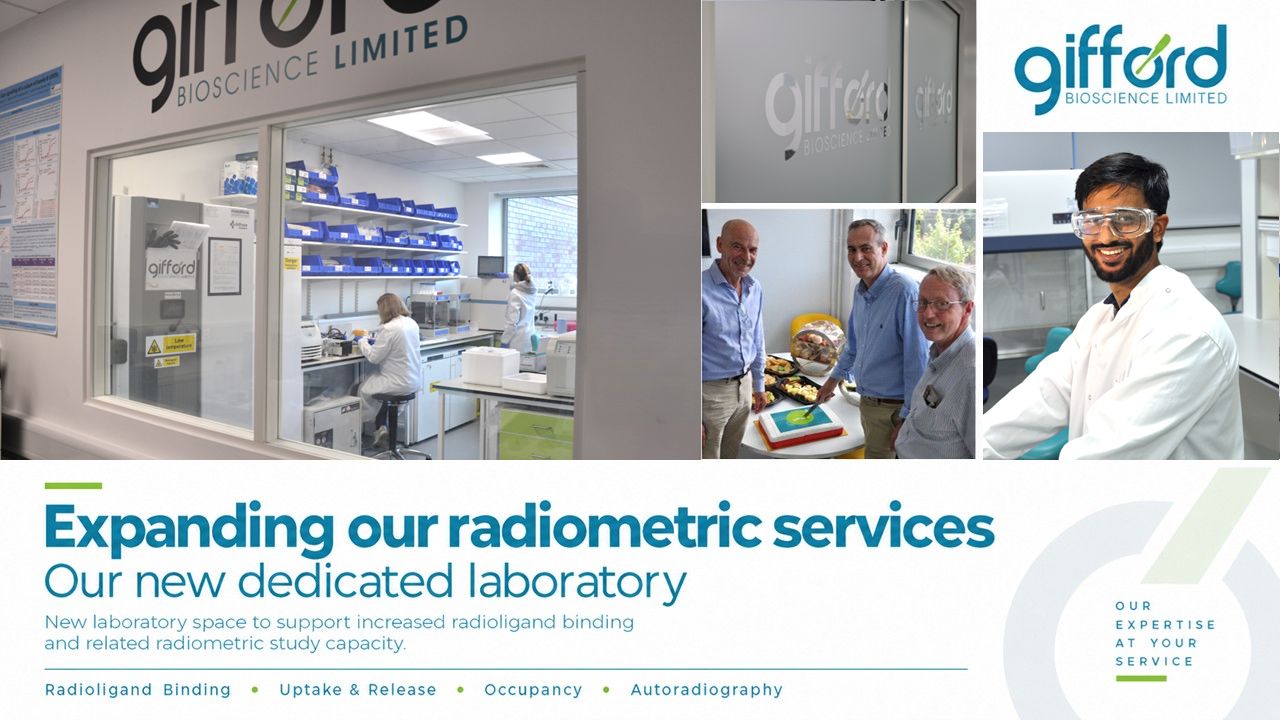
We’ve expanded our radiometric services into a new dedicated laboratory at Gifford Bioscience. The additional space increases our capacity across radioligand binding, uptake & release, receptor occupancy and quantitative autoradiography, while allowing us to continue developing bespoke assays around the requirements of individual drug discovery programmes. From measuring receptor affinity in recombinant systems through to target engagement in endogenous tissue, including human tissue, our focus remains the same: generating pharmacology that helps our clients make clearer development decisions. Our expertise at your service. #DrugDiscovery #ReceptorPharmacology #RadioligandBinding #Autoradiography #ReceptorOccupancy #CRO
- LINKEDIN · IMAGESince 15 Apr 2026
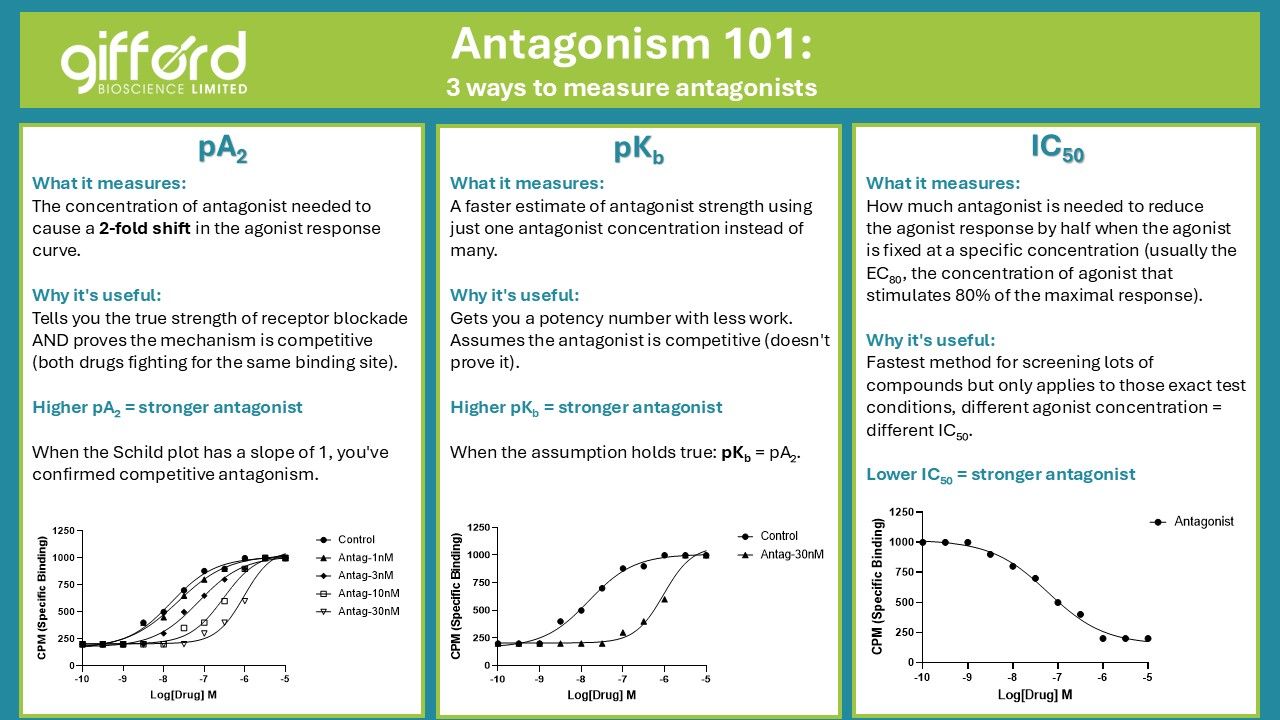
Measuring antagonist potency: Why the method matters There are multiple ways to measure potency. If you're screening compounds, optimizing leads, or publishing your findings, choosing the right antagonist assay can save time and money. pA₂ proves competitive mechanism while measuring true affinity. Gold standard for publications and when you need mechanistic confidence. Multiple full concentration-response curves required. pKb gives you a potency estimate faster - just two curves instead of five. Trade-off? You're assuming competitive antagonism rather than proving it. Ideal for lead optimization. IC₅₀ is your rapid screening tool. One curve, quick rank-ordering. But remember: the number is locked to those specific test conditions. The right choice depends on your project stage. Early hit screening? IC₅₀ gets you there. Lead optimization? pKb balances speed and rigor. Need to publish mechanism? Time for that Schild plot. What methods are you using for antagonist characterization? Drop a comment, we're always interested to hear what's working in different labs. 📧[email protected] 💻 www.giffordbioscience.com #DrugDiscovery #Pharmacology #FunctionalAssays #Antagonism #Biotech #GPCR #Receptors #OncologyResearch #NeuroscienceResearch #BiotechNews #CROServices
- LINKEDIN · IMAGESince 15 Apr 2026
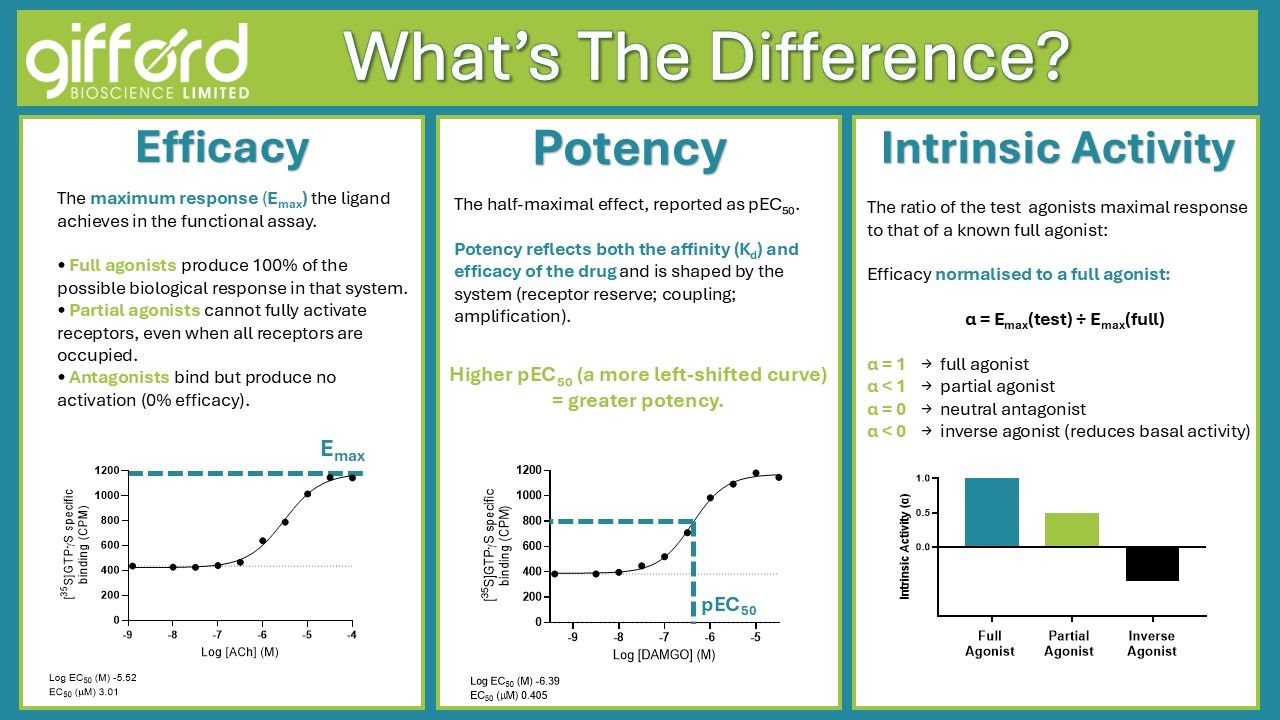
Potency, efficacy, intrinsic activity — what do they actually tell you about an agonist? Here’s a quick guide you can use at a glance. At Gifford Bioscience, our functional assays (GTPγS, cyclic AMP and calcium) quantify how strongly and how effectively ligands activate receptors, allowing you to distinguish full agonists, partial agonists, inverse agonists, and everything in between. Here are some important metrics functional assays can provide: Emax describes efficacy, the maximum response produced by your drug; pEC₅₀ describes potency, the range of concentrations over which your drug produces a response; Intrinsic activity (α), how your drug compares to a full agonist in this system. When combined, these parameters reveal the balance between receptor occupancy and signalling efficiency. Essential for understanding ligand bias, receptor reserve, and translational relevance. We help you interpret these values, so your pharmacology makes biological sense, not just numerical sense. 📧[email protected] 💻 www.giffordbioscience.com #DrugDiscovery #Pharmacology #BindingAssays #Radioligand #Biotech #GPCR #OncologyResearch #NeuroscienceResearch #BiotechNews #CROServices
- LINKEDIN · IMAGESince 15 Apr 2026
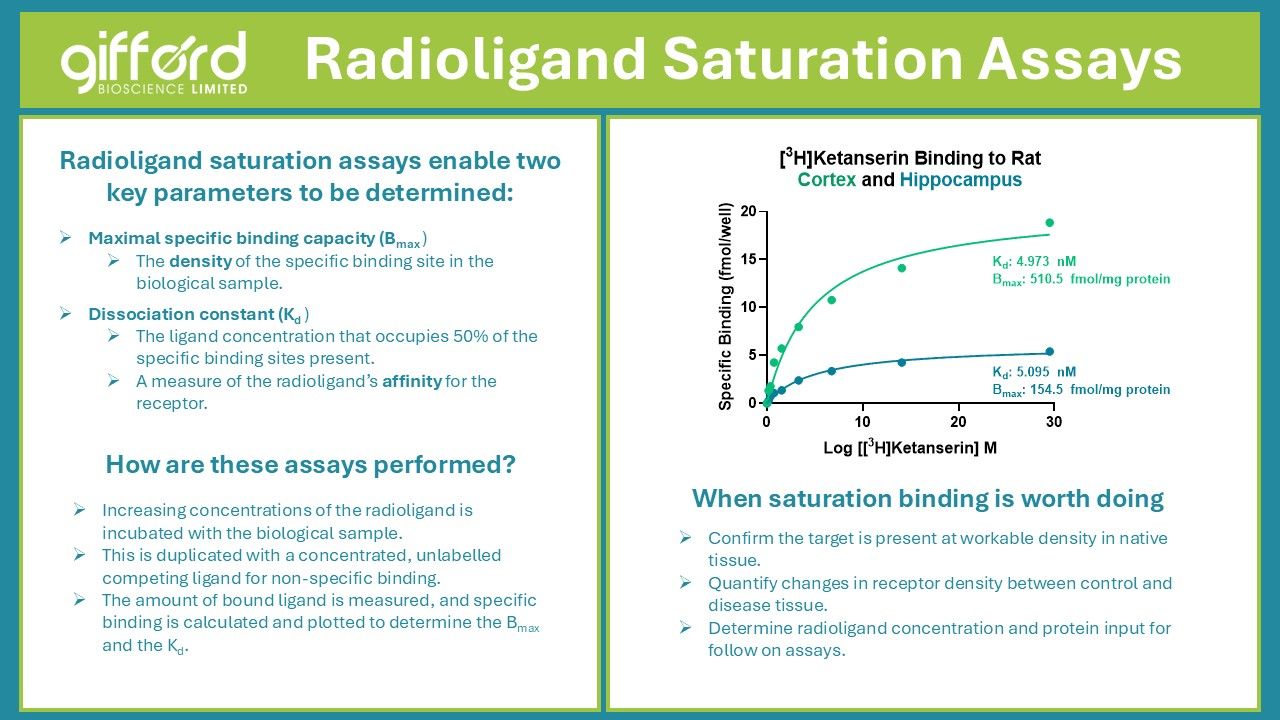
Saturation binding answers two basic questions in native tissue: how many receptors are there (Bmax) and what is the radioligand’s equilibrium affinity (Kd). In the [³H]ketanserin example here, Kd is very similar in cortex and hippocampus, about 5 nM, but Bmax is very different, roughly 510 vs 155 fmol per mg protein. This is where problems start. When Bmax is lower, the specific signal is a smaller fraction of total binding, so non specific binding and assay noise take up more of the curve. Competition data can look messy, or even appear shifted after subtraction and fitting, for reasons that are not true affinity changes. Regional or disease comparisons can be over interpreted as pharmacology, when they are really just differences in available sites. If a competition curve shifts, or an occupancy readout behaves oddly, it is worth checking whether receptor density is the hidden variable, before you chase chemistry. 📧[email protected] 💻 www.giffordbioscience.com #DrugDiscovery #Pharmacology #BindingAssays #Radioligand #Biotech #GPCR #OncologyResearch #NeuroscienceResearch #BiotechNews #CROServices
6 of 69 adsSign up to see every Gifford Bioscience Limited ad, filter by format and date, and get alerts on new ones.
See all 69 adsWatch the companies you care about.
Filter every ad by industry, country, format and network, and get alerts when a company you watch starts running new ads.