Not on air · 2 of 3 networks checked
Frederic Fernandez & Associates
- fredericfernandezassociates.com
- Professional Services
- CH
- 9 employees
Frederic Fernandez & Associates’s ads on LinkedIn, Meta and Google, recorded by adsrunning. Browse the latest here for free. Sign up free to see all 24. Watch Frederic Fernandez & Associates with Starter to get each new one in your feed.
Watchlist with Starter · $49/mo
| Network | Status | Live ads | Nov 2025LinkedIn activity · 52 weeksOct 2026 | Checked | Next step |
|---|---|---|---|---|---|
| None recorded | 0 | Checked 31 Oct 2026 | See all 24 ads → | ||
| Meta | Not checked | — | |||
| None recorded | 0 | No ads found on the Google Ads Transparency Center | Checked 29 Oct 2026 | Collect them with the API → |
Frederic Fernandez & Associates has no live LinkedIn ads. We recorded no Google ads on 29 Oct 2026.
Latest ads
- LINKEDIN · IMAGESince 16 Oct 2026
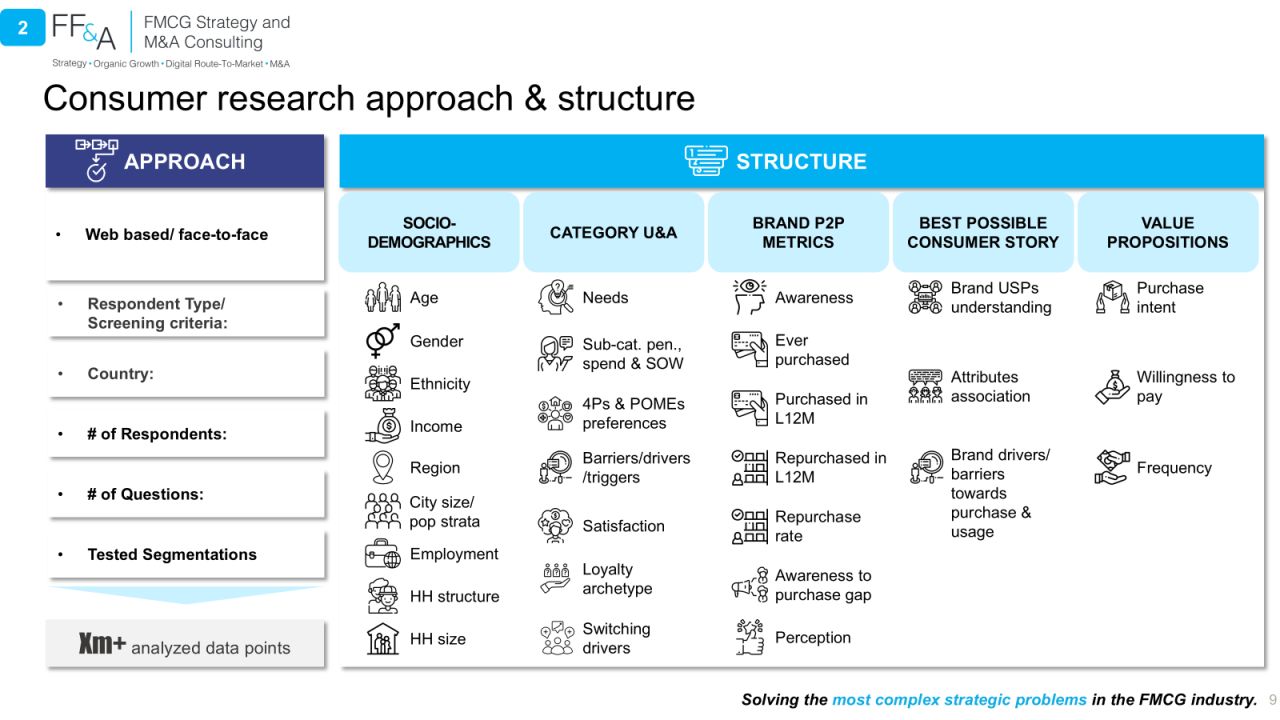
Most segmentations describe a consumer who no longer exists. 'The greatest enemy of knowledge is not ignorance, it is the illusion of knowledge.' Hawking, on physics. Also the single most important sentence in FMCG brand strategy. Every brand team believes it understands its consumer. The tracker. The U&A from 2023. The agency segmentation. Twenty years of institutional memory. That is the illusion. Most of it describes a consumer who moved on, an average that never existed, or the brand's view of itself dressed up as insight. It is why >1/3 of every ZBG®️ engagement goes into fresh consumer & gatekeeper research. Not for the love of research. Because the method depends on replacing inherited assumptions with evidence. What the research is for, & only this: - Test the hypotheses from the diagnostic - Find the optimal segmentation: the consumers who drive 80% of growth vs the ones who make up the numbers - Surface the real barriers, drivers & triggers - Read purchase intent & willingness to pay before a single euro goes into a launch Do it properly & the growth levers rank themselves. Skip it & you build a plan on what you wish were true. Key question for FMCG CEOs: when was your consumer segmentation last rebuilt from primary research, not refreshed from the old one? The ZBG®️ Sprint gives your brand team the research protocols FF&A uses in its own engagements, plus 40+ frameworks to turn the evidence into ranked growth levers. See how your brand team can run Zero-Based Growth®️ with the ZBG®️ Sprint: https://lnkd.in/euRV3jhD
- LINKEDIN · IMAGESince 16 Oct 2026
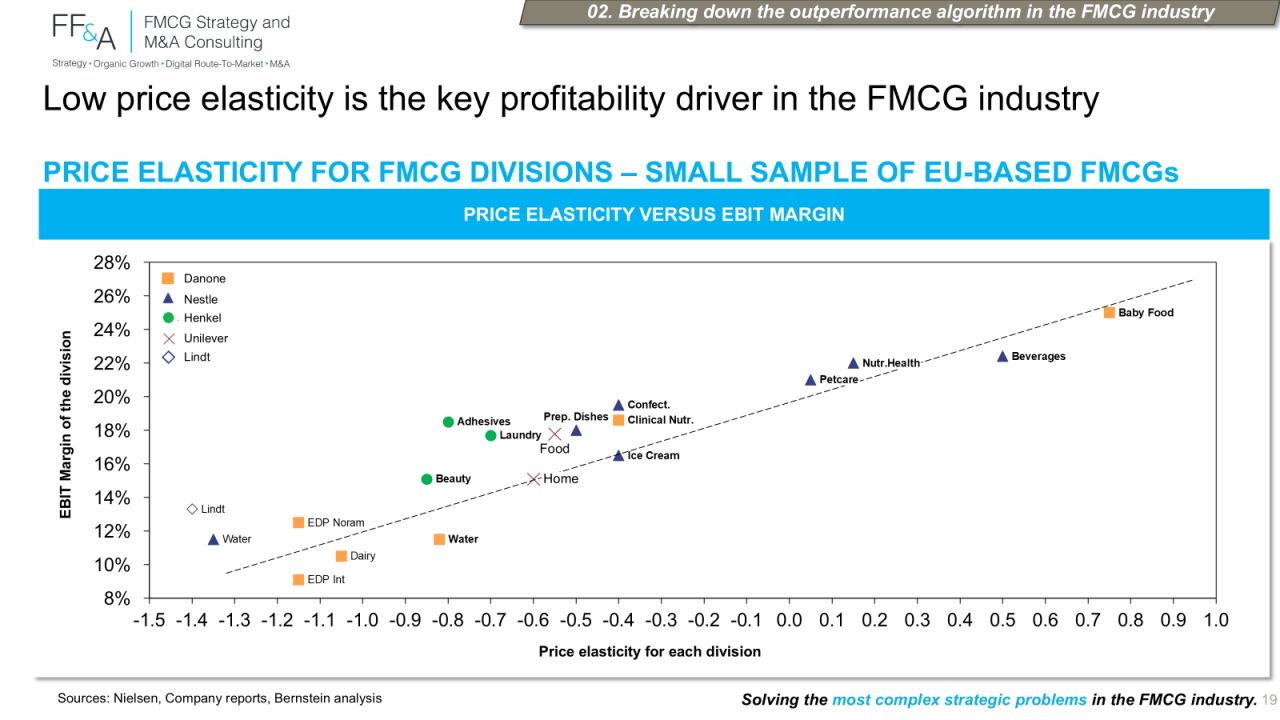
FMCGs: If your last two price increases cost you volume, the problem isn't your price ladder. Low price elasticity is the #1 driver of profitability in FMCG. Not scale. Not cost structure. Desirability. We plotted price elasticity against EBIT margin for a sample of EU-based FMCG divisions. The brands that move price without losing volume earn the highest margins. Every time. Which means margin is downstream of desirability: - A brand consumers prefer, that solves something, that they would miss: prices for its value - A brand that is merely available & familiar: every price increase leaks volume until the arithmetic stops working We saw the cost of ignoring this over 2022-24. The industry priced hard, the consumer absorbed it, & many read that as pricing power. It was inflation cover. Cover is gone. The brands that kept volume are the ones with real desirability under the price, not just the courage to raise it. So if you want pricing power in 2027, the work is not on the price ladder. It is on the reasons anyone would pay it: superiority, relevance to the consumers who matter most, a story that earns the premium before you ask for it. Build the desirability. Elasticity & margin follow. Key question for FMCG CEOs: what happened to your volume on the last two price increases? That number is your desirability score. Zero-Based Growth®️, our replicable approach to organic growth, uses engagement-based segmentation to predict willingness to pay better than socio-demographic or needs-based segmentation. See how your brand team can run Zero-Based Growth®️ with the ZBG®️ Sprint: https://lnkd.in/euRV3jhD
- LINKEDIN · IMAGESince 1 Oct 2026
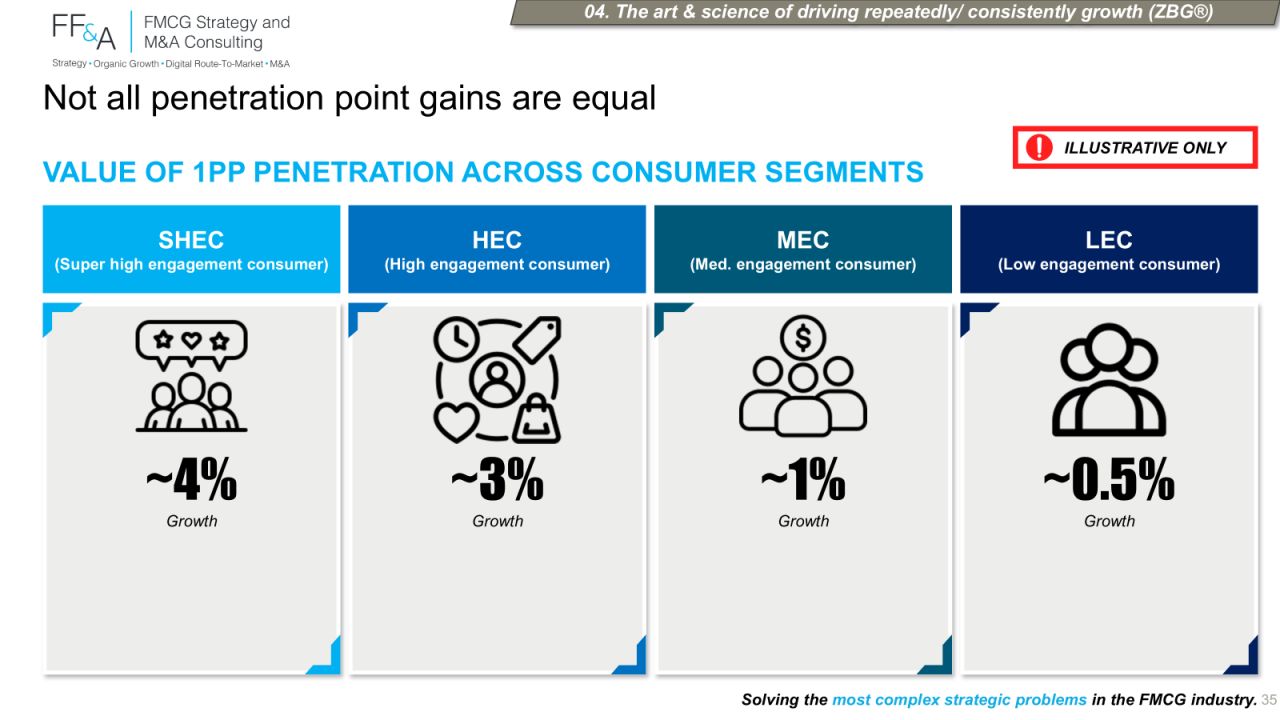
Consumer Health: Consumer segmentation is King & Penetration is Queen. Not loyalty. Penetration, of the right consumers. The number that changes the plan: <20% of consumers account for >70% of your category's RSV. Go further: - Super-high-engagement consumers, ~5% of households: ~30% of RSV, ~35% of profit, ~45% of growth - Add the high-engagement tier: 25% of households drive 65% of RSV, 75% of profit, 90% of growth Now look where the money goes. Mass reach. An average consumer who does not exist. A media plan built to talk to everyone while the growth sits with a few. It is why segmentation comes first in every CHC engagement we run, & why it is engagement-based, not demographic: - Who drives the category? - What do they value? - Where are their barriers? - Which of them are not yet in your brand? & the part that surprises people: the goal is not loyalty. In a category of symptoms & occasions, loyalty programmes chase the wrong thing. The goal is quality penetration: winning more of the consumers who matter most, one purchase at a time. One penetration point among the most engaged is worth ~8x one among the least engaged. Segment first, to know who. Penetrate second, to win them. Everything else follows from those two. Key question for CHC CEOs: what share of your media reaches the 25% who drive 90% of growth? If you want to see how brand teams run that precision with Zero-Based Growth®️, the ZBG®️ Sprint is here: https://lnkd.in/euRV3jhD Exciting times #fmcg #cpg #consumerhealth
- LINKEDIN · IMAGESince 1 Oct 2026
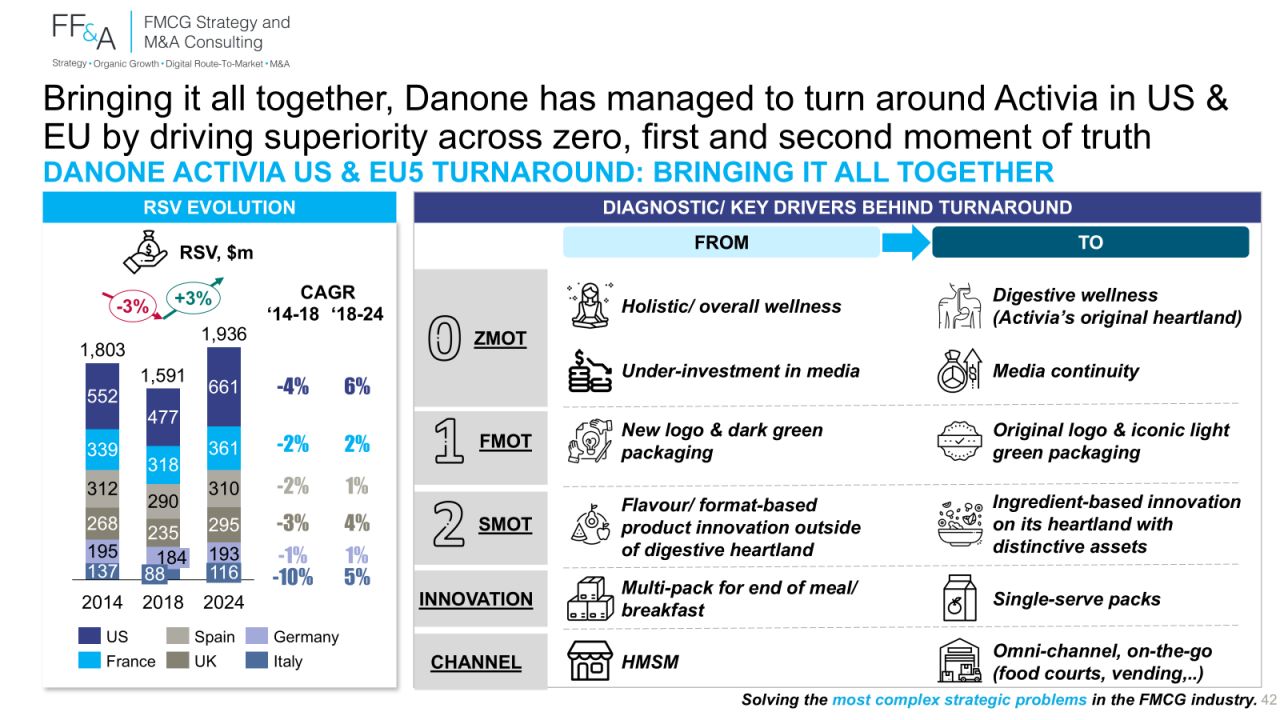
Danone Activia lost its way in the US and EU5 over 2014–18. It came back by winning three moments, not one. The old model had two moments of truth: first at the shelf, second in use. Whole marketing plans were built for those two. The real journey has three that matter: Zero moment: intent forms long before the shop. Search, reviews, social First moment: the shelf Second moment: the product in use, and whether the consumer comes back or churns A brand can be strong at one and bleeding at another. Most brands pour money into the shelf, where the decision is often already made, and under-invest in the moments that set intent and drive repeat. Activia’s turnaround in three lines: Zero: back to its digestive-health core, media it had cut restored First: earned the shelf again with the right packaging and identity Second: ingredient-led innovation that delivered the product truth Map your consumer’s real journey, moment by moment. Then be honest about where your money sits vs where the decision is won. For most brands the two drifted apart years ago. That is Zero-Based Growth®️ in practice: find where growth is actually won, then put the plan and the budget on those levers, not the average journey. Key question for FMCG CEOs: what share of your budget sits at the zero moment? If you want to see how brand teams run that precision with Zero-Based Growth®️, the ZBG®️ Sprint is here: https://lnkd.in/euRV3jhD Exciting times #fmcg #cpg #growth
- LINKEDIN · IMAGESince 1 Oct 2026
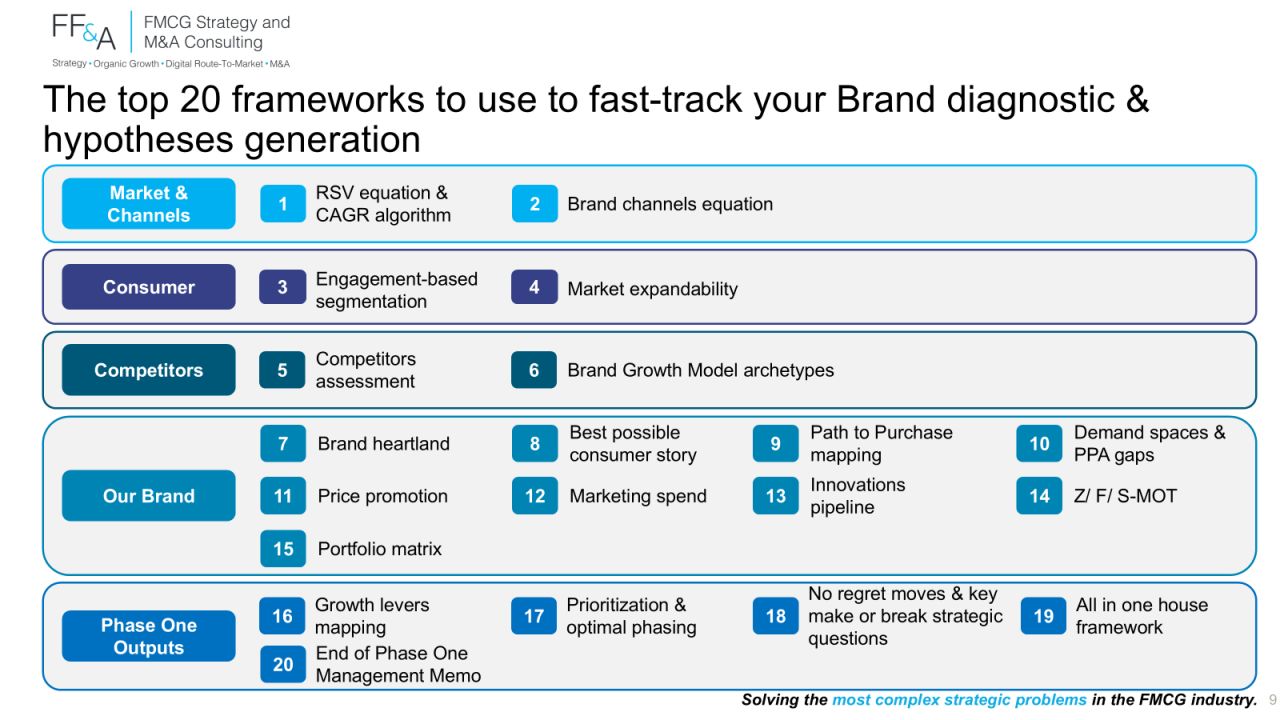
The fastest way to waste six months on a growth strategy: start with the data. Strange thing to say from a data-obsessed firm. But the teams that drown are the ones that collect everything, cut it every way & hope an answer surfaces. What surfaces is a 200-page deck & a decision nobody can defend. The teams that move start with hypotheses. Sharp, falsifiable, specific: - 'Our growth sits in 3 cells, not 30' - 'The heavy user is under-served on this occasion' - 'We are losing the zero moment, not the shelf' Then they test exactly those, with exactly the data & research that can prove them wrong. It is how a strategy consultant works. It is the discipline most brand teams were never taught. Every one of our 20 diagnostic frameworks produces the same three outputs: top 5 insights, the strategic hypotheses they imply, the data gaps that would settle them. Nothing else. & balance fast & slow. Slow: hypothesis-led, rigorous testing. Fast: at the end of each phase, act on the no-regret moves that are already obvious. Complement that with rigorous bespoke consumer & gatekeeper research to test those hypotheses and you get a robust replicable approach Hypotheses first. Data second. Action throughout. If you want to see how brand teams run that precision with Zero-Based Growth®️, the ZBG®️ Sprint is here: https://lnkd.in/euRV3jhD Exciting times #fmcg #cpg #strategy
- LINKEDIN · IMAGESince 29 Sept 2026
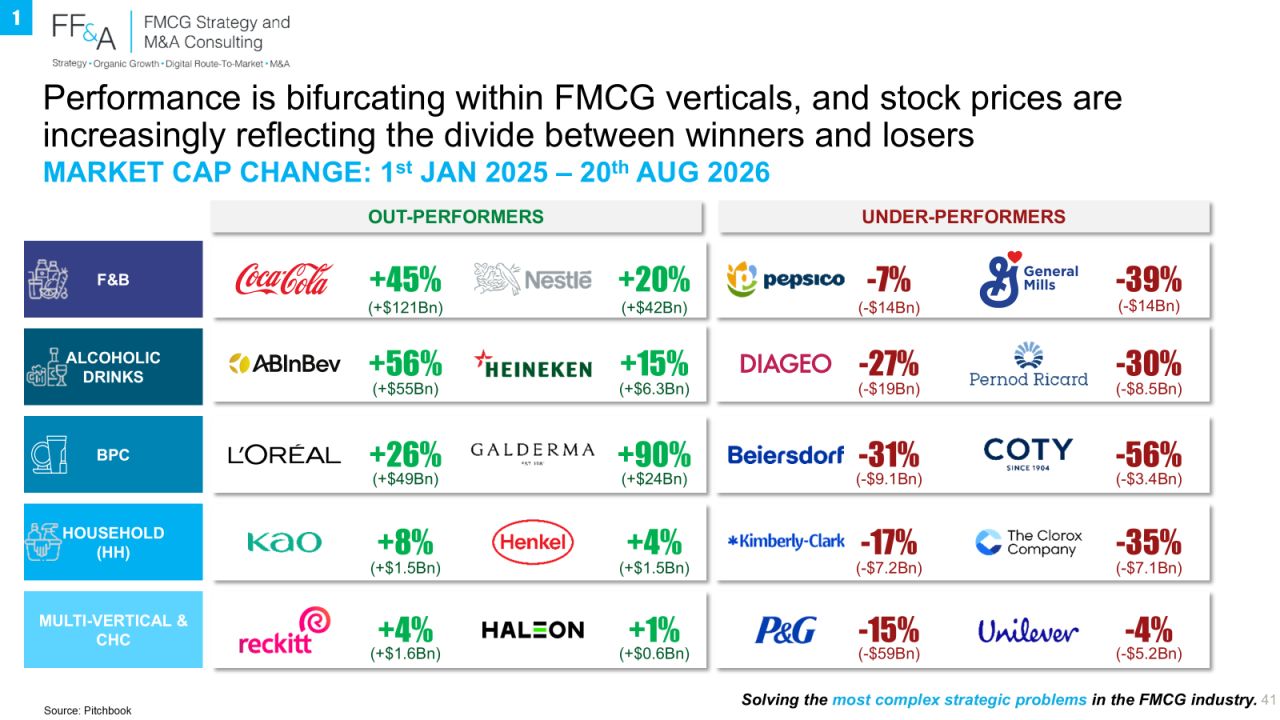
The Coca-Cola Company +$121Bn of market cap since Jan’25. PepsiCo -$14Bn. Same category, opposite fates. The 51 largest listed FMCGs: market cap +11% since Jan’25, behind the S&P 500 at +12%. 43% of them lost value. The divide is not between verticals. It runs inside every one of them: F&B: The Coca-Cola Company +45% vs PepsiCo down Alc. Drinks: AB InBev +56% vs Diageo -27% BPC: L’Oréal +26% vs Coty -56% Household: Kao up vs The Clorox Company -35% Same consumer. Same macro. Same retailers. If category exposure explained it, winners and losers would sort by vertical. They don’t. They sort by one thing: how precisely each company understood where its growth sat and went after it. That is Zero-Based Growth®️ in one line: find the 10% of levers that hold most of the value at stake, then build the plan around them. Saying it differently: “our category is tough” has expired as an excuse. Someone in your category is compounding. Key question for FMCG CEOs: who is the Coca-Cola of your vertical, and what are they doing that you are not? If you want to see how brand teams run that precision with Zero-Based Growth®️, check out the ZBG®️ Sprint: https://lnkd.in/euRV3jhD Keen to hear your perspective Exciting times
6 of 24 adsSign up to see every Frederic Fernandez & Associates ad, filter by format and date, and get alerts on new ones.
See all 24 adsWatch the companies you care about.
Filter every ad by industry, country, format and network, and get alerts when a company you watch starts running new ads.