On air · 2 of 3 networks
Framnex
- framnex.com
- Fintech & Financial Services
- GB
- 15 employees
Framnex’s ads on LinkedIn, Meta and Google, recorded by adsrunning. Browse the latest here for free. Sign up free to see all 67. Watch Framnex with Starter to get each new one in your feed.
Watchlist with Starter · $49/mo
| Network | Status | Live ads | Nov 2025LinkedIn activity · 52 weeksOct 2026 | Checked | Next step |
|---|---|---|---|---|---|
| Running | 66 | Checked 30 Oct 2026 | See all 67 ads → | ||
| Meta | Not checked | — | |||
| Running | 36 | Ads on the Google Ads Transparency Center | Checked 29 Oct 2026 | Collect them with the API → |
Framnex has 66 live LinkedIn ads. We recorded 36 Google ads on 29 Oct 2026.
Latest ads
- LINKEDIN · IMAGESince 13 Aug 2026
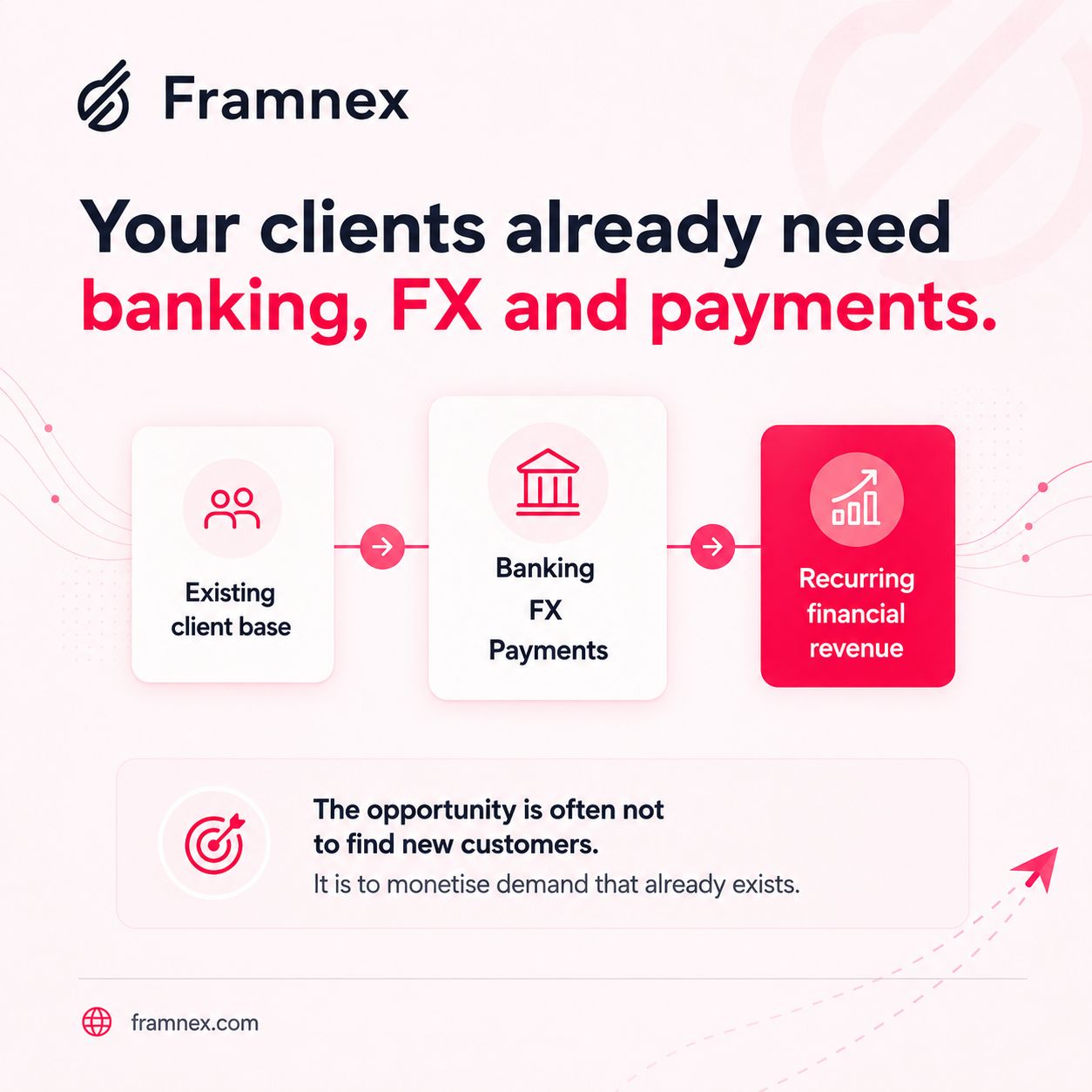
Your clients may already be asking for the financial products you are not monetising today. For FX brokers, company formation firms, banking consultants and other trusted advisers, the biggest asset is often not technology. It is the client relationship they already own. Those clients still need accounts, payments, FX, cards and other financial services. If that demand is handed off to third parties, the commercial value often leaves with it. Framnex helps partners turn existing client relationships into branded financial products and recurring revenue — without having to build the underlying infrastructure from scratch. The opportunity is not always to find more customers. Sometimes it is to create more value from the customers who already trust you. Explore Framnex: framnex.com #Framnex #FintechInfrastructure #Payments #FX #EmbeddedFinance
- LINKEDIN · IMAGERecorded 27 Oct 2026
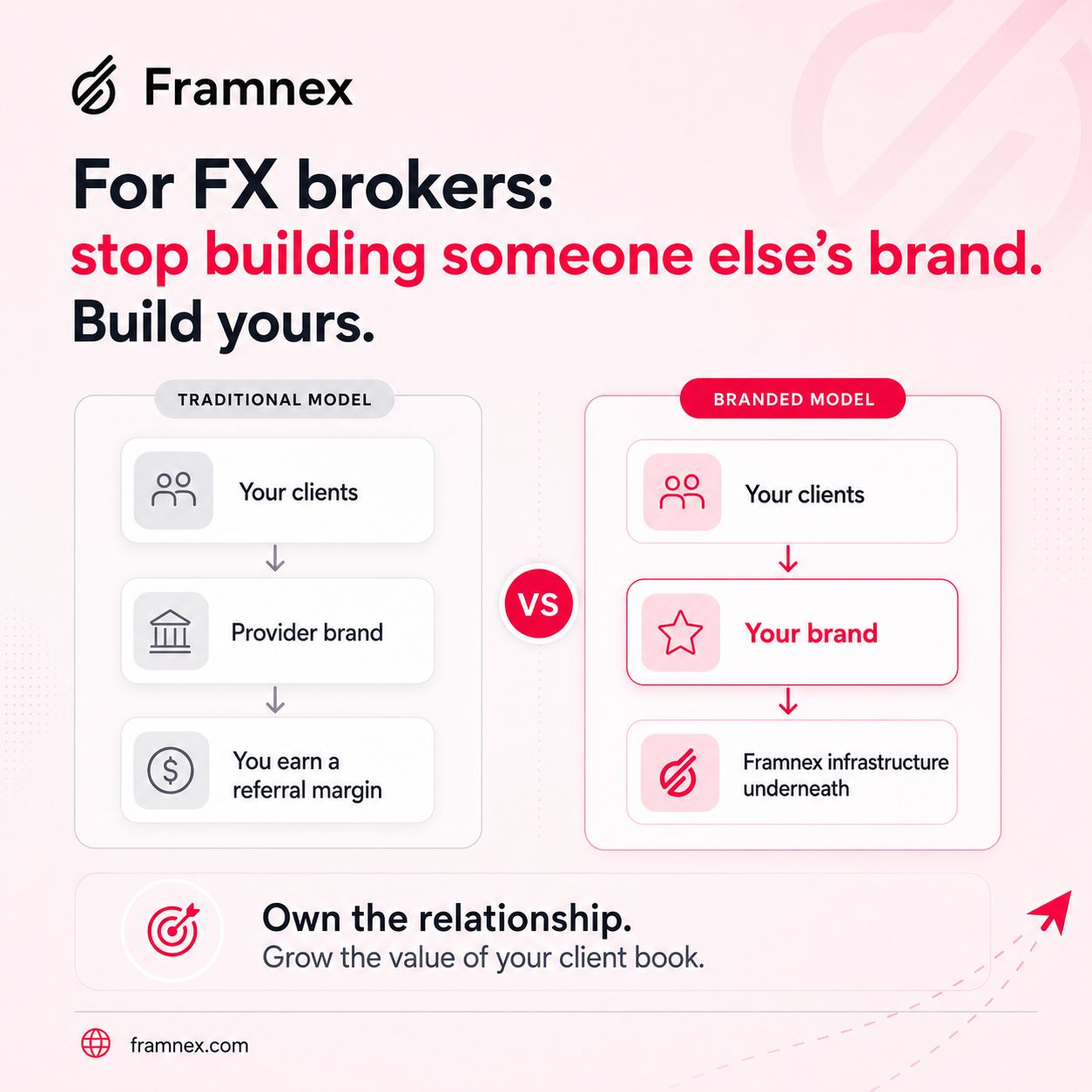
If you already know how to sell FX, the next question is who owns the customer relationship around it. A traditional broker model often sends the customer into somebody else’s product environment. The broker brings the relationship and the volume. The infrastructure provider owns much of the product experience. There is another model. Launch FX and payment services under your own brand, keep the customer relationship closer to your business and use infrastructure partners behind the scenes for the technology you do not want to build yourself. For established FX professionals, that can turn an existing client book into the foundation of a broader financial product. Framnex provides the modular infrastructure behind that model. Your clients. Your brand. Infrastructure underneath. #Framnex #FX #Payments #WhiteLabel #FintechInfrastructure
- LINKEDIN · IMAGERecorded 27 Oct 2026
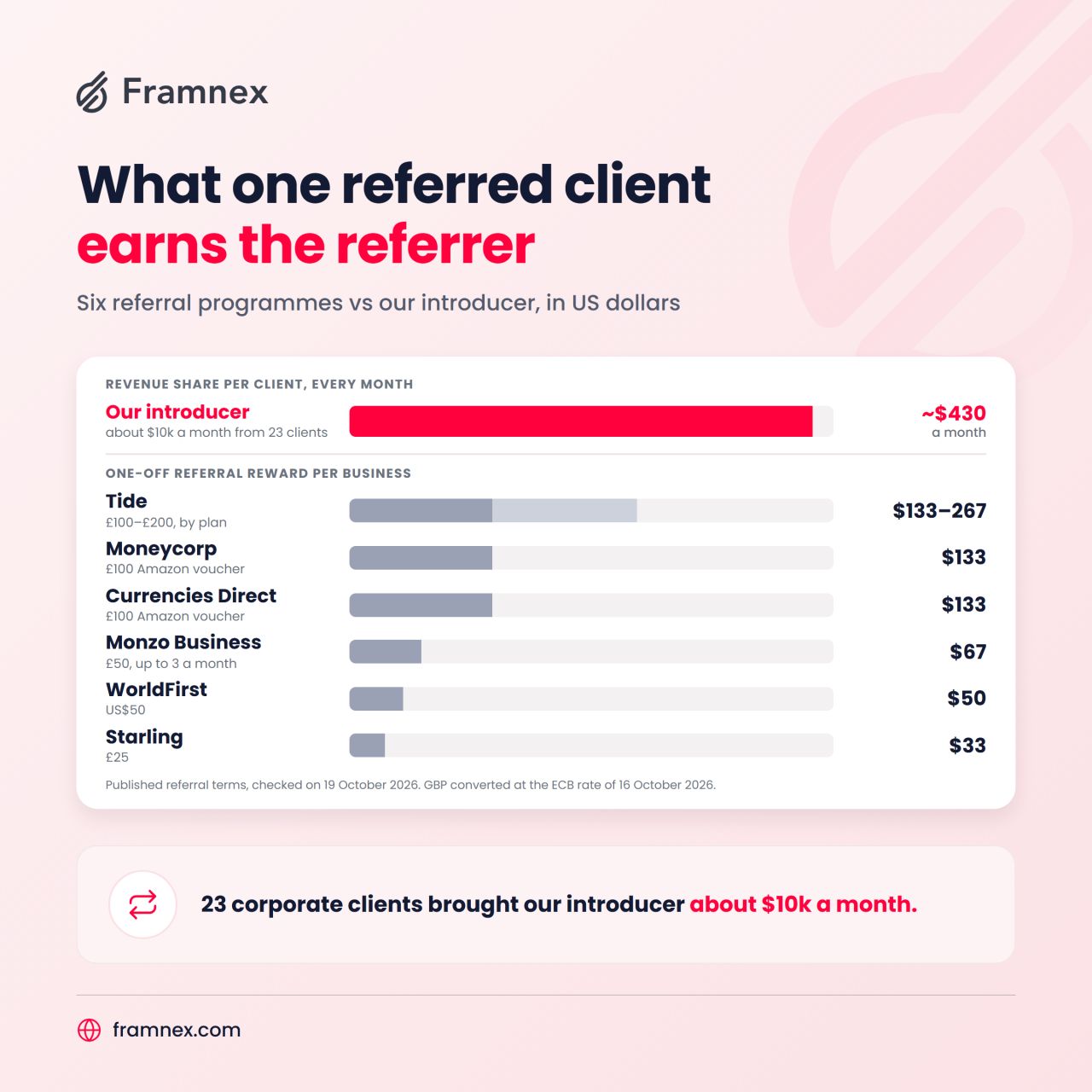
Six payment providers publish what they pay for referring a business: a one-off £25 to £200. The terms, as of October: → Tide: £100 to £200, depending on your plan → Moneycorp and Currencies Direct: a £100 Amazon voucher → Monzo Business: £50, for up to three referrals a month → WorldFirst: US$50 → Starling: £25 Each is paid once, after the referred business opens an account or starts transacting. An introducer earns a share of the revenue its clients generate each month. One FX salesperson on our introducer model brought 23 corporate clients in two months and reached around $10k a month, about $430 per client. Five months on, new clients are still arriving, and the founder has decided to move to an own-brand product. Before you refer a client book, ask what each client earns you after the first month. The full case is in the first comment. #FXBrokers #WhiteLabelBanking
- LINKEDIN · IMAGERecorded 27 Oct 2026
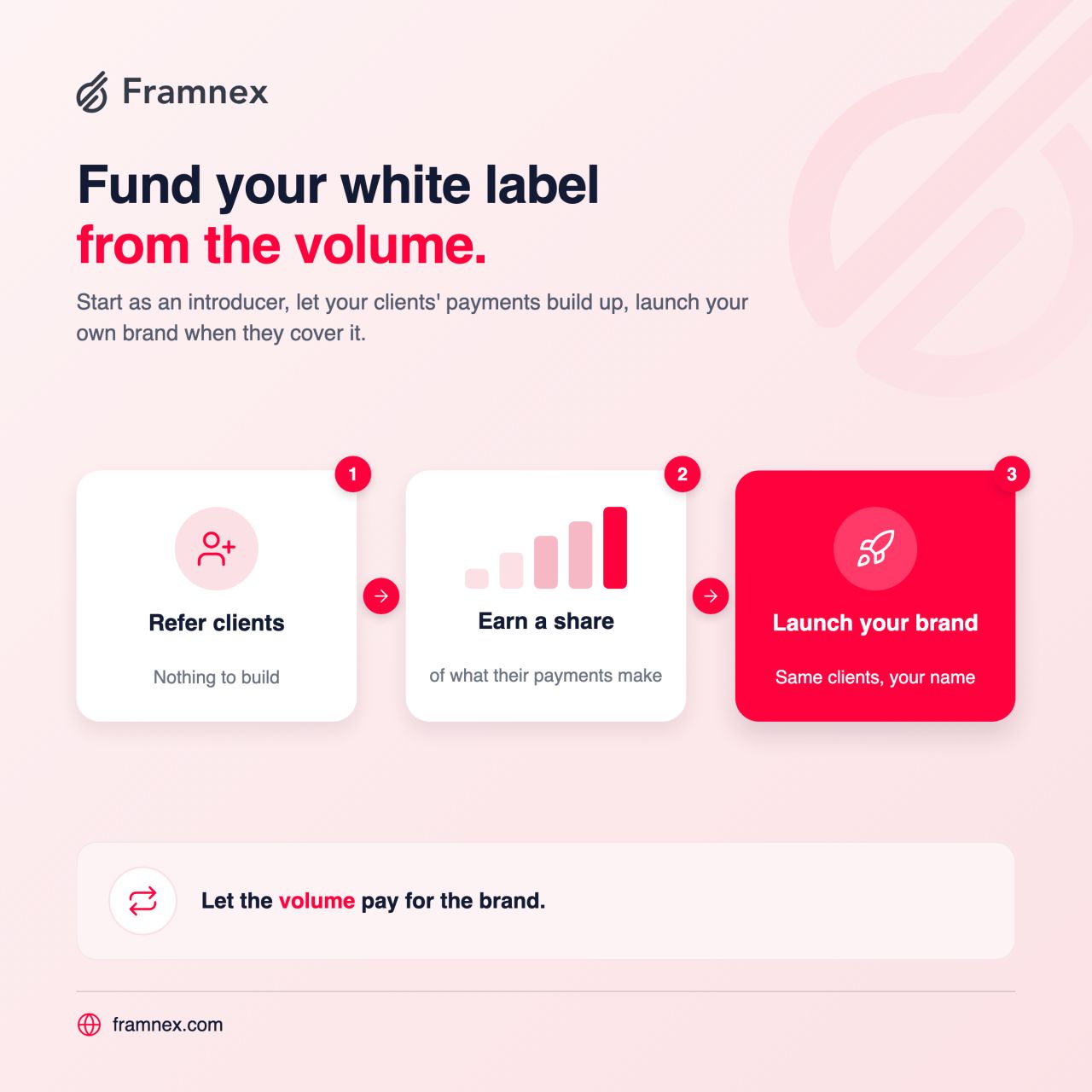
How partners fund a white label without funding it. On about half of our recorded first calls, the conversation stops at the same place within minutes. The partner has clients, wants their own brand on the accounts, and has no budget for a setup fee. There is a route that starts one step lower. 1. Start as an introducer. You refer clients, they open accounts and send payments, and you earn a share of the payment revenue they generate. Nothing to build. 2. Set that income aside for the launch. Say five of your clients start transacting in the first month and a few more join each month after. The share builds up, and your client book proves itself with real volume. 3. When the amount you have set aside covers the setup of your own branded product, move up. The same clients, now under your name, and the launch is paid for by the payments they have already made. Where it breaks: a partner with no time to make introductions builds up nothing. The route works for a client book that is active today. It also changes the order of the decision. You learn whether your clients will use the product before you pay to put your brand on it. At Framnex, Introducer, Light White Label and Full White Label are three steps of the same ladder, and partners climb it this way. Let the volume pay for the brand. #WhiteLabelBanking #FXBrokers #FintechInfrastructure
- LINKEDIN · IMAGERecorded 27 Oct 2026
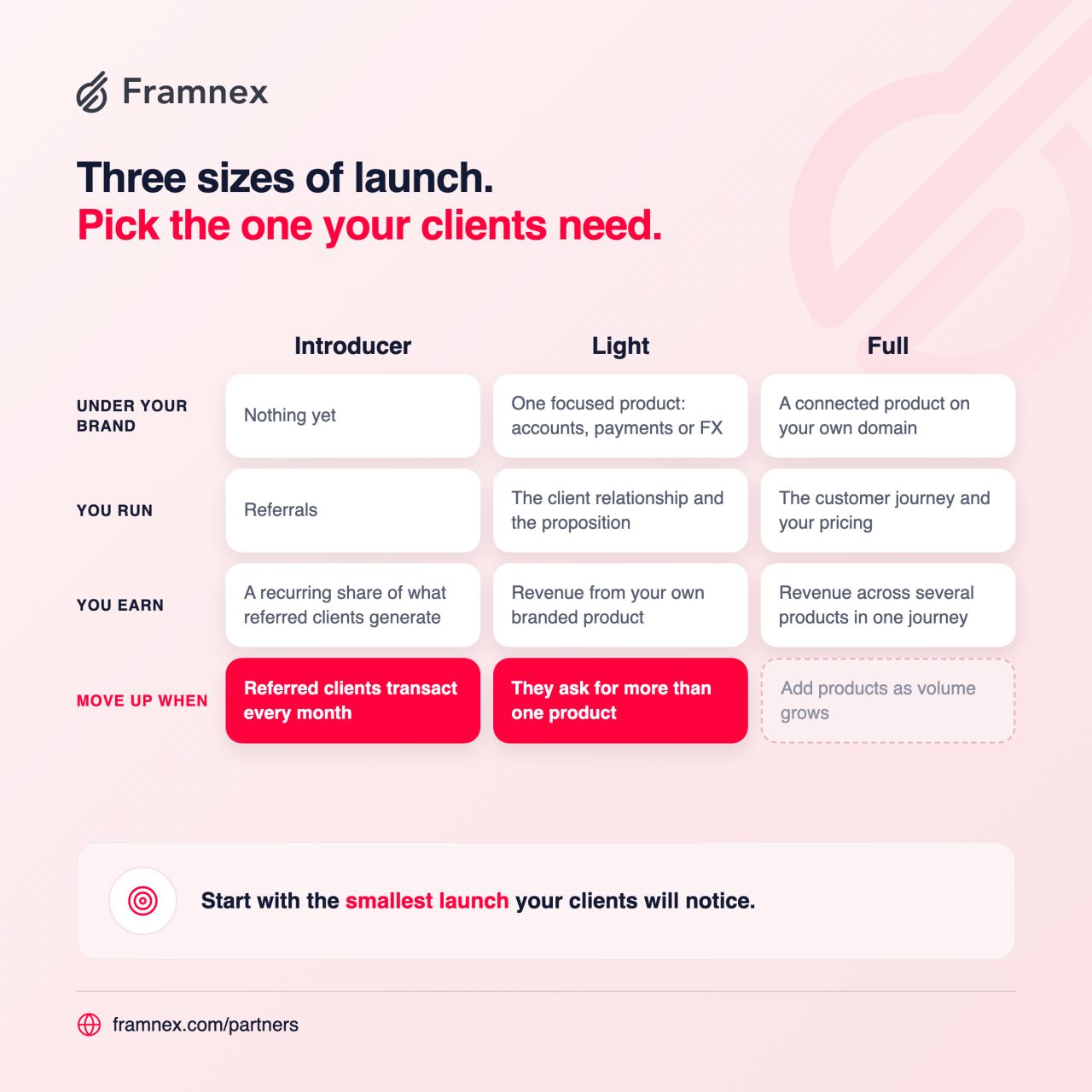
How big does a first financial product need to be? Smaller than most partners plan on the first call. There are three sizes, and each one gives you a different job. → Introducer. You refer clients who need accounts, FX or payments, and earn a recurring share of what they generate. There is no product to run, and your clients use someone else's brand. → Light White Label. One focused product under your name: accounts, payments or FX. You own the client relationship and the proposition around it. → Full White Label. A connected product built around your business: your app or web interface, your domain, your pricing, several services in one journey. More of the customer journey becomes yours to run. The split of roles stays the same in all three. You own the brand and the client. We run the product layer. Regulated providers deliver the regulated services. Where it breaks: choosing the size by ambition. A branded app launched before your clients transact is a cost with your logo on it. Start with the smallest launch your clients will notice. The three models on one page: https://lnkd.in/djWcS7yN #WhiteLabelBanking #FintechInfrastructure
- LINKEDIN · IMAGERecorded 8 Oct 2026
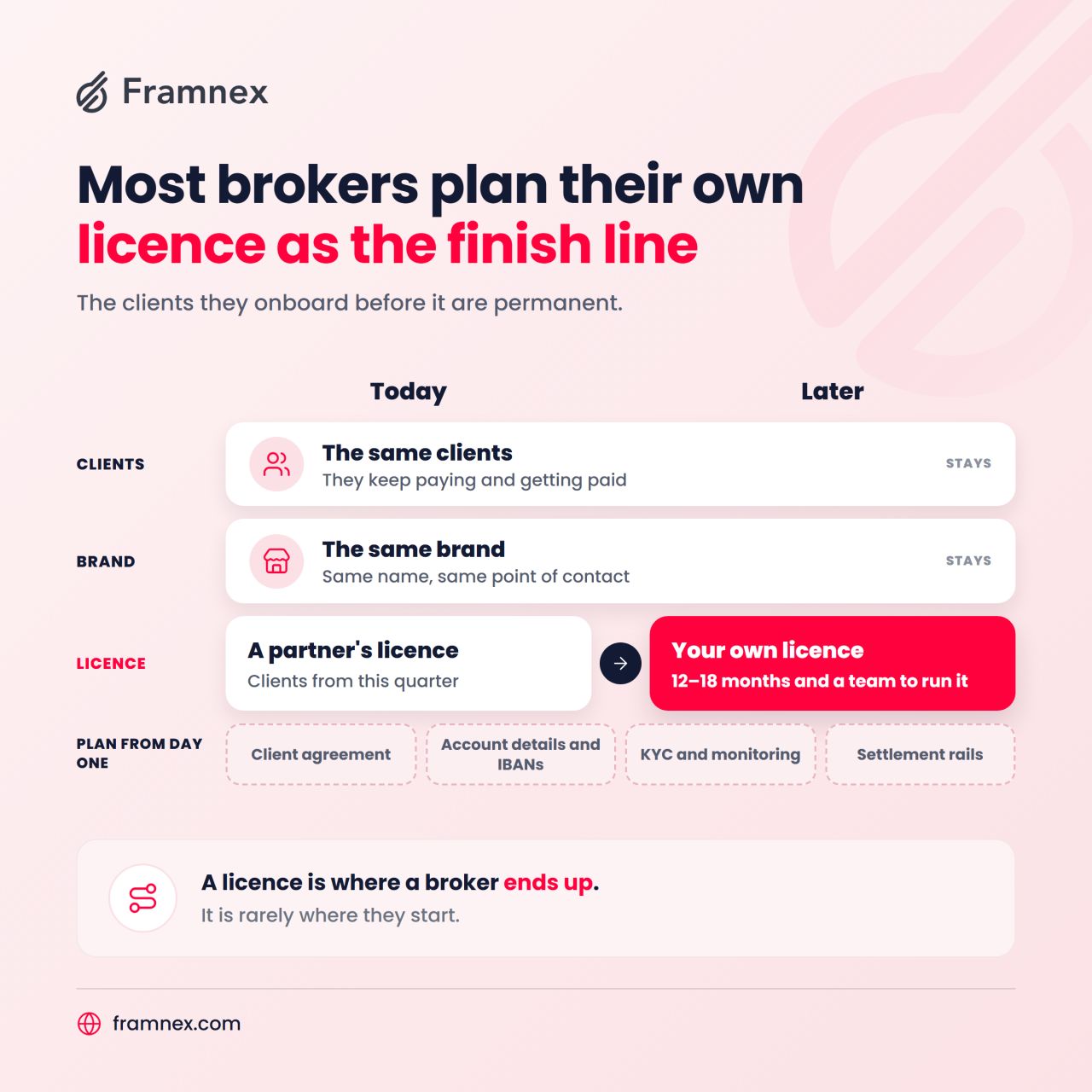
Most brokers plan their own licence as the finish line and treat everything before it as temporary. The clients they onboard in the meantime are permanent. Getting a licence takes twelve to eighteen months and a team to run it. Operating under a partner's licence lets the same business take clients this quarter, under an entity that already holds the permission. Both are real ways to run a firm. Four things move when a firm switches from one to the other: → the client agreement, and whose name the client signs with → the account details and IBANs clients already use to get paid → who owns KYC and monitoring before and after the change → the settlement rails underneath, which can carry across untouched Firms that keep their clients plan the switch from the first day: same account details, same point of contact, the licence changing underneath while the client sees nothing. Firms that lose clients run the switch as a relaunch and ask every customer to onboard again. A licence is rarely where the broker starts. #FintechLicensing #FXBrokers
6 of 67 adsSign up to see every Framnex ad, filter by format and date, and get alerts on new ones.
See all 67 adsWatch the companies you care about.
Filter every ad by industry, country, format and network, and get alerts when a company you watch starts running new ads.