On air · 1 of 3 networks
EngineeringTrainer
- engineeringtrainer.com
- Education
- NL
- 6 employees
EngineeringTrainer’s ads on LinkedIn, Meta and Google, recorded by adsrunning. Browse the latest here for free. Sign up free to see all 35. Watch EngineeringTrainer with Starter to get each new one in your feed.
Watchlist with Starter · $49/mo
| Network | Status | Live ads | Nov 2025LinkedIn activity · 52 weeksOct 2026 | Checked | Next step |
|---|---|---|---|---|---|
| None recorded | 0 | Checked 30 Oct 2026 | See all 35 ads → | ||
| Meta | Not checked | — | |||
| Running | 98 | Ads on the Google Ads Transparency Center | Checked 28 Oct 2026 | Collect them with the API → |
EngineeringTrainer has no live LinkedIn ads. We recorded 98 Google ads on 28 Oct 2026.
Latest ads
- LINKEDIN · IMAGESince 13 Aug 2026
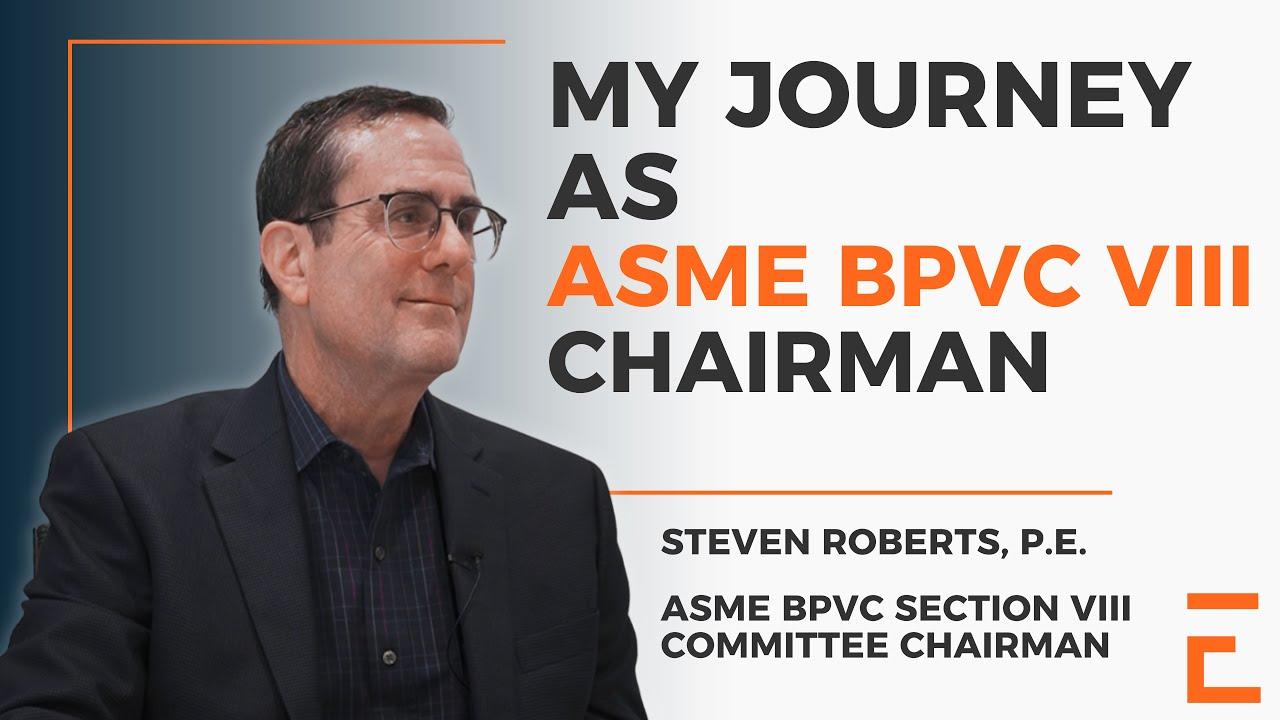
💡 How do you go from a project engineer to Chairman of ASME Section VIII? Continuing the insights from the ASME B31 Code Week in Amsterdam last year, when our CEO, Luuk Hennen, had the privilege of speaking with Steven Roberts, former Chairman of the ASME Boiler and Pressure Vessel Code (BPVC) Section VIII. Steven’s journey is a powerful reminder that the leaders of our industry started exactly where many of us are today. His path to the chairmanship didn't begin with a formal invitation to this position, but with a simple desire to understand the "why" behind the codes he was using as a design engineer and project manager. Key takeaways for your career development: The "Just Show Up" Rule: When Steven asked how much experience or what certification he needed to join a committee, the answer was simple: "Just show up". The committees are looking for engineers with the enthusiasm and desire to contribute. As Steven notes, "We can train you on knowledge, but you’ve got to have the desire". Stand on the Shoulders of Giants: Steven’s growth was accelerated by seeking out mentorship from the "giants" of the industry. Being involved in ASME committees is one of the most effective ways to ensure your technical work is fit for purpose while learning directly from the experts who help define the standards. Watch the full interview with Steven Roberts to hear more about his 25-year journey and the exciting technical developments happening in the pressure vessel space. 📺 Watch the full interview on our YT channel here: https://lnkd.in/eTK3puwX At EngineeringTrainer, we are honored to capture and share this contextual knowledge from industry leaders like Steven and share it with the next generation of engineering specialists. Understanding the journey behind the position helps demystify the path to becoming a technical authority yourself. ASME (The American Society of Mechanical Engineers)
- LINKEDIN · IMAGESince 22 Jul 2026
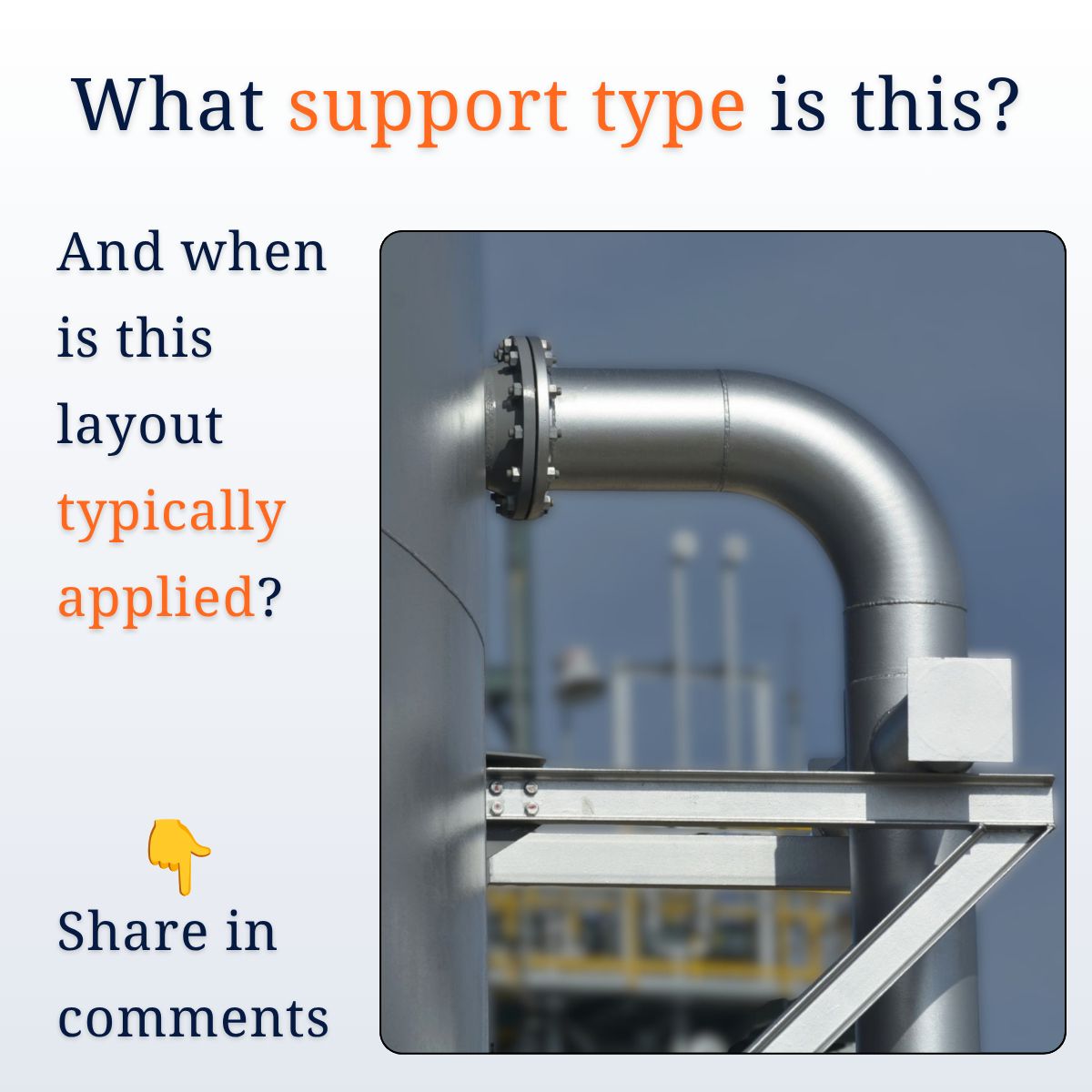
We often see this support arrangement in which the supporting structure is directly connected to the vertical vessel. But when is this arrangement typically used, and what problem is it solving? Share your thoughts in the comments. We’ll comment our insights this Friday, including the key load cases, local-stress considerations and design checks that shouldn’t be overlooked. Like the post so it pops up again when the answer is published! #PipingEngineering #PipeSupports #PipingDesign #StressAnalysis #MechanicalEngineering #PlantEngineering #EngineeringDesign #OilAndGas #Petrochemical #EngineeringTrainer
- LINKEDIN · IMAGESince 7 Jul 2026
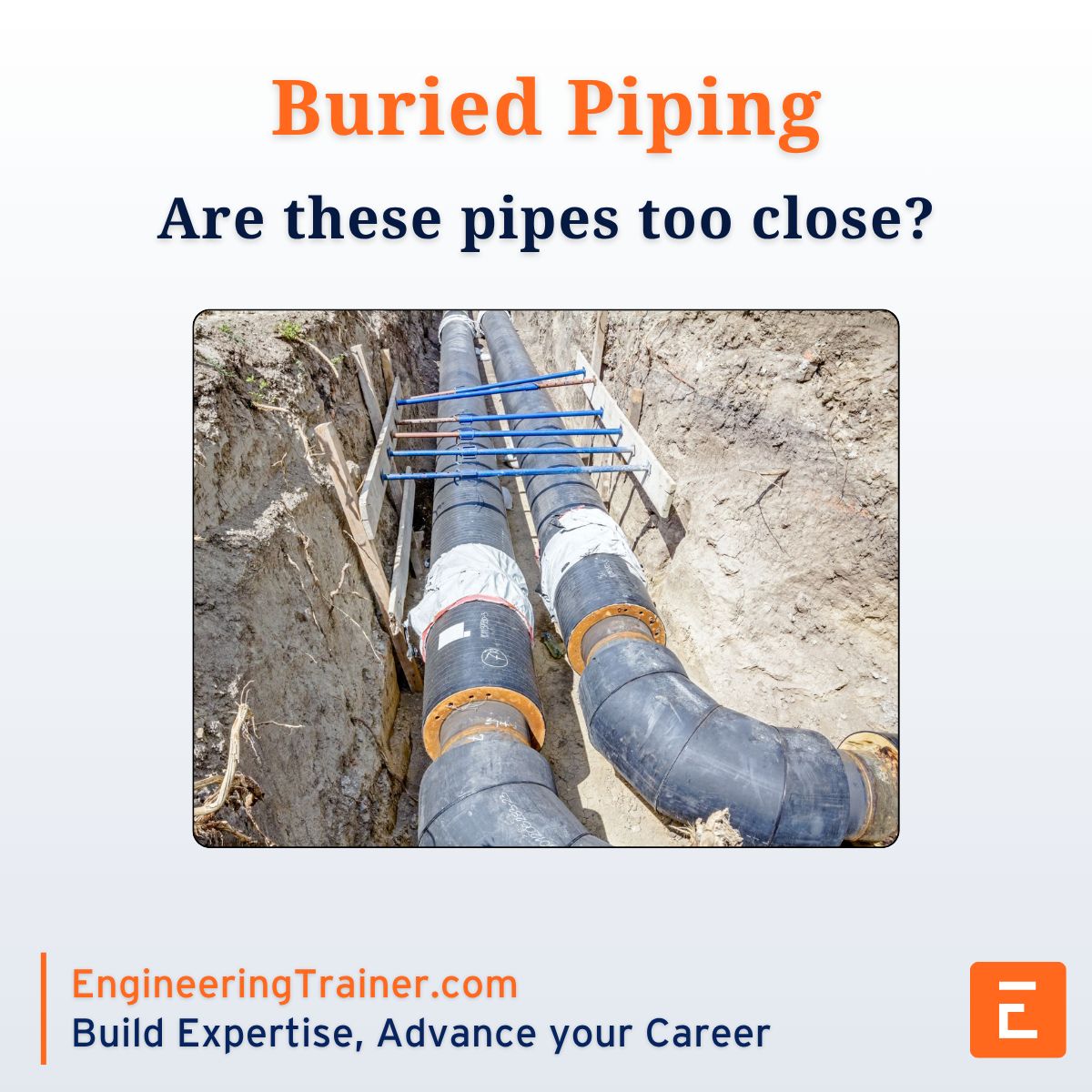
For below-ground piping, system integrity starts with a good understanding of soil mechanics and pipe-soil interaction. This drives important design choices. An example is the minimum distance between buried pipes. This spacing is essential to manage pipe circumferential loads of each individual line and helps create a design that is practical to install, ensures proper backfill, and aligns how the pipe, soil, supports, and surrounding infrastructure work together. A well-considered buried piping layout supports better compaction, clearer access, improved constructability, and more reliable interaction between adjacent lines. This is where buried piping engineering becomes especially interesting. You are not only designing the pipe itself, but also the relationship between the pipe, the soil, the loads, the crossings, the ground entries, and the operating environment. Do your projects involve below-ground piping systems? Build expertise with our advanced course “Buried Piping Engineering using Caesar II”, in collaboration with Dynaflow Research Group. In this course, you will learn the theoretical and practical aspects of buried piping design, including soil mechanics, Caesar II stress analysis, critical failure mechanisms, steel and non-steel piping differences, and practical design details such as thrust blocks, underground supports, road crossings, and ground entries. ⬇️ Learn more here: https://lnkd.in/ey6w_J7u #EngineeringTrainer #BuriedPiping #CAESARII #PipeStressEngineering #PipingDesign #StressAnalysis #PipingEngineering #MechanicalEngineering #ProcessEngineering #IndustrialPiping
- LINKEDIN · IMAGESince 28 Apr 2026
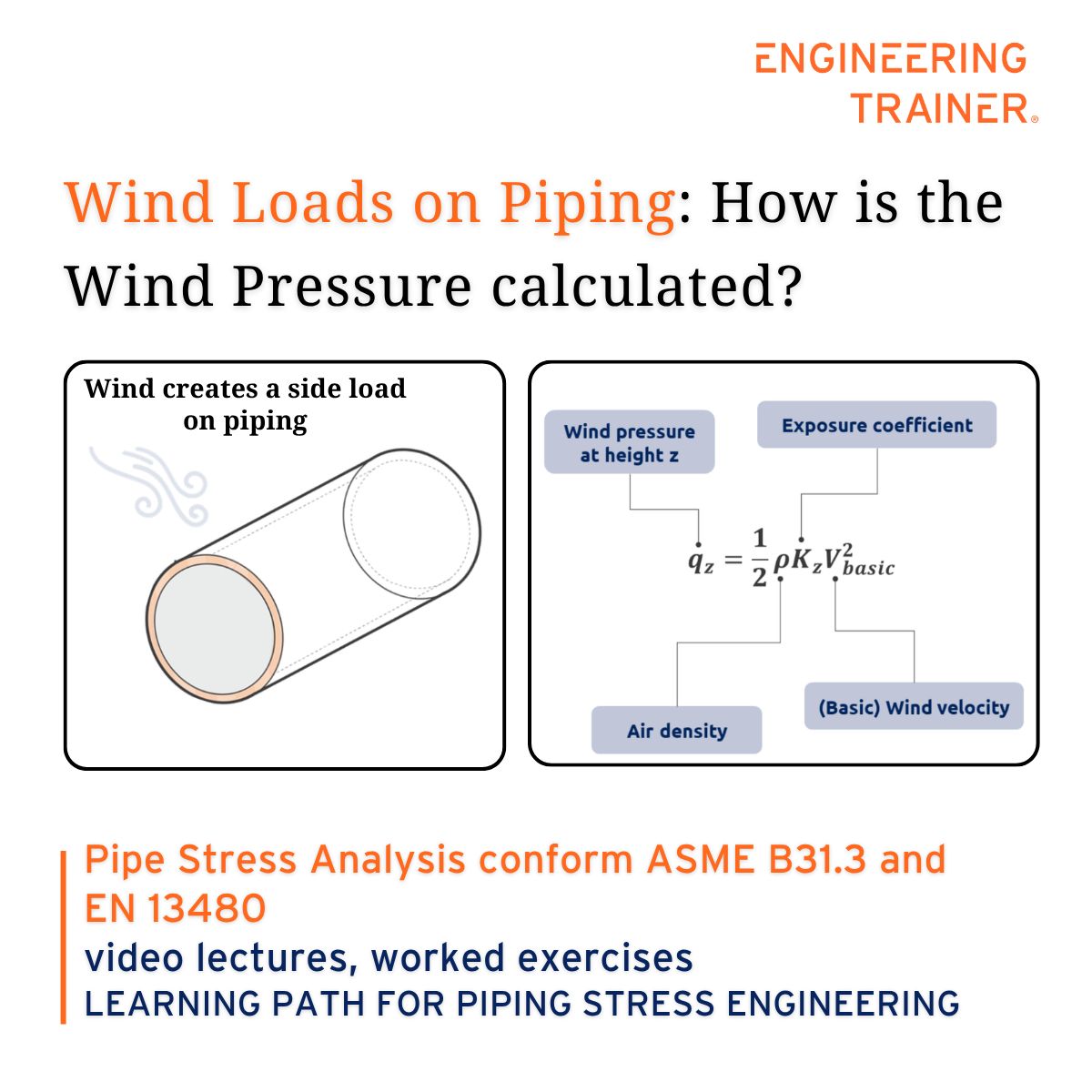
Wind loads are an occasional load case in a pipe stress analysis. How is the wind load calculated, as this is not defined in a piping design code such as ASME B31.3 or EN 13480? The wind load should be taken from a design code specifically covering wind profiles, such as EN 1991-1-4 (Eurocode 1) in Europe. A design code, such as EN 1991-1-4, does not give a wind load per unit on a pipe. Instead, the velocity should be taken from the wind load design code at the height of your piping and converted to a pressure using the formula in the image. This pressure can then be multiplied by the projected area of your pipe to give the wind load. As seen in the formula in the image below, there are various coefficients, which are dependent on the location of your piping. And as always, when using inputs from other design codes, be careful that there is not a double safety factor on top of that in the piping design code. In our comprehensive online self-paced learning path in Pipe Stress Engineering you will be guided through the core principles and practical application of pipe stress analysis and support placement philosophies — from first principles to hand-calculated code checks. ⬇️ Learn more here: https://lnkd.in/eFQKZwD8 #EngineeringTrainer #PipeStressAnalysis #ASMEB313 #EN13480 #PipingEngineering #StressAnalysis #ProcessPlant
- LINKEDIN · IMAGESince 20 Apr 2026
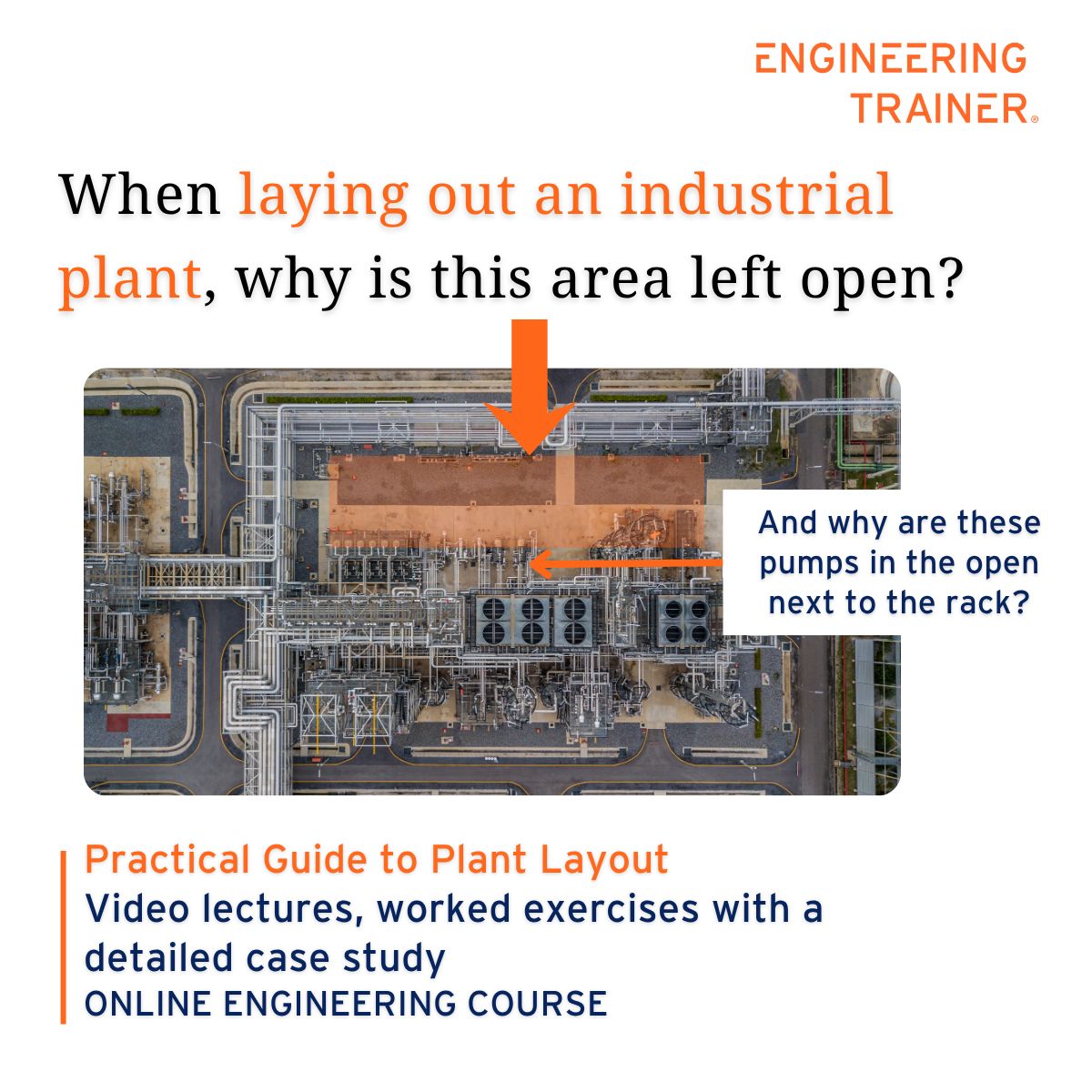
The space is needed on this side of the piping rack to give maintenance access to the pumps on the upper side of the unit and crane access to the coolers located on top of the unit. Another important aspect of plant layout is fire safety, and often, pumps are located outside of the unit, rather than under the piping, as pumps represent a fire risk and thus, in the open air, they pose less of a hazard. Want to learn more about plant layout and the decisions made? Join us for our training course from an experienced piping layout specialist, formerly from Shell. Next to video lectures, the course includes a detailed example to challenge you to lay out your own plant. This course is designed for: ✔ Beginner and intermediate plant layout designers ✔ People involved in plant design and site selection, such as pipe designers ✔ Plant process designers who want to know the impact of their designs on the plant layout ⬇️ Learn more here: https://lnkd.in/eegcEPUq #EngineeringTrainer #PlantLayout #ProcessEngineering #PipingEngineering #EngineeringTraining
- LINKEDIN · IMAGESince 14 Apr 2026
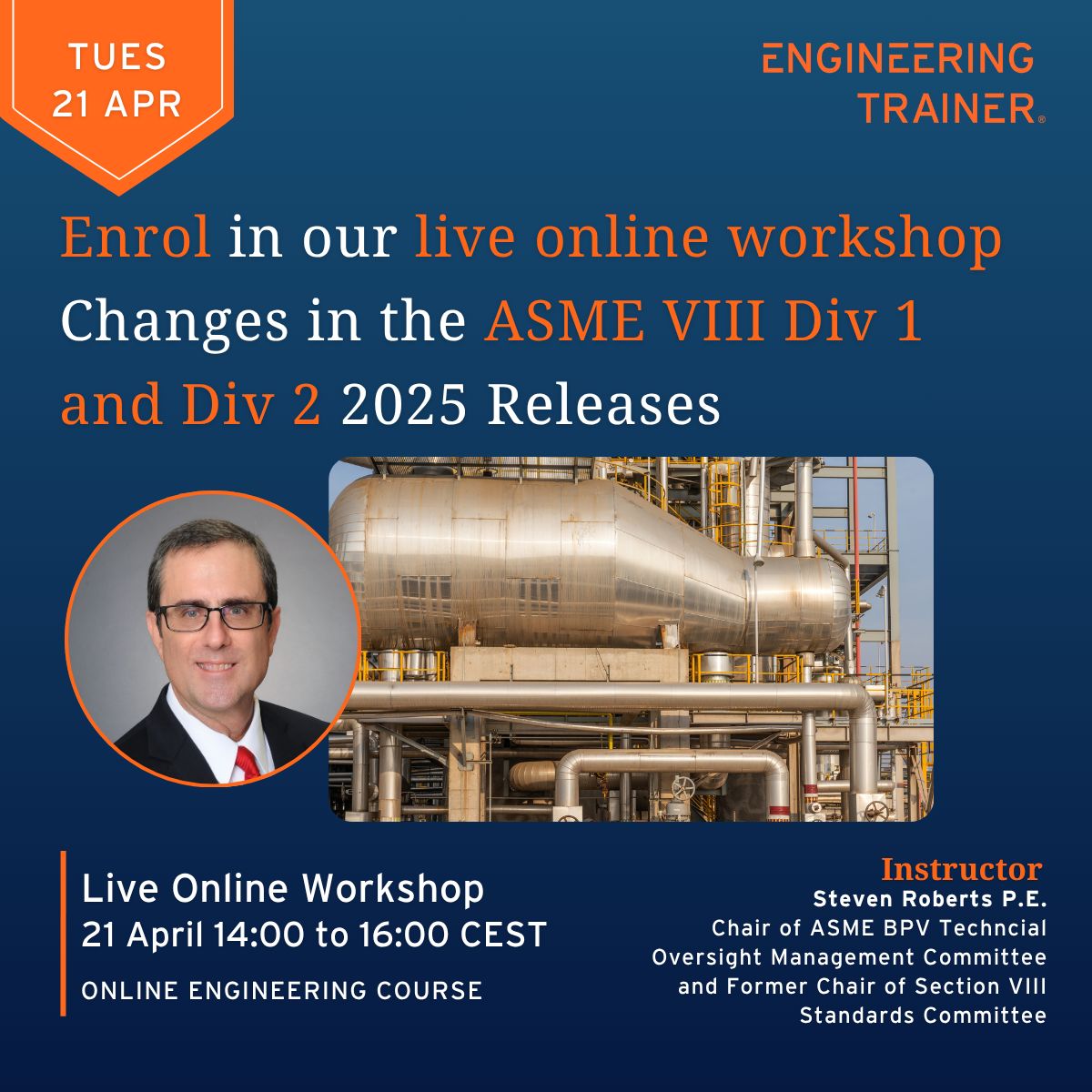
The 2025 update of the ASME VIII pressure vessel design code features key changes compared to the earlier 2023 revision as part of the ongoing ASME VIII “common rules” effort. In this live session, Steven Roberts, chair of the ASME BPV Technical Oversight Management Committee and the past chair of the Section VIII Standards Committee, will take you through these changes. Within this workshop setting, there is also ample opportunity to ask the instructor questions directly. Date: 21 April 2026 Time: 14:00 to 16:00 CET) After this live workshop, you, ✔ know what has changed in the ASME VIII 2025 release as part of the common rules effort ✔ understand how to navigate between Div 1 and Div 2, where this is needed for analytical calculation methods ✔ seen the new workflow for Appendix 2 Flange Design ✔ have seen the updates for Materials, Fabrication, and the new subsection D ✔ know the updates on Pressure Testing ✔ have seen the enhancements made to Overpressure Protection by System Design ✔ are familiar with the updates in Appendices 10, 46, and 47 ✔ understand what has been changed in Part 5 of ASME VIII Div 2 ⬇️ Enrol directly here: https://lnkd.in/eTs-u9pV #EngineeringTrainer #ASME #PressureVessels #MechanicalEngineering #ProcessEngineering
6 of 35 adsSign up to see every EngineeringTrainer ad, filter by format and date, and get alerts on new ones.
See all 35 adsWatch the companies you care about.
Filter every ad by industry, country, format and network, and get alerts when a company you watch starts running new ads.