On air · 2 of 3 networks
Efficient Computer
- efficient.computer
- Hardware & Electronics
- US
- 71 employees
Efficient Computer’s ads on LinkedIn, Meta and Google, recorded by adsrunning. Browse the latest here for free. Sign up free to see all 33. Watch Efficient Computer with Starter to get each new one in your feed.
Watchlist with Starter · $49/mo
| Network | Status | Live ads | Nov 2025LinkedIn activity · 52 weeksOct 2026 | Checked | Next step |
|---|---|---|---|---|---|
| Running | 11 | Checked 30 Oct 2026 | See all 33 ads → | ||
| Meta | Not checked | — | |||
| Running | 9 | Ads on the Google Ads Transparency Center | Checked 28 Oct 2026 | Collect them with the API → |
Efficient Computer has 11 live LinkedIn ads. We recorded 9 Google ads on 28 Oct 2026.
Latest ads
- LINKEDIN · IMAGESince 19 Oct 2026
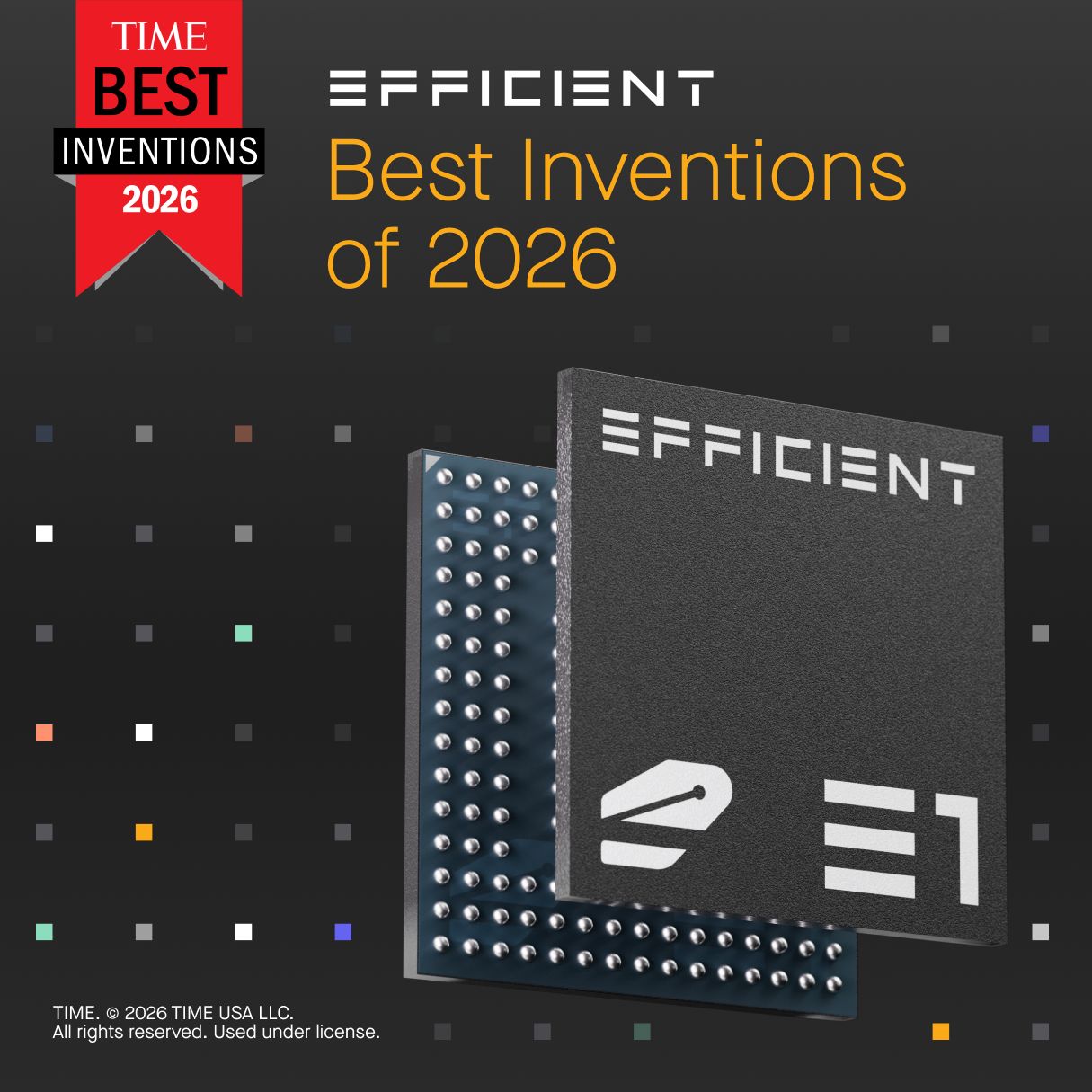
Efficient Computer’s Electron E1 general-purpose processor is one of TIME’s Best Inventions of 2026—and we’re just getting started. The next level of performance. Longer battery life. New possibilities for what you can build. What will you design next? #TIMEBestInventions Read the TIME feature https://lnkd.in/eeHEPRFa
- LINKEDIN · IMAGESince 29 Sept 2026
Today we're announcing our $97 million Series B funding round, bringing our total funding to $173 million. The round is led by TQ Ventures, with participation from Eclipse, Union Square Ventures, Giant Ventures, Triatomic Capital, TO Capital, TF Capital, Mana Ventures, Toyota Ventures, Overmatch, and Borderless. With the Electron E1 general-purpose processor now in volume production, this funding scales the Fabric architecture from physical AI systems to datacenter-class performance, at more than 10x improvement in energy consumption over systems built today. Full story, link below: https://lnkd.in/eTv4cMhT
- LINKEDIN · IMAGESince 23 Sept 2026
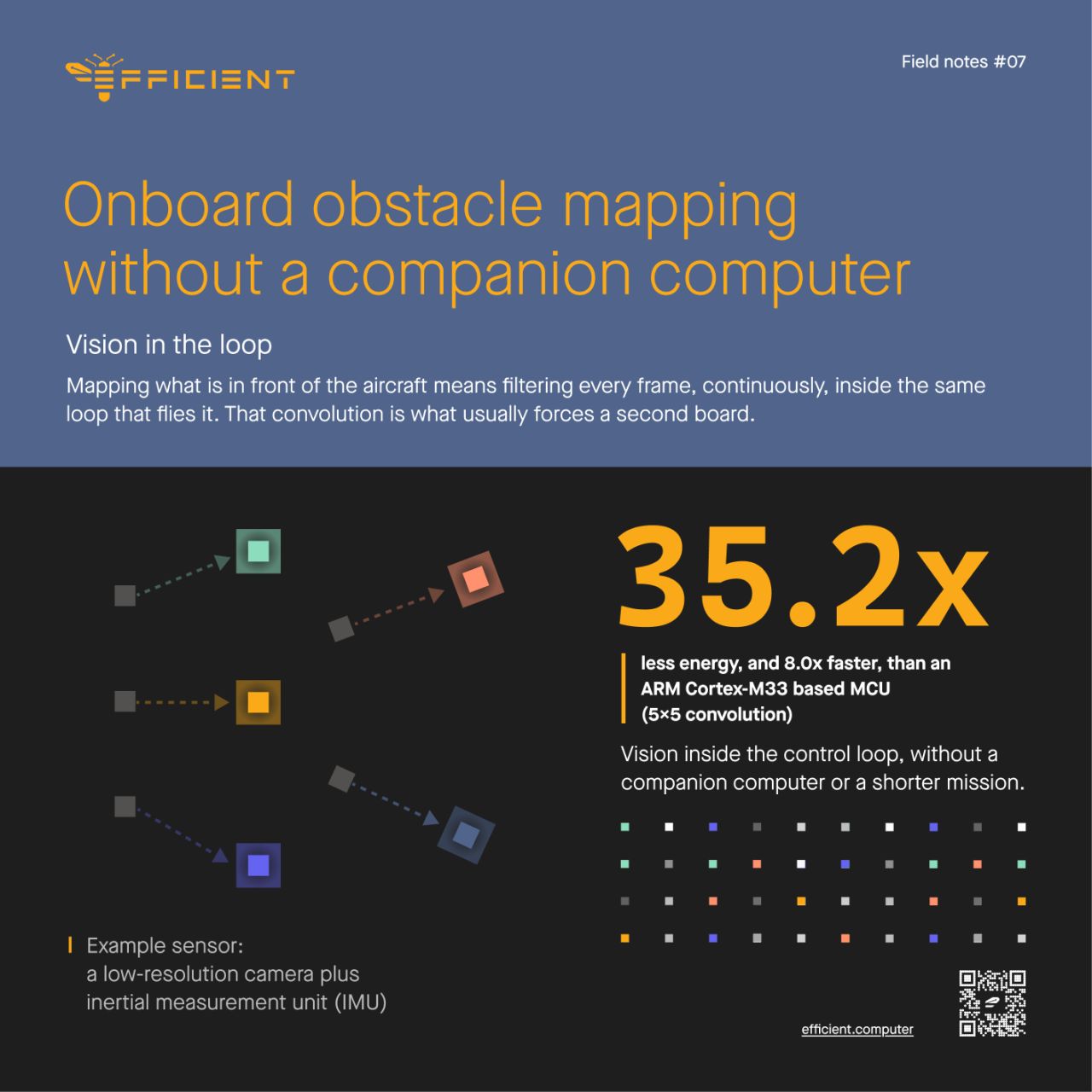
Vision usually gets pulled off the flight controller and onto a companion computer, because convolving every frame, continuously, costs more than the airframe can spare. That second board bills the platform twice: once in watts, once in the grams it takes to carry. We measured the convolution itself. On Electron E1x, the evaluation silicon of the Electron E1 general-purpose processor, a 5x5 convolution runs at 35.2x lower energy and 8.0x faster than on an ARM Cortex-M33 based MCU. Standard C, compiled with the effcc Compiler onto the Fabric architecture. No vendor kernel library, no operator allowlist. This is one kernel measured honestly, not a full perception stack or a flight-time claim. What it supports is narrower: mapping stops being the reason for a second board. #FabricArchitecture #Autonomy
- LINKEDIN · IMAGESince 9 Sept 2026
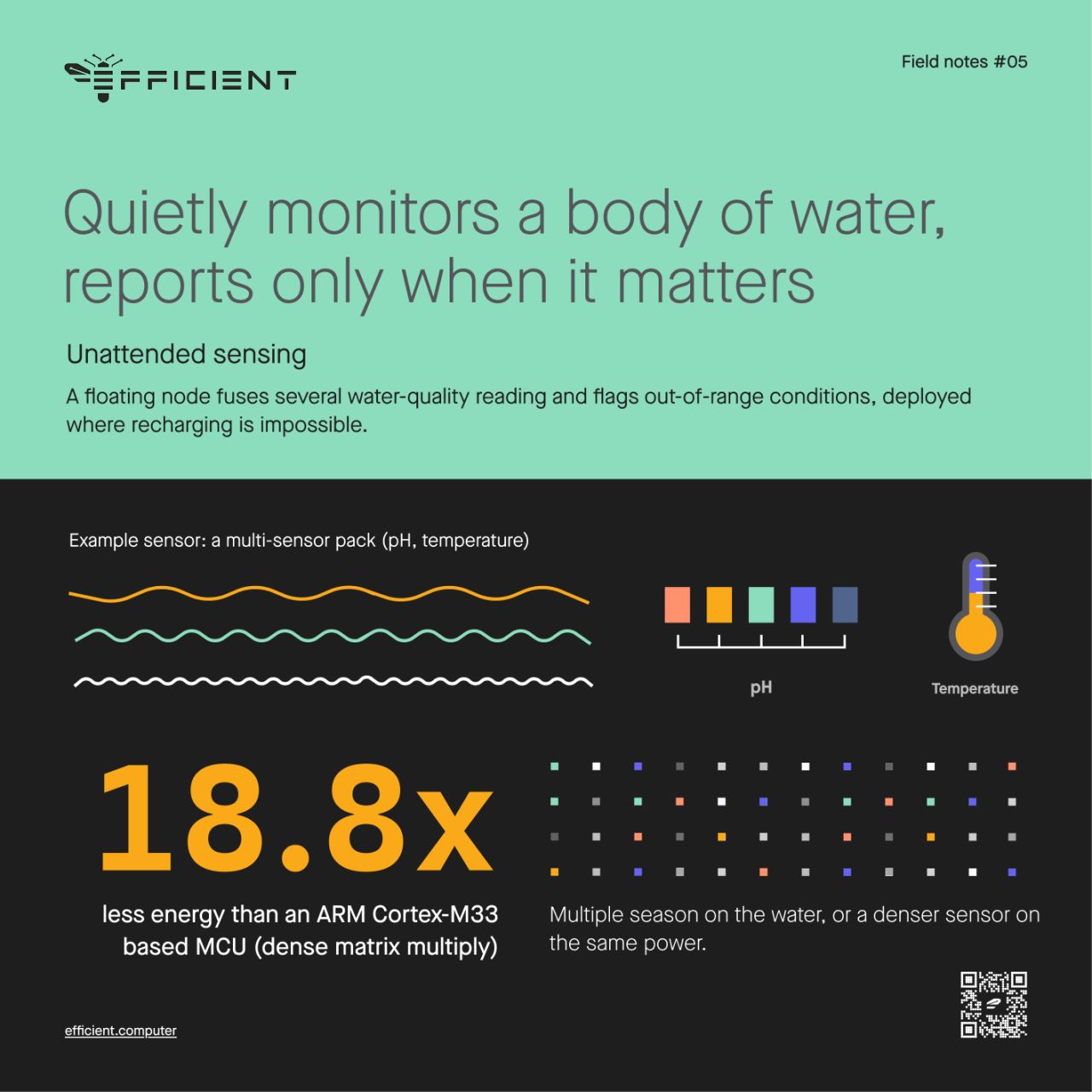
One buoy in the middle of a reservoir tells you the reservoir has a problem. Twenty tell you where. Density is the whole game in water monitoring, and density is limited by what each node costs to keep alive. A floating node that fuses pH and temperature readings into an out-of-range call on the water is doing real work every cycle, deployed somewhere recharging is impossible, and that fusion is where its power goes. On the Electron E1 general-purpose processor, the dense matrix multiply behind that fusion runs at 18.8x less energy than on an ARM Cortex-M33 based MCU. Hand-optimized Electron E1 variant against the competitor's best measured result, kernel region. Take that as multiple seasons on the water instead of one, or as a denser sensor network on the same power. Either way the radio carries conclusions instead of raw readings. https://lnkd.in/giZpnXRg #waterquality #environmentalmonitoring
- LINKEDIN · IMAGESince 9 Sept 2026
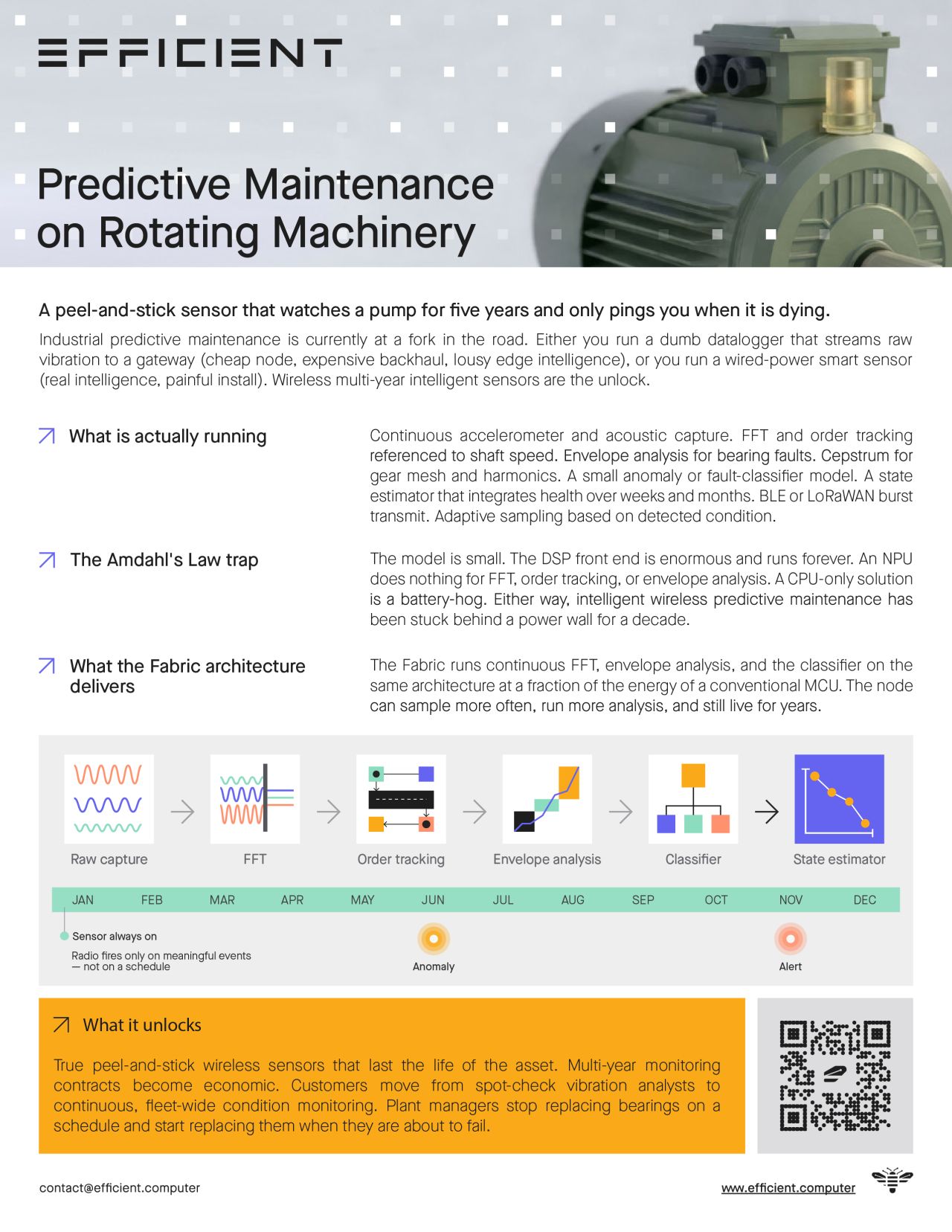
A peel-and-stick sensor that watches a pump for five years and only pings you when it is dying. Predictive maintenance has been stuck at a fork: dumb dataloggers with lousy edge intelligence, or wired smart sensors with a painful install. The problem is what actually has to run on that node: continuous FFT, order tracking, envelope analysis, and a classifier, all day, every day. An NPU does nothing for that workload, and a CPU-only solution is a battery-hog. The Fabric architecture changes that math, running FFT, envelope analysis, and classification at a fraction of the energy of a conventional MCU. The node can sample more, analyze more, and still last for years. That's what finally makes true peel-and-stick wireless sensors possible, and lets plant managers replace bearings when they're about to fail instead of on a schedule. https://lnkd.in/giZpnXRg #EdgeComputing #EnergyEfficiency
- LINKEDIN · IMAGESince 2 Sept 2026
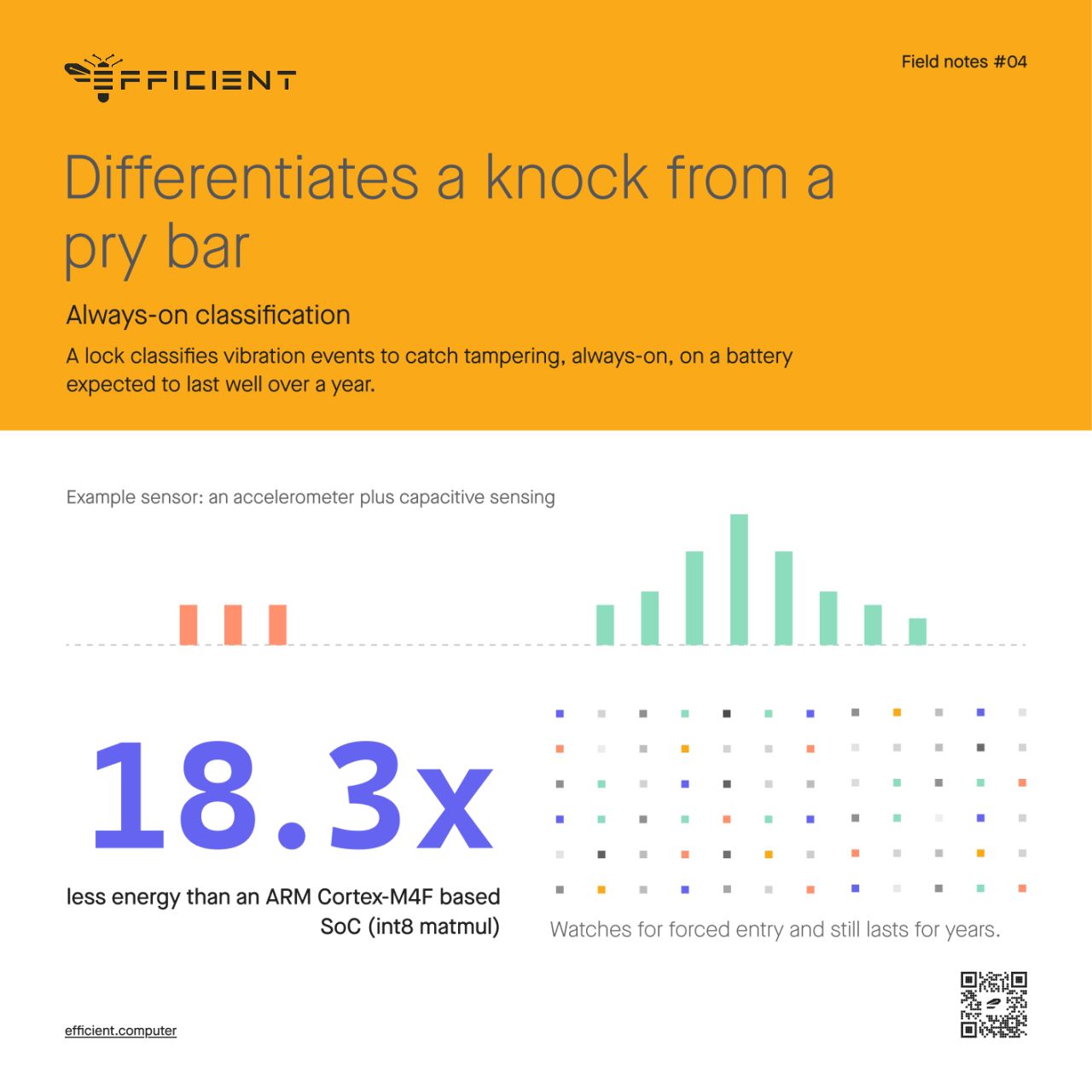
Every smart lock ships with a battery-life number on the box, and every feature added after that number is fixed has to be paid for out of it. Tamper detection is usually the feature that loses. Differentiating a knock from a pry bar means classifying vibration events continuously, not waking on a threshold and hoping. That classifier is small, but it never stops, so it is the part of the design that argues with the number on the box. On the Electron E1 general-purpose processor, the int8 matrix multiply behind it runs at 18.3x less energy than on an ARM Cortex-M4F based SoC. Watches for forced entry and still lasts for years. That is the whole argument for running the always-on tier on a processor built for energy efficiency. https://lnkd.in/giZpnXRg

6 of 33 adsSign up to see every Efficient Computer ad, filter by format and date, and get alerts on new ones.
See all 33 adsWatch the companies you care about.
Filter every ad by industry, country, format and network, and get alerts when a company you watch starts running new ads.