On air · 2 of 3 networks
Edumine
- edumine.com
- Education
- CA
- 8 employees
Edumine’s ads on LinkedIn, Meta and Google, recorded by adsrunning. Browse the latest here for free. Sign up free to see all 25. Watch Edumine with Starter to get each new one in your feed.
Watchlist with Starter · $49/mo
| Network | Status | Live ads | Nov 2025LinkedIn activity · 52 weeksOct 2026 | Checked | Next step |
|---|---|---|---|---|---|
| Running | 6 | Checked 30 Oct 2026 | See all 25 ads → | ||
| Meta | None recorded | 0 | No active ads recorded on the Meta Ad Library | Checked 20 Oct 2026 | Collect them with the API → |
| Running | 21 | Ads on the Google Ads Transparency Center | Checked 28 Oct 2026 | Collect them with the API → |
Edumine has 6 live LinkedIn ads. Its Facebook page had no active ads on 20 Oct 2026, and we recorded 21 Google ads on 28 Oct 2026.
Latest ads
- LINKEDIN · CAROUSELSince 6 May 2026
The Academy for Metallurgists Gives mining companies a structured 24-course pathway: from comminution to economics. The content is industry-specific, the delivery is self-paced, and you get monthly reporting on usage and completion.
- LINKEDIN · CAROUSELSince 5 May 2026
The Academy for Metallurgists is a structured 24-course pathway across the full mineral processing flowsheet, running from Tier 1 to Tier 4 and designed for teams rather than individuals. The content is industry-specific, the delivery is self-paced around production schedules, and you get monthly reporting on usage and completion.
- LINKEDIN · CAROUSELSince 5 May 2026
The Academy for Metallurgists is a structured 24-course pathway across the full mineral processing flowsheet: comminution, flotation, hydrometallurgy, process mineralogy, and project economics.
- LINKEDIN · CAROUSELSince 5 May 2026
The Academy for Metallurgists is designed for teams where half the metallurgists came up through chemical, mechanical, or process engineering rather than mineral processing. It is a structured 24-course pathway covering comminution, grinding, flotation, hydrometallurgy, process mineralogy, and project economics, organised across four tiers from foundational knowledge through to senior judgement. The content is industry-specific, the delivery is self-paced, and you get monthly reporting on usage and completion. See if it fits your team.
- LINKEDIN · VIDEOSince 5 May 2026
Half the metallurgists running mining plants were never formally trained in mineral processing. Chemical, mechanical, and process engineers fill the gap every day, and they're learning the plant the slow way. The Academy for Metallurgists is a structured 24-course pathway across the full mineral processing flowsheet: comminution, flotation, hydrometallurgy, process mineralogy, and project economics. Designed for teams.
- LINKEDIN · IMAGESince 30 Mar 2026
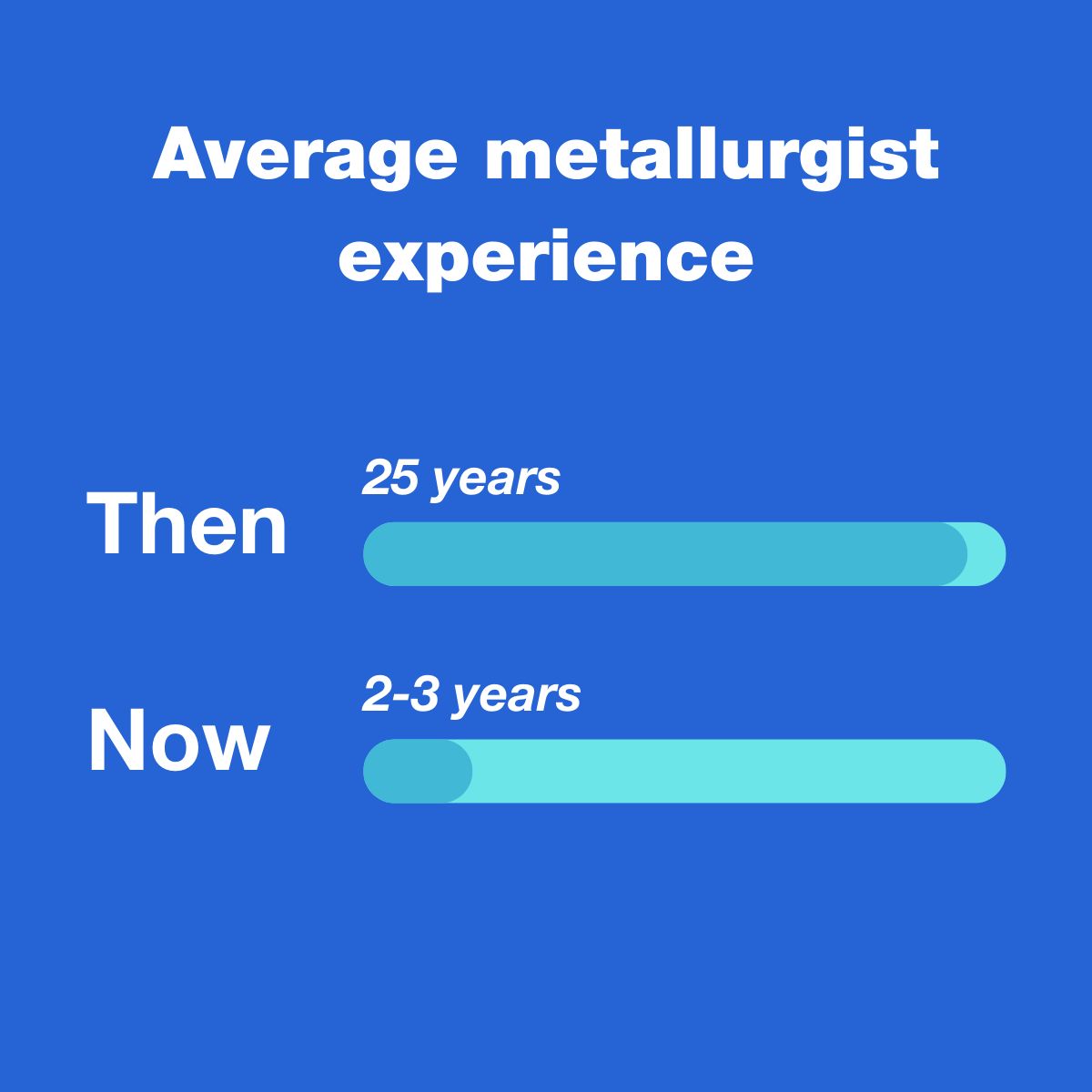
Half of metallurgical engineers lack formal education. They are chemical engineers, mechanical engineers, professionals from other disciplines who were asked to become plant metallurgists with no foundational knowledge of plant metallurgy. This is not a reflection of their capability. It reflects where the industry stands. There are not enough graduates from mining programs, so companies hire talented engineers from adjacent fields and assume they will develop on the job. The assumption made sense when the workforce could support it. If you are leading technical services at a mining company, you know that some operations carried 20 to 25 years of average experience across the workforce. Flotation operators who understood every behavior of the circuit. Supervisors promoted from the hourly ranks who had operated every piece of equipment in the plant. A young engineer without a mineral processing background could learn through proximity. There were experienced people everywhere able to teach. That environment no longer exists at most operations. Today there are sites where the average workforce experience is two or three years. Supervisors have come in from other departments and have never operated the plant. Meanwhile, equipment is aging, ore grades are declining, and the margin for inefficiency is shrinking. A concentrator built in 1940 running lower-grade ore than it was designed for requires more skill to operate profitably, not less. The people being asked to run it have less experience than at any point in the past three decades. One gap rarely discussed is the disconnect between plant performance and economic performance. Many young metallurgists underestimate the value of incremental recovery. When operating cost is two to three dollars per pound of copper, an additional pound recovered through flotation optimization does not carry the full cost of mining and milling again. The incremental cost is usually limited to extra processing, reagents, and downstream treatment, making that pound some of the highest-margin metal in the entire operation. Engineers who understand this optimize differently, because they understand the economics, not just the metallurgy. Structured professional development is how organizations close these gaps when organic mentorship is no longer sufficient. Engineers need a common technical baseline in comminution, flotation, hydrometallurgy, and process mineralogy before they can build the judgment that comes with experience. Without that baseline, experience accumulates slowly and unevenly. We recently published a skills survey that quantifies much of what I am describing here. For anyone managing a technical services group and recognizing these patterns, it is worth reviewing. https://lnkd.in/gzpVrwV2
6 of 25 adsSign up to see every Edumine ad, filter by format and date, and get alerts on new ones.
See all 25 adsWatch the companies you care about.
Filter every ad by industry, country, format and network, and get alerts when a company you watch starts running new ads.