On air · 2 of 3 networks
DNA Genotek
- dnagenotek.com
- Healthcare & Life Sciences
- CA
- 116 employees
DNA Genotek’s ads on LinkedIn, Meta and Google, recorded by adsrunning. Browse the latest here for free. Sign up free to see all 60. Watch DNA Genotek with Starter to get each new one in your feed.
Watchlist with Starter · $49/mo
| Network | Status | Live ads | Nov 2025LinkedIn activity · 52 weeksOct 2026 | Checked | Next step |
|---|---|---|---|---|---|
| Running | 32 | Checked 30 Oct 2026 | See all 60 ads → | ||
| Meta | Not checked | — | |||
| Running | 30 | Ads on the Google Ads Transparency Center | Checked 27 Oct 2026 | Collect them with the API → |
DNA Genotek has 32 live LinkedIn ads. We recorded 30 Google ads on 27 Oct 2026.
Latest ads
- LINKEDIN · IMAGESince 22 Oct 2026
What makes a drug target worth pursuing? Human genetics is increasingly part of the answer. A new Nature Genetics study analyzed exomes from 44,028 British Pakistani and Bangladeshi participants, uncovering 100+ novel gene-phenotype associations and nearly 3,000 human knockout genes. One finding stands out for drug developers: drugs targeting genes with knockouts in adults were associated with a 2.2x higher likelihood of progressing beyond Phase 1 clinical trials. Built on saliva samples using the Oragene™ collection kits, this resource highlights how scalable, participant-friendly sampling can generate the diverse datasets needed to inform target selection. At DNA Genotek, we're proud to support research that advances our understanding of human genetics and helps inform drug discovery and development. Read the study: https://lnkd.in/eAuXxq6R #HumanGenetics #DrugDiscovery #TargetValidation #Genomics #PrecisionMedicine
- LINKEDIN · IMAGESince 16 Oct 2026
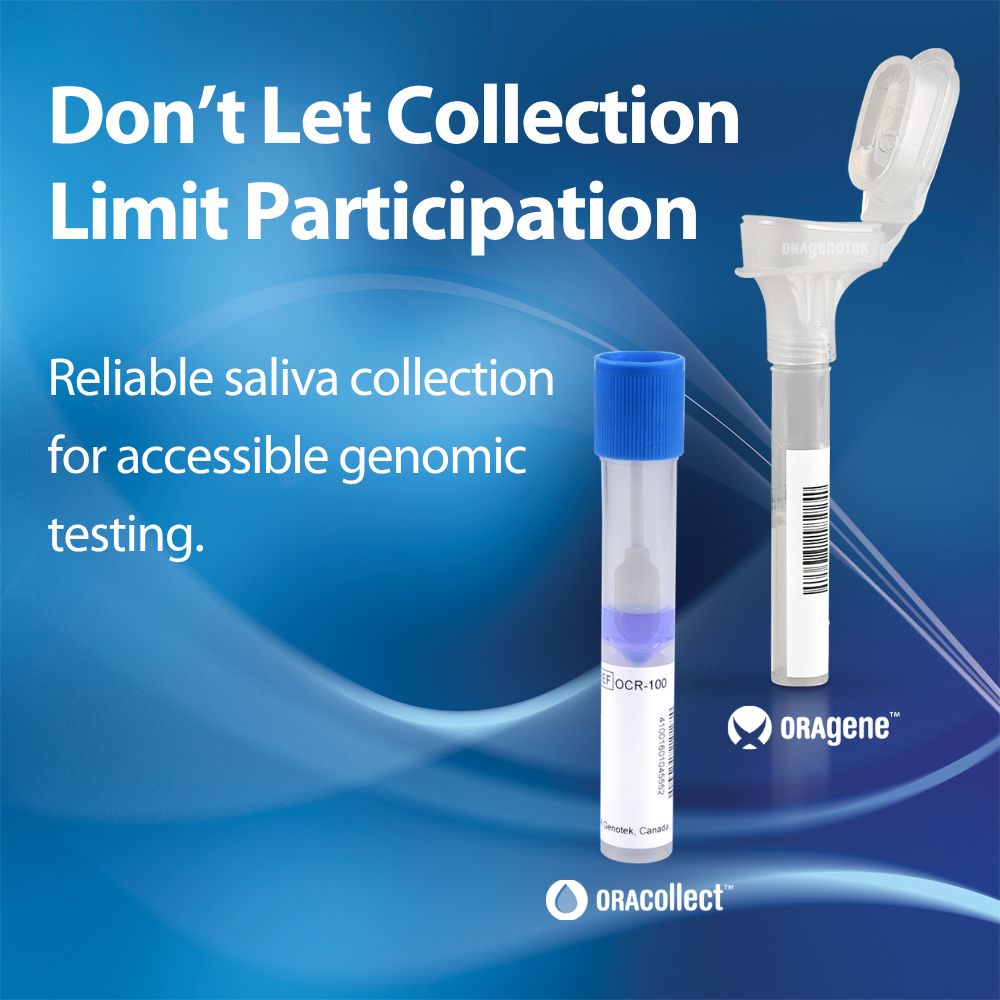
Can saliva-based genomic research help uncover new therapeutic targets for youth mental health? The Genetic Architecture of Youth Anxiety (GAYA) study aims to recruit 13,000 Canadian youth across clinical and community settings to better understand the genetic factors underlying anxiety disorders. Researchers hope the findings will help inform early intervention strategies, support precision medicine approaches, and identify novel targets for future therapeutics. To support recruitment of Canadian youth, participants can provide DNA samples using the Oragene™ or ORAcollect™ saliva collection devices, either at study sites or through at-home collection kits. The study's decentralized approach shows how non-invasive, self-collection methods can help support participation in large-scale genomic research while reducing logistical barriers. ► Explore the eBook to see how researchers are using saliva collection to support genomic studies at scale. https://bit.ly/4ymnYbQ McAusland L, et al. The genetic architecture of youth anxiety: a study protocol. BMC Psychiatry. 2024;24:159. #Genomics #PrecisionMedicine #PsychiatricGenetics
- LINKEDIN · VIDEOSince 21 Sept 2026
Can a saliva sample help change the endometriosis diagnostic journey? Endometriosis affects an estimated 190 million women worldwide, yet diagnosis still takes an average of 7 years. In this webinar, Andrew Spiers, M.D. explores the science behind non-invasive, saliva-based diagnostics and the role of microRNA (miRNA) plays in early endometriosis detection. His presentation covers the ENDO-miRNA research programme, the development of a 109-miRNA signature using next-generation sequencing and machine learning, and the role of standardized saliva collection in the study workflow. Learn how our saliva collection devices enabled at-home saliva collection while preserving RNA integrity for downstream analysis in this important study. Listen to the presentation: https://bit.ly/4cH9U4W #Endometriosis #WomensHealth #miRNA #MolecularDiagnostics #SalivaDiagnostics Bendifallah S, Suisse S, Puchar A, et al. Salivary MicroRNA Signature for Diagnosis of Endometriosis. J Clin Med. 2022;11(3):612. doi:10.3390/jcm11030612.
- LINKEDIN · IMAGESince 26 Aug 2026
Genetic research starts with participation. In a study exploring attitudes toward psychiatric genetic testing among Black/African American mothers at risk for depression, researchers used the Oragene™ saliva collection kits as part of the study design. Most participants indicated a willingness to participate in genetic testing, highlighting the importance of accessible, participant-friendly approaches to research. As genomics expands into more diverse populations, making participation easier remains a critical part of advancing research. Explore our research review eBook to see how saliva is being used across ancestry research, disease risk assessment, population genetics, epigenetics, sequencing applications, and more→ https://bit.ly/4w6LgRX #Genomics #MolecularDiagnostics #GeneticTesting #ClinicalGenomics #HealthDisparities Atkins R, Kelly T-A, Johnson S, et al. Eliciting Willingness and Beliefs towards Participation in Genetic Psychiatric Testing in Black/African American Mothers at Risk for Depression. Behavioral Sciences. 2020;10(12):181.
- LINKEDIN · IMAGESince 20 Aug 2026
Can genetic risk assessment scale beyond the clinic? The GRADE study, evaluating polygenic risk scores for glaucoma and age-related macular degeneration (AMD), allowed participants to provide either saliva collected using the Oragene™ collection kits or blood samples for genomic analysis. As population-scale genetic testing grows, participant-friendly collection methods can help simplify study logistics while supporting DNA collection for genotyping. Explore our research review eBook to see how saliva is being used across disease risk assessment, ancestry research, population genetics, and more → https://bit.ly/4xtDH9g #Genomics #PolygenicRiskScores #MolecularDiagnostics #GeneticTesting Hollitt GL et al. Genetic Risk Assessment of Degenerative Eye Disease (GRADE): study protocol of a prospective assessment of polygenic risk scores to predict diagnosis of glaucoma and age-related macular degeneration. BMC Ophthalmology (2023).
- LINKEDIN · IMAGESince 11 Aug 2026
When samples travel farther than ever, can your collection process keep up? A 2023 study exploring the genetic history of the Southern Andes generated genomic data from 64 Mapuche participants across Southern Chile using saliva collected in the Oragene™ devices. Researchers were able to study the ancestry of one of South America's largest Indigenous populations using decentralized saliva collection across geographically distributed communities. For population genomics and ancestry research, collection logistics can be just as important as sequencing performance. Saliva collection offers a minimally-invasive approach that can help researchers reach geographically distributed participants while simplifying sample transport and storage. Genomics doesn't always happen near a clinic. Explore how saliva is being used across ancestry testing, population genetics, disease risk assessment and more in our Research Review eBook→ https://bit.ly/3TDyg8Z #Genomics #PopulationGenomics #Biobanking #SampleCollection #NGS Arango-Isaza E, Capodiferro M, Aninao M The genetic history of the Southern Andes from present-day Mapuche ancestry, Current Biology, 2023; 33, 2602-2615.e5.




6 of 60 adsSign up to see every DNA Genotek ad, filter by format and date, and get alerts on new ones.
See all 60 adsWatch the companies you care about.
Filter every ad by industry, country, format and network, and get alerts when a company you watch starts running new ads.