On air · 1 of 3 networks
DistillerSR
- distillersr.com
- Healthcare & Life Sciences
- CA
- 83 employees
DistillerSR’s ads on LinkedIn, Meta and Google, recorded by adsrunning. Browse the latest here for free. Sign up free to see all 93. Watch DistillerSR with Starter to get each new one in your feed.
Watchlist with Starter · $49/mo
| Network | Status | Live ads | Nov 2025LinkedIn activity · 52 weeksOct 2026 | Checked | Next step |
|---|---|---|---|---|---|
| Running | 13 | Checked 28 Oct 2026 | See all 93 ads → | ||
| Meta | Not checked | — | |||
| None recorded | 0 | No ads found on the Google Ads Transparency Center | Checked 28 Oct 2026 | Collect them with the API → |
DistillerSR has 13 live LinkedIn ads. We recorded no Google ads on 28 Oct 2026.
Latest ads
- LINKEDIN · IMAGESince 28 Oct 2026
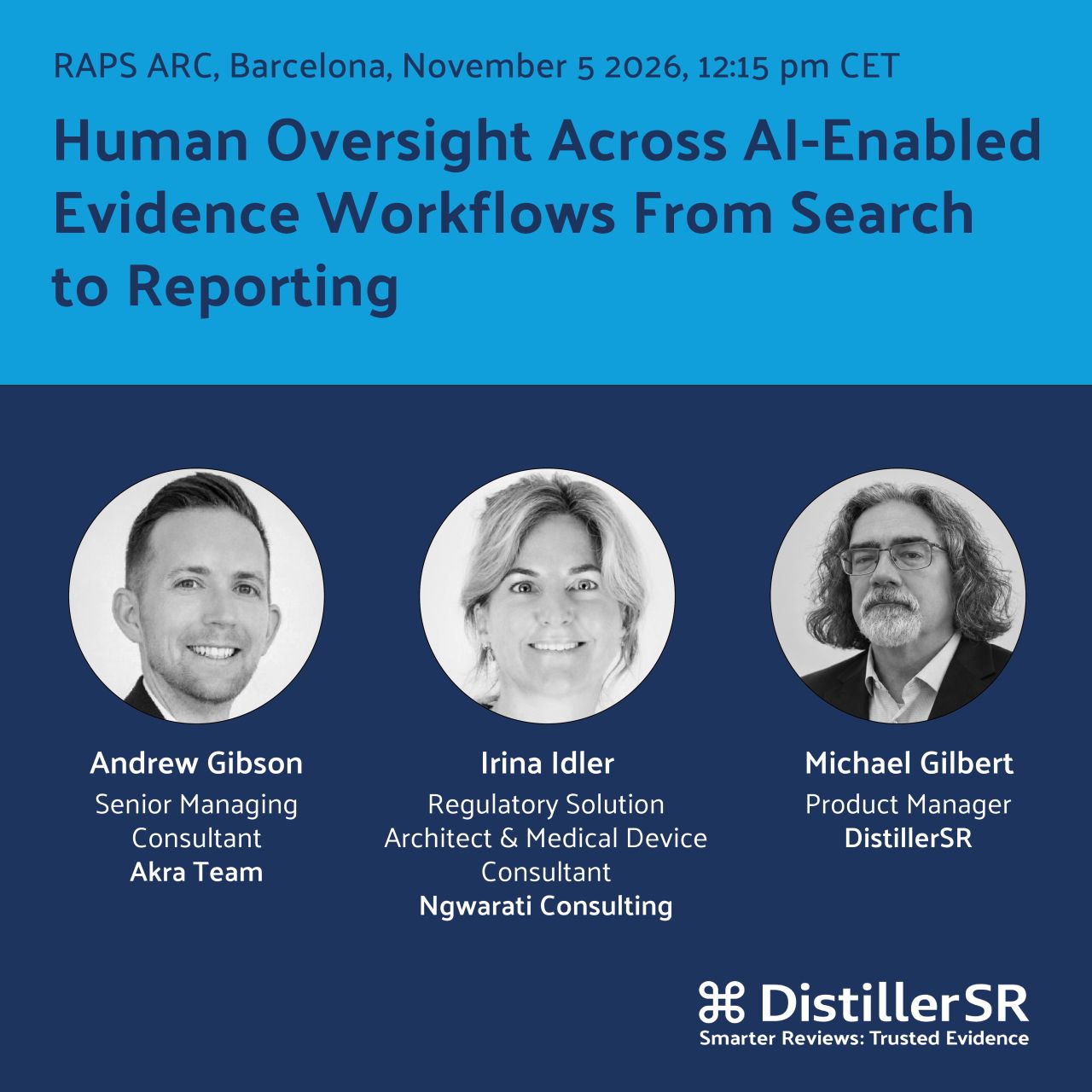
If validating AI output takes as long as doing the work by hand, the case for using AI loses relevance. That tension is at the center of our session at Regulatory Affairs Professionals Society (RAPS) AI in Regulatory Conference. Michael Gilbert will examine where human review adds the most value in an AI-enabled evidence workflow, and how to verify AI-extracted evidence against source documents so it stays traceable and defensible through to the final report. The discussion draws on findings from the AIDESL consortium, led by DistillerSR, an ITEA 4 research project benchmarking autonomous AI data extraction from scientific literature. Thank you Tom Kokhuis from Philips for contributing with your test results. Speakers: Dr. Irina Idler, M.Sc., Regulatory Solution Architect & Medical Device Consultant, Ngwarati Consulting Michael Gilbert, Product Manager, DistillerSR Andrew Gibson, PhD, RAC, Senior Managing Consultant, AKRA TEAM Our session, “Human Oversight Across AI-Enabled Evidence Workflows From Search to Reporting,” takes place on Thursday, November 5, from 12:15 to 13:15 CET at Glories BC. Attending ARC? Book time with our team to continue the conversation: https://lnkd.in/e-uiGxzH #RAPS #RAPSARC #AIinRegulatoryConference #RegulatoryAffairs #ClinicalEvaluation #EvidenceSynthesis
- LINKEDIN · IMAGESince 27 Oct 2026
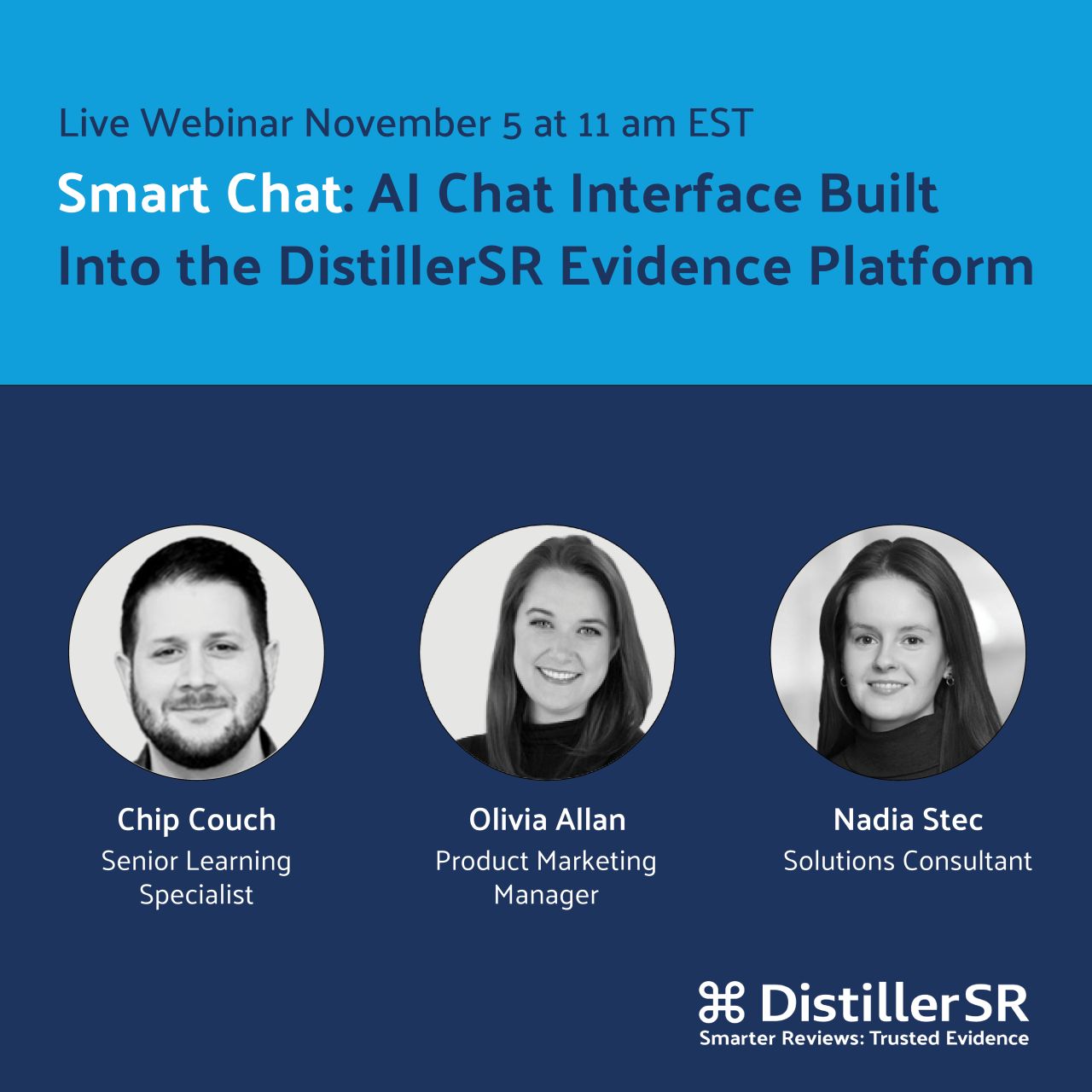
Talk to your evidence. Trust the answer. Today we launched Smart Chat, an AI chat interface built into DistillerSR. Ask a question in plain language and get an answer drawn only from your own projects. Smart Chat brings DistillerSR’s Agentic AI capabilities in-platform. Since September 2025, DistillerSR Agentic AI has eliminated evidence silos at customer organizations by connecting Large Language Models to a repository of expertly validated literature evidence. Smart Chat now makes that same capability available natively within DistillerSR’s secure platform. “Many don’t have the support, access or security needed to connect a corporate LLM to their research data,” said Peter O'Blenis, CEO of DistillerSR. “Smart Chat removes that barrier.” Five things you need to know about Smart Chat: 1️⃣ Grounded in Your Own Data: Smart Chat works only with the data in your DistillerSR projects. It can’t browse the web or pull from outside sources, which dramatically reduces the risk of hallucination. Customer data is never used to train AI models. 2️⃣ Interrogate Your Evidence: Ask questions, summarize findings and compare extracted data across projects. 3️⃣ Draft Reports and Other Outputs: Generate summaries of findings, regulatory submission sections, tables and formatted content for your experts to review and finalize. 4️⃣ Configure Protocols and Workflows: Build and edit forms, add questions across many projects, and manage reference metadata and labels. 5️⃣ Governed and Auditable: Every action follows your existing DistillerSR roles and permissions and is fully auditable. There’s no integration to build and no separate LLM license to buy. Smart Chat is available now and included with all versions of DistillerSR. With Smart Screening and Smart Evidence Extraction (SEE), teams can screen and extract their evidence, and now converse with it, with experts in the loop at every step. Learn more: https://lnkd.in/e39Bn3xp Want to see Smart Chat in action? Join us for a live demo on Thursday, November 5, 2026 at 11:00 AM EST. Register now: https://lnkd.in/eP2UcsMv
- LINKEDIN · IMAGESince 27 Oct 2026
Validated evidence delivers more value when more of your organization can use it. Join us on November 5th at 11:00 AM EST, for a live 30-minute walkthrough of our newest AI capability in DistillerSR, Smart Chat. Using prompts, customers can build forms, synthesize data, and draft report content. It also gives commercial teams access to validated insights for competitive battlecards, messaging, and forecasting. Every output is strictly grounded in validated literature, and backed by enterprise security that never uses proprietary data to train AI models. What you'll walk away with: 🔷 How Medical Affairs, Marketing and other teams can get answers from validated evidence through a simple chat interface. 🔷 What Smart Chat drafts: summaries, tables, and more. 🔷 Where it saves time on repetitive work, like updating forms across many projects. Register now: https://lnkd.in/eP2UcsMv
- LINKEDIN · IMAGESince 26 Oct 2026
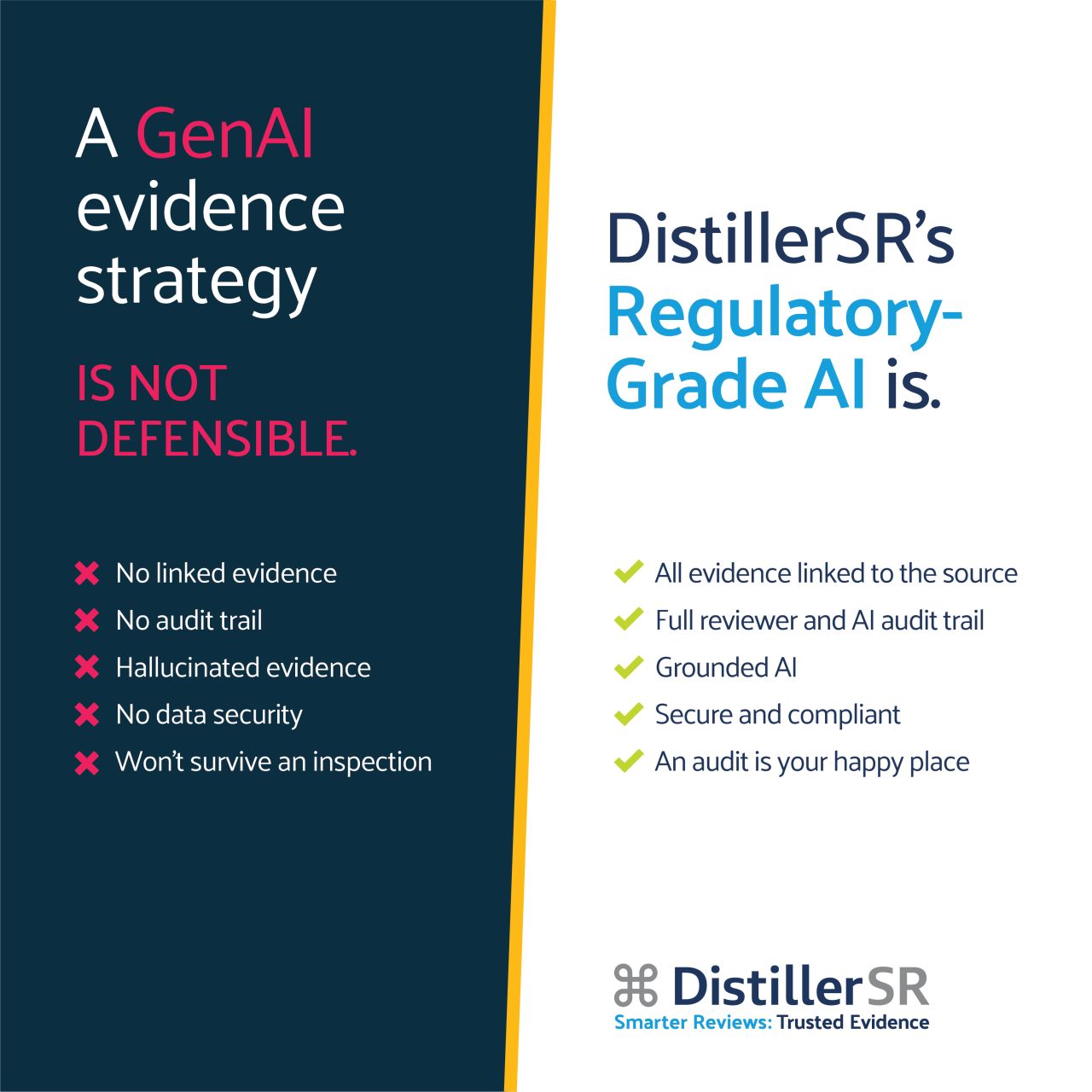
Most AI tools can't answer the questions regulators will ask. ◾Can this output be traced back to its source? ◾Can the methodology be reproduced under audit? ◾Was every screening decision logged with a timestamp? For most general-purpose GenAI tools, the answer is no. The problem isn't AI. It's the wrong AI. Life sciences teams are under pressure to move faster, faster literature reviews, faster HEOR dossiers, faster regulatory submissions. So when an AI tool promises to summarize 500 abstracts in minutes, the appeal is obvious. But speed without traceability isn't a shortcut. It's a liability. ◾A missed citation in a safety review puts patients at risk. ◾A hallucinated effect size distorts a cost-effectiveness model. ◾Undocumented screening decisions delay approvals. Regulatory-Grade AI is different by design. It's built around four principles the industry is converging on: ◾Defensibility over convenience, every data point traces back to source ◾Human expertise in the loop, AI accelerates decision making, it doesn't replace it ◾Audit-ready by default, every search, citation, and decision is logged ◾Your evidence stays yours, no inadvertent sharing your confidential data with third-party LLMs The deeper opportunity isn't speed. It's strategic. When literature reviews are conducted on a regulatory-grade platform, they stop being one-off documents and become reusable organizational assets, validated once, available across regulatory submissions, HEOR dossiers, and medical affairs communications. Evidence silos dissolve. Teams stop reworking the same evidence.And patients get access to treatments faster. The question isn't whether AI belongs in regulated workflows. It's whether the AI you're using was actually built for them. Learn more about DistillerSR
- LINKEDIN · IMAGESince 26 Oct 2026
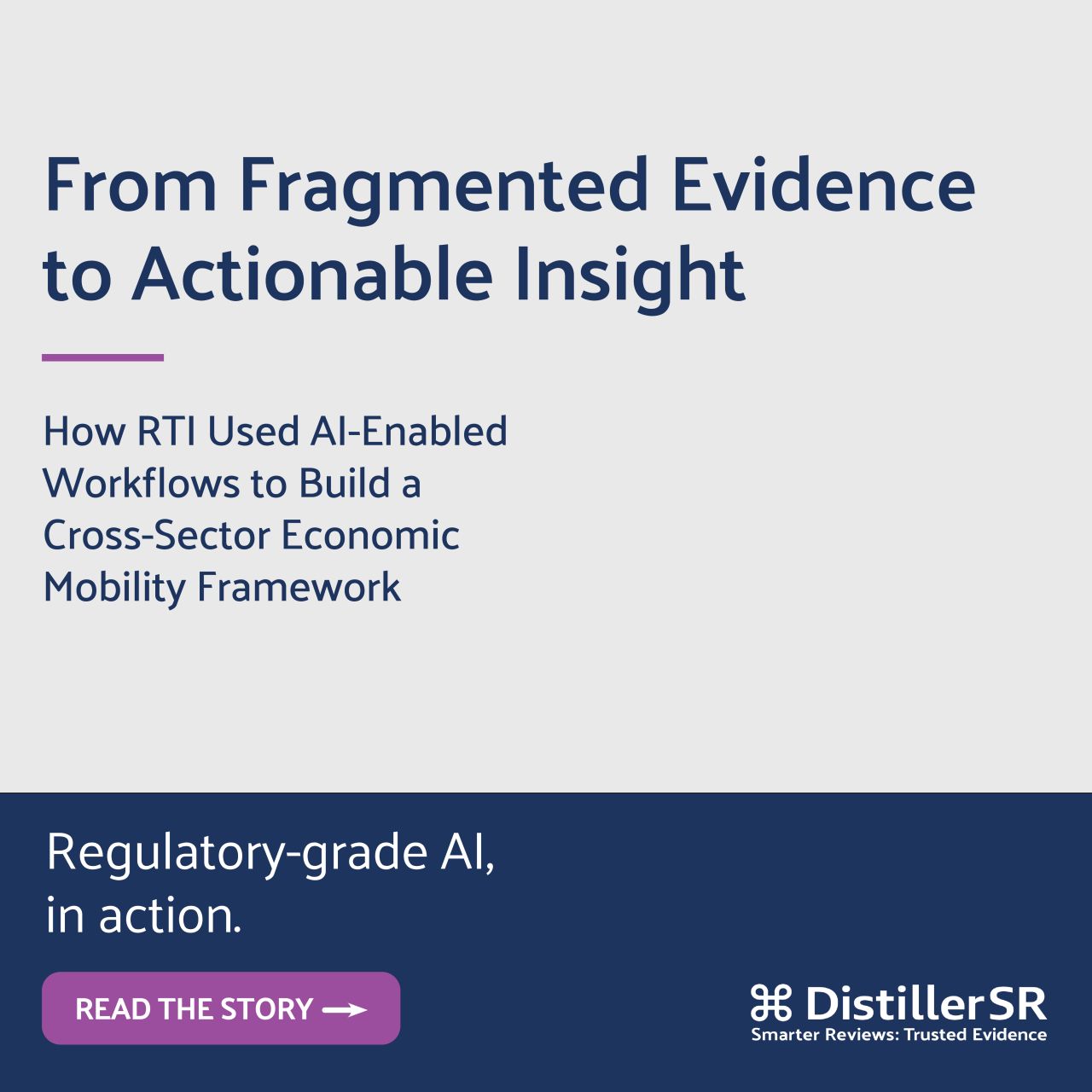
"AI-assisted workflows saved an estimated 7–9 hours of screening effort and reduced extraction time from 70+ manual hours to approximately one hour, without compromising data quality." What actually moves the needle on economic mobility? The evidence sits across housing, education, workforce development, health, and human services, each with its own terminology and its own way of measuring success. This was the task at hand for an internally funded RTI International research effort. Here is where RTI leveraged DistillerSR’s regulatory-grade AI to make the difference. ◾ One place for a fragmented evidence base. Records from academic and gray literature sources were imported, deduplicated, and managed in a single centralized workflow, with 397 references entering title and abstract review. ◾Human-in-the-loop screening by design. AI Rerank continuously surfaced the most promising papers for human review. That accounted for an estimated 7 to 9 hours of screening effort. ◾Data extraction measured in hours instead of weeks. Smart Evidence Extraction populated structured extraction forms directly from full text while keeping every field traceable to its source. At the team's observed manual pace, the 281 records processed would have taken 70 or more hours. With DistillerSR’s regulatory-grade AI, the recorded review time was about one hour. ◾Quality checks aimed at the hardest cases. Weighted kappa across reviewers and AI-assisted decisions was 0.93. The team then hand-checked a random sample of records with below-median AI confidence scores and found a single false inclusion, along with strong alignment between extracted fields and source documents. With the routine review work handled, the team put its time into thematic synthesis, cross-sector comparison, and building a theory-driven economic mobility framework that policy and program leaders can actually apply. Read the full case study https://bit.ly/4hafWxZ to see how RTI scaled a complex, cross-sector review without giving up rigour or reproducibility. A special thanks to Megan Lindstrom and Tatiana E. B. for sharing their journey with us.
- LINKEDIN · IMAGESince 26 Oct 2026
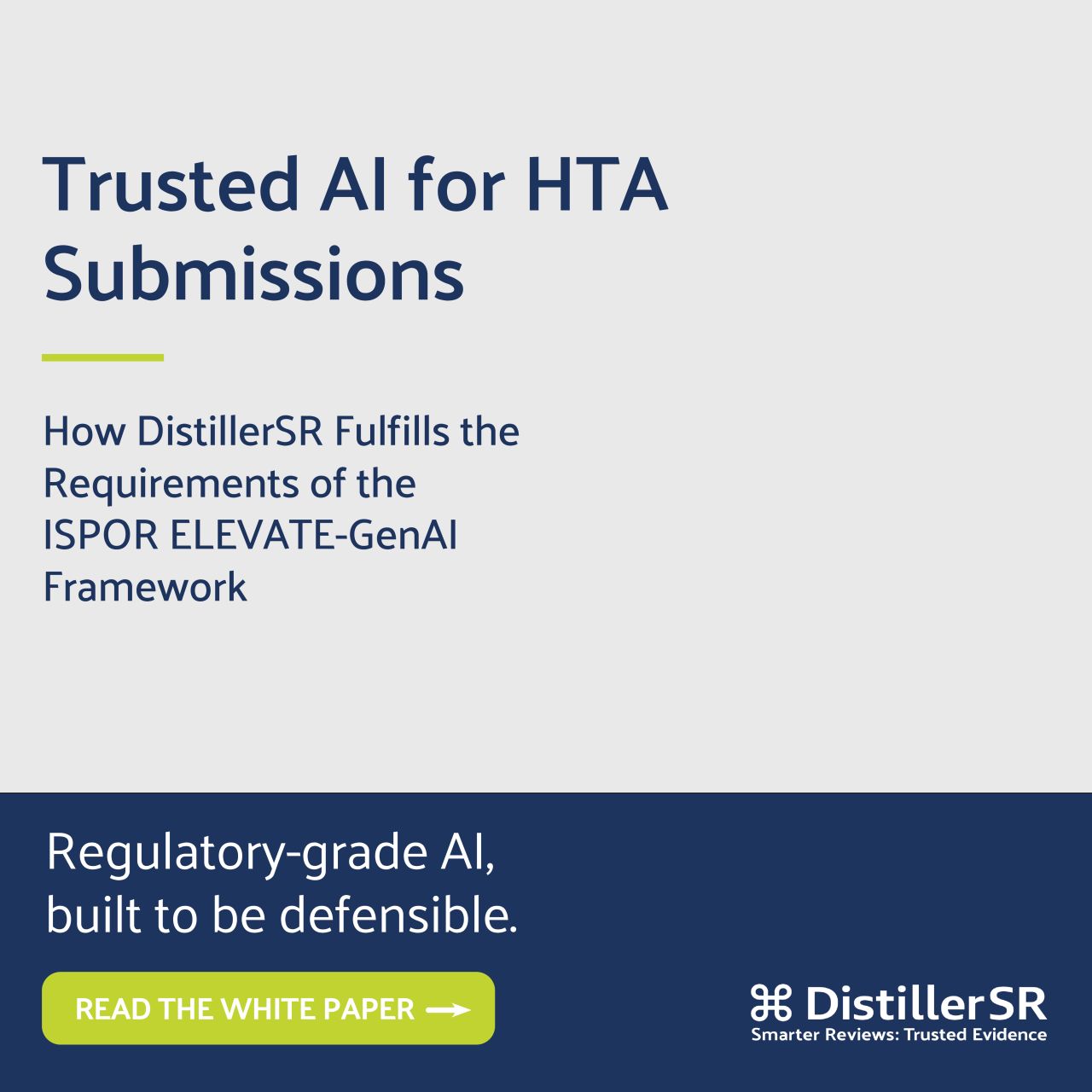
We hear a version of the same question in almost every customer conversation and RFP: can we use generative AI in research workflows, and if so, how do we make sure the outputs pass regulatory scrutiny? The concern is legitimate. A peer-reviewed study published in JMIR Publications Mental Health in November 2025 found that nearly 20% of citations generated by GPT-4o in simulated literature reviews were fabricated, rising to 29% in less familiar or specialized topics. ISPOR—The Professional Society for Health Economics and Outcomes Research 's ELEVATE-GenAI framework, published in Value in Health in November 2025, sets out what HEOR teams need to document when LLMs play a substantive role in their evidence. It is already referenced in NiCE 's position statement on AI in HTA submissions, and CDA and G-BA are following suit. Organizations submitting HEOR evidence to these bodies will increasingly be expected to document AI use against its 10 domains. Every extraction must be traceable to its source document. Model version and update governance must be documented. Outputs must be reproducible from the same document, prompt, and model version. Confidence levels must be communicated. All AI activity must be logged. General-purpose LLMs used through a chat interface cannot meet these requirements. Their outputs are non-deterministic by design, and training data provenance is opaque. The variability and inference beyond the source that make them useful for open-ended tasks are the same properties that make them indefensible in a regulatory submission. This is a problem specific to general-purpose LLMs. Deterministic AI has been part of systematic review workflows for years, including our own. DistillerSR's Smart Evidence Extraction (SEE) was purpose-built for regulated evidence environments. Every extraction is source-cited, every model version is traceable, and every AI suggestion requires a human decision that is logged to the audit record. Customer data is never used to train third-party models. Our new white paper maps SEE against all 10 ELEVATE-GenAI domains and explains what that means in practice for teams preparing HTA submissions. Read the white paper: https://lnkd.in/gsWtnn8M
6 of 93 adsSign up to see every DistillerSR ad, filter by format and date, and get alerts on new ones.
See all 93 adsWatch the companies you care about.
Filter every ad by industry, country, format and network, and get alerts when a company you watch starts running new ads.