On air · 1 of 3 networks
Disivo
- disivo.com
- Consumer, Retail & E-commerce
- CZ
- 19 employees
Disivo’s ads on LinkedIn, Meta and Google, recorded by adsrunning. Browse the latest here for free. Sign up free to see all 801. Watch Disivo with Starter to get each new one in your feed.
Watchlist with Starter · $49/mo
| Network | Status | Live ads | Nov 2025LinkedIn activity · 52 weeksOct 2026 | Checked | Next step |
|---|---|---|---|---|---|
| None recorded | 0 | Checked 30 Oct 2026 | See all 801 ads → | ||
| Meta | Not checked | — | |||
| Running | 3 | Ads on the Google Ads Transparency Center | Checked 27 Oct 2026 | Collect them with the API → |
Disivo has no live LinkedIn ads. We recorded 3 Google ads on 27 Oct 2026.
Latest ads
- LINKEDIN · IMAGESince 21 Aug 2026
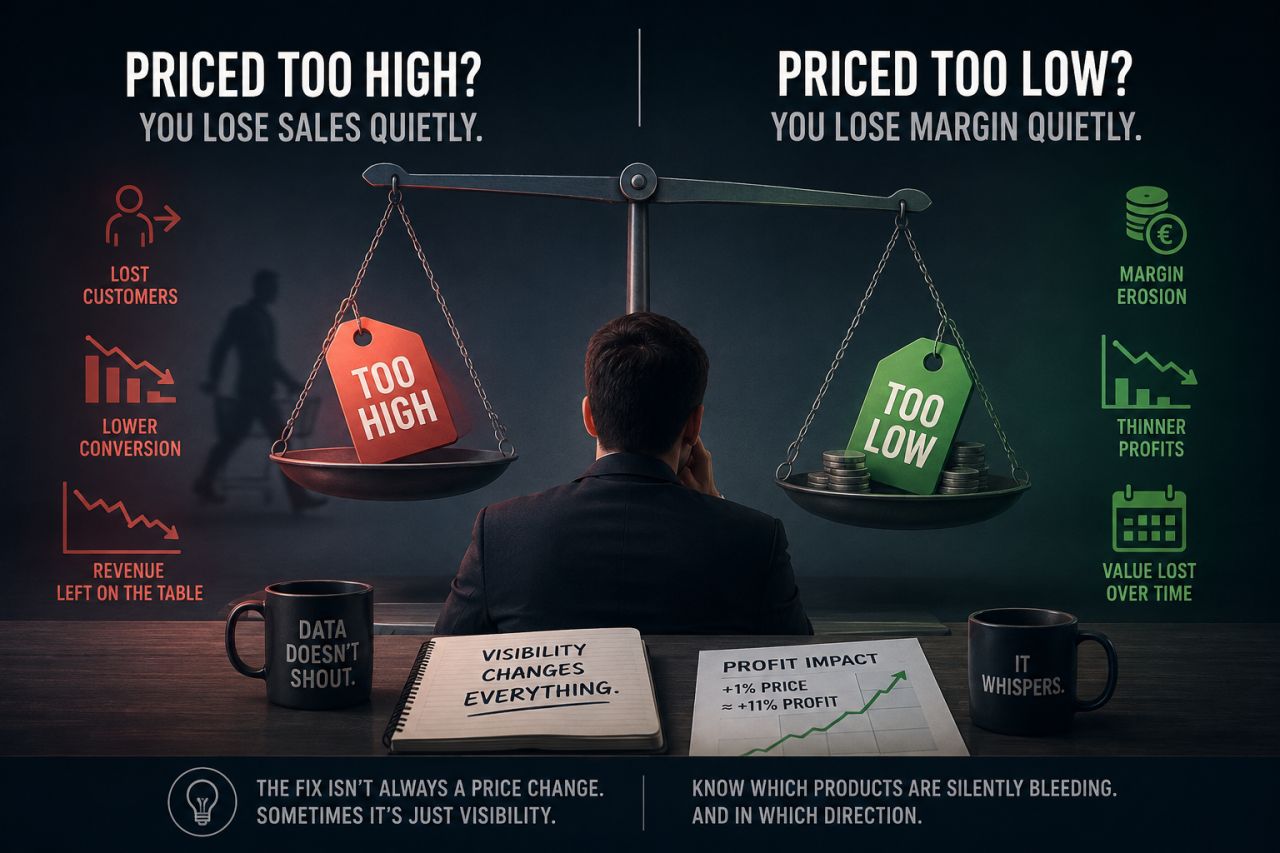
Priced too high? You lose sales quietly. Priced too low? You lose margin quietly. The dangerous thing about both mistakes is that neither one announces itself. No alarm goes off when a customer bounces because your price is 8% above the market. No alert fires when you've been leaving €2 on every transaction for six months because your floor was set too conservatively. You just see slightly lower conversion. Slightly thinner margins. Easy to blame on seasonality, competition, the algorithm. Here's what makes this worth paying attention to: McKinsey research on the Global 1200 found that a 1% price increase, with demand held constant, lifts profits by an average of 11%. The flip side is equally true: many companies default to conservative pricing to avoid alienating customers, but this approach often leaves significant value uncaptured. The fix isn't always a price change. Sometimes it's just visibility: knowing which products are silently bleeding and in which direction. Which one keeps you up at night more: pricing too high or too low? Source: https://lnkd.in/evtXa3DY
- LINKEDIN · IMAGESince 20 Aug 2026
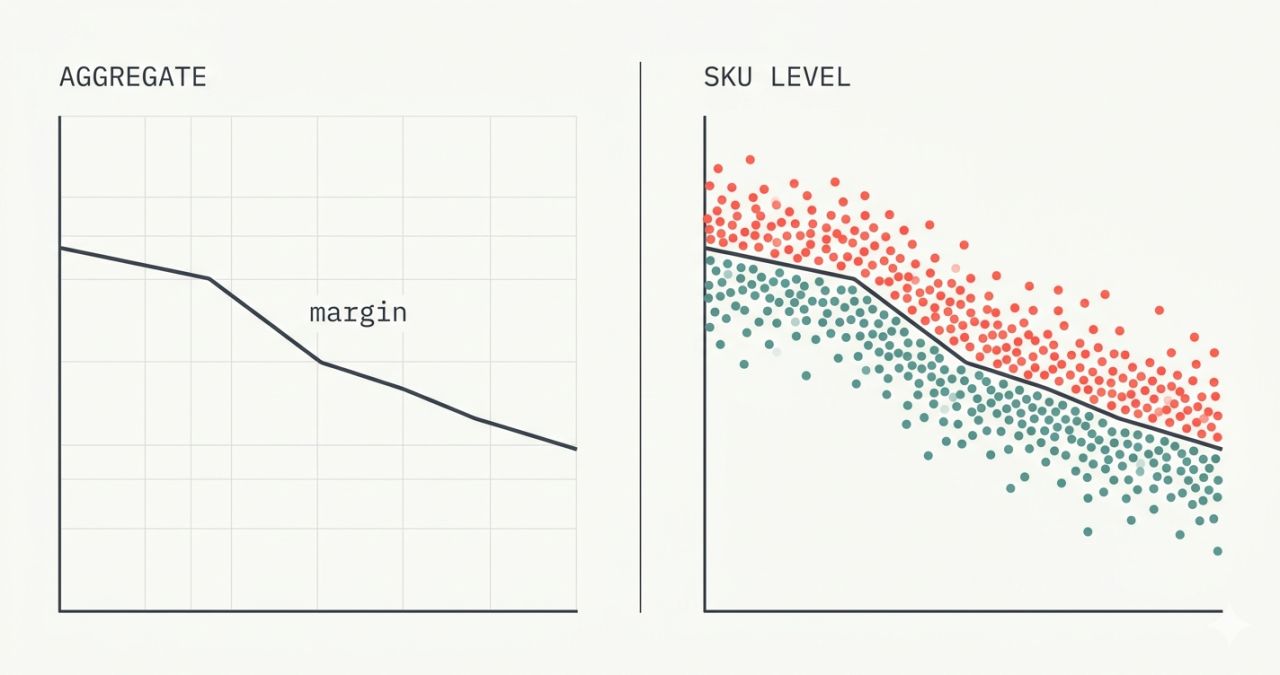
Most pricing teams I talk to can name their 3 biggest competitors. Almost none can tell me which specific SKUs those competitors are pricing below them on, right now. That gap is where margin leaks happen. Not at the strategy level - at the SKU level, product by product, quietly, every day. Two questions worth asking your team this week: 1. Which products are we losing volume on because a competitor is 8% cheaper? 2. Which products are we 15% below market and don't need to be? The first costs you revenue. The second costs you margin on every sale. You don't need a bigger pricing team to fix this. You need visibility.
- LINKEDIN · IMAGESince 20 Aug 2026
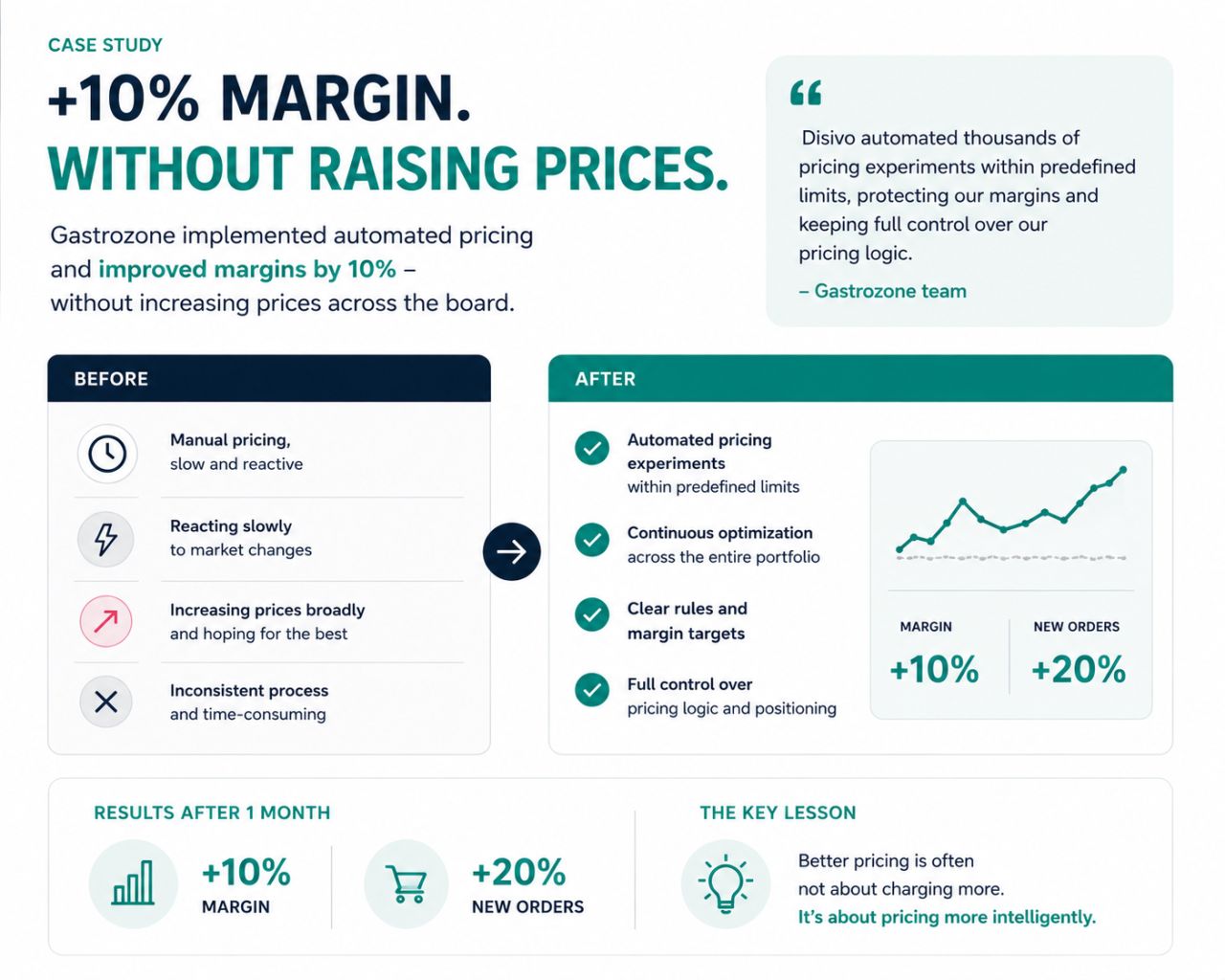
“We improved margins by 10%.” Without increasing prices across the board. That was one of the key results after Gastrozone implemented Disivo’s automated pricing models. Sounds simple. But the interesting part is how it happened. Before automation, pricing changes were mostly manual: – testing prices product by product – reacting slowly – increasing prices broadly and hoping for the best Some products performed better. Some performed worse. The process was inconsistent and time-consuming. Instead of blanket price increases, Gastrozone started optimizing pricing on a product-by-product basis with clear rules and margin targets. That changed everything. Disivo automated thousands of pricing experiments within predefined limits: ✅ protecting margins ✅ keeping control over pricing logic ✅ continuously adapting pricing across the portfolio The result after the first month: 📊 +10% margin 📦 +20% new orders Better pricing is often not about charging more. It’s about pricing more intelligently. 👉 Want to see how that works in practice? Sources: https://lnkd.in/ddVjsf9x
- LINKEDIN · IMAGESince 20 Aug 2026
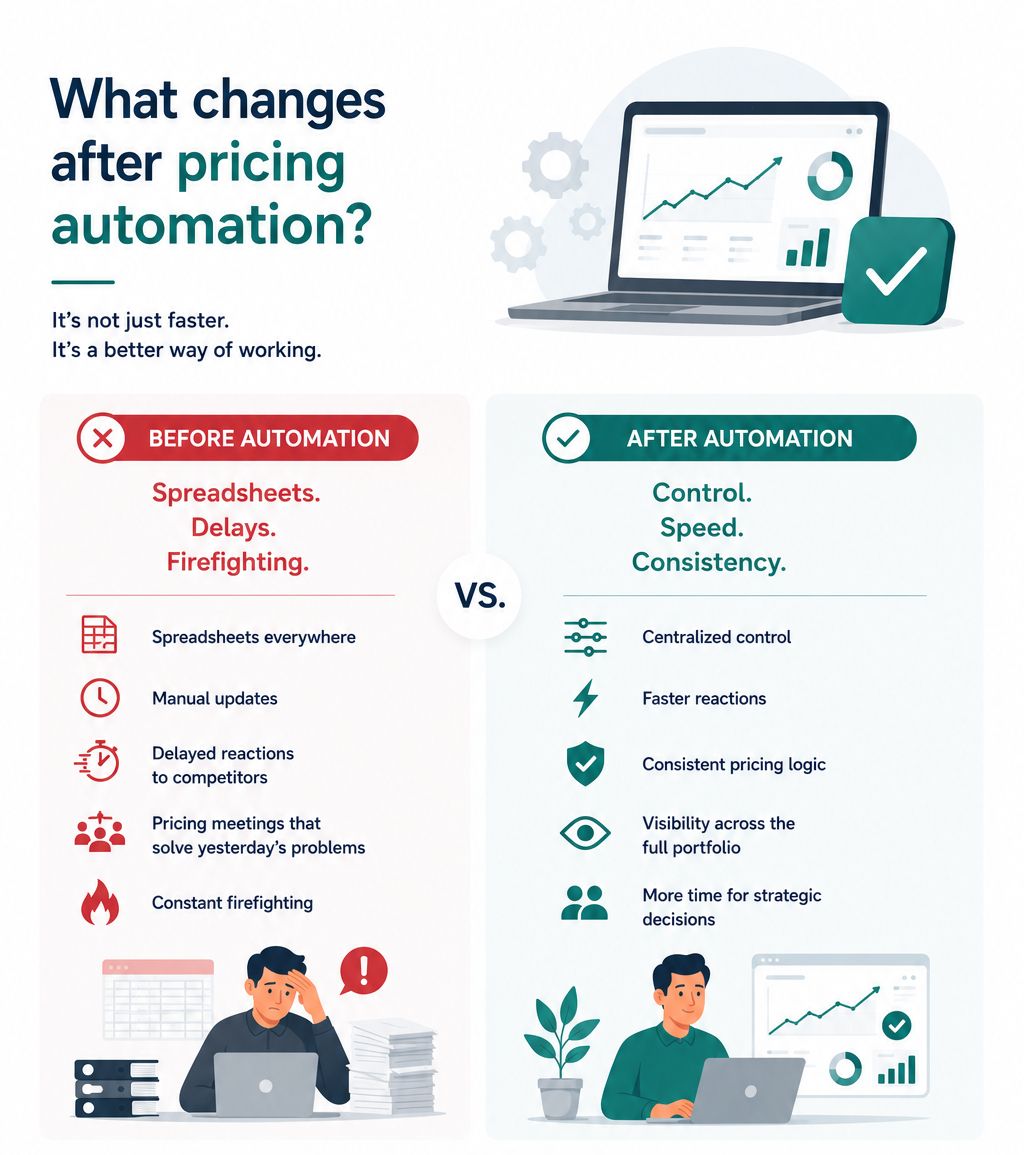
What changes after pricing automation? Usually, everything around the process. Before: – spreadsheets everywhere – manual updates – delayed reactions to competitors – pricing meetings that solve yesterday’s problems – constant firefighting The team spends most of the time maintaining pricing instead of improving it. After automation, the shift is surprisingly simple: ✅ centralized control ✅ faster reactions ✅ consistent pricing logic ✅ visibility across the full portfolio ✅ more time for strategic decisions The biggest difference is not just speed. It’s consistency. When pricing is handled manually, every category manager, marketer, or country team tends to approach it differently. Automation creates structure: – the same rules – the same logic – the same level of control Across thousands of SKUs. And suddenly, pricing stops being a weekly task. It becomes a continuous process. The goal is not to remove humans from pricing. The goal is to remove repetitive manual work from humans. 👉 Which side are you closer to today?
- LINKEDIN · IMAGESince 20 Aug 2026
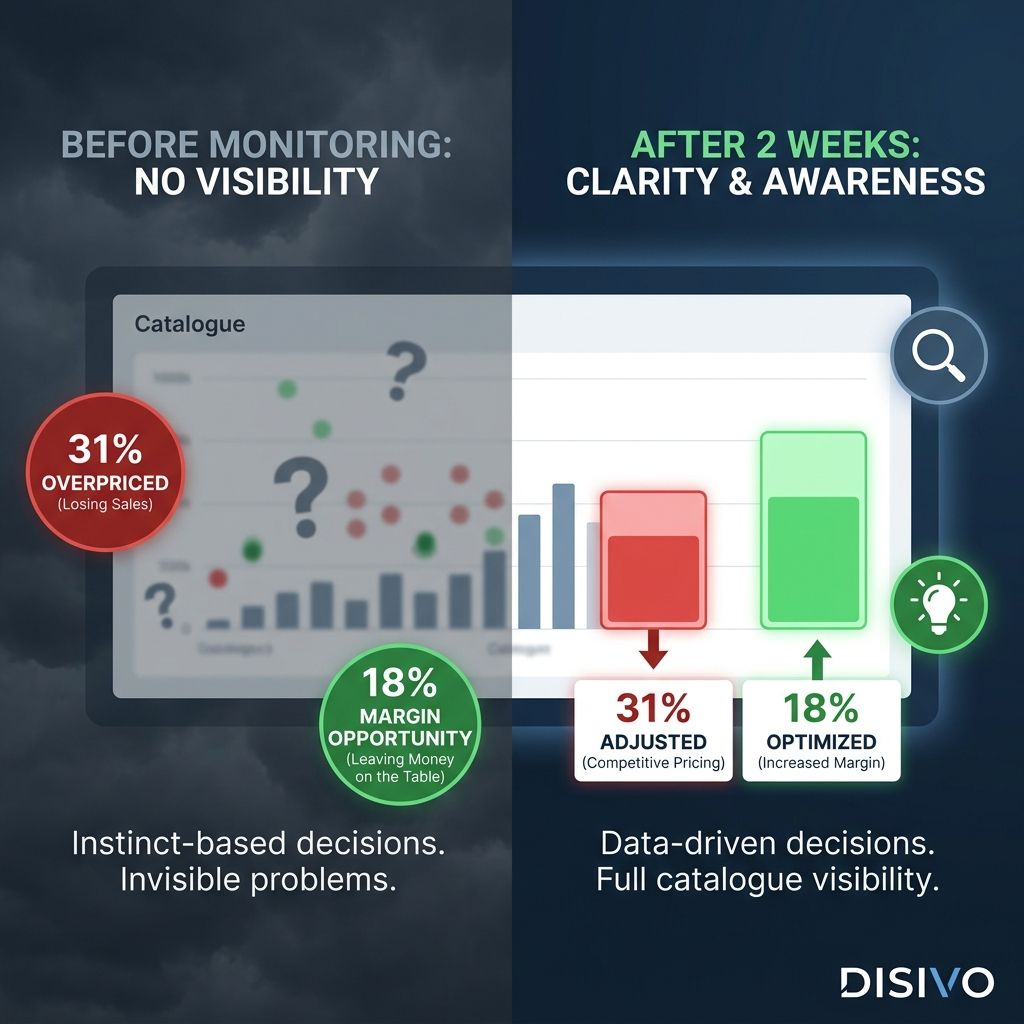
Two weeks after turning on competitor monitoring, here is what the data showed to one of our clients: 🔴 31% of their catalogue was priced above the cheapest competitor by more than 10%, on products where price is the main deciding factor for the buyer. 🟢 18% of their catalogue had no competition at all, yet prices were set as if they were fighting for every sale. Nobody had done anything wrong. There was no negligence. The team was working hard. They just had no visibility. The 31% was quietly losing sales. The 18% was quietly leaving margin on the table. Both were invisible without monitoring. What changed after two weeks was not the pricing. It was the awareness. For the first time, the team could see their full catalogue against the market, product by product and make decisions based on data rather than instinct. That is the starting point with most of our clients at Disivo. Not a dramatic rescue. Just clarity, where there was none before. What would you do first if you suddenly had full visibility across your catalogue?
- LINKEDIN · IMAGESince 20 Aug 2026
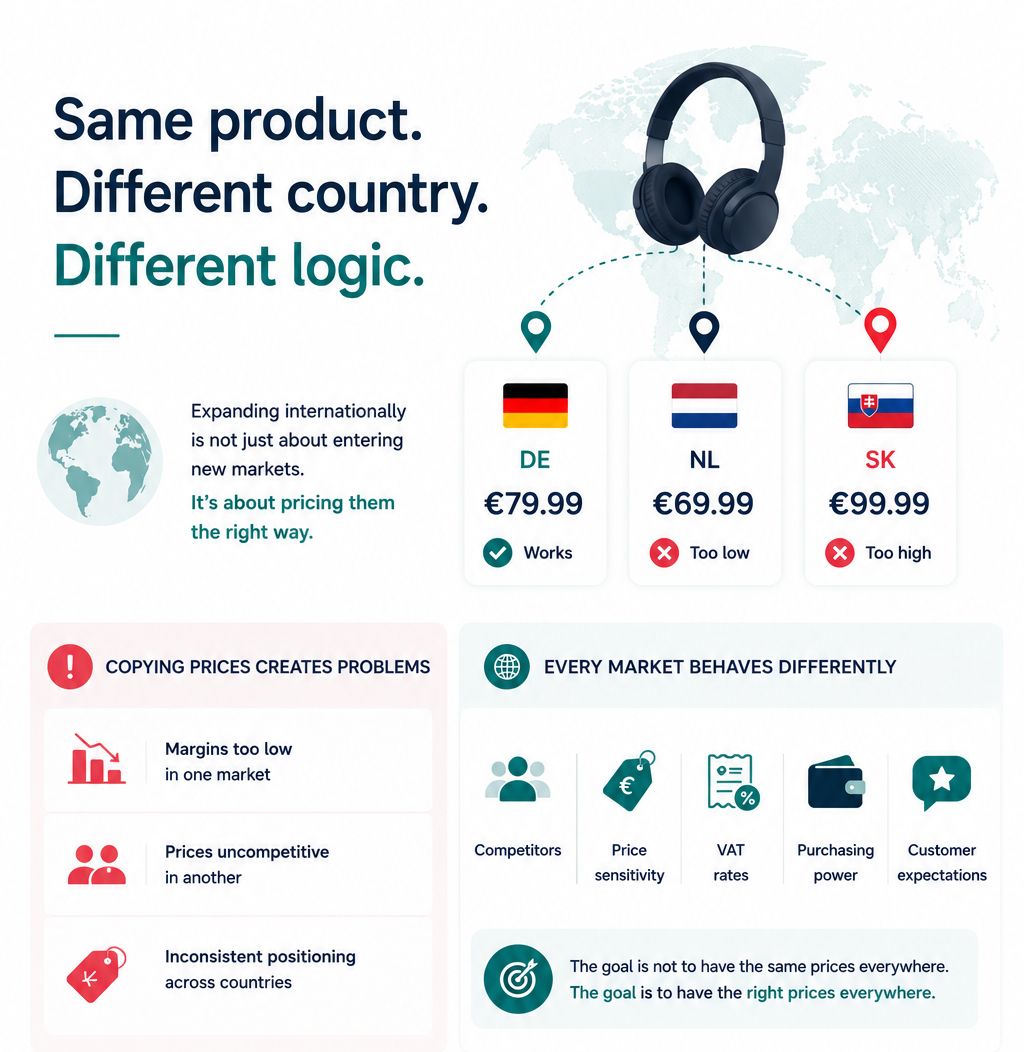
Many retailers expand internationally by simply copying prices from one market to another. It feels efficient. But in reality, it often creates problems: – margins too low in one market – prices uncompetitive in another – inconsistent positioning across countries Because every market behaves differently. Differences: – competitors – price sensitivity – VAT rates – purchasing power – customer expectations A price that works perfectly in Germany may completely fail in the Netherlands or Slovakia. That’s why multi-market pricing is not just currency conversion. It’s a strategy. The goal is not to have the same prices everywhere. The goal is to have the right prices everywhere. The most successful retailers usually combine: ✅ centralized pricing control ✅ local market adaptation ✅ clear pricing rules ✅ market-specific positioning Because scaling internationally without localized pricing often means scaling inefficiencies too. 👉 Do you localize pricing by market, or mostly copy it?
6 of 801 adsSign up to see every Disivo ad, filter by format and date, and get alerts on new ones.
See all 801 adsWatch the companies you care about.
Filter every ad by industry, country, format and network, and get alerts when a company you watch starts running new ads.