On air · 1 of 3 networks
Discover Dollar Inc
- discoverdollar.com
- Fintech & Financial Services
- US
- 123 employees
Discover Dollar Inc’s ads on LinkedIn, Meta and Google, recorded by adsrunning. Browse the latest here for free. Sign up free to see all 60. Watch Discover Dollar Inc with Starter to get each new one in your feed.
Watchlist with Starter · $49/mo
| Network | Status | Live ads | Nov 2025LinkedIn activity · 52 weeksOct 2026 | Checked | Next step |
|---|---|---|---|---|---|
| Running | 49 | Checked 28 Oct 2026 | See all 60 ads → | ||
| Meta | None recorded | 0 | No active ads recorded on the Meta Ad Library | Checked 19 Oct 2026 | Collect them with the API → |
| None recorded | 0 | No ads found on the Google Ads Transparency Center | Checked 27 Oct 2026 | Collect them with the API → |
Discover Dollar Inc has 49 live LinkedIn ads. Its Facebook page had no active ads on 19 Oct 2026, and we recorded no Google ads on 27 Oct 2026.
Latest ads
- LINKEDIN · VIDEOSince 18 May 2026
A GCC gives you something headquarters never will - the person who owns the problem is also the person you're building with. With Target, their tech team was here. We built the integration together, no filters, no delays, just the people who needed it most, in the room. That's not a small thing. Most startups spend their best energy navigating enterprise layers just to reach the actual stakeholder. In a GCC that distance doesn't exist. Enterprise scale. Direct access. That combination is rare - and most startups aren't looking for it here yet. Conversation with Abhay and Malahar Pinelli, VP & Country Leader, 7-Eleven GSC - The Innovators and Disruptors Collective.
- LINKEDIN · IMAGESince 18 May 2026
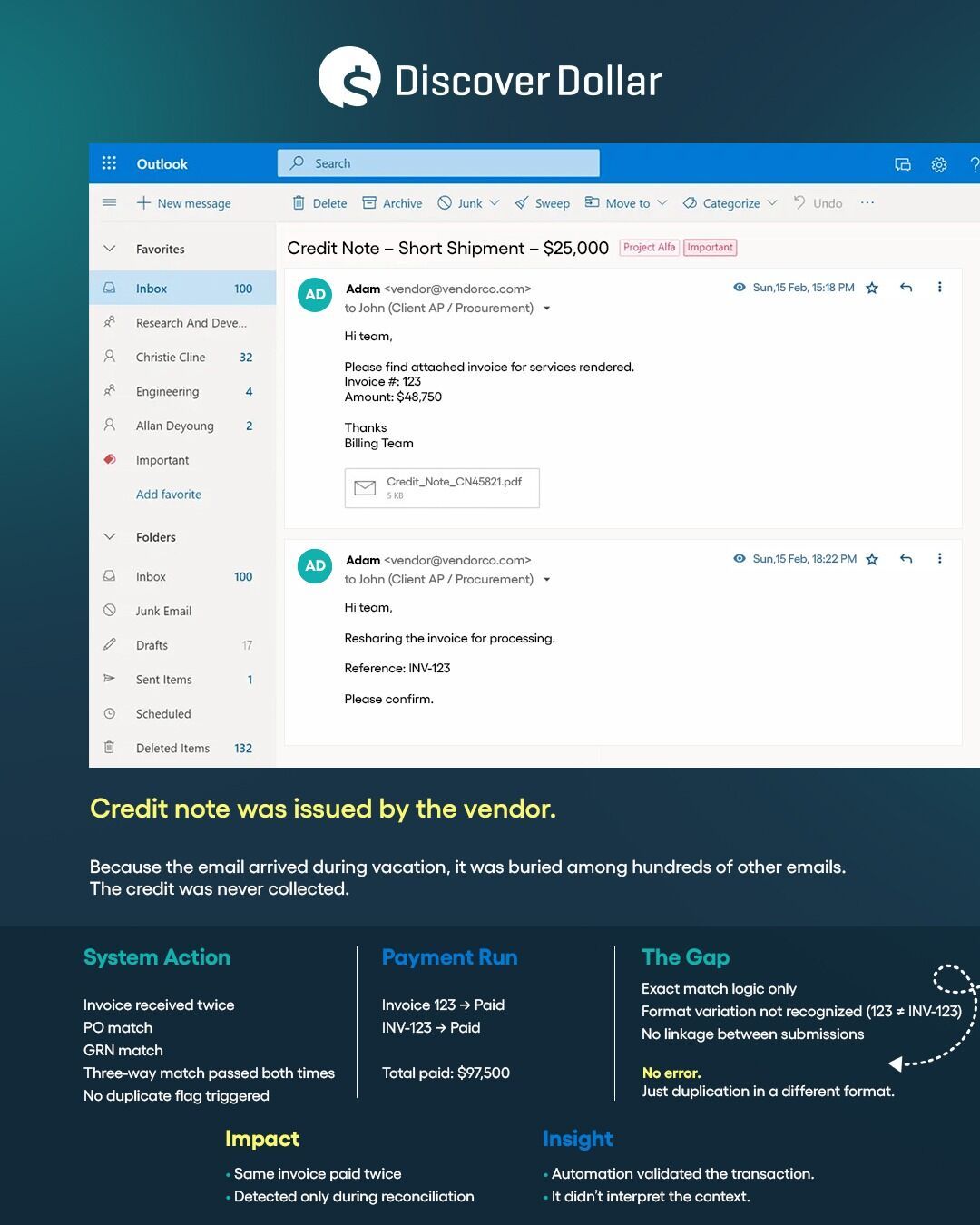
Most AP leaks don't come from fraud. They come from things that look completely normal. John Mercer, AP Manager at Meridian Logistics, came back from vacation to 340 unread emails. He caught up on everything. He missed one. Subject: Credit Note - Short Shipment - $25,000 It was from Adam Cole, Billing Lead at VendorCo - one of Meridian's tier-1 suppliers. Adam had done what any billing person does when they don't hear back - he resent the invoice. Same amount. Same vendor. Different reference. INV-123 instead of 123. Meridian's ERP ran the three-way match. PO matched. GRN matched. Amount matched. Paid. Twice. The credit note sat unopened. Expired. No fraud. No system error. Just a billing lead doing follow-ups, an AP manager catching up after a holiday, and an ERP doing exactly what it was built to do. The dots were all there. The system just wasn't built to connect them. $73,750. Gone. Detected only at quarter-end reconciliation. Note: The company and individuals mentioned here are fictional. The pattern, the logic, and the gap are very real.
- LINKEDIN · VIDEOSince 18 May 2026
Malahar is right. Enterprises aren't slow - they're cautious. And they should be. When we decided to go after enterprise, we made a choice early - don't ask them to trust us. Earn it before we walk in. SOC 2 Type 2, GDPR, ISO 27001:2022 & ISO 42001:2023. These aren't badges. They're the work. Months of getting our house in order - security, data governance, AI management systems - so that when a large enterprise opens the door, compliance is never the reason it closes. Completely agree with Malahar's perspective here - the sandbox works only when the startup inside it is actually ready for that environment. Speed matters. But trust is what gets you in the room. Malahar Pinelli, VP & Country Leader, 7-Eleven GSC, sharing this at The Innovators and Disruptors Collective - when Abhay Tandon asked about what enterprises and startups actually learn from each other.
- LINKEDIN · VIDEOSince 18 May 2026
Many people still ask me, “Discover Dollar” is a very cool name for the company, but what do you do? I have summarized it in two mins in my recent podcast with Abhay. Truly to our name, we help companies “Discover Dollar” out of nowhere. To understand, you need to understand the large enterprise source-to-pay first. Most have 6-7 departments - Sourcing teams: who help in finding vendors - Procurement team: who negotiates and onboards the vendors - Requisition teams: who place orders based on demand forecast, etc - Accounts Payable: who makes payment based on goods received, invoices - Treasury: who owns and initiates payments Each team uses different tools and stack - Zoom, Teams, Contract Management Systems, Vendor Portals, Contract CLMs, Spreadsheets, ERPs, etc We have observed that companies lose up to $300K per $100M in procurement. For example: 1. Sourcing negotiated a better price this month, and it’s in a spreadsheet in SharePoint. But the requisition team placed an order at older, higher rates. 2. The procurement team had included a volume rebate in the contract when it was signed 3 years back. The company is eligible for rebates this year, but no one noticed it. We have 300+ leakage scenarios and over 1000+ use cases across $1 Trillion dollars+ data that we have analyzed We have specialized AI Agents that can extract key financial terms from millions of unstructured data sources, such as contracts, emails, and spreadsheets, and compare them against billions of transaction records to help enterprises capture all the money they leave on the table. Typically, in the first year, we work on an outcome-based model. Where enterprises pay only when we deliver real outcomes. Then many companies chose flexible licensing or other options we have. Over the past years, we have helped Fortune 500 companies across North America, Europe, and GCCs save over a billion dollars, which otherwise would have been lost forever Abijith Dheemanth R Owais Manoranjan j Kavya Konishko Chatterjee Sanit Roy Varshita Samy The Innovators and Disruptors Collective
- LINKEDIN · IMAGESince 18 May 2026
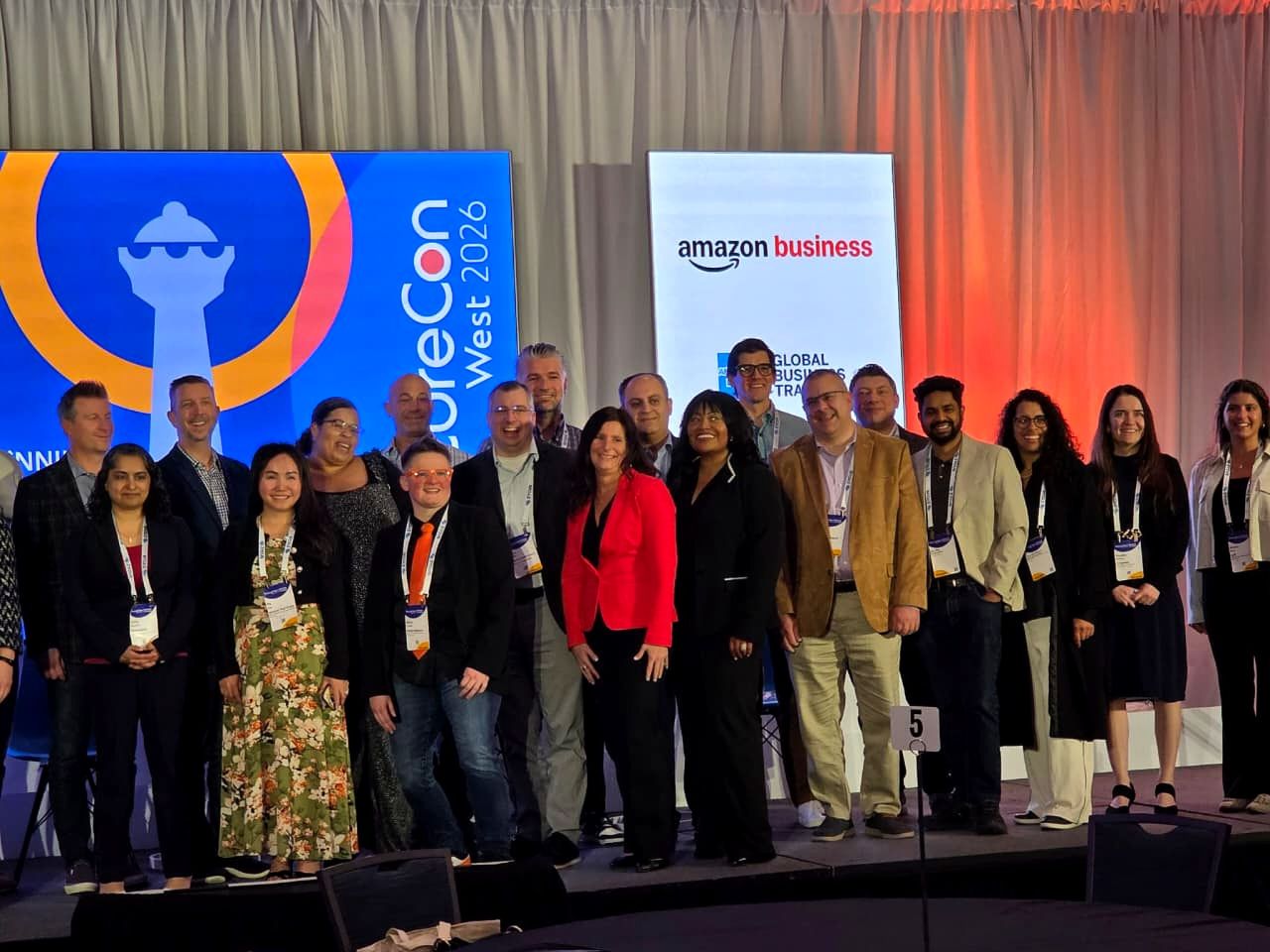
I had the chance to speak, listen, and exchange ideas with some incredible leaders at ProcureCon US Indirect West 2026. Over the past few days, a few themes kept surfacing across conversations with leaders from healthcare, pharma, manufacturing, finance, retail, and infrastructure. Here is what stayed with me. 1. Procurement is moving closer to the center of the business In large enterprises, procurement is no longer operating quietly in the background. Leaders like Karan Arora, Lindsey Kirchberg, Brian Peters and Eric Mott kept coming back to the same shift. Procurement is increasingly expected to shape decisions, not just execute them. When procurement is connected to strategy, technology investments, and transformation initiatives, the function starts to look very different. It stops acting like a cost center and starts acting like a coordination layer across the business. 2. Supplier ecosystems are becoming strategic assets Another theme that kept emerging was the growing importance of supplier relationships. Across discussions involving Aaron Michaels, Lawrence, Joseph Steen and Bernardo Del Hoyo, the conversation moved beyond contracts and negotiations. The real focus now is resilience. The strength of a supplier ecosystem often determines how quickly a company can respond to disruptions, supply shocks, or market changes. Procurement leaders are increasingly responsible for building and maintaining that resilience. 3. Technology and risk are reshaping the operating model Technology came up in nearly every discussion, but not in the way people often expect. Leaders like Kyle Peckens, Seth Dunn, Michael Wang and Zvjezdan Prole spoke about how digital tools and AI are beginning to reshape how procurement teams operate. At the same time, conversations with Christina Hernandez and Mark Darius Frank highlighted something equally important. As vendor ecosystems grow, so does the responsibility for managing third-party risk. Procurement increasingly sits at the center of that balance between opportunity and risk. 4. Sustainability is no longer a parallel conversation In manufacturing and pharma environments, procurement is also becoming central to sustainability efforts. Leaders like Mathew Daniel and Ana Talamas highlighted how sourcing decisions now directly influence environmental goals, operational resilience, and long-term supply strategies. Sustainability is no longer adjacent to procurement. It is becoming embedded within it. My biggest takeaway Procurement leaders today sit at the intersection of spend, suppliers, risk, technology, and sustainability. Very few functions have visibility across all five. Which makes me think the real shift ahead may not be inside procurement itself. It may be how the rest of the organization starts working with it.
- LINKEDIN · VIDEOSince 18 May 2026
When Abhay asked me about the "biggest myth in enterprise-startup collaborations", I didn't have to think long. The myth is that it's a marriage made in heaven - two parties with aligned incentives, and things just fall into place. The reality is messier. And more human. What I've seen actually move the needle isn't the MOU, the pilot agreement, or even the product fit. It's whether there's someone on the enterprise side who has taken personal ownership of navigating the complexity - an innovation leader, a program manager, a champion who treats this like their problem, not a vendor relationship to be managed. When that person exists, the relationship compounds. When they don't, even the best pilots die quietly in some committee review. No one talks about this enough because it doesn't fit the clean narrative of "startups + enterprises = innovation." But if you're a founder trying to crack enterprise, ask yourself: do I have a champion inside, or just a contact? That one question has saved me more time than any pitch deck. From my conversation with Abhay Tandon, Innovation Leader, and Malahar Pinelli, VP & Country Leader, 7-Eleven GSC — at The Innovators and Disruptors Collective.
6 of 60 adsSign up to see every Discover Dollar Inc ad, filter by format and date, and get alerts on new ones.
See all 60 adsWatch the companies you care about.
Filter every ad by industry, country, format and network, and get alerts when a company you watch starts running new ads.