On air · 2 of 3 networks
Digital Journal
- digitaljournal.com
- Media, Events & Publishing
- CA
- 37 employees
Digital Journal’s ads on LinkedIn, Meta and Google, recorded by adsrunning. Browse the latest here for free. Sign up free to see all 20. Watch Digital Journal with Starter to get each new one in your feed.
Watchlist with Starter · $49/mo
| Network | Status | Live ads | Nov 2025LinkedIn activity · 52 weeksOct 2026 | Checked | Next step |
|---|---|---|---|---|---|
| Running | 16 | Checked 30 Oct 2026 | See all 20 ads → | ||
| Meta | Not checked | — | |||
| Running | 2 | Ads on the Google Ads Transparency Center | Checked 27 Oct 2026 | Collect them with the API → |
Digital Journal has 16 live LinkedIn ads. We recorded 2 Google ads on 27 Oct 2026.
Latest ads
- LINKEDIN · IMAGESince 20 Oct 2026
Anyone who has picked up a Rubik’s cube knows the problem: You solve one face, turn it over, and the other sides are scrambled. Fix those and the face you finished comes apart. Computer Modelling Group CEO, Pramod Jain, says AI agents can create the same problem inside companies when a decision passes from one team of specialists to the next. In energy, a decision about where to drill moves from one expert to the next, each building on the last one’s work and flagging what they’re unsure of. An AI agent can run through that whole chain in one go, and it only stops at those checkpoints if it’s built to. If it isn’t, the answer can come back looking finished and still be wrong. The same goes for any decision that passes through several teams before someone acts on it: a loan approval at a bank, a treatment plan at a hospital, a shipping schedule at a logistics company, a crop insurance claim. Any organization putting agents to work across those teams will run into similar challenges. In his latest piece for Digital Journal, Jain makes the case for AI that speeds up and coordinates the work around the science engineers already trust, and lays out what that takes: software that shows what each answer depends on, uncertainty passed along with every handover, and a named person signing off on each step. 🔴 Read Pramod's latest piece for Digital Journal here: https://lnkd.in/gyBPhaBp ⚫️ Subscribe to our newsletter for a weekly look at the technology stories reshaping how Canadian businesses operate and compete: https://lnkd.in/gT-y69vE
- LINKEDIN · IMAGESince 10 Apr 2026
How companies grow through acquisition will determine whether the innovation inside them compounds or gets absorbed into platforms built to protect what already exists. The energy sector is facing this more acutely than most. The problem isn't technology. It's structure. And addressing it requires a model specifically designed to keep innovation possible as a company grows. Most acquirers take the same approach: absorb the target, bend the roadmap toward the parent company's priorities, and watch the people who built the original product start to leave. But keeping acquired companies completely independent has its own limits. The cross-sell opportunity disappears, connected workflows go unrealized, and the customer still manages separate vendor relationships for problems that are sequential steps in the same decision. In his latest article with Digital Journal, Computer Modelling Group CEO, Pramod Jain, makes the case for a different model: a federation built on autonomous product teams, shared commercial infrastructure, and a clear-eyed view of what gets destroyed when acquirers move too fast to consolidate. 🔴 Read the article here: https://lnkd.in/gbsgdW2a
- LINKEDIN · IMAGESince 17 Dec 2025
If you were asked to put one million tonnes of CO₂ underground every year for decades, how confident would you be in what happens next? Would you insure it? Would you finance it? Would you be ready to defend that confidence to a regulator, an insurer, or a board? These questions once sat with a small group of technical reviewers. Today, they’re central for regulators, insurers, lenders, investors, commercial partners, and operators involved in carbon capture and storage (CCS). The energy transition is accelerating, and with it, the push to manage emissions at scale. CCS is drawing attention because more companies are preparing to capture carbon dioxide and return it to the subsurface instead of releasing it into the atmosphere. As that shift picks up speed, the challenge isn’t just injection. It’s proving that storage will remain contained over time. Once underground, CO₂ moves through porous rock, changes under pressure, and interacts with geology in ways no one can directly observe. How do you understand that behaviour? Through modelling. The next phase of CCS will be defined not only by how well operators model the subsurface, but by how effectively that modelling supports regulatory, financial, and commercial decisions made under uncertainty. In his first Insight Forum article with Digital Journal, Computer Modelling Group CEO, Pramod Jain, shares insight drawn from CMG’s decades of experience in subsurface modelling. He argues that modelling is no longer a technical formality. It’s confidence infrastructure for approvals, insurance, and capital. Subsurface modelling has become the ‘confidence infrastructure’ of CCS projects worldwide. Read the article: https://lnkd.in/gj_HKuwg
- LINKEDIN · IMAGERecorded 15 Sept 2026
Strong leadership isn't only about vision and results. It's also about how we show up for people when the work gets hard. In her latest Insight Forum article, Sarah Coleman, Communications Lead at CSV Midstream Solutions, explores how leadership can change the conversation on mental health at work. What stands out in this story is a shift in mindset. Mental health support isn't a checklist or a campaign. It's a relationship. It begins when leaders choose to notice, reach in, and offer support before being asked. Coleman highlights how CSV integrated this approach into its company culture through the "Buddy Up" program, developed with the Centre for Suicide Prevention, making care for people part of daily operations. It’s a reminder that when leaderships starts with care, performance and results follow. 🔴 Read Sarah's Insight forum article here: https://lnkd.in/gygHPwpe ⚫️ Want more innovation news in your inbox? Subscribe to the Digital Journal newsletter: https://lnkd.in/gT-y69vE ⚫️ Download our Canada’s Innovation Spectrum 2025 report. Benchmarking leadership, culture and innovation in Canadian workplaces: https://lnkd.in/gcEvp_bC
- LINKEDIN · IMAGERecorded 15 Sept 2026
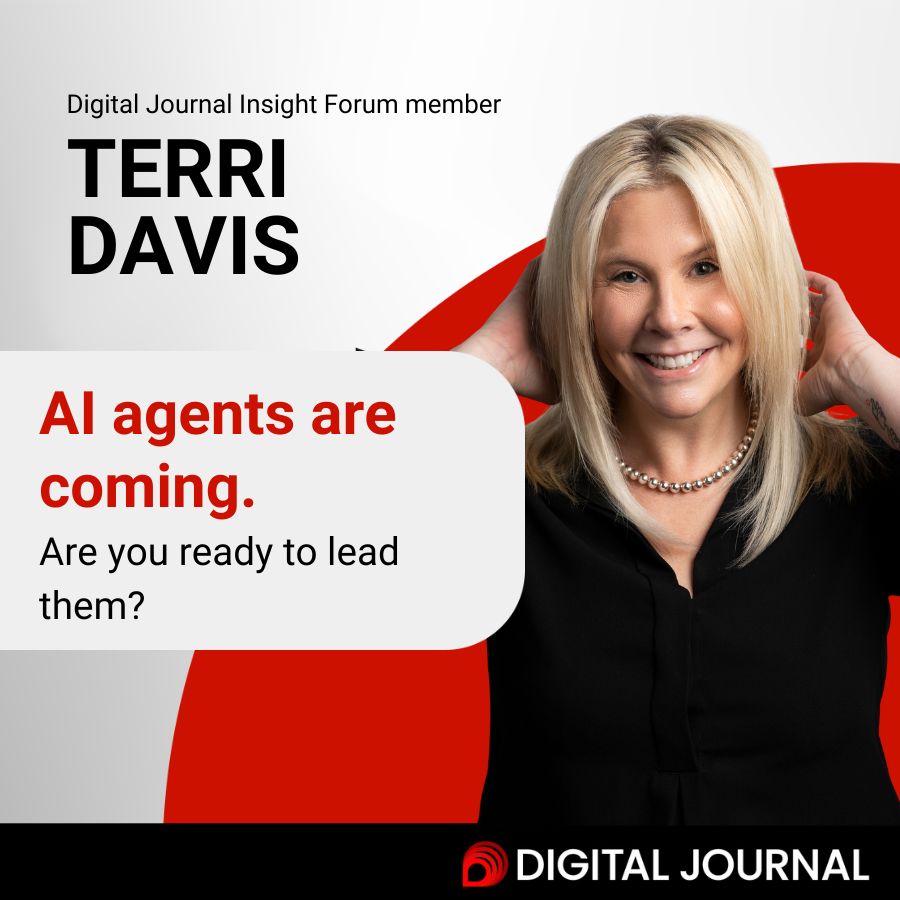
Most leaders are preparing to manage teams. Few are preparing to lead machines. In her new Insight Forum column, Terri Davis, founder of ProFound Talent Inc. and oolu, explores what leadership looks like when part of your team is non-human. She unpacks the idea of agentic leadership, which is the ability to lead autonomous AI systems that think, plan, and act toward defined goals. As Davis writes, “Tomorrow’s leaders won’t just lead people, they’ll lead AI.” Drawing on research from Gartner and McKinsey, she outlines the principles every executive will need by 2030: ▪️ Shared agency with AI, not abdication ▪️ Trust through explainability and feedback loops ▪️ Data hygiene as a leadership priority This isn’t a story about machines taking over. It’s about how leaders evolve to co-lead with intelligence they didn’t hire, but must now guide. 🔴 Read the full Insight Forum article by Terri Davis on Digital Journal: https://lnkd.in/gHKzs5Rf - ⚫️ Want more innovation news in your inbox? Subscribe to the Digital Journal newsletter: https://lnkd.in/gT-y69vE - ⚫️ Download our Canada’s Innovation Spectrum 2025 report. Benchmarking leadership, culture and innovation in Canadian workplaces: https://lnkd.in/gcEvp_bC
- LINKEDIN · IMAGERecorded 15 Sept 2026
As governments wrestle with how to keep pace with innovation, two Alberta firms are testing whether artificial intelligence can become part of the machinery of policymaking itself. Later this week, Diplomat Consulting and Punchcard Systems will announce the launch of LegEngine, a tool that combines compliance checks, intelligent search, and drafting support to make legislative work faster and more reliable. The two Edmonton-based firms describe the tool as a response to a growing problem: governments at all levels are struggling to match the pace of new industries and technological change. LegEngine will be piloted in Alberta, with a focus on transportation and trade corridors, including Alberta-Northwest Territories. These corridors were chosen because they cut across multiple ministries and governments, making them a natural test case for AI in policymaking. In an interview ahead of the launch, Digital Journal sat down with Nathan Mison and Sam Jenkins, to discuss why they built the tool, why they are partnering, and what LegEngine could mean for governments and citizens across Canada. 🔴 Read the article by Chris Hogg here: https://lnkd.in/gtvZrKTt ⚫️ Want more innovation news in your inbox? Subscribe to the Digital Journal newsletter: https://lnkd.in/gT-y69vE ⚫️ Download our Canada’s Innovation Spectrum 2025 report. Benchmarking leadership, culture and innovation in Canadian workplaces: https://lnkd.in/gcEvp_bC





6 of 20 adsSign up to see every Digital Journal ad, filter by format and date, and get alerts on new ones.
See all 20 adsWatch the companies you care about.
Filter every ad by industry, country, format and network, and get alerts when a company you watch starts running new ads.