On air · 1 of 3 networks
DeNovo | Legal Costs Experts
- denovolegalservices.co.uk
- Professional Services
- GB
- 7 employees
DeNovo | Legal Costs Experts’s ads on LinkedIn, Meta and Google, recorded by adsrunning. Browse the latest here for free. Sign up free to see all 37. Watch DeNovo | Legal Costs Experts with Starter to get each new one in your feed.
Watchlist with Starter · $49/mo
| Network | Status | Live ads | Nov 2025LinkedIn activity · 52 weeksOct 2026 | Checked | Next step |
|---|---|---|---|---|---|
| Running | 37 | Checked 30 Oct 2026 | See all 37 ads → | ||
| Meta | Not checked | — | |||
| None recorded | 0 | No ads found on the Google Ads Transparency Center | Checked 27 Oct 2026 | Collect them with the API → |
DeNovo | Legal Costs Experts has 37 live LinkedIn ads. We recorded no Google ads on 27 Oct 2026.
Latest ads
- LINKEDIN · IMAGERecorded 15 Sept 2026
⚖️ Court Orders Costs Budgeting in £340m Uber Case — A Win for Access to Justice Mrs Justice O’Farrell’s decision in White & Ors v Uber London Ltd & Ors [2025] EWHC 2972 (Comm) sends a powerful message: the value of a claim alone does not dictate whether costs budgeting applies, particularly in large group actions involving individuals of modest means. Despite the £340m headline value, the Commercial Court ordered full costs budgets, prioritising proportionality, equality of arms, and access to justice for approximately 13,000 London black cab drivers. 📌 The Case at a Glance Around 13,000 drivers allege unlawful means conspiracy arising from Uber’s market entry and operating model, claiming an average of £15,000 each. A preliminary limitation issue could dispose of the case entirely. The defendants, having already incurred £2m in costs, argued that the £10m high-value threshold in CPR PD 3D exempted the litigation from budgeting. The court disagreed. 💡 Why the Court Ordered Budgeting 🔹 The Nature of the Claimants Matters The judge emphasised that the claimants are private individuals of modest means. Budgeting was necessary to ensure proportionality and fairness—their need for certainty outweighed the headline value. 🔹 Managing “Known Unknowns” Without a costs budget, the claimants would have had to over-insure against open-ended adverse costs. Budgeting allows them to secure appropriate and affordable ATE cover for the whole litigation. 🔹 Proportionality Is Multi-Factorial The court reinforced that proportionality depends on the importance, complexity, and parties’ financial positions—not just the numbers. 🔹 Administrative Burden vs Visibility Although budgeting adds work, the judge held that the benefits of visibility and predictable litigation costs outweigh the burden. 📝 Key Takeaways The £10m threshold is a starting point, not an exemption. Parties resisting budgeting in high-value cases must address all aspects of the overriding objective—not just claim size. For claimant groups, this decision strengthens the case for seeking budgeting to control cost exposure and maintain viable funding arrangements. DeNovo | Legal Costs Experts #Denovolegalcostsexperts #CostsLaw #CivilLitigation #GroupLitigation #Uber #CommercialCourt #CPR #LegalFunding #ATEInsurance #AccessToJustice #OverridingObjective
- LINKEDIN · IMAGERecorded 15 Sept 2026
🚀Important Ruling on Part 36 Offers: A Change of Mind is Not a "Change of Circumstances” 🎺 A recent High Court decision serves as a critical reminder of the binding nature of Part 36 offers and the high bar for withdrawing them before expiry of the Relevant Period. In Dr Ezebunwo Chinda v Cardiff & Vale University Health Board [2025] EWHC 2692 (KB), the court was asked to grant a seriously injured claimant permission to withdraw his own Part 36 offer after the defendant had accepted it. The Core Issue: The claimant, who had become paraplegic due to a delayed diagnosis, made a Part 36 offer to settle his claim based on a mix of lump sum and periodical payments. Days later, after reflection and further financial advice, he sought to withdraw it and replace it with a lump-sum-only offer. The defendant then accepted the original offer, leaving the claimant needing the court's permission to withdraw it. The Legal Test: Under CPR 36.10(3), the court can only grant permission if there has been a "change of circumstances" and it is in the interests of justice to do so. The Court's Decision: Senior Master Cook refused the application. The judgment reinforces several key principles: ✅ Certainty is Paramount: Part 36 is a "self-contained procedural code" designed to provide certainty and predictability in settlements. Allowing a mere change of mind to qualify as a "change of circumstances" would undermine this fundamental objective. ❌ A Change of Mind is Not Enough: The claimant's fatigue and desire to reconsider his options after a stressful settlement meeting did not meet the legal threshold. The authorities require a "radical alteration," such as new evidence or a change in the law; not a reassessment of known facts. ❌ Vulnerability Argument Rejected: While sympathetic to the claimant's condition, the court found his legal team had not previously identified any issues with his capacity to instruct them. The argument that his medical vulnerability constituted a relevant "change" was not accepted in this context. Key Takeaway for Litigators: The judgment underscores the finality of Part 36 offers. Once made, an offer is a serious tactical step. Ensuring a client is fully advised, calm, and certain of their instructions before an offer is served is crucial. The court will not readily release a party from its tactical decisions to preserve the integrity of the settlement process. #Denovolegalcostsexperts #Part36 #Litigation #CivilProcedure #DisputeResolution #PersonalInjuryLaw #LegalUpdate #Settlement #HighCourt
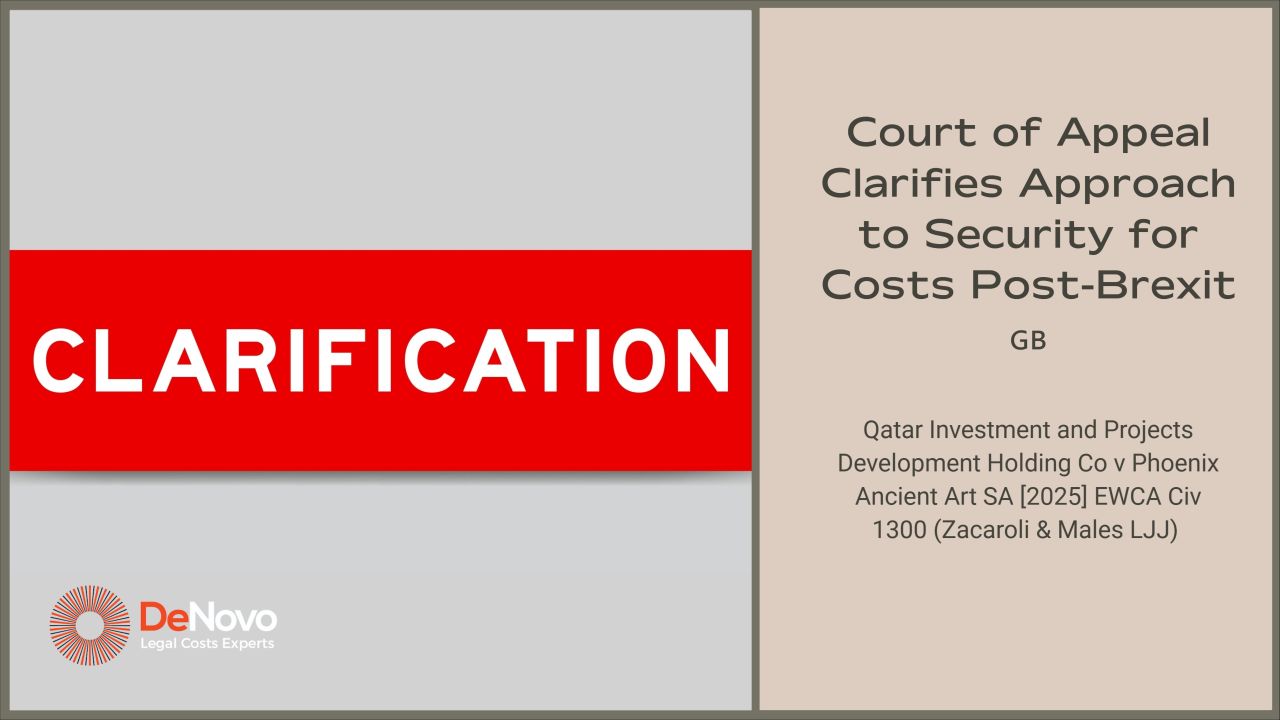
- LINKEDIN · IMAGERecorded 15 Sept 2026
⚖️ Court of Appeal Clarifies Approach to Security for Costs Post-Brexit The decision in Qatar Investment and Projects Development Holding Co v Phoenix Ancient Art SA [2025] EWCA Civ 1300 provides a nuanced exploration of security for costs on appeal under CPR Part 25, particularly in the post-Brexit and post-2025 Rules landscape. 🧩 Background The dispute stemmed from two actions (2020 and 2023) concerning allegedly forged artefacts sold by Phoenix Ancient Art S.A. and its principals, Ali and Hicham Aboutaam. Following disclosure breaches, Garnham J struck out the defendants’ defences and entered summary judgment for the claimants. The appellants challenged those orders; the claimants in turn sought security for their costs of appeal, totalling ~US$229,000 (or 75% of anticipated costs). ⚙️ Legal Issues The application turned on three grounds under CPR 25.27(b): 1️⃣ Residence abroad – the appellants were resident in Switzerland and the US; 2️⃣ Inability to pay – reason to believe Phoenix could not meet a costs order; 3️⃣ Steps making enforcement difficult – alleged asset dissipation and nondisclosure. Zacaroli LJ held that all three conditions were met, drawing on authorities such as Phaestos Ltd v Ho [2012] EWHC 662 (TCC) and Ackerman v Ackerman [2011] EWHC 2183 (Ch). 📚 Highlights ❕ Post-Brexit transitional rules: The Court rejected the argument that pre-2020 proceedings preserved the old CPR 25.13 test. The Civil Procedure (Amendment) Rules 2025 (SI 2025/106) supersede prior versions, even for pre-Brexit claims. ❕ Evidential threshold: “Reason to believe” under CPR 25.27(b)(ii) demands more than doubt—there must be tangible justification that the party will be unable to pay. ❕ Asset concealment & dissipation: Failure to disclose assets can itself support an inference of concealment under Ackerman principles. ❕ Non-discrimination: Following Bestfort Developments LLP v RAKIA [2016] EWCA Civ 1099, the Court stressed that residence abroad is not per se discriminatory if objectively justified by enforcement risks. ❕ Quantum: Though conditions satisfied, security limited to £70,000—a proportionate figure reflecting only the costs of responding to the appeal, (excluding respondent’s notice). 🧠 Takeaways ❕ The 2025 CPR reforms have unified the approach to security for costs, removing Brexit-era carve-outs. ❕ Evidence of insolvency and asset opacity remains pivotal—mere assertions of impecuniosity won’t suffice. ❕ Courts will calibrate security to proportionality and procedural fairness, especially where appeal points are confined to law. ❕ Practitioners should carefully separate enforcement risk analysis from residence-based discrimination concerns. 💡 Final Outcome Security for costs granted, but reduced from £225,000 to £70,000 — a balanced exercise of discretion ensuring fairness while safeguarding enforceability. #CivilProcedure #SecurityForCosts #CourtOfAppeal #CPR2025 #PostBrexitLaw #CostsOrders #CommercialLitigation #DenovoCostsExperts
- LINKEDIN · IMAGERecorded 15 Sept 2026
✈️ AerCap v AIG Europe SA (2025): The Costs Judgment in High Stakes Russian Aircraft Lessor Litigation Mr Justice Butcher’s October 2025 ruling on costs and interest in the AerCap litigation provides one of the most detailed modern applications of CPR r.44.2 to complex multi-party insurance claims. Following his main judgment in June, this decision disentangles responsibility for £100M+ in litigation costs across war risks and all-risks insurers. 💰 The Core Cost Principles 💠 The court reaffirmed that “the successful party gets its costs” (r.44.2(2)), but that rule is not absolute — particularly where parallel alternative claims are pursued against multiple defendants under different perils. 💠 Justice Butcher applied a structured, issue-based analysis drawn from Serious Fraud Office v Litigation Capital Ltd [2021] EWHC 2803 (Comm), emphasizing: ➡️ The proportion of trial time and importance of each issue (here, the “peril” question consumed the majority of the hearing); ➡️The need for practical, percentage-based reductions rather than fine-grained “issue-by-issue” cost allocation. ⚖️ Allocation and Apportionment 💠 AerCap succeeded against war risk insurers, but only after running (and losing) its primary “all risks” case. 👉 Result: recovery of 65% of its costs from the war risk insurers. 💠All-risks insurers (HFW/Chubb), as successful defendants, were entitled to their costs — subject to a 10% deduction for non-peril issues. 💠The court made a Sanderson order (not Bullock) requiring war risk insurers to pay 65% of 90% of HFW’s costs, given the intertwined issues of causation between all-risks and war-risks perils. 💠Cost liability was ordered to be several, not joint, reflecting the underlying several nature of insurance lines. 📉 Interest on Costs 💠Interest on costs was awarded at 1% above Bank of England base rate, switching to 8% (Judgments Act 1838) three months after service of a detailed bill — a pragmatic nod to the scale and complexity of these costs assessments. 💠Payments on account were ordered at 45–50% of recoverable proportions, reflecting judicial caution over the “astronomical” sums involved (AerCap’s total c. £81m). 🔍 Key Takeaways for Practitioners 💠The judgment underscores the discretionary elasticity of CPR 44.2 in multi-defendant, alternative-claim litigation. 💠Sanderson orders remain a potent, if “strong,” tool to avoid injustice in complex insurance structures where causation is disputed across markets. 💠The ruling reinforces the importance of properly pleading cost-shifting arguments (including interest rate challenges) — a lesson not only on substance but on procedural discipline. 🚀 For insights or collaboration on complex legal costs matters, you can reach DeNovo | Legal Costs Experts via the web or connect with us here on Linkedin.🚀 #LitigationCosts #InsuranceLaw #WarRisks #SandersonOrder #AerCap #CPR44 #InterestOnCosts #CommercialCourt #AviationLaw #DenovoCostsUpdates
- LINKEDIN · IMAGERecorded 15 Sept 2026
⚖️ Interest on VAT and Costs: Pharos Offshore v Keynvor Morlift (TCC, 2025) In a detailed follow-up to its main judgment, the Technology and Construction Court (Constable J) examined a series of consequential issues — most notably, whether interest can accrue on the VAT element of a commercial debt, and the appropriate treatment of costs under CPR 36.17. 💰 Interest on VAT under the Late Payment Act The defendant, Keynvor Morlift Ltd (KML), argued that statutory interest under the Late Payment of Commercial Debts (Interest) Act 1998 should not run on the VAT portion of the claimant’s invoices. 💠 KML contended that VAT is not part of the "contract price" (s.3(1) LPA), citing its own contractual clause that defined the price as “exclusive of VAT”. 💠The court rejected this argument. Constable J held that the obligation to pay VAT arose under the contract itself, not merely under statute — making VAT part of the “qualifying debt”. 💠The judge emphasised that nothing in the LPA excludes VAT from its scope and that Parliament intended the regime to discourage late payment, even if this results in a “windfall” beyond purely compensatory interest. 📚 Key takeaway: Interest under the LPA does accrue on VAT, even where the contract defines prices as VAT-exclusive, provided that the contract itself imposes a corresponding obligation to pay VAT. This ensures consistency between VAT-inclusive and VAT-exclusive pricing models. ⚖️ CPR 36 and Enhanced Interest on Costs Pharos had made a Part 36 offer to settle for £550,000 (inclusive of VAT, counterclaim and interest), which KML failed to beat. 💠Under CPR 36.17(4), the court awarded indemnity costs from the expiry of the offer period, with enhanced interest of 5% above base rate (a mid-range uplift between the 4–10% range seen in comparable cases). 💠The judge declined to restrict this interest to exclude VAT, noting that Part 36 aims to incentivise early settlement, not to narrow the scope of recoverable sums. 💼 On pre-offer costs, Constable J refused to depart from the general rule that costs follow the event, despite the defendant’s partial success on its counterclaim. 🧭 Practical Implications ❕ VAT-inclusive interest exposure: Businesses should be alert that LPA interest may run on VAT components of overdue invoices. ❕Part 36 strategy: Even late-stage offers can have major costs consequences — including enhanced interest on both principal and costs. ❕Judicial discretion on uplift: Courts will calibrate the enhanced rate based on conduct, timing, and proportionality — but 4–5% above base rate remains the practical benchmark in TCC litigation. #ConstructionLaw ⚙️ #CommercialLitigation 💼 #LatePaymentAct #CPR36 #InterestOnVAT #TCC #LegalCosts #ContractLaw #UKLaw #PharosOffshore #DeNovoCostsUpdates
- LINKEDIN · IMAGERecorded 15 Sept 2026
⚖️ Google LLC v Robertson [2025] EWCA Civ 1262 — Costs, Causation & Judicial Discretion 💼 In this Court of Appeal decision, Google successfully appealed against a finding that service of Mr Robertson’s claim form was valid despite procedural defects. Alongside the procedural issue, the case raises a technically interesting point on costs and causation under CPR r.44.3. 💬 The Costs Issue After the County Court granted Mr Robertson relief from sanctions, it ordered him to pay Google’s costs of the application — following the usual rule that the party seeking relief bears the costs. Google appealed the principal ruling and Robertson cross-appealed, arguing that a substantial portion of those costs related instead to Google’s unsuccessful jurisdictional challenge. He contended there was no causal link between that argument and his own application for relief from sanctions, so the costs order was overly broad. The Court of Appeal (Coulson LJ giving judgment) dismissed the cross-appeal, reaffirming the wide discretion afforded to judges in costs matters. Applying SCT Finance v Bolton [2003] 3 All ER 434, the court reiterated that appellate interference is rare unless the order is plainly unprincipled. Even though Coulson LJ acknowledged he might have reduced costs by around 20 percent, he emphasised that this was not the test — the question is whether the decision was open to the judge. 📚 Key Takeaways for Practitioners 💠Causation remains central — costs must relate to the issues caused by a party’s default, but overlap with related issues won’t automatically disentitle recovery. 💠Discretion is paramount — appellate courts will intervene only where there is an error of principle or manifest unfairness. 💠Relief from sanctions and costs — applicants for relief should anticipate paying the costs of that application even if they succeed. 💠Jurisdictional arguments that emerge because of procedural failings may still legitimately influence the overall costs landscape. 🔍 Why It Matters The court’s reasoning aligns with a pragmatic view of case management: where a procedural misstep (here, invalid service) triggers additional argument, those costs fall on the party responsible. Judgment of 07/10/25 available here: https://lnkd.in/ejiQMN9P 🚀 For insights or collaboration on complex legal costs matters, you can reach DeNovo | Legal Costs Experts via the web or here on LinkedIn.🚀 #CivilProcedure #CostsLaw #ReliefFromSanctions #CPR44 #CourtOfAppeal #LitigationStrategy #GoogleLLCvRobertson #ServiceOfProcess #UKLaw #DeNovoCostsUpdates





6 of 37 adsSign up to see every DeNovo | Legal Costs Experts ad, filter by format and date, and get alerts on new ones.
See all 37 adsWatch the companies you care about.
Filter every ad by industry, country, format and network, and get alerts when a company you watch starts running new ads.