Not on air · 2 of 3 networks checked
Credisense
- credisense.com
- Fintech & Financial Services
- NZ
- 14 employees
Credisense’s ads on LinkedIn, Meta and Google, recorded by adsrunning. Browse the latest here for free. Sign up free to see all 23. Watch Credisense with Starter to get each new one in your feed.
Watchlist with Starter · $49/mo
| Network | Status | Live ads | Nov 2025LinkedIn activity · 52 weeksNov 2026 | Checked | Next step |
|---|---|---|---|---|---|
| None recorded | 0 | Checked 31 Oct 2026 | See all 23 ads → | ||
| Meta | Not checked | — | |||
| None recorded | 0 | No ads found on the Google Ads Transparency Center | Checked 26 Oct 2026 | Collect them with the API → |
Credisense has no live LinkedIn ads. We recorded no Google ads on 26 Oct 2026.
Latest ads
- LINKEDIN · IMAGESince 24 Aug 2026
Six days before the EU AI Act's credit-scoring rules were due to bite, Brussels moved the deadline to December 2027. Much of the coverage still reports the old date. The Official Journal says otherwise: the Digital Omnibus, in force since 27 July, deferred the high-risk obligations, credit scoring included. For lenders in our part of the world, the reprieve is the least interesting part. The obligations did not change, only the date: risk management, data governance, human oversight, logging, explainability. That is not a European compliance checklist. It is a description of the decisioning infrastructure lenders will need everywhere, because regulators in every market read the same homework. And the quieter lesson: the deadline itself moved with six days notice. If changing your credit systems takes a quarter, regulation at this velocity is unfollowable. Our full read, including what to build during the extension: https://lnkd.in/euiJcy7K #EUAIAct #CreditRisk #AIinFinance #Lending #RegTech
- LINKEDIN · IMAGERecorded 8 Oct 2026
Two months in with the FMA as New Zealand's consumer credit regulator, one obligation is reshaping operations more than any other: self-reporting. Self-reporting assumes you can find your own breaches before the regulator does. That is not a compliance-team virtue, it is a systems property: decision records you can query, override trails you can read, policy versions you can compare against what actually ran. Licensed lenders are discovering that auditability is no longer a project you schedule. It is an operating requirement you either have or do not. Thanks to the NZ Credit and Finance Institute for the work it does keeping this community across the change. NZCFI #CCCFA #FMA #NewZealand #Lending #Compliance https://lnkd.in/eCHG6_dN
- LINKEDIN · IMAGERecorded 8 Oct 2026
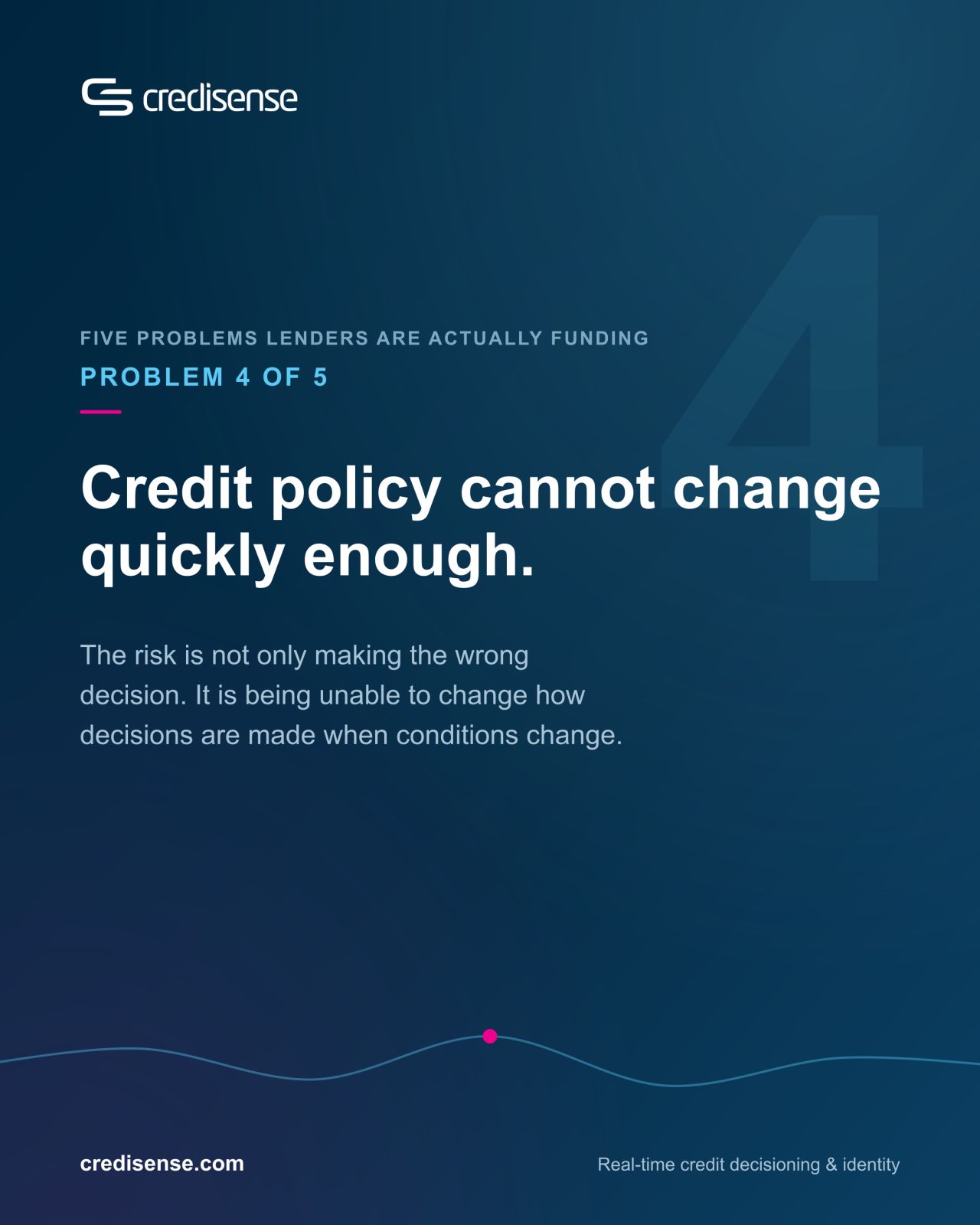
Problem 4 of 5: credit policy cannot change quickly enough. The risk is not only making the wrong decision. It is being unable to change how decisions are made when conditions change. And conditions are changing monthly: liquidations at multi-year highs, a hold-high rate cycle, fraud patterns that reinvent themselves each quarter. If adjusting a serviceability buffer or a sector limit means a vendor ticket, a release cycle and a quarter of waiting, then your live policy is always a description of the previous quarter. Credit teams on Credisense change policy themselves: versioned, simulated against real volume, effective-dated, reversible. The change that used to be a programme is an afternoon. #CreditPolicy #Lending #CreditRisk
- LINKEDIN · IMAGERecorded 22 Sept 2026
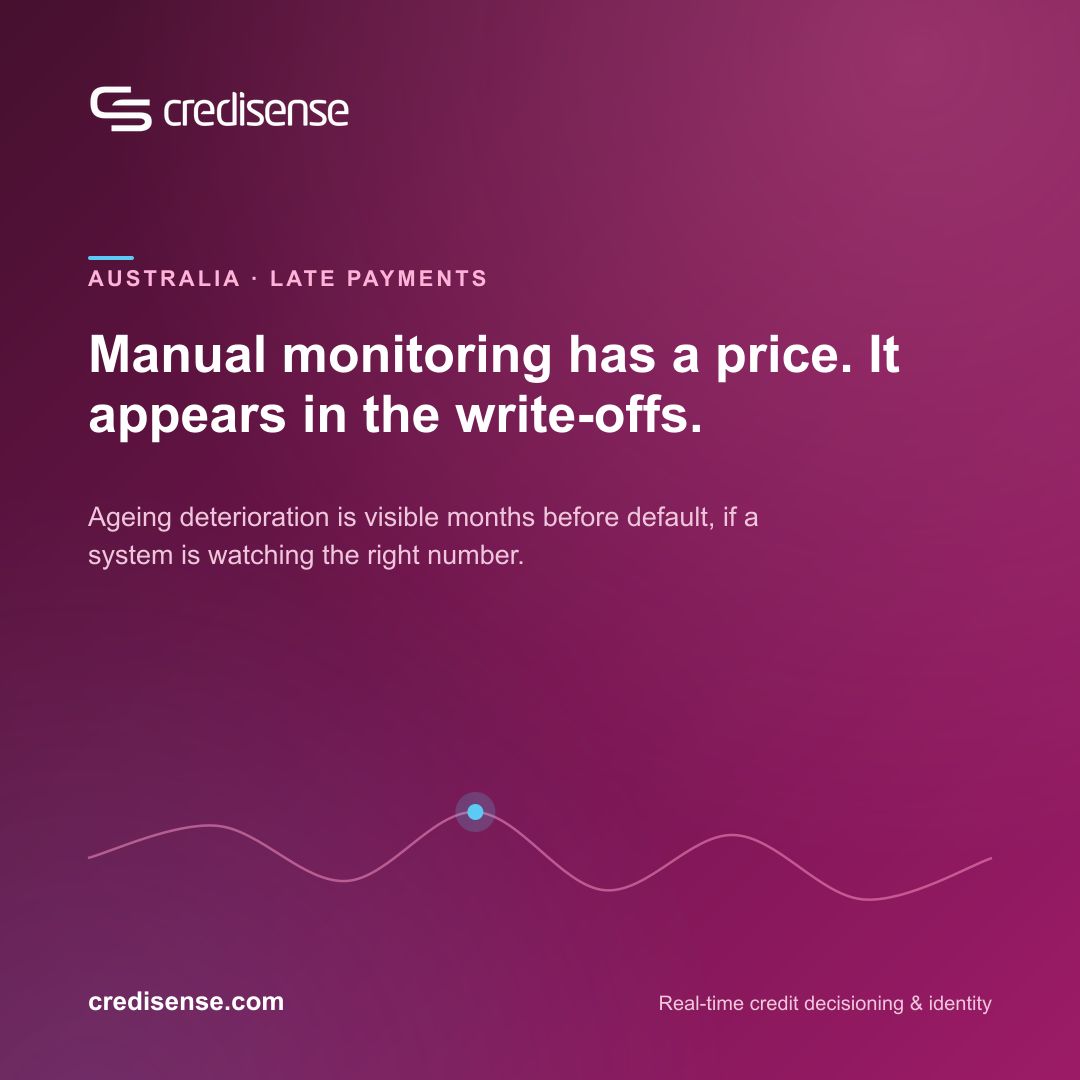
Manual monitoring has a price. It does not appear on the operations budget. It appears in the write-offs. Australian B2B late payments remain around their highest levels in six years, with stress concentrated in sectors tied to household spending. The signal is visible months before default, in ageing drift, in payment-pattern change, in order behaviour. A monitoring process that depends on someone finding time to run the report is a process that finds out late. The cost question and the risk question have the same answer: watch the number automatically, act on triggers, spend the analyst hours on the accounts that need judgement. #TradeCredit #CreditRisk #AccountsReceivable https://lnkd.in/eeMXxD4t
- LINKEDIN · IMAGERecorded 22 Sept 2026
A default is the end of a process. Ageing deterioration is the start of one. The customer drifting from 30 to 75 days is telling you something months before their bank knows it, and long before a bureau records it. The question is whether anything in your process is listening. The shift worth making: turn ageing deterioration into a defined trigger that re-scores the account and reviews the limit automatically, rather than a conversation that happens after the write-off risk has arrived. Next week we start walking through the five problems lenders are actually funding. This is a preview of the territory. #TradeCredit #CreditManagement #AccountsReceivable https://lnkd.in/evkMeb2K
- LINKEDIN · IMAGERecorded 22 Sept 2026
New Zealand's credit story is running in two directions at once. Consumer arrears are at their lowest level since 2021. Mortgage arrears are the best they have been since late 2022. On the household side, the healing is real. Company liquidations are at an 11-year high. Construction leads the count. Hospitality is deteriorating fastest. IRD recovery activity is pulling weak balance sheets over the edge. If you extend credit to businesses, the second line is your line. The gap between those two stories is where credit policy earns its keep this year. #CreditRisk #NewZealand #Insolvency #TradeCredit https://lnkd.in/euzAx983




6 of 23 adsSign up to see every Credisense ad, filter by format and date, and get alerts on new ones.
See all 23 adsWatch the companies you care about.
Filter every ad by industry, country, format and network, and get alerts when a company you watch starts running new ads.