On air · 2 of 3 networks
CommerceIQ
- commerceiq.ai
- Consumer, Retail & E-commerce
- US
- 610 employees
CommerceIQ’s ads on LinkedIn, Meta and Google, recorded by adsrunning. Browse the latest here for free. Sign up free to see all 459. Watch CommerceIQ with Starter to get each new one in your feed.
Watchlist with Starter · $49/mo
| Network | Status | Live ads | Nov 2025LinkedIn activity · 52 weeksOct 2026 | Checked | Next step |
|---|---|---|---|---|---|
| Running | 309 | Checked 30 Oct 2026 | See all 459 ads → | ||
| Meta | Not checked | — | |||
| Running | 39 | Ads on the Google Ads Transparency Center | Checked 25 Oct 2026 | Collect them with the API → |
CommerceIQ has 309 live LinkedIn ads. We recorded 39 Google ads on 25 Oct 2026.
Latest ads
- LINKEDIN · IMAGESince 26 Aug 2026
Brands are seeing fewer views on their product pages since Alexa for Shopping moved into Amazon's search bar in May. The shopping agent provides customers with a shortlist of products, so shoppers no longer have to scroll through pages of search results to find and compare their options. Shoppers who use Alexa for Shopping are more likely to make a purchase, since the agent surfaces exactly what they need. That makes every recommendation a brand doesn't get costly. Optimizing for shopping agents is different than winning share of search. Brands have to shift their strategies to update listings for agents, not keywords. In my latest piece, I wrote about how brands are making it onto Alexa for Shopping's shortlists: https://hubs.li/Q04sL-4w0 #AlexaForShopping #AEO #DigitalShelf #CPG #Ecommerce #AgenticRetail
- LINKEDIN · IMAGESince 23 Aug 2026
50.9% of AI shoppers have walked away from a purchase after an AI assistant flagged a concern with the product. That's the new reality of ecommerce. Shoppers aren't just searching anymore: a third of Amazon queries are now questions, not keywords; and AI shopping assistants like Alexa for Shopping and Walmart's Sparky are answering them before a customer ever sees your product page. The upside is real: Alexa for Shopping customers spend 40% more per order, and Sparky shoppers build baskets ~35% larger than non-users. But only if your content actually answers the questions these assistants get asked. That's what Answer Engine Optimization (AEO) is for. And it builds on SEO, it doesn't replace it. In our latest blog post, we break down how brands can audit, prioritize, and rewrite product content so AI assistants recommend them instead of a competitor. Read the full post: https://lnkd.in/ec_G_GRg #AnswerEngineOptimization #AgenticCommerce #DigitalShelf #ecommerce #RetailMedia
- LINKEDIN · IMAGESince 22 Aug 2026
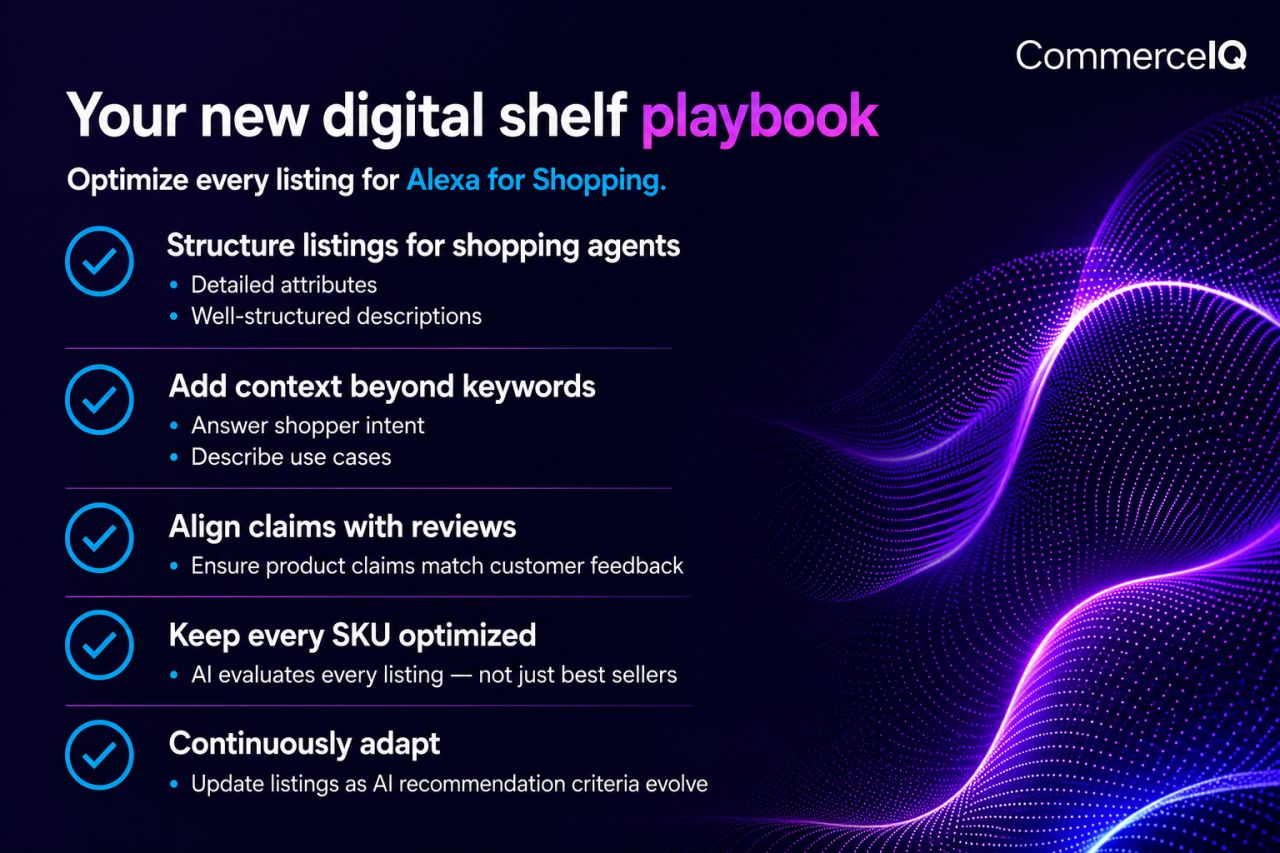
Amazon moved Alexa for Shopping into the main search bar in May, making an AI shopping agent the default first stop for product discovery. The way shopping agents evaluate product pages differs from how brands traditionally optimized listings for search. The agents review a product page more thoroughly before recommending it on a shortlist, so even a brand with a high share of search may not be included. Agents also recommend different shortlists to each shopper, tailored to what they already know about them from past purchases and preferences. A single optimized page no longer puts a brand in front of everyone. In her latest piece, Emmanuelle Gounot, VP of Customer Success at CommerceIQ, shares the new digital shelf playbook for brands selling on Amazon: https://hubs.li/Q04sr0HQ0 #AlexaForShopping #AEO #DigitalShelf #CPG #Ecommerce #AgenticRetail
- LINKEDIN · IMAGESince 1 Aug 2026
AI agents are becoming the primary way shoppers find and buy products. The brands appearing in agent recommendations are capturing that traffic. The brands that are still optimizing only for traditional search are being filtered out before a shopper ever sees them. The difference comes down to how agents read product pages. Search algorithms rank by title and keywords. AI agents scan descriptions, reviews, bullet points and pricing to determine whether a product matches what the shopper actually asked for. Most product pages aren't built for that. When Newell Brands deployed a content agent to optimize PDPs for SEO, AEO and GEO, the company saw a 40x improvement in time saved across thousands of SKUs. Brands need agents to talk to agents if they want to keep showing up wherever AI decides what shoppers see. Read the full article here: https://hubs.li/Q04qzWPM0 #AgenticRetail #CPG #Ecommerce #ProductDiscovery #RetailAI Emmanuelle Gounot
- LINKEDIN · IMAGESince 1 Aug 2026
The 80/20 rule was a capacity constraint. Now it's a choice. Most CPGs used to only update 20% of the catalog, while 80% remained untouched. Meanwhile, more than half of CPG leaders say agency costs are too high relative to results. The traditional agency model penalizes scale. Every additional SKU added to active management requires more hours and a higher retainer. Agentic retail inverts this. Each additional SKU costs less as AI agents manage more of the catalog, generating more revenue from previously dormant listings. A content agent updates a product page in 35 seconds, compared to 35 minutes for a human. And every decision runs on a unified data model — so when spend gets adjusted on one SKU, the agent already knows what's happening across the rest of the catalog. Read the full article here: https://lnkd.in/eWcFDkYi #AgenticRetail #CPG #Ecommerce #SKUManagement #RetailAI
- LINKEDIN · IMAGESince 1 Aug 2026
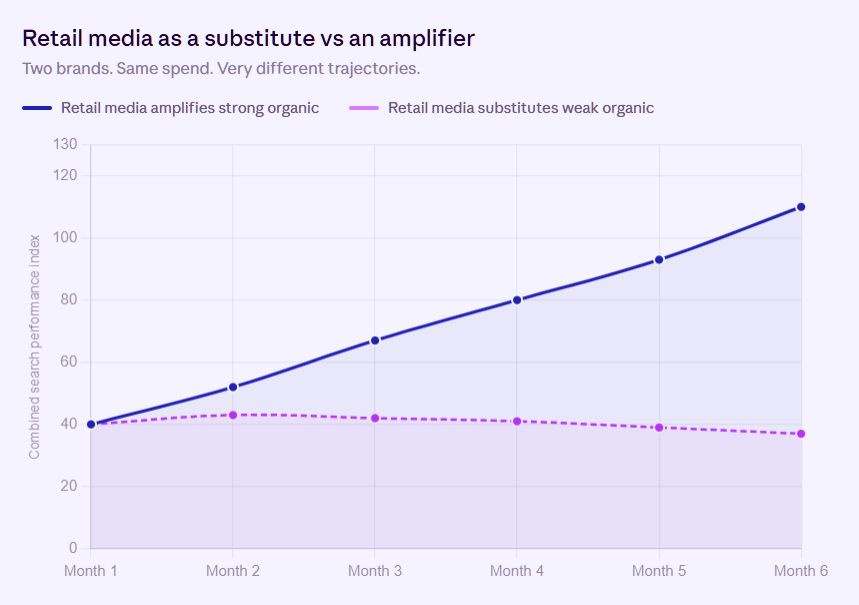
There's a pattern I keep seeing across CPG brands right now. Organic search rankings drop. Sales and market share follow. The response? Increase retail media spend to plug the gap. Great when I think about my previous role 😉. Not so great if you are the brand. It works briefly. But it's an expensive way to paper over a structural problem and in today’s climate it’s probably not a great plan to keep asking for additional budget. I see it on Amazon, on Tesco, on Carrefour and many others. The brands spending more on sponsored placements whilst their organic content is weak are just renting visibility they should own. Retail media spend is designed to amplify strong organic performance. When it becomes a substitute for it, the economics stop making sense. The brands we work with are pulling ahead and doing it differently. They fix the content and visibility gap first: titles, attributes, search terms. Then they use retail media to accelerate what's already working organically. Sponsored placements on top of strong organic presence compound positively. Sponsored placements on top of weak organic presence just burns budget. The question isn't how much to spend on retail media. It's whether your organic foundation is strong enough to make that spend worth it. See what building that foundation looks like: https://lnkd.in/gEw5NHpN




6 of 459 adsSign up to see every CommerceIQ ad, filter by format and date, and get alerts on new ones.
See all 459 adsWatch the companies you care about.
Filter every ad by industry, country, format and network, and get alerts when a company you watch starts running new ads.