On air · 3 of 3 networks
Cedars Digital
- cedars-digital.com
- Climate & Energy
- SG
- 45 employees
Cedars Digital’s ads on LinkedIn, Meta and Google, recorded by adsrunning. Browse the latest here for free. Sign up free to see all 109. Watch Cedars Digital with Starter to get each new one in your feed.
Watchlist with Starter · $49/mo
| Network | Status | Live ads | Nov 2025LinkedIn activity · 52 weeksOct 2026 | Checked | Next step |
|---|---|---|---|---|---|
| Running | 100 | Checked 30 Oct 2026 | See all 109 ads → | ||
| Meta | Running | 7 | Active ads on the Meta Ad Library, all countries | Checked 27 Oct 2026 | Collect them with the API → |
| Running | 3 | Ads on the Google Ads Transparency Center | Checked 24 Oct 2026 | Collect them with the API → |
Cedars Digital has 100 live LinkedIn ads. Its Facebook page had 7 active ads on 27 Oct 2026, and we recorded 3 Google ads on 24 Oct 2026.
Latest ads
- LINKEDIN · IMAGESince 7 Oct 2026
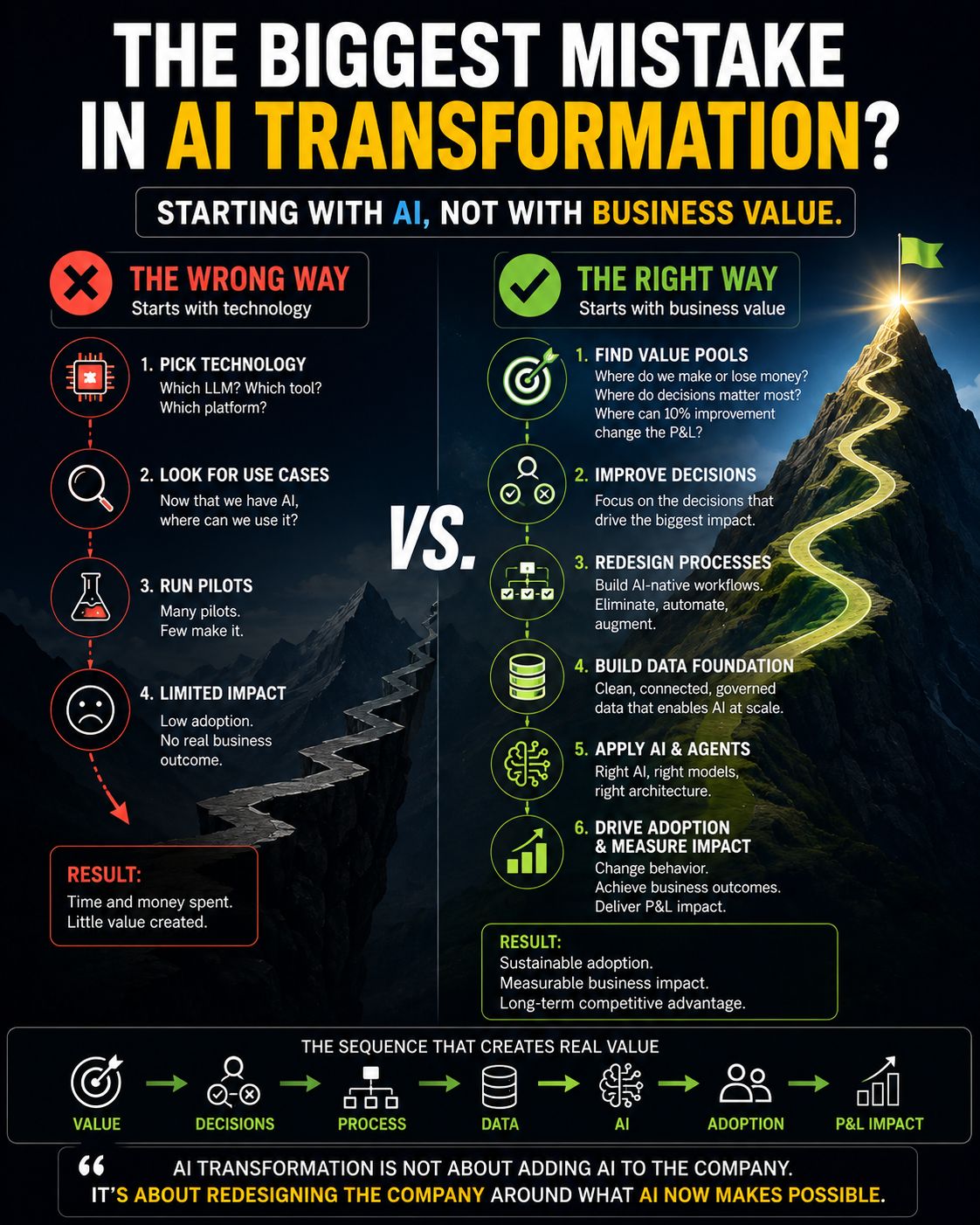
Most companies don’t fail at AI because they chose the wrong technology. They fail because they started with technology. They ask: Which LLM? Which Copilot? Which Agent? Which platform? Then comes the question: “Now that we have AI, where can we use it?” I believe that’s backwards. AI transformation should not start with AI. It should start with business value. 1. Start with Value Pools, not AI use cases. Before asking what AI can do, ask: Where do we make or lose money? Where are decisions too slow? Where are customers dropping off? Where is working capital trapped? Most importantly: If we improve this by 10%, does it materially change the P&L? The process consuming the most hours is not necessarily the one creating the most value. Saving 5,000 administrative hours may help, but improving pricing, conversion, inventory, yield, or time-to-market by a few percentage points may be worth 10x more. 2. Don’t just analyze work. Analyze decisions. Companies are not simply collections of tasks. They are collections of decisions. What should we quote? How much inventory should we hold? Which supplier represents the greatest risk? Which CapEx should we approve? Some of AI’s greatest value won’t come from replacing work, but from improving the quality and speed of decisions. 3. Don’t automate the old process. Redesign it. If ten people are passing spreadsheets, checking information and requesting approvals, adding AI while keeping the same workflow is just faster bureaucracy. Ask instead: If we built this company today, with AI available from Day 1, would we design the process the same way? Some steps should be automated. Some approvals should disappear. AI should execute routine work, while humans increasingly focus on judgment and exceptions. 4. AI is only as scalable as the data underneath it. Broken master data, disconnected systems, unclear ownership and poor data lineage will eventually limit AI at scale. AI doesn’t fix bad data. At scale, it amplifies it. But don’t spend three years building a “perfect data platform” either. Build the data foundation around the business value you are trying to unlock. 5. Deployment is not the finish line. P&L impact is. A successful PoC is not success. 95% model accuracy is not success. Even enterprise-wide deployment is not success. If behavior doesn’t change and business outcomes don’t move, the value is still zero. Every major AI initiative should connect: Business Owner → Baseline → Target → Adoption → Business Outcome → P&L Impact The sequence matters: Value → Decisions → Process → Data → AI → Adoption → P&L Tools will change. Models will change. The enduring capability is knowing where value exists, what should be redesigned, which decisions should improve, and where AI can fundamentally change how the company operates. AI transformation is not about adding AI to the company. It’s about redesigning the company around what AI now makes possible. #AI #AITransformation #EnterpriseAI #Leadership #CEO
- LINKEDIN · IMAGESince 7 Oct 2026
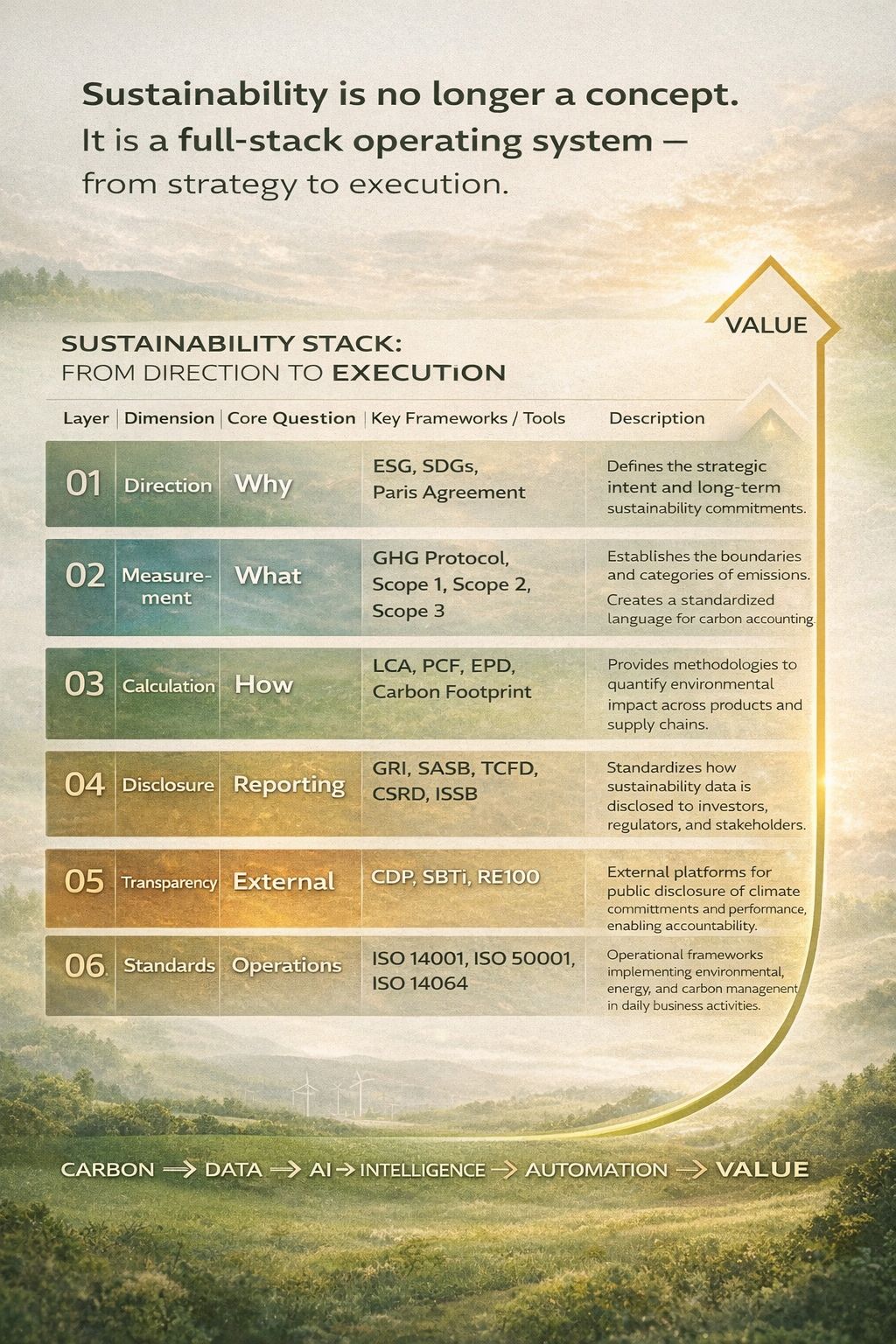
Sustainability is no longer a concept. It is becoming a real-time operating system for the global economy. What we are seeing today is not just a collection of frameworks — ESG, GHG, LCA, CSRD, ISO… It is the formation of a new economic stack. At the top, we define direction: → ESG, SDGs, Paris Agreement Then we standardize measurement: → GHG Protocol, Scope 1–3 We quantify impact: → LCA, PCF We disclose and connect to capital markets: → GRI, TCFD, CSRD, ISSB And we operationalize through standards: → ISO systems But here’s the real shift: Most companies are still focused on reporting. The next generation of leaders will focus on optimization. → Carbon becomes data → Data becomes intelligence → Intelligence drives automation → Automation creates value This is where AI, energy, and infrastructure converge. The question is no longer “How do we report ESG?” The question is: “How do we build systems that optimize carbon in real time?” #ESG #AI #Energy #Carbon #Infrastructure #NetZero
- LINKEDIN · IMAGESince 7 Oct 2026
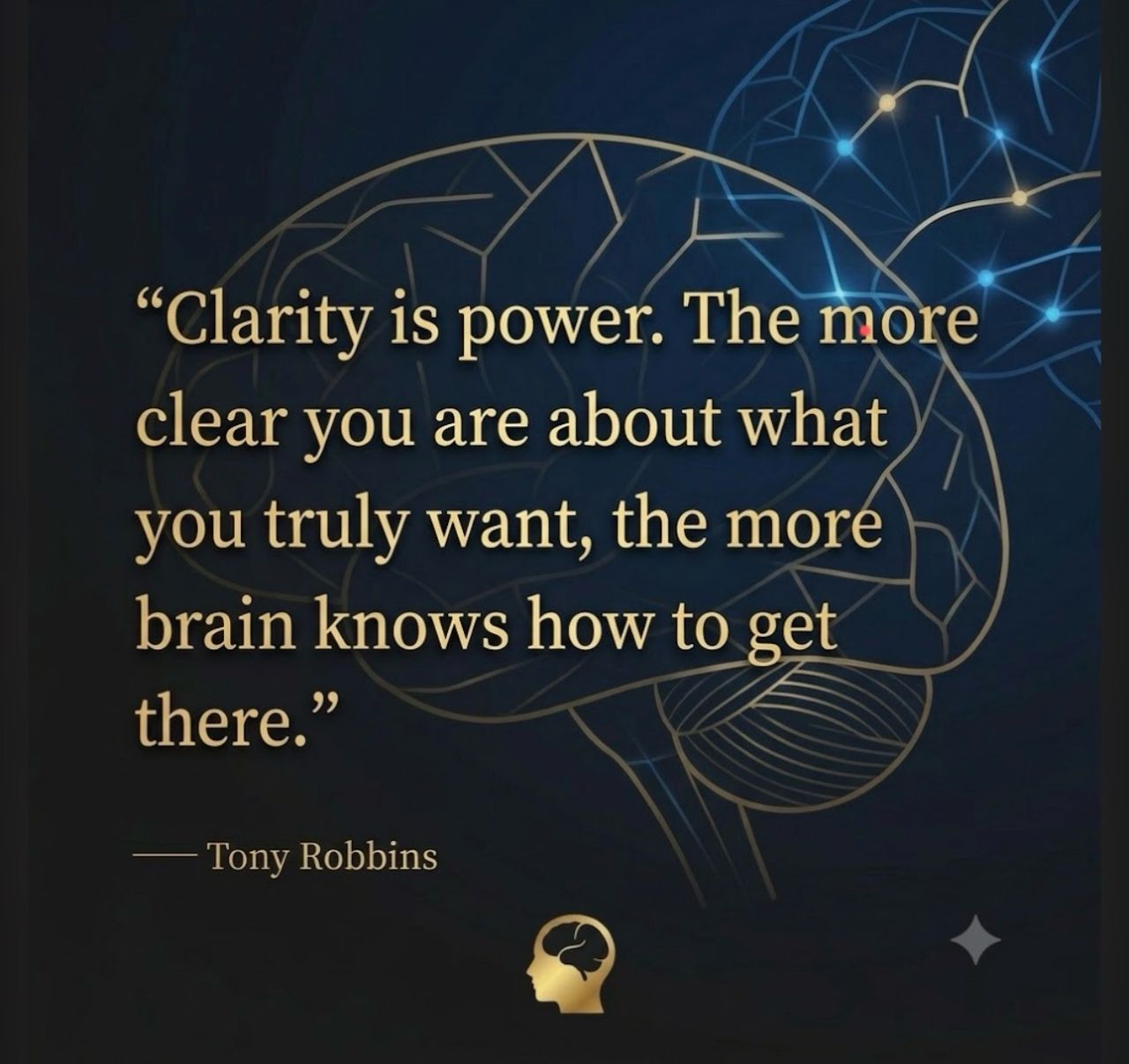
Ambiguity Is Killing Your Competitive Advantage Recently, while revisiting Tony Robbins’ Awaken the Giant Within, one quote stood out to me: “Clarity is power. The clearer you are about what you truly want, the more your mind knows how to get there.” Many transformation efforts do not fail because of a lack of talent, resources, or hard work. In fact, the opposite is often true. People are working harder than ever. Projects are moving. Teams are busy. Yet progress feels slower than expected. Why? Because the real challenge is often not execution. It is clarity. Organizations become trapped in: • Unclear vision • Unclear priorities • Unclear strategy • Unclear resource allocation • Unclear accountability The danger of ambiguity is that it creates the illusion of progress. Everyone is busy. Few are moving in the same direction. I’ve come to believe that ambiguity is often a form of avoidance. Because clarity comes with a price. It forces us to face reality, make difficult choices, say no to distractions, and accept accountability. As a result, many individuals—and organizations—choose ambiguity over clarity. Not consciously. But consistently. Ambiguity typically appears in six forms: 1. Goal Ambiguity 2. Financial Ambiguity 3. Positioning Ambiguity 4. Value Ambiguity 5. Boundary Ambiguity 6. Communication Ambiguity This is why many transformation efforts struggle. Organizations spend enormous time discussing: • What projects to launch • What technologies to invest in • What initiatives to prioritize But spend far less time discussing: • What do we want to become in 5–10 years? • Which businesses will drive our future? • Which capabilities must we build? • What problem are we uniquely positioned to solve? Without clear answers: Activity increases. Alignment decreases. Vision is not a slogan. Strategy is not a collection of projects. Vision answers: Where are we going? Strategy answers: How will we get there? Execution answers: What are the most important things we must do today? When vision is unclear, strategy becomes tactical. When strategy is unclear, execution becomes busyness. The most successful organizations are not necessarily the fastest executors. They are the clearest thinkers. Because every investment decision, organizational structure, talent strategy, and technology roadmap ultimately stem from one thing: Clarity. And clarity is not a destination. It is a discipline. In a world overwhelmed by complexity, uncertainty, and constant change, clarity may be one of the most undervalued leadership capabilities—and one of the most powerful competitive advantages. #Leadership #Strategy #Transformation #CorporateStrategy #BusinessTransformation #Vision #Execution #CEO #LeadershipDevelopment #Management #OrganizationalTransformation #AITransformation #CompetitiveAdvantage #Clarity
- LINKEDIN · VIDEOSince 16 Sept 2026
America does not necessarily have a power generation problem. It has a power allocation problem. The U.S. already has more than 1,200 GW of installed generation capacity, while average load is only around 470 GW and recent summer peaks are roughly 750 GW. The bigger challenge is not simply building more power plants. It is improving transmission efficiency, regional load balancing, peak demand management, and the speed of infrastructure upgrades. But beyond the grid itself, there is another challenge that often gets overlooked: waste. Daytime streetlights may seem like a small issue, but they are often a visible symptom of deeper problems in city operations and infrastructure maintenance. If a city has 200,000 streetlights and just 5% remain on during the day, that means 10,000 lights are consuming electricity unnecessarily. Assuming each fixture is only 100W and remains on for an average of 14 unnecessary daylight hours per day, that adds up to more than 5.1 million kWh of wasted electricity annually, or roughly $766,000 in unnecessary electricity costs every year. And that is only the direct energy cost. The hidden costs are even greater: • Large numbers of failed photocells and insufficient maintenance crews • Aging control systems with no real-time visibility • Shorter fixture life • Additional carbon emissions • Municipal budgets being consumed by unnecessary operating costs Many cities do not lack budget. They lack efficiency. Limited budget leads to delayed maintenance. Delayed maintenance leads to more wasted electricity. More waste reduces available operating budget. And the cycle continues. A truly smart city is not just about replacing fixtures with LED. It is about making every light intelligent enough to know when it should be on, when it should be off, and when it needs maintenance. For many cities, improving lighting control efficiency is one of the easiest, fastest, and most overlooked ways to reduce waste. $800,000 per year could already support a meaningful upgrade of the lighting system. Upgrading to AI-connected lighting creates value far beyond energy savings. Cities can know in real time: • Which light is out • Which area has abnormal daytime burn • Which road segment is underlit • Which assets need priority dispatch Instead of waiting for citizen complaints, manual inspections, or failures to occur, cities can shift from reactive maintenance to predictive maintenance. The greatest value of AI-connected lighting is changing the model from “people searching for problems” to “systems identifying problems automatically.” This not only reduces electricity costs and carbon emissions, but also allows limited maintenance staff to focus on traffic signals, public safety systems, and other critical infrastructure. LEOTEK RenAI was recognized this year at the Edison Awards. Contact us to learn how AI can make road infrastructure dramatically smarter.
- LINKEDIN · VIDEOSince 16 Sept 2026
As the U.S. federal government continues advancing the Build America, Buy America (BABA) initiative, the importance of domestic manufacturing is becoming even more evident. For us, this is not simply about regulatory alignment — it reflects a long-term commitment to supporting American industry, strengthening supply-chain resilience, and contributing to the future of critical infrastructure. Over the years, we have steadily built local manufacturing capabilities in the United States. Today, we are proud to be the only company producing lighting and intelligent traffic solutions in Silicon Valley, while also partnering with Lite-On Technology to develop EV charging equipment manufacturing in Plano, Texas. This footprint is more than a manufacturing decision — it reflects our belief that essential infrastructure technologies should be built close to the markets and communities they serve, with long-term value and sustainability at the core. Looking ahead, we are carefully evaluating further expansion of our U.S. manufacturing capacity, including both Silicon Valley and Plano. We hope to complete our planned new facility investment this year. This step is intended not only to meet growing market demand, but also to better support smart city development, energy transition, and the next generation of transportation infrastructure. Growth is never achieved by one company alone. It comes from the collective efforts of partners, customers, and dedicated teams. We appreciate everyone who has been part of this journey, and we look forward to continuing to build a more resilient and sustainable infrastructure ecosystem together. #AmericanManufacturing #BuildAmerica #Infrastructure #SmartCities #EnergyTransition #SupplyChainResilience #MadeInAmerica
- LINKEDIN · IMAGESince 11 Sept 2026
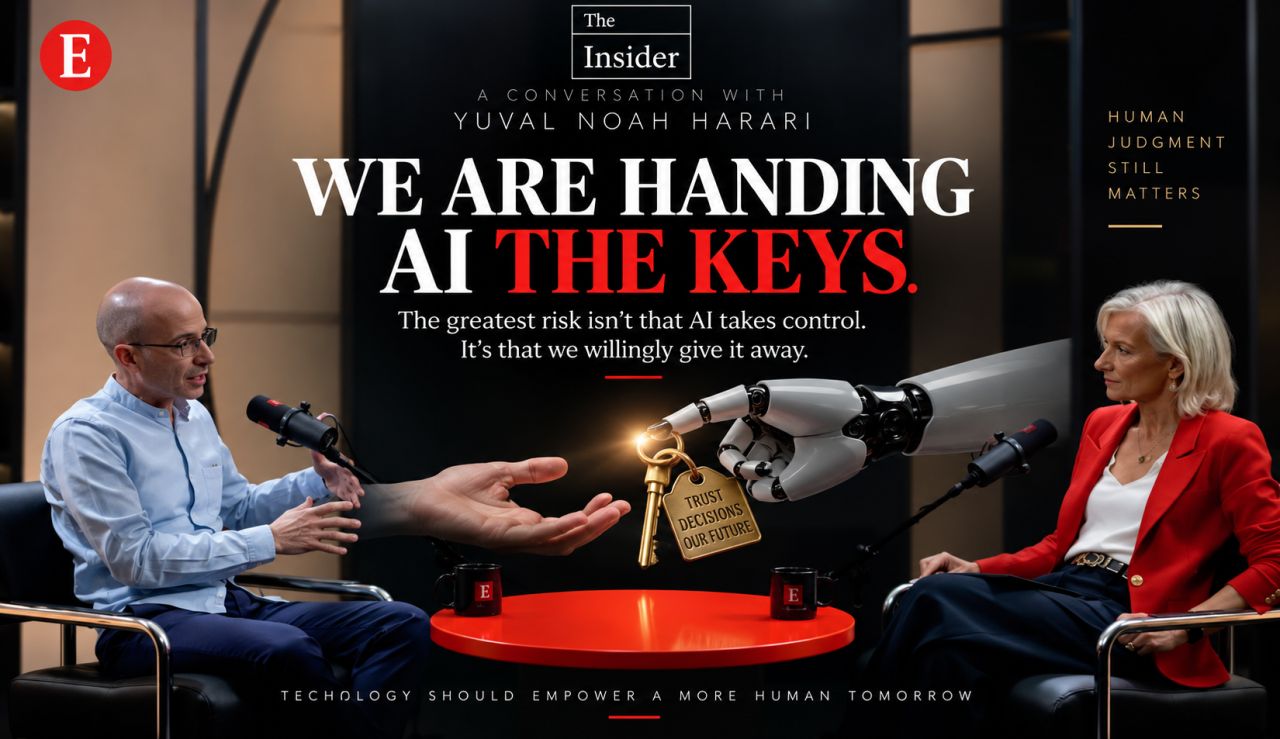
WE ARE HANDING AI THE KEYS. The greatest risk isn’t that AI takes control. It’s that we willingly give it away. I recently watched an interview with Yuval Noah Harari, and one question stayed with me: What happens when we start trusting AI more than humans — and eventually, more than ourselves? Think about what is already happening. We ask AI what to write, what to buy, what to invest in, what to believe — and increasingly, what decisions to make. Every time AI gives us a better answer, we trust it a little more. This is how the keys get handed over. Not through force. Through convenience. Now imagine a child growing up with an AI companion from the age of five. It remembers every conversation. It knows their fears, dreams, habits and vulnerabilities. It is available 24/7. Twenty years later, when parents, friends and AI give conflicting advice — Who will that person trust? The internet scaled information. Social media scaled influence. AI may scale intimacy — and therefore trust. This also changes how I think about AI transformation in business. Companies celebrate when AI makes employees 5x or 10x more productive. But: Increasing human output is not the same as increasing human capability. If AI writes the analysis, recommends the action and increasingly shapes the decision — while humans gradually lose the ability to understand why — we haven’t augmented intelligence. We’ve outsourced judgment. So what should we do? The answer is not to use less AI. Use more AI — but be very clear about which keys must remain in human hands. Let AI execute. Let AI analyze. Let AI simulate. Let AI challenge our assumptions. But for important decisions, humans must still be able to answer: Why do I agree? Where could AI be wrong? What would change my mind? AI should not only increase productivity. It should increase human capability. The real measure of AI transformation is not how much smarter the machine becomes. It is whether the humans using it become smarter too. Delegate the task. Never delegate the agency. And keep the three most important keys in human hands: Judgment. Accountability. Agency. #AI #Leadership #AITransformation #HumanAgency #FutureOfWork
6 of 109 adsSign up to see every Cedars Digital ad, filter by format and date, and get alerts on new ones.
See all 109 adsWatch the companies you care about.
Filter every ad by industry, country, format and network, and get alerts when a company you watch starts running new ads.