On air · 1 of 3 networks
BWD Strategic
- bwdstrategic.com
- Professional Services
- AU
- 43 employees
BWD Strategic’s ads on LinkedIn, Meta and Google, recorded by adsrunning. Browse the latest here for free. Sign up free to see all 42. Watch BWD Strategic with Starter to get each new one in your feed.
Watchlist with Starter · $49/mo
| Network | Status | Live ads | Nov 2025LinkedIn activity · 52 weeksOct 2026 | Checked | Next step |
|---|---|---|---|---|---|
| Running | 42 | Checked 30 Oct 2026 | See all 42 ads → | ||
| Meta | Not checked | — | |||
| None recorded | 0 | No ads found on the Google Ads Transparency Center | Checked 24 Oct 2026 | Collect them with the API → |
BWD Strategic has 42 live LinkedIn ads. We recorded no Google ads on 24 Oct 2026.
Latest ads
- LINKEDIN · IMAGERecorded 16 Oct 2026
AMP's first climate disclosure under Australia's mandatory reporting regime quantifies no financial impact. It addresses vulnerability in prose, without a dollar figure or percentage attached. This from one of Australia's largest wealth managers, whose revenue rises and falls with the value of assets under management. I reviewed the first mandatory reports. Read the full article here: https://lnkd.in/gs2dizT2
- LINKEDIN · IMAGERecorded 20 Oct 2026
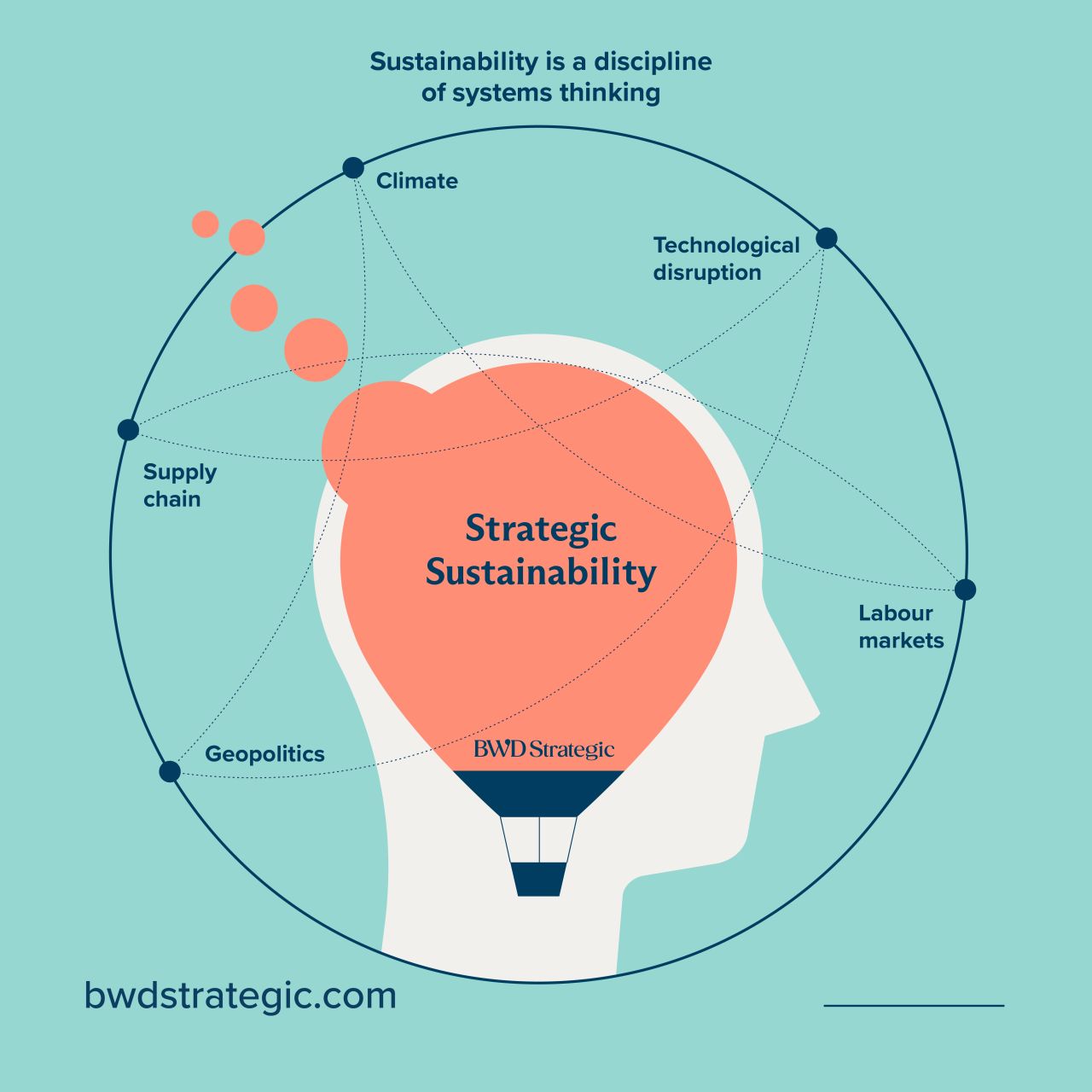
Corporate sustainability has never mattered more — yet the discipline is stuck in a credibility trough. We’re living through a contradiction. Climate volatility, geopolitical fragmentation, supply-chain fragility, and accelerating technological disruption all demand long-term thinking. Yet sustainability has been dragged into culture wars and buried in regulatory fatigue. The word itself has become what speechwriters call a glittering generality — like “freedom” or “justice”: stretched until it covers everything and nothing — from carbon credits to corporate volunteering. In that sprawl, its core purpose gets lost: building long-term value and resilience. At the same time, sustainability teams are spending most of their time producing disclosures that satisfy regulators but do little to shape strategic decisions. Necessary work — but not the work that drives an organisation forward. At BWD Strategic, we believe sustainability must be repositioned as a source of enterprise value creation, not a compliance obligation. Sustainability is a discipline of systems thinking: a way of seeing how climate, supply chains, geopolitics, labour markets, and technological disruption collide and cascade. This requires elevating sustainability professionals from spreadsheet and report owners to strategic decision-makers — people who can map interdependencies, anticipate shocks, and build organisational resilience. Reframed correctly, sustainability becomes a competitive advantage in a world defined by compounding disruption. ______ To see more of our approach, visit our website here: https://lnkd.in/ds3WCzcz
- LINKEDIN · IMAGERecorded 16 Oct 2026
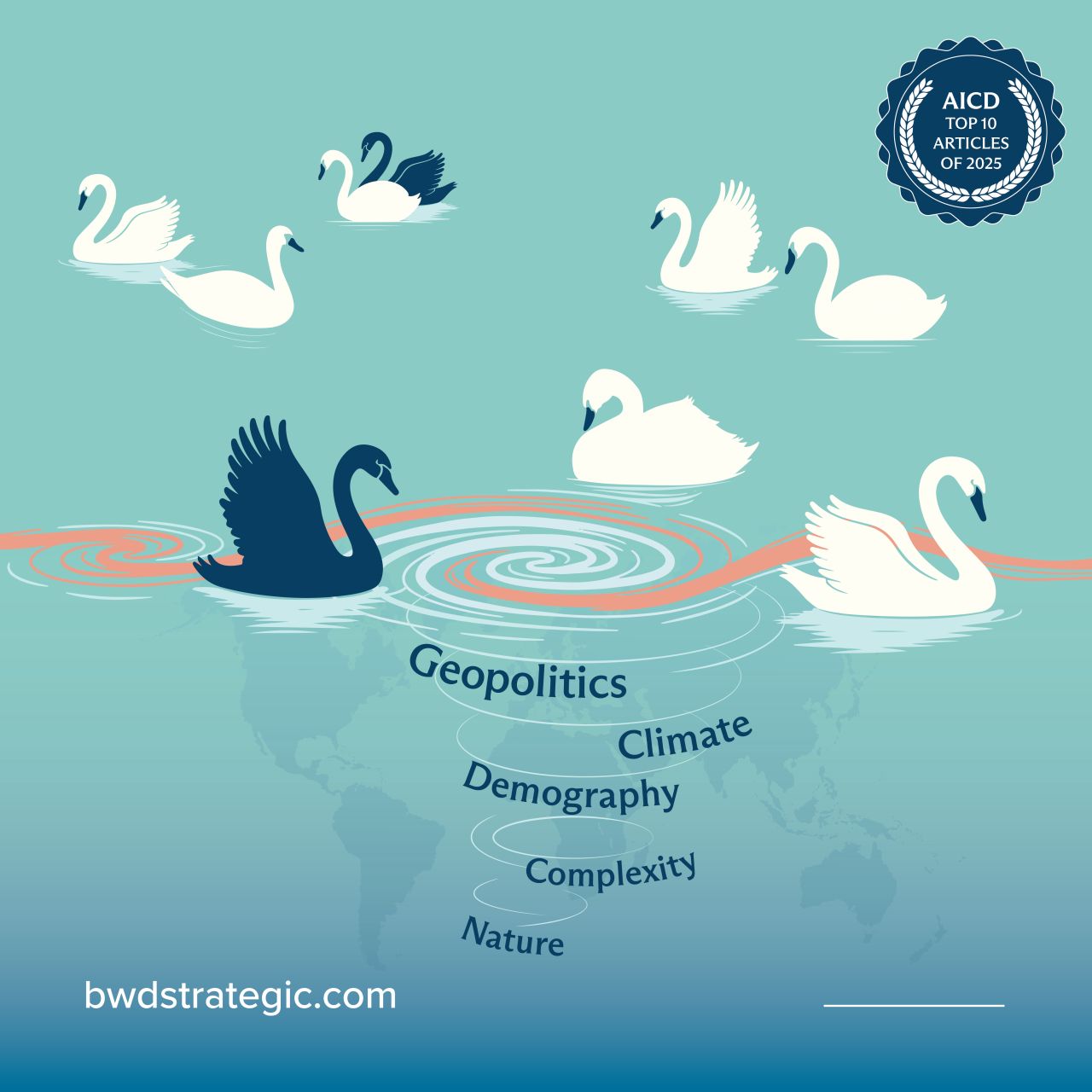
An article I wrote on reviving sustainability was recognised by Australian Institute of Company Directors as one of their top 10 pieces for 2025. Not because it defended the status quo but because it argued for dismantling it. ESG is dead. It drifted from responsible value creation into compliance theatre and virtue signalling. Ratings agencies turned ESG into gameable metrics, while management championed causes with little relevance to their business. The backlash was partially self-inflicted. But ESG's collapse doesn't mean sustainability is finished. What emerges is something far more powerful: sustainability reimagined as anti-fragile strategy — systems that don't just survive disruption but grow stronger from it. The article explores how organisations can build this capability through three moves: 1️⃣ Renovate business models — Position for emerging value pools rather than defending legacy positions 2️⃣ Embed geopolitics into materiality — Understand how international affairs reshape cost, return, and risk of capital 3️⃣ Broaden scenario planning — Rehearse disruption before it hits, with predefined trigger points for action To unpack this statement and explore how organisations can make this shift, see the link below. I'd love to hear your thoughts and discuss how to translate these ideas into practical business value. Read the article: https://lnkd.in/gXX-8m44
- LINKEDIN · IMAGERecorded 16 Oct 2026
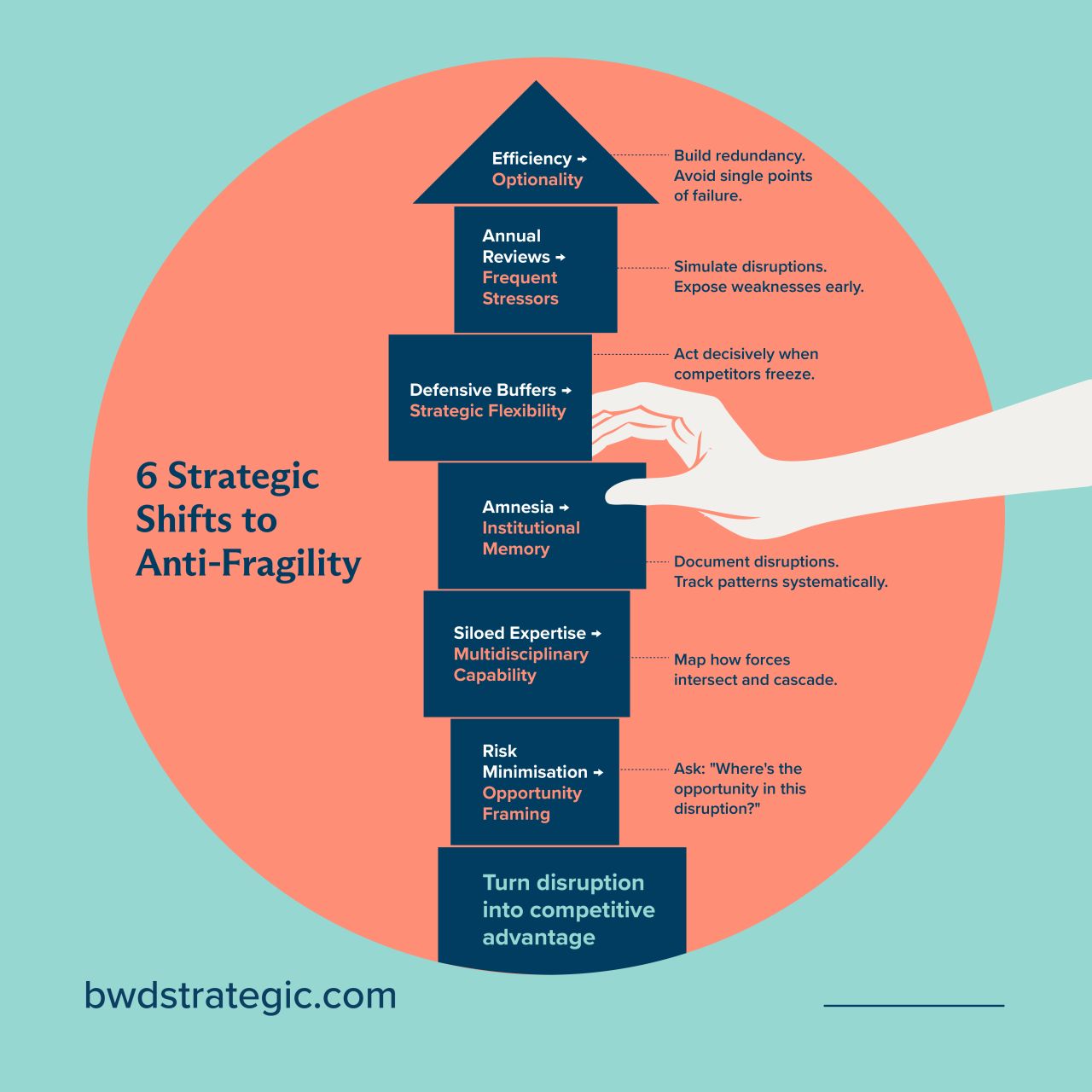
Most companies are trying to become more resilient. The smart ones are doing something harder, and far more valuable. They're becoming anti-fragile: learning to grow stronger because of disruption, not despite it. We've entered a decade of converging shocks: geopolitical fragmentation, AI upheaval, supply chain fragility, accelerating climate extremes. S&P 500 companies averaged 33 years' lifespan in 1965, 20 years in 1990. Today, just 14. Storms aren't interruptions to business-as-usual anymore. They're the operating environment. Resilience helps you absorb shocks. Anti-fragility helps you turn them into advantage. Consider BHP, now reshaping its portfolio around future-facing commodities — copper, nickel, potash — the backbone of electrification and renewable energy. It exited thermal coal and doubled down on resources that become more strategically valuable as volatility increases. This is anti-fragility in practice: reallocating capital ahead of disruption, strengthening the business as markets shift, turning the energy transition into strategic advantage. Anti-fragile organisations make six strategic shifts: 1️⃣ Efficiency → optionality: Build deliberate redundancy into critical systems to avoid single points of failure. 2️⃣ Annual reviews → frequent stressors: Use regular, simulated disruptions to expose weaknesses before real crises hit. 3️⃣ Defensive buffers → strategic flexibility: Maintain the liquidity and resources to act decisively when competitors freeze. 4️⃣ Amnesia → institutional memory: Turn every disruption into documented learning; patterns only emerge through systematic tracking. 5️⃣ Siloed expertise → multidisciplinary capability: Bring in systems thinkers who can map how climate, technology, capital, and geopolitics intersect. 6️⃣ Risk minimisation → opportunity framing: Ask not only "How do we minimise harm?" but "Where might this disruption help us advance?" At BWD Strategic, we see sustainability — reframed as long-term value and resilience — as the discipline best suited to building anti-fragility. It’s how organisations understand the way climate, nature, technology, capital flows and geopolitics collide and cascade. Read more: https://lnkd.in/gXX-8m44 _____ To see more of our approach, visit our website here: https://lnkd.in/dYHx3BwN
- LINKEDIN · IMAGERecorded 20 Oct 2026
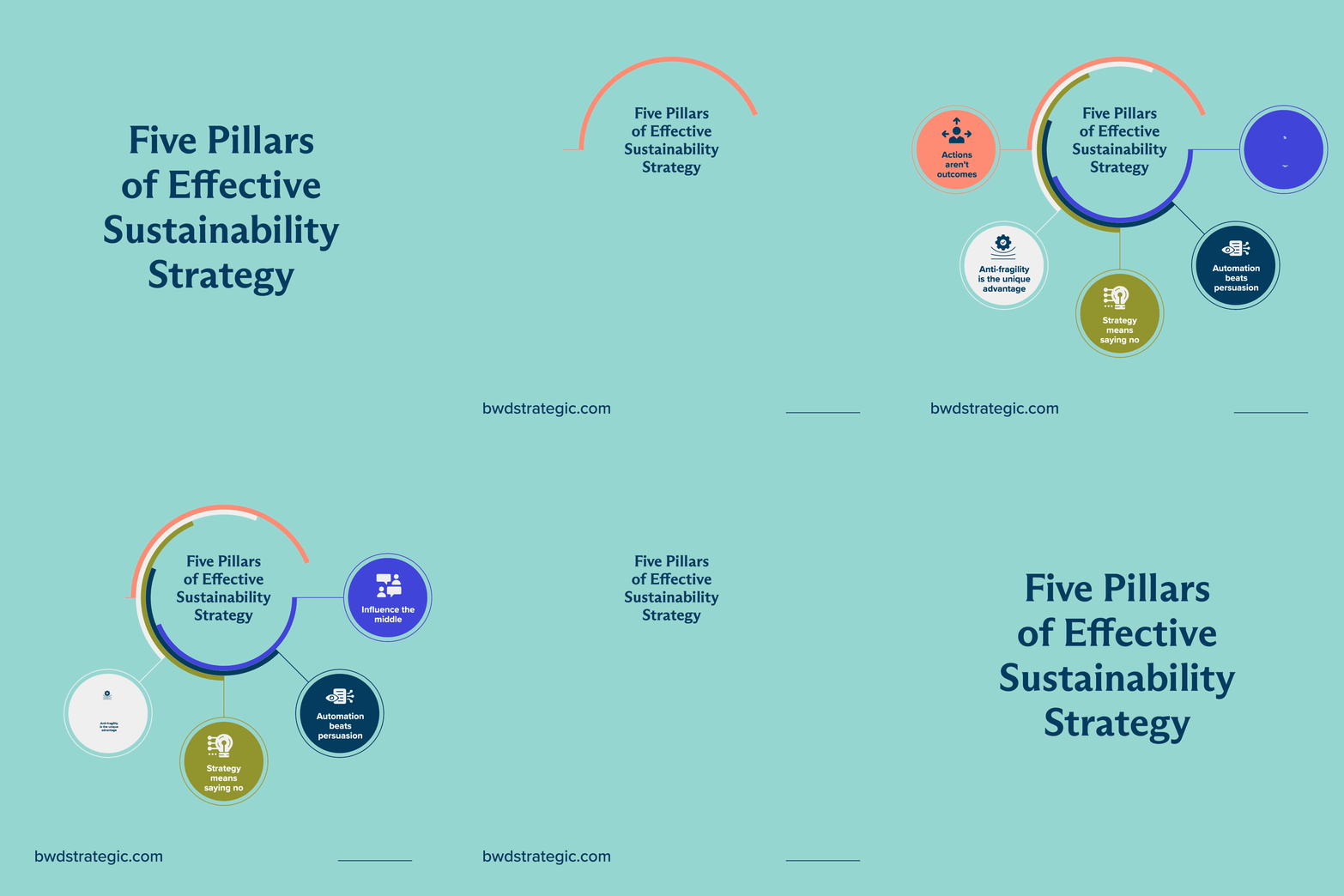
Most sustainability strategies fail for a simple reason: they confuse activity with impact. Real strategy builds long-term value and resilience — everything else is theatre. Across sectors, organisations are producing glossy plans, long lists of initiatives, and spreadsheets full of ESG data. Yet many of these strategies quietly disappear when budgets tighten or leadership changes. Why? Because they’re built on tasks, not outcomes. Good sustainability strategy isn’t separate from enterprise strategy — it strengthens it by clarifying priorities, exposing risks, and revealing opportunities others miss. Effective sustainability strategy rests on five principles: 1️⃣ Actions aren’t outcomes: Recycling programs, solar panels, and small circular pilots look good in reports — but unless they deliver tangible stakeholder or financial value, they won’t survive. Strategy starts with the question: What business value will this create? 2️⃣ Anti-fragility is the unique advantage: Sustainability, done properly, helps organisations sense shifts earlier and gain strength from disruption. Winners don’t just withstand shocks; they capitalise on them. 3️⃣ Strategy means saying no: A credible materiality assessment doesn’t produce a laundry list — it sharpens focus. The best organisations elevate a handful of priorities that matter most for competitive positioning. If your strategy doesn’t disappoint someone, it isn’t a strategy. 4️⃣ Automation beats persuasion: Behaviour change doesn't scale by asking people to "care more." It scales by removing friction — procurement defaults, energy-management automation, packaging redesign that cuts cost and emissions simultaneously. 5️⃣ Influence the middle: Transformation doesn’t require winning over every detractor. Focus on the undecided middle — the largest and most movable group. Once they shift, resistance collapses and momentum becomes self-sustaining. _____ For more practical insights on sustainability, join our mailing list here: https://lnkd.in/d-S5-C3z
- LINKEDIN · IMAGERecorded 20 Oct 2026
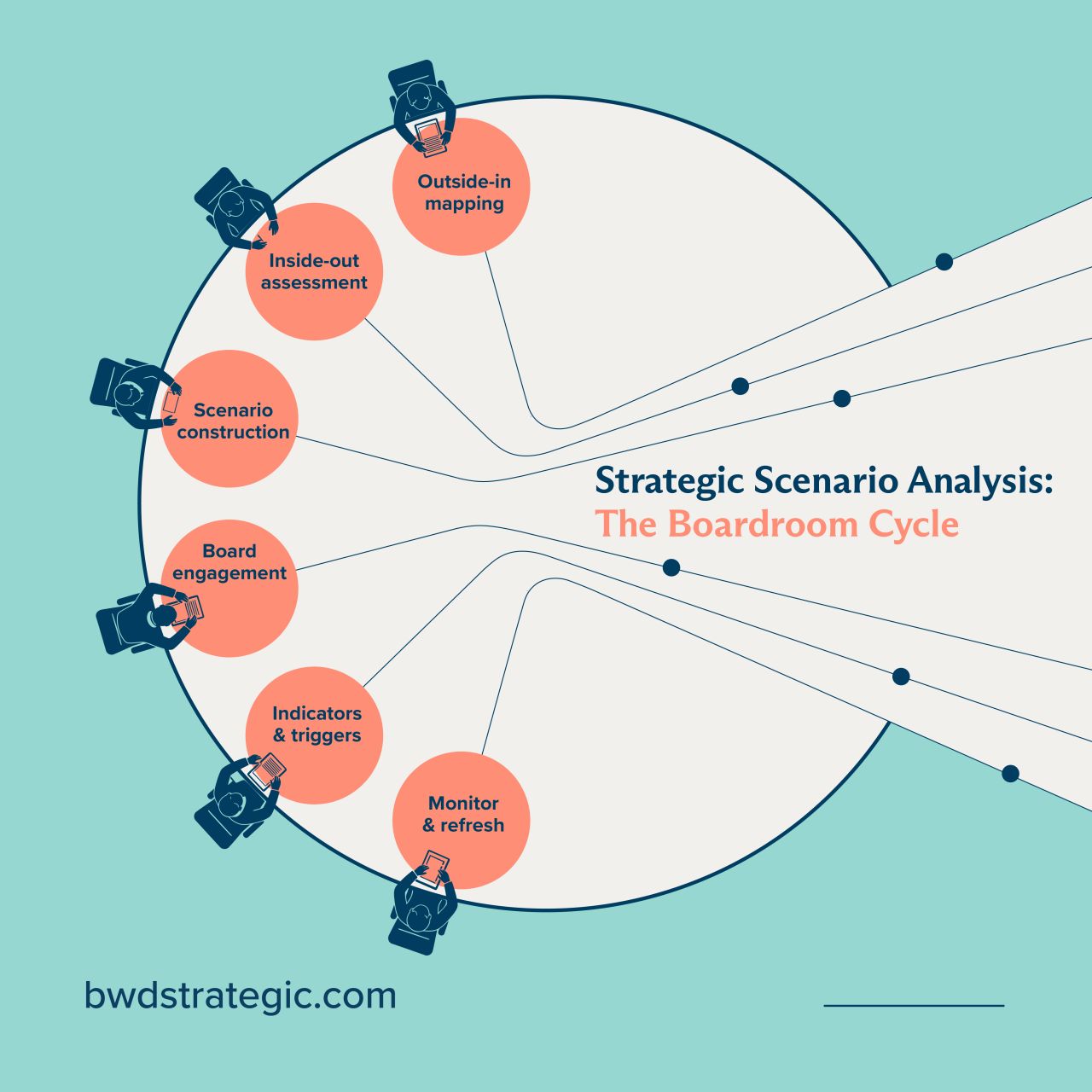
ESG didn’t lose momentum by accident. It was pulled into culture wars, buried in compliance, and stripped of strategic relevance. Boards have stopped listening. So what now? We don't like to admit it. But sustainability advocates are partly responsible: 1️⃣ Virtue signalling: Leaders postured on ESG issues they neither understood nor believed in. That reputational arbitrage is gone — and with it, trust. 2️⃣ Compliance theatre: Reporting became templated box-ticking: a commoditised service optimised for assurance revenue, not strategic value. Meanwhile, climate risk, supply-chain fragility, geopolitical volatility and technological disruption are already reshaping balance sheets. Boards don’t need more slogans or disclosure. They need sharper judgement under uncertainty. Scenario analysis, used properly, isn't a forecast. It's rehearsal — a way for directors to test decisions before the stakes become existential. Royal Dutch Shell pioneered this approach. It didn’t predict the 1973 oil crisis — it prepared for the consequences. When rivals froze, Shell moved. Within a decade it leapt from eighth to second in global market share. The six elements of strategic scenario analysis: 1️⃣ Outside-in mapping — identify the external forces likely to reshape your business. 2️⃣ Inside-out assessment — locate your specific strengths, vulnerabilities, and exposures. 3️⃣ Scenario construction — develop distinct futures (best, worst, baseline). 4️⃣ Board engagement — pressure-test decisions through tabletop simulations. 5️⃣ Indicators & triggers — link scenarios to early-warning signs and pre-set responses. 6️⃣ Monitor & refresh — update scenarios regularly to sharpen judgement over time. Boards value this because it reveals patterns, sharpens decision-making, and reduces the risk of paralysis when disruption arrives. _____ As Eisenhower said, plans are useless, but planning is indispensable. If ESG fatigue is creeping in, scenario analysis can help boards refocus on what really matters. DM me to discuss a more strategic approach. ______ For more practical insights on sustainability, join our mailing list here: https://lnkd.in/gdQNGmnu
6 of 42 adsSign up to see every BWD Strategic ad, filter by format and date, and get alerts on new ones.
See all 42 adsWatch the companies you care about.
Filter every ad by industry, country, format and network, and get alerts when a company you watch starts running new ads.