On air · 1 of 3 networks
BRITE
- wearebrite.nl
- IT Services & Consulting
- NL
- 15 employees
BRITE’s ads on LinkedIn, Meta and Google, recorded by adsrunning. Browse the latest here for free. Sign up free to see all 30. Watch BRITE with Starter to get each new one in your feed.
Watchlist with Starter · $49/mo
| Network | Status | Live ads | Nov 2025LinkedIn activity · 52 weeksOct 2026 | Checked | Next step |
|---|---|---|---|---|---|
| None recorded | 0 | Checked 30 Oct 2026 | See all 30 ads → | ||
| Meta | Not checked | — | |||
| Running | 3 | Ads on the Google Ads Transparency Center | Checked 24 Oct 2026 | Collect them with the API → |
BRITE has no live LinkedIn ads. We recorded 3 Google ads on 24 Oct 2026.
Latest ads
- LINKEDIN · IMAGESince 2 Apr 2026
You are spending way too much time debating which CRM to select and WAY too little time on everything else. I see so many wasted hours go into CRM selection processes. Sitting through demo's, checking of requirements that majority of tools support. After 18+ years in the space, I know the technology doesn't matter nearly as much as the other components of a successful CRM program: 👉 Business case instead of wishlists: Work backwards from actual impact to be created within your business. Align your needs to your ultimate objectives. 👉 Process over functionality: Design the customer journey and the way of working first. If you do not agree on the customer experience, the process and the definitions, you will less likely achieve your objective. 👉 Data hygiene from day one: A CRM without clean data is losing the trust of your users directly after go-live. Check back 12 months after and nobody feels the system and its data accurately reflects reality. 👉 Adoption is not an afterthought: If the team doesn't see the value, the system becomes an administrative burden instead of a steering instrument. The business change is 80% of your success, be ready to spend 80% of your time there. Select a great tool, a great partner and start working on your change. You will get 💯 times the result.
- LINKEDIN · IMAGESince 2 Apr 2026
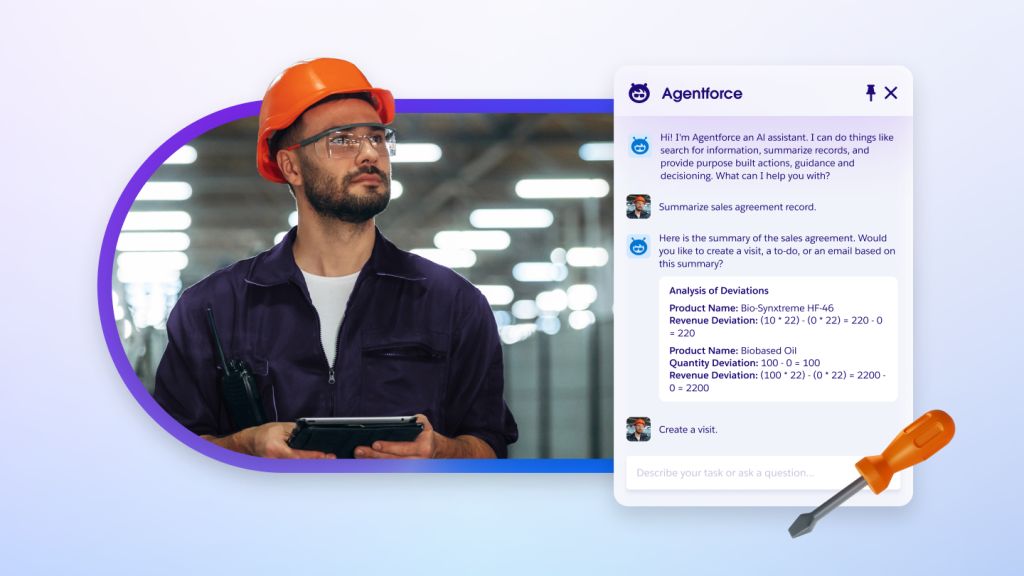
If I was in sales at a make-to-order manufacturer, here is the Agentic AI I would want to make my day much more productive: ⚡ The agent that let’s you come prepared I still talk to sales people who walk into a meeting only to be blindsided by a 2-week-old unresolved service ticket or a piece of news he or she missed. I would request an AI agent that scans every open ticket and recent news about the client and brief me on my way to my meeting. No more awkward "I didn't know that" moments and no more opening of multiple systems to ‘stitch’ together pieces of information manually. ⚡The agent sales coach As a technical seller, you may geek out on the specs of your product when you should be talking business. We shouldn’t practice on our customers. We should use an AI coach to roleplay with—one that acts like a tough procurement officer. It should call me out when I’m focused on the "how it works" instead of the "how much it saves." ⚡ The agent that points at patterns most people miss Most sales I meet do not have time to bring data together in the hopes of finding something to work with. I want an agent that spots patterns I miss—like a lead downloading a specific part manual three times in 48 hours. I want the AI to tell me: "Call them now, they may be going to have a breakdown." ⚡The post-event follow-up agent We all know the "post-trade show fatigue." A stack of business cards and a week of data entry. I want an agent that processes my scanned leads instantly, sends personalized technical whitepapers based on my input, and updates the CRM without me having to worry about this. Most sales enjoy the time with their customers more than the admin work that is often required. With well thought out agents, they can spend less time being a secretary and more time being an advisor to your customers. Your tools should make it simpler, luckily with Salesforce AI and Agentforce you can do just that. What would you have your agent do? Let me know your biggest frustration in the comments 👇
- LINKEDIN · IMAGESince 2 Apr 2026
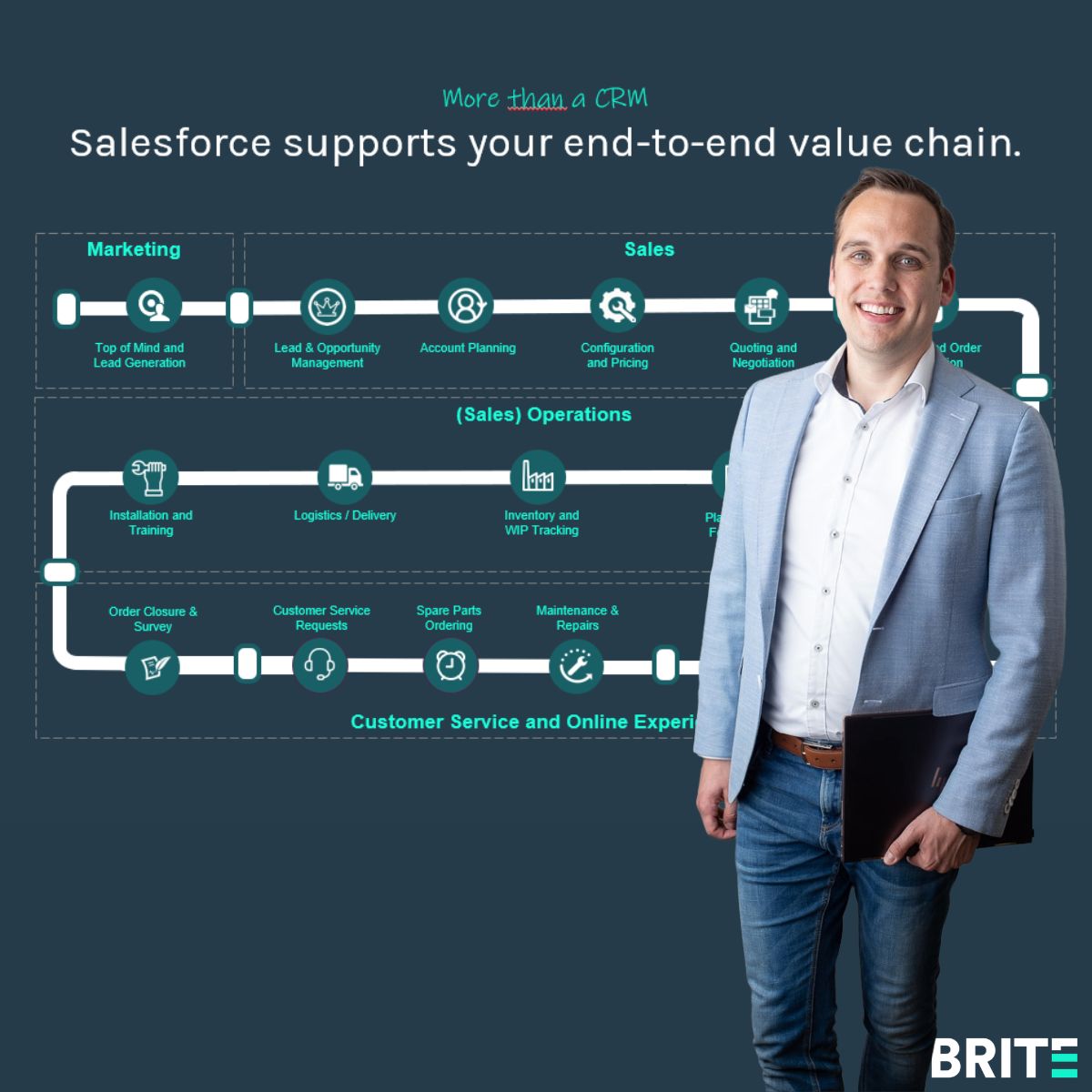
If you think of Salesforce as a CRM only, let me clarify some things for you. You are not alone. I speak to many Make-to-Order manufacturers who think the same. Yet after 18+ years of helping customers automate customer processes I know the Salesforce platform goes well beyond the tool for 'sales'. It easily acts as the backbone of your entire end-to-end process. 👉 Marketing & Sales: From lead generation to account planning and from quote configuration to contract configuration. 👉 Operations: It doesn't stop at the deal. It supports order validation, planning, forecasting, logistics and installation. 👉Service and experience: Once delivered, it enables customer support, spare parts and other self-service for partners and customers. And you surely do not need to custom build anything either. With the standard configurable applications and natively built MES and ERP systems, your backbone is complete. Check out 24Flow - shop floor management and production scheduling platform and Rootstock Software if you are looking for a modern cloud MES or ERP. You do not need to start from scratch or reinvent the wheel. The building blocks are there, built on the Salesforce low-code platform, ready to be used by and tailored for your business. What are other misconceptions about Salesforce for Manufacturing that we need to set straight? Let me know in the comments! 👇
- LINKEDIN · IMAGESince 20 Mar 2026
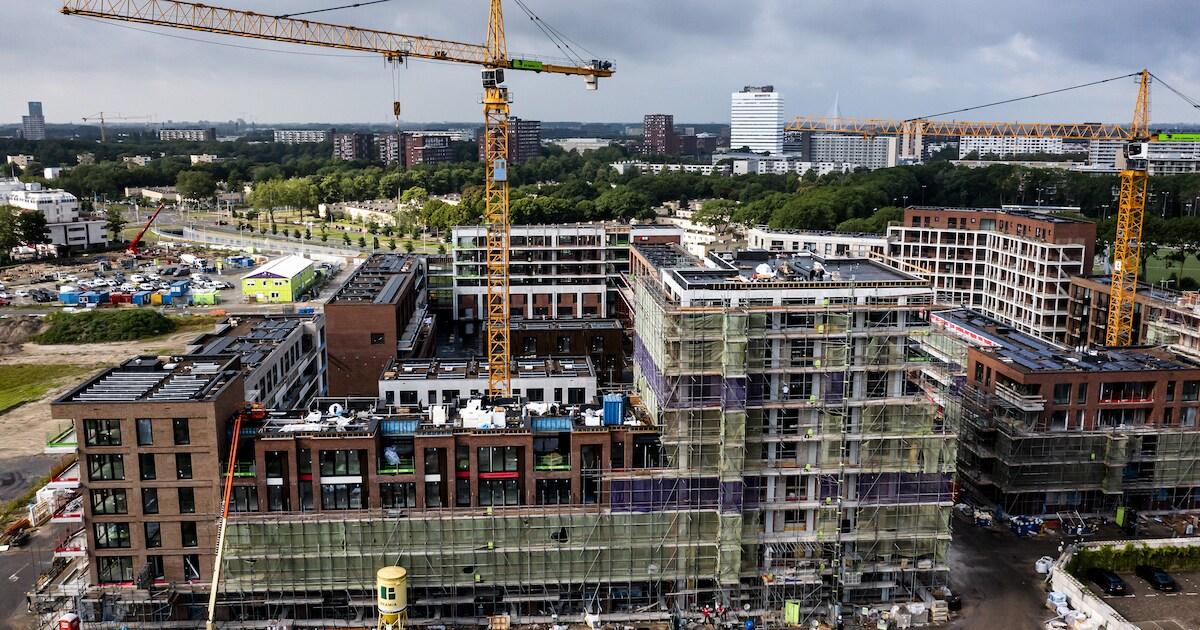
⚡ 𝗭𝗲𝘁 𝗱𝗲 𝗯𝗲𝘄𝗼𝗻𝗲𝗿 𝗰𝗲𝗻𝘁𝗿𝗮𝗮𝗹 𝗲𝗻 𝗻𝗶𝗲𝘁 𝗱𝗲 𝗿𝗲𝗴𝗲𝗹𝘀. Het artikel (https://lnkd.in/eZ3tAbMn) over ouderen in een ‘gouden kooi’ raakt de kern: ons systeem verwacht dat ouderen doorstromen, maar dan vergeet men dat dit niet zo eenvoudig is. Zo wil niet elke oudere verhuizen naar een kleinere woning. En voor degenen die het wel willen, maakt het systeem het praktisch onmogelijk. Er wordt al jaren gepraat over doorstroming alsof het een van de simpele oplossing is voor ons probleem, maar we vergeten te luisteren naar de mensen om wie het gaat. Sommige ouderen willen graag kleiner, gelijkvloers, dichter bij voorzieningen. Anderen voelen zich nog volledig thuis in het huis waar ze jarenlang hun leven hebben opgebouwd. Allebei is natuurlijk goed, maar ons doorstromingsbeleid houdt geen rekening met deze beide wensen. In plaats daarvan creëren we regels, fiscale drempels, financiële risico’s en bureaucratische blokkades die zelfs gemotiveerde ouderen vastzetten in woningen die niet meer passen. En ondertussen zijn we verbaasd “Waarom vindt er geen doorstroming plaats?” De oplossing is geen nieuwe regel. De oplossing is het veranderen van perspectief: - Bewoners centraal, luister naar hun en kijk niet alleen naar de regels. - Woonbeleid dat aansluit bij wensen in alle varianten: blijven, verhuizen, samenwonen, levensloopbestendig wonen. - Minder barrières voor wie wil verhuizen. - Meer respect voor wie niet wil verhuizen. Willen we echt beweging in de woningmarkt? Dan moeten we stoppen met sturen op modellen en beginnen met luisteren naar de bewoners. 𝗗𝗼𝗼𝗿𝘀𝘁𝗿𝗼𝗺𝗶𝗻𝗴 𝘄𝗲𝗿𝗸𝘁 𝗽𝗮𝘀 𝗮𝗹𝘀 𝘄𝗲 𝗱𝗲 𝗺𝗲𝗻𝘀 𝗯𝗼𝘃𝗲𝗻 𝗱𝗲 𝗺𝗼𝗱𝗲𝗹𝗹𝗲𝗻 𝗽𝗹𝗮𝗮𝘁𝘀𝗲𝗻. #woningnood #doorstroming #ouderenhuisvesting #wonen #beleid
- LINKEDIN · IMAGESince 24 Feb 2026
If I was responsible for data quality in Salesforce, here is what I would do. Poor data quality and adoption doesn't occur because people are lazy; it occurs for a number of well known reasons. Gartner has estimated that the average organization, loses or misses out on $12.9 million annually due to poor data quality. McKinsey has found that data quality issues account for 20% decrease in productivity. I typically see the following reasons for data quality issues: ⭕ Natural decay or ‘silent’ degradation. Because data is not static but it describes a world that is constantly changing (job changes, rebrands, company closures). Dun and Bradstreet have estimated decay by 2 to 3% per month, resulting in 30% inaccuracy within the first year of Salesforce usage. ⭕ Errors at data entry, the man made cause of poor data quality. MIT has estimated that 47% of newly created records contain at least one critical error that impacts downstream processes. The lack of common definitions feeds into this issue. ⭕ Data duplication. A typical way of getting data from point A to point B. If not managed correctly, it will create a fragmented truth that leads to data slowly getting out of synch. ⭕ Technical drift. As companies make updates to systems and data models the underlying data suffers as not all consequences were accounted for and addressed. ⭕ Ownership and accountability. Typically nobody is really 'responsible'. Harvard Business review found that only 3% of companies data meets basic data quality standards. The most common reason this is that data is treated as a ‘project’ rather than a continuous process. If I wanted to fix this permanently, I wouldn't touch Salesforce first. I would do this instead: 👉 Fix the definitions and process first. You need to design and lock down the definitions and data flows first. If the process and your Salesforce environment doesn't force consistency in the right areas, your data will never be of high quality. 👉 Fix the future AND the foundation. New process rules only stop new bad data. To trust the system, you must transform the legacy mess. There are plenty of ways to clean, structure, and enrich the historical base data. Set it up in a repeatable way, so you are not back at square 1 in a few months’ time. 👉 Fix the dashboards and training of users Only when the definitions are clear and the historical data is clean, do you fix the dashboards and retrain your users. 👉 Fix ownership and treat it as a continuous process. Although assigning ownership is easy, having the right technical expertise and data skills in place can be a challenge. Finding a good partner that can help the internal owner makes a massive difference as well. In short: You do not need to accept bad data quality as something unavoidable. If you follow above steps, you can trust your data, actually use it for decision making and keep your users happy. How do you address your data quality issues?
- LINKEDIN · IMAGESince 24 Feb 2026
If I was responsible for Salesforce and I had to find an implementation partner that would get me results and that would be great to work with, here is what I’d look for: After 20 yrs of Salesforce project experience, I wouldn't just look for the partner with the most developers or certifications. I would look for the partner who refuses to start with a blank sheet of paper. You will find a great partner in a company that can confidently ticks these five boxes: 👉 They can reliably help with aligning your team around the value case, not start with everyone’s wishlist. Most projects fail because they focus on features rather than the desired outcome. I would look for a partner who helps clarify the 'why' first. They should provide a sharp summary of expected results to get internal decision-makers aligned and work backwards before they start checking off all the requested features. 👉 They bring the blueprint. I don't have the time to pay someone to start from a blank sheet of paper every project. The right partner brings industry-specific templates and proven knowledge. It will speed up the project and let’s me focus my energy only on the customization that actually makes my company unique. 👉 They design before they execute. "Agile" shouldn't mean "making it up as we go." I'd look for a partner who uses customer journeys and process visualizations to put the dot on the horizon and work backwards to a clearly defined roadmap. That is the only way to ensure the system supports people and customers, not the other way around. 👉 They take the pain out of testing. Testing is usually where teams drown. I like a partner who does the heavy lifting here. They should handle the bulk of the technical testing, not throw stuff over the fence after the build. They make User Acceptance Testing (UAT) intuitive so my team isn't filling out Excel sheets all day. 👉 They make training stick. A one-off classroom session is forgotten in a week. The right partner provides task-based video tutorials that my team can watch on-demand. This prevents my key users from being overwhelmed by questions and ensures knowledge actually lasts. Starting a new Salesforce project can feel overwhelming. The right partner means you are not just hiring extra hands that you have to manage yourself. If you feel you constantly need to think through the solution yourself and bring that to your partner (or admin) for build, you have got the wrong partner. A great partner co-owns the result, does the heavy lifting and brings peace of mind. What do you look for in a partner?



6 of 30 adsSign up to see every BRITE ad, filter by format and date, and get alerts on new ones.
See all 30 adsWatch the companies you care about.
Filter every ad by industry, country, format and network, and get alerts when a company you watch starts running new ads.