On air · 1 of 3 networks
Biotech Support Group
- biotechsupportgroup.com
- Healthcare & Life Sciences
- US
- 9 employees
Biotech Support Group’s ads on LinkedIn, Meta and Google, recorded by adsrunning. Browse the latest here for free. Sign up free to see all 71. Watch Biotech Support Group with Starter to get each new one in your feed.
Watchlist with Starter · $49/mo
| Network | Status | Live ads | Nov 2025LinkedIn activity · 52 weeksNov 2026 | Checked | Next step |
|---|---|---|---|---|---|
| Running | 26 | Checked 30 Oct 2026 | See all 71 ads → | ||
| Meta | Not checked | — | |||
| Recently | 4 | Ads on the Google Ads Transparency Center | Checked 11 Oct 2026 | Collect them with the API → |
Biotech Support Group has 26 live LinkedIn ads. We recorded 4 Google ads on 11 Oct 2026.
Latest ads
- LINKEDIN · IMAGESince 6 Oct 2026
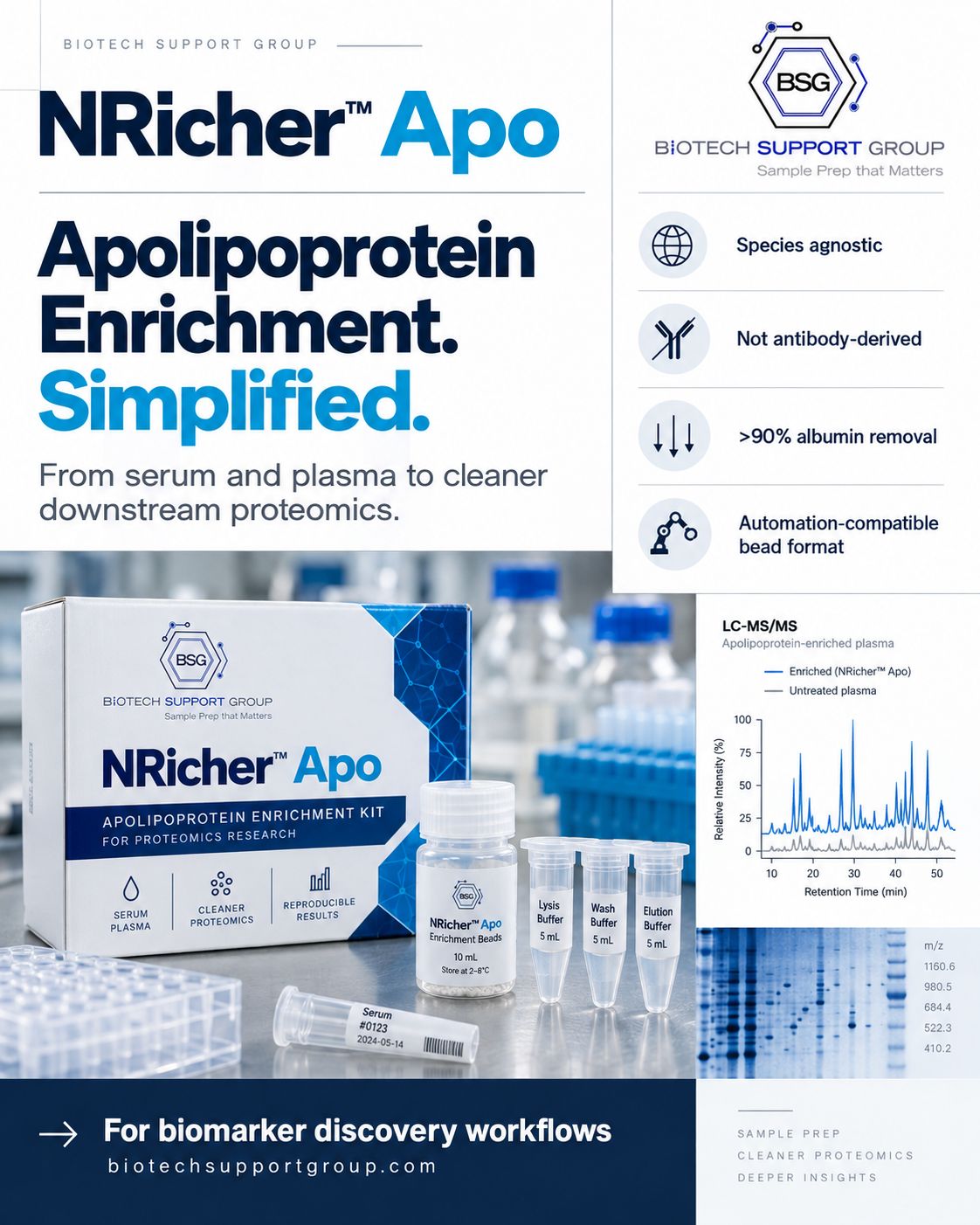
Not immuno-affinity derived, >90 Albumin Removal
- LINKEDIN · IMAGESince 4 Aug 2026
Glycoprotein Enrichment Kit - With Phenyl Boronic Acid NuGel™ Beads The Phenyl Boronic Acid (PBA) ligand is immobilized through the NuGel™ poly-Epoxy linkage. While various lectins bind to specific saccharide residues, the PBA ligand binds to the 1,2-cis-diol groups of biomolecules and enriches for heterogeneous sets of glycoproteins containing both N-linked and O-linked oligosaccharides. An easy and fast spin-filter format makes glycoprotein enrichment simple starting from 50µl serum, or 1-2 mg total protein. A recent article describes its advantageous use in a glyco-proteomics study of Synovial Fluid (SF) Proteins.
- LINKEDIN · IMAGESince 1 May 2026
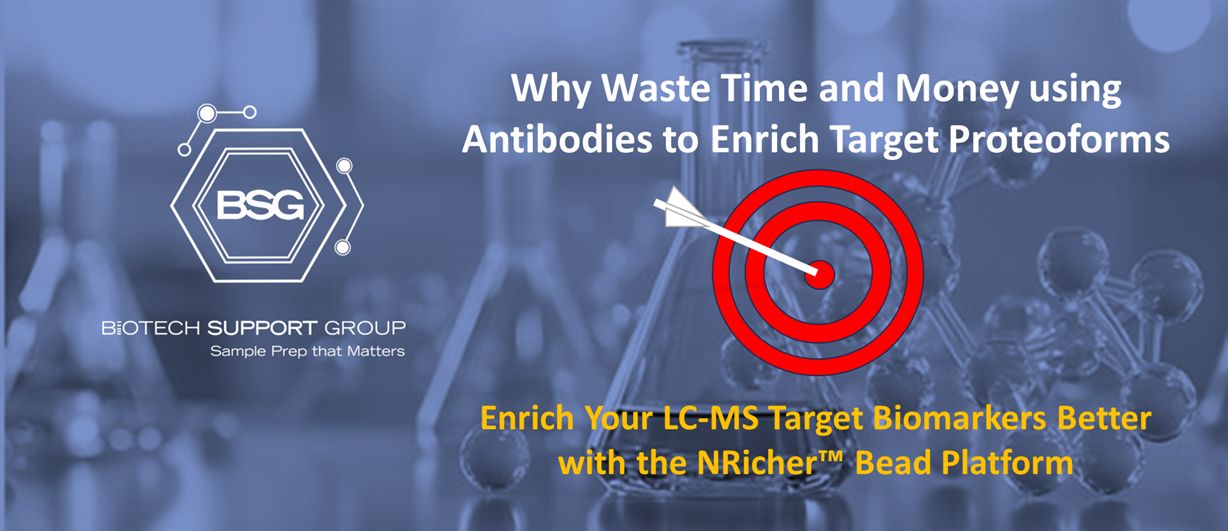
NRicher™ - The PCR alternative for targeted proteomics, simplifies the path • Amplify the LC-MS signal of low-abundance proteins 10-100X • Amplify the LC-MS signal of functional regions (PTMs, amino-acid variants) within mid-high abundance proteins 10-100X • Reduce sample complexity, background noise, without immuno-affinity, and raise the the lower limit of quantification (LLOQ) • Fingerprint proteoforms by differential binding affinities Discover how Biotech Support Group's NRicher™ technology amplifies protein signals for targeted proteomics. Simplify your sample prep process and elevate biomarker detection to new levels of precision and efficiency. Our open access NRicher™ Knowledgebase supports this opportunity. Contact our scientific and business development team and lets collaboratively prepare an experimental design to advance your biomarkers of interest (whether inside the Knowledgebase or not) into precision healthcare.
- LINKEDIN · IMAGESince 1 Apr 2026
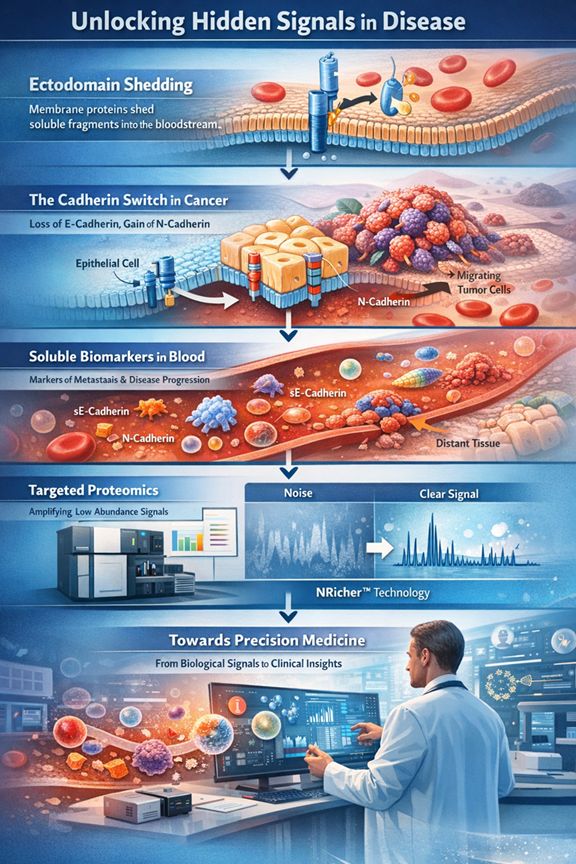
Unlocking Hidden Signals in Disease: The Role of Soluble Cadherins in Precision Medicine Through a tightly regulated process known as ectodomain shedding, nearly 10% of membrane proteins are released from the cell surface into circulation as soluble fragments. Among the most important of these soluble proteins are cadherins, a family of calcium-dependent cell adhesion molecules responsible for maintaining tissue integrity. In healthy systems, cadherins keep cells anchored and organized. In disease, particularly cancer, that stability begins to unravel. A critical transition known as the “cadherin switch” occurs during tumor progression: • Loss of E-cadherin (CDH1) • Gain of N-cadherin (CDH2) This shift allows tumor cells to detach, migrate, and invade—marking a key step in metastasis. What makes this clinically relevant is that the soluble forms of these proteins can be detected in the bloodstream, where they correlate with tumor stage, metastasis, and recurrence risk. The significance of soluble cadherins extends well beyond cancer. • VE-cadherin (CDH5): Elevated in sepsis and chronic heart failure, reflecting endothelial dysfunction and vascular permeability • T-cadherin (CDH13): Plays a critical role in metabolic regulation, insulin secretion, and cardiovascular protection. Potential biomarkers such as these often show up in discovery. So, while there remains an industry focus on coverage and discovery, we have curated close to 200 proteomic biomarkers that have translational potential. What has limited their impact is an inability to measure them reliably. When taking into account, costs, labor, LCMS acquisition time, and scalability, conventional methods designed to deplete high abundance proteins, or enrich low abundance proteins, are remarkably inefficient. NRicher™ - The PCR alternative for targeted proteomics, simplifies the path • Amplify the LC-MS signal of low-abundance proteins 10-100X • Amplify the LC-MS signal of functional regions (PTMs, amino-acid variants) within mid-high abundance proteins 10-100X • Reduce sample complexity, background noise, without immuno-affinity, and raise the the lower limit of quantification (LLOQ) • Fingerprint proteoforms by differential binding affinities Discover how Biotech Support Group's NRicher™ technology amplifies protein signals for targeted proteomics. Simplify your sample prep process and elevate biomarker detection to new levels of precision and efficiency. Our open access NRicher™ Knowledgebase supports this opportunity. Contact our scientific and business development team and lets collaboratively prepare an experimental design to advance your biomarkers of interest (whether inside the Knowledgebase or not) into precision healthcare. Contact: [email protected] or visit https://lnkd.in/e99ZFgmH
- LINKEDIN · IMAGESince 5 Mar 2026
Biotech Support Group has achieved key milestones in proteomic research, pioneering innovative technologies in sub-proteome fractionation, functional proteomics, on-bead digestion, and targeted biomarker quantitation. It is based on the NRicher™ Bead Chemistry Platform, that started in 2010. The company goals were to apply new proteome subfractionation technology, not based on immuno-affinity, with simple, cost-effective workflows, without the need for HPLC or additional capital expenditures. Now, the NRicher™ platform presents an opportunity to enhance efficiency and productivity in targeted proteomic workflows through precise sub-proteome enrichment. Researchers can leverage specialized bead chemistries tailored to specific applications, while further process refinements will streamline workflows, reduce acquisition time, and improve cost-effectiveness. Our open access NRicher™ Knowledgebase supports this opportunity. Each NRicher™ bead chemistry enriches low abundance biomarker proteins at remarkably different LC-MS signals (semi-quantitative), ideal for targeted and multiplex proteomics.
- LINKEDIN · IMAGESince 4 Mar 2026
Biotech Support Group has achieved key milestones in proteomic research, pioneering innovative technologies in sub-proteome fractionation, functional proteomics, on-bead digestion, and targeted biomarker quantitation. It is based on the NRicher™ Bead Chemistry Platform, that started in 2010. The company goals were to apply new proteome subfractionation technology, not based on immuno-affinity, with simple, cost-effective workflows, without the need for HPLC or additional capital expenditures. Now, the NRicher™ platform presents an opportunity to enhance efficiency and productivity in targeted proteomic workflows through precise sub-proteome enrichment. Researchers can leverage specialized bead chemistries tailored to specific applications, while further process refinements will streamline workflows, reduce acquisition time, and improve cost-effectiveness. Our open access NRicher™ Knowledgebase supports this opportunity. Each NRicher™ bead chemistry enriches low abundance biomarker proteins at remarkably different LC-MS signals (semi-quantitative), ideal for targeted and multiplex proteomics. This addresses a key challenge in proteomics: the inability of current ‘omic’ platforms to distinguish functional proteoforms and pathway outcomes. There remains a conventional proteomic assumption that all protein functions correlate to relative abundances, a carry-over viewpoint from gene expression. However, this assumption can be egregiously misleading regarding functional outcomes. The NRicher™ technology is designed to encourage the investigation of differentiated functional post-translational modifications (PTMs), and non-canonical variant regions, as well as imbalances due to activating and regulating sub-proteomes of innate immunity. Download our free NRicher™ Knowledgebase. Let us assist in new research avenues for biomarker discovery, and personalized medical decisions, overcoming the limitations of strictly counting proteins as a yardstick. BSG is a leading supplier of proteomic sample prep and enrichment products. Meet us at HUPO World Congress in Toronto, November 9-13. Booth 205. Flagship products include Cleanascite™ for lipid removal, AlbuVoid™ and AlbuSorb™ PLUS for serum protein depletion, HemogloBind™ and HemoVoid™ for hemoglobin removal, and NRicher™ for low abundance, family specific, and targeted proteome enrichment. These products support translational research by simplifying workflows and improving sample quality for all downstream analyses. Even if you cannot attend, we are offering a discount code 2025HUPO; for a 15% discount to any on-line or direct orders (not distributor) through the end of the year.

6 of 71 adsSign up to see every Biotech Support Group ad, filter by format and date, and get alerts on new ones.
See all 71 adsWatch the companies you care about.
Filter every ad by industry, country, format and network, and get alerts when a company you watch starts running new ads.