On air · 1 of 3 networks
Bio-Works Technologies
- bio-works.com
- Healthcare & Life Sciences
- SE
- 51 employees
Bio-Works Technologies’s ads on LinkedIn, Meta and Google, recorded by adsrunning. Browse the latest here for free. Sign up free to see all 40. Watch Bio-Works Technologies with Starter to get each new one in your feed.
Watchlist with Starter · $49/mo
| Network | Status | Live ads | Nov 2025LinkedIn activity · 52 weeksOct 2026 | Checked | Next step |
|---|---|---|---|---|---|
| Running | 2 | Checked 30 Oct 2026 | See all 40 ads → | ||
| Meta | Not checked | — | |||
| Recently | 22 | Ads on the Google Ads Transparency Center | Checked 11 Oct 2026 | Collect them with the API → |
Bio-Works Technologies has 2 live LinkedIn ads. We recorded 22 Google ads on 11 Oct 2026.
Latest ads
- LINKEDIN · IMAGESince 10 Sept 2026
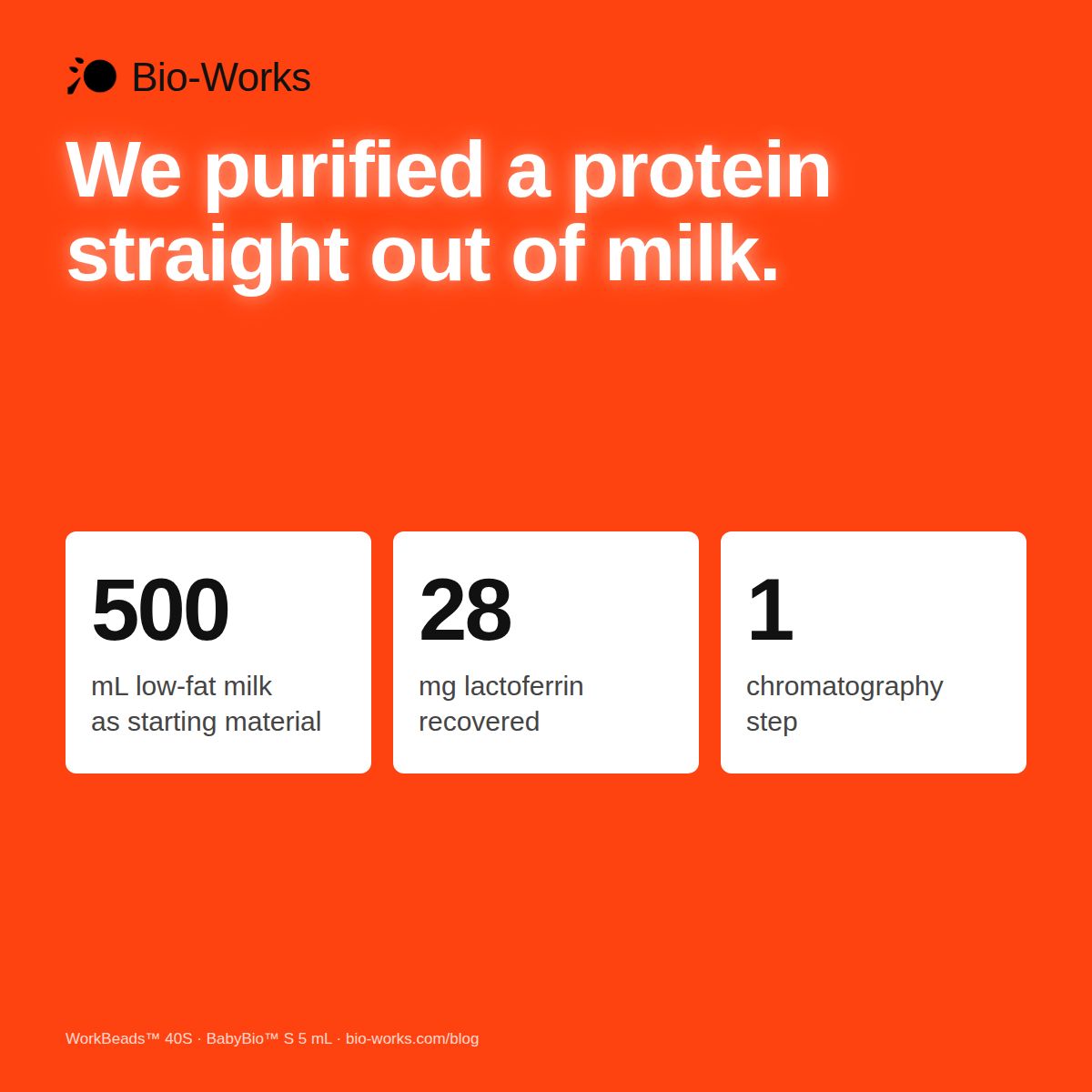
𝐖𝐞 𝐩𝐮𝐫𝐢𝐟𝐢𝐞𝐝 a therapeutic protein out of low-fat milk. Not a spiked buffer. Not a clarified fermentation broth. 500 mL of ordinary 0.1% fat bovine milk, straight onto a column. Lactoferrin is an iron-binding glycoprotein of about 78 kDa with a pI around 7.9 Part of the innate immune system, antimicrobial, 𝐚𝐧𝐝 𝐢𝐧𝐭𝐞𝐫𝐞𝐬𝐭𝐢𝐧𝐠 𝐞𝐧𝐨𝐮𝐠𝐡 that the world gets through more than 200 tonnes of it a year in infant formula, supplements and personal care. 𝐓𝐡𝐞 𝐬𝐞𝐭𝐮𝐩: WorkBeads™ 40S cation exchange in a 5 mL BabyBio™ S column, 50 mM sodium phosphate at pH 6.8, 2.5 mL/min. Lactoferrin binds hard, it takes roughly 1 M NaCl to bring it off, which is exactly what makes it separable from everything else in milk. Dynamic binding capacity 𝐜𝐚𝐦𝐞 𝐨𝐮𝐭 around 78 mg/mL at 3 minutes residence time. 28 mg of lactoferrin recovered at high purity, in a 𝐬𝐢𝐧𝐠𝐥𝐞 chromatography step. Milk is a genuinely difficult feed; Fat, casein micelles, a crowded protein background. If a single CIEX step handles that, 𝐢𝐦𝐚𝐠𝐢𝐧𝐞 what it can do to your feed.
- LINKEDIN · IMAGESince 10 Sept 2026
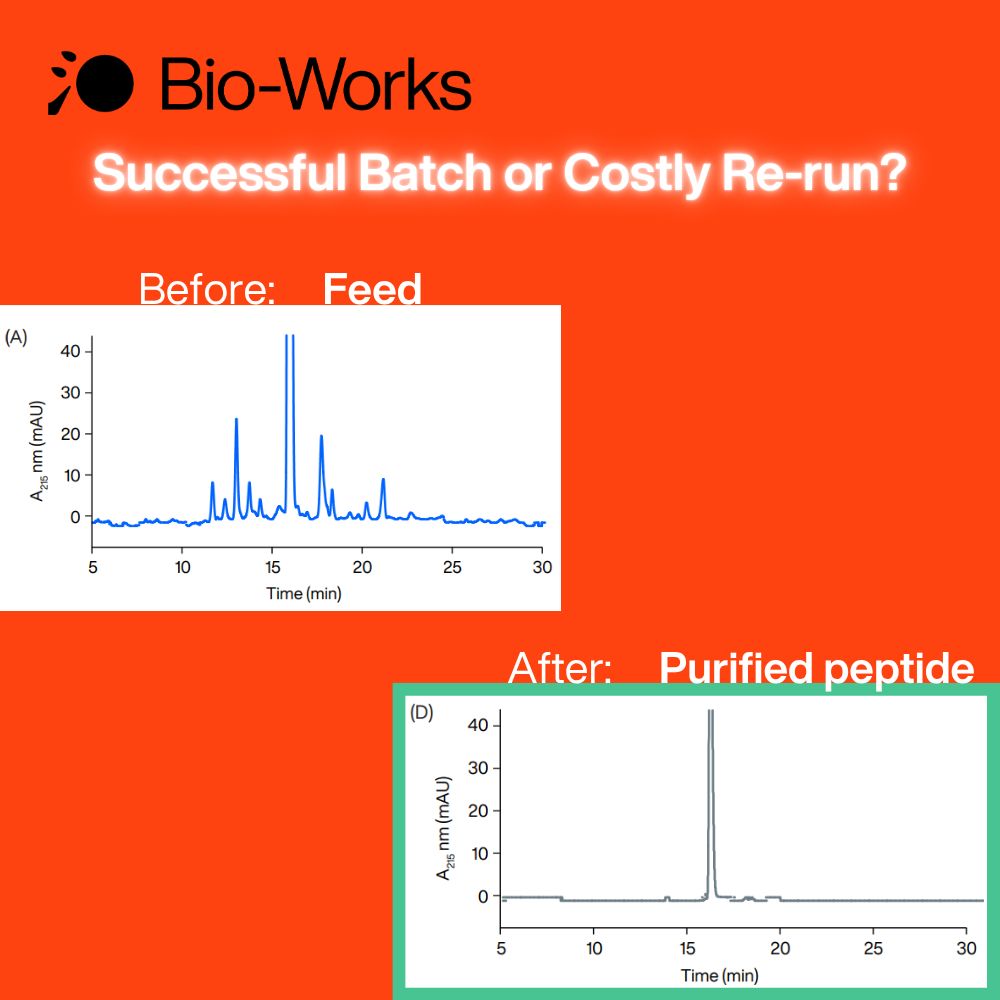
🧬 𝐖𝐡𝐲 99% purity is 𝐨𝐧𝐥𝐲 the beginning in peptide purification. Purifying therapeutic peptides like 𝐆𝐋𝐏-𝟏 analogues or insulin isn't just about capacity. 𝐈𝐭’𝐬 𝐚𝐛𝐨𝐮𝐭 the surgical separation of closely related impurities. When your impurities are truncated sequences or deamidated forms of your target molecule, they often 𝐛𝐞𝐡𝐚𝐯𝐞 almost identically in your chromatography column. Achieving that final 𝟏% of purity can be the 𝐝𝐢𝐟𝐟𝐞𝐫𝐞𝐧𝐜𝐞 between a successful batch and a costly re-run. The 𝐜𝐡𝐚𝐥𝐥𝐞𝐧𝐠𝐞 for process engineers is balancing this extreme resolution with high productivity. 𝐈𝐟 your resin can’t handle high flow rates at process-scale, your timeline suffers. At Bio-Works Technologies, we’ve documented how our highly rigid 𝐖𝐨𝐫𝐤𝐁𝐞𝐚𝐝𝐬™ CIEX resins provide the selectivity needed to remove these difficult impurities early in the process, 𝐬𝐢𝐦𝐩𝐥𝐢𝐟𝐲𝐢𝐧𝐠 your subsequent Reverse Phase (RPC) steps. 👉 Want to see the data? We’ve gathered our 𝐤𝐞𝐲 application insights on how to optimize your peptide purification strategy here: https://lnkd.in/dWtDGi-b #PeptidePurification #DownstreamProcessing #Biomanufacturing #Chromatography #GLP1 #BioWorks
- LINKEDIN · IMAGESince 10 Sept 2026
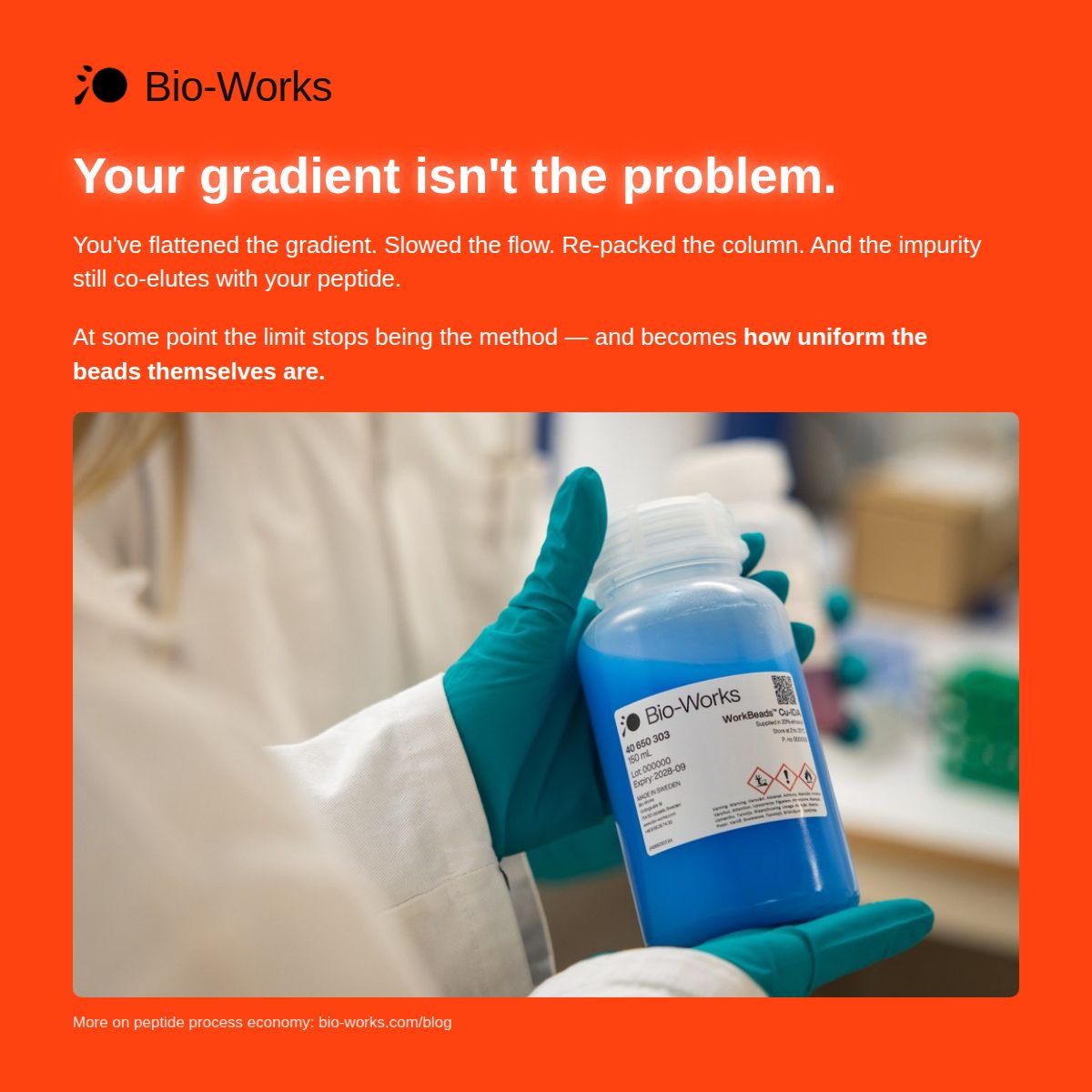
𝐘𝐨𝐮𝐫 𝐠𝐫𝐚𝐝𝐢𝐞𝐧𝐭 𝐢𝐬𝐧'𝐭 𝐭𝐡𝐞 𝐩𝐫𝐨𝐛𝐥𝐞𝐦👀 You've flattened the gradient. Slowed the flow. Re-packed the column. Maybe changed the buffer system. 𝐀𝐧𝐝 𝐭𝐡𝐞 𝐢𝐦𝐩𝐮𝐫𝐢𝐭𝐲 𝐬𝐭𝐢𝐥𝐥 𝐜𝐨-𝐞𝐥𝐮𝐭𝐞𝐬 𝐰𝐢𝐭𝐡 𝐲𝐨𝐮𝐫 𝐩𝐞𝐩𝐭𝐢𝐝𝐞! There's a point in method development where the method stops being the constraint. 𝐖𝐡𝐚𝐭'𝐬 𝐥𝐞𝐟𝐭 is the physical thing the separation happens on: How tightly the bead sizes cluster, how consistent the pores are, how reproducibly that was manufactured this batch and the last one. 𝐀 𝐫𝐞𝐬𝐢𝐧 with a wide particle size distribution puts a ceiling on resolution that no gradient can lift. You can spend months optimising underneath that ceiling. Worth checking before the next round of screening: 𝙒𝙝𝙖𝙩 𝙙𝙤𝙚𝙨 𝙩𝙝𝙚 𝙥𝙖𝙧𝙩𝙞𝙘𝙡𝙚 𝙨𝙞𝙯𝙚 𝙙𝙞𝙨𝙩𝙧𝙞𝙗𝙪𝙩𝙞𝙤𝙣 𝙤𝙛 𝙮𝙤𝙪𝙧 𝙘𝙪𝙧𝙧𝙚𝙣𝙩 𝙧𝙚𝙨𝙞𝙣 𝙖𝙘𝙩𝙪𝙖𝙡𝙡𝙮 𝙡𝙤𝙤𝙠 𝙡𝙞𝙠𝙚?
- LINKEDIN · CAROUSELSince 1 Sept 2026
3 reasons to use prepacked columns:
- LINKEDIN · IMAGESince 20 Aug 2026
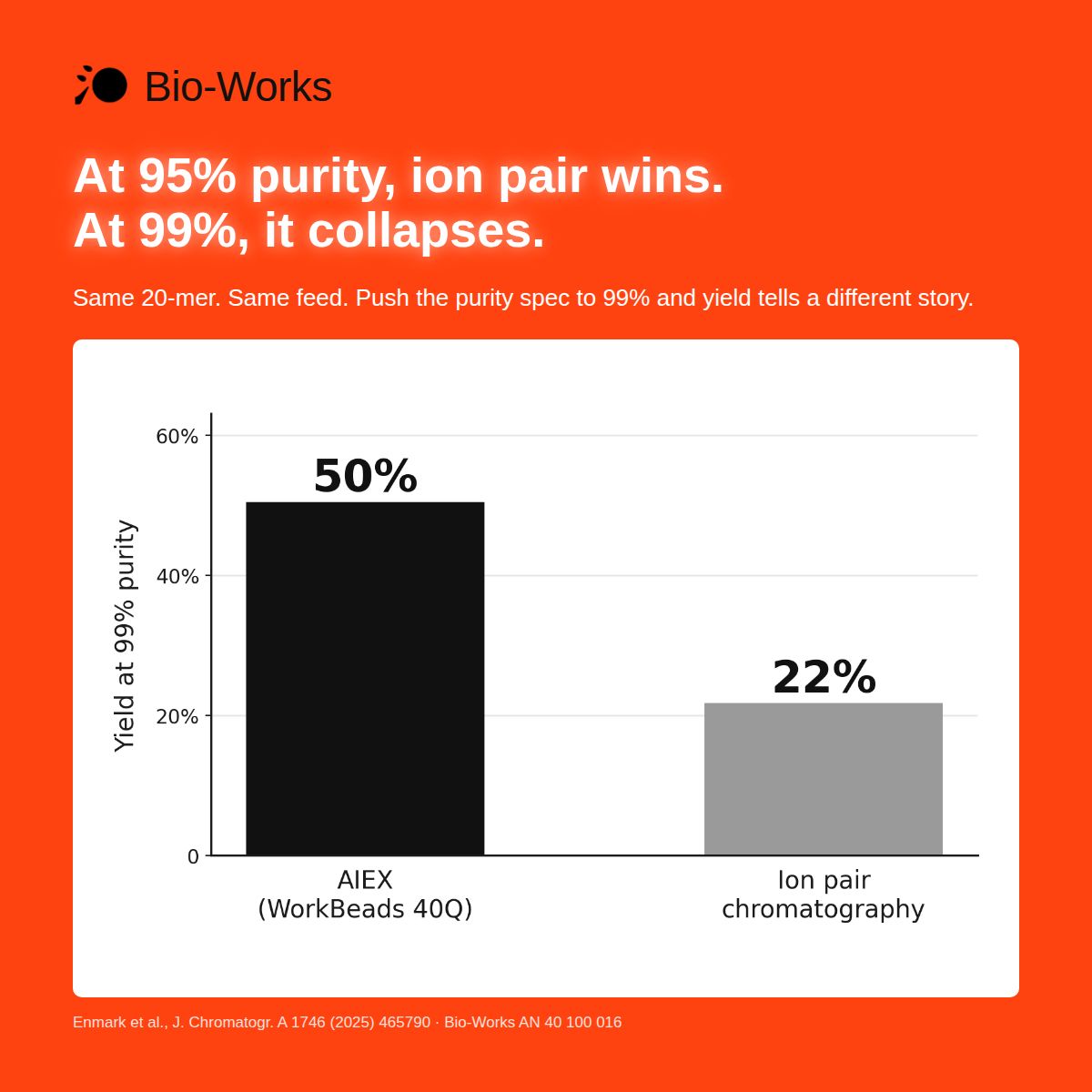
At 95% purity, ion pair chromatography wins. 𝐀𝐭 𝟗𝟗%, 𝐢𝐭 𝐜𝐨𝐥𝐥𝐚𝐩𝐬𝐞𝐬. Same 20-mer oligo. Same feed, split in two. One half purified by AIEX on WorkBeads 40Q, the other by IPC at an external site under their own optimised conditions. At a 95% purity spec, IPC gives the better yield: 92% against 77%. That matches what most people expect from a high-resolution technique. Move the spec to 99% and it inverts: AIEX holds 50% yield, IPC drops to 22%. The reason is peak shape. Impurities elute at the front of the AIEX peak, so you shave the front and keep the rest. In IPC they sit right on top of the yield optimum, so tightening the spec cuts into the product itself. 𝐏𝐫𝐨𝐝𝐮𝐜𝐭𝐢𝐯𝐢𝐭𝐲 𝐟𝐨𝐥𝐥𝐨𝐰𝐞𝐝: 𝟐× 𝐡𝐢𝐠𝐡𝐞𝐫 𝐟𝐨𝐫 𝐀𝐈𝐄𝐗 𝐚𝐭 𝟗𝟓% 𝐩𝐮𝐫𝐢𝐭𝐲, 𝟕× 𝐚𝐭 𝟗𝟗%. 𝐒𝐨𝐥𝐯𝐞𝐧𝐭 𝐜𝐨𝐧𝐬𝐮𝐦𝐩𝐭𝐢𝐨𝐧 𝐫𝐚𝐧 𝟑× 𝐭𝐨 𝟏𝟎× 𝐡𝐢𝐠𝐡𝐞𝐫 𝐟𝐨𝐫 𝐈𝐏𝐂. Read the full story 👇 https://lnkd.in/eqmQsCQ2
- LINKEDIN · IMAGESince 20 Aug 2026
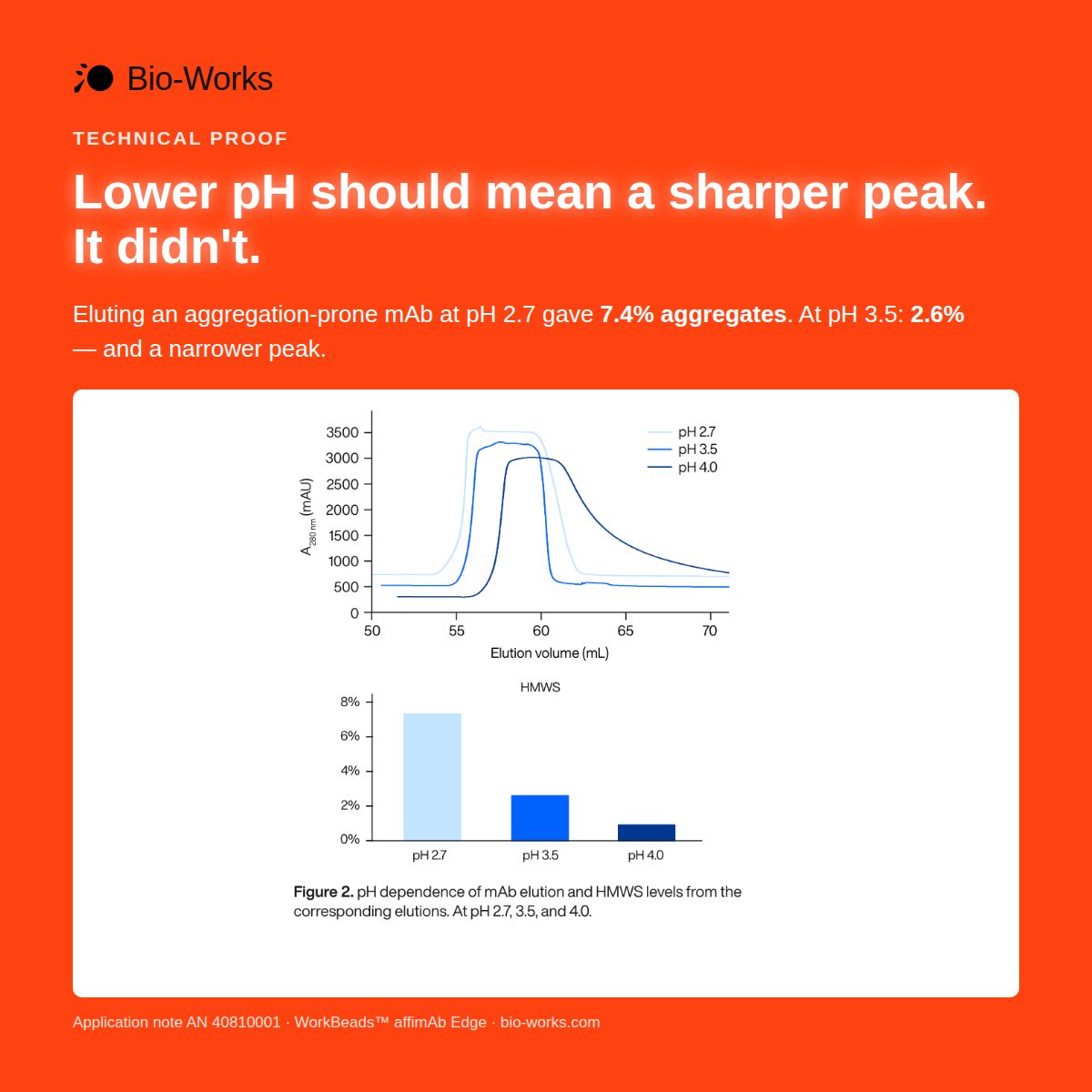
Lower pH should mean a sharper peak. 𝐈𝐭 𝐝𝐢𝐝𝐧'𝐭👀 Protein A elution is a trade-off everyone in downstream knows: 𝐘𝐨𝐮 𝐧𝐞𝐞𝐝 acid to release the antibody, and the acid is exactly what makes it aggregate. We ran an aggregation-prone mAb across pH 2.7, 3.5 and 4.0. 𝐓𝐡𝐞 𝐚𝐠𝐠𝐫𝐞𝐠𝐚𝐭𝐞 𝐧𝐮𝐦𝐛𝐞𝐫𝐬 𝐛𝐞𝐡𝐚𝐯𝐞𝐝 𝐚𝐬 𝐞𝐱𝐩𝐞𝐜𝐭𝐞𝐝: 7.4% HMWS at pH 2.7, down to 2.6% at pH 3.5 and 0.9% at pH 4.0. 𝐓𝐡𝐞 𝐩𝐞𝐚𝐤 𝐬𝐡𝐚𝐩𝐞 𝐝𝐢𝐝 𝐧𝐨𝐭. pH 3.5 gave a narrower peak than pH 2.7, which is the opposite of what the textbook predicts. 𝐓𝐡𝐞 𝐫𝐞𝐚𝐬𝐨𝐧 turned out to sit in the buffer chemistry rather than the pH: Citrate propagates through the column as a clean front, while glycine-HCl overshoots before it drops, delaying desorption and broadening the peak. If you're fighting aggregates in your capture step, 𝐭𝐡𝐞 𝐞𝐥𝐮𝐭𝐢𝐨𝐧 𝐛𝐮𝐟𝐟𝐞𝐫 𝐢𝐬 𝐰𝐨𝐫𝐭𝐡 𝐚𝐬 𝐦𝐮𝐜𝐡 𝐚𝐭𝐭𝐞𝐧𝐭𝐢𝐨𝐧 𝐚𝐬 𝐭𝐡𝐞 𝐩𝐇 𝐬𝐞𝐭𝐩𝐨𝐢𝐧𝐭. Full application note in the comments👇

6 of 40 adsSign up to see every Bio-Works Technologies ad, filter by format and date, and get alerts on new ones.
See all 40 adsWatch the companies you care about.
Filter every ad by industry, country, format and network, and get alerts when a company you watch starts running new ads.