On air · 1 of 3 networks
BenchSci
- benchsci.com
- Healthcare & Life Sciences
- CA
- 191 employees
BenchSci’s ads on LinkedIn, Meta and Google, recorded by adsrunning. Browse the latest here for free. Sign up free to see all 28. Watch BenchSci with Starter to get each new one in your feed.
Watchlist with Starter · $49/mo
| Network | Status | Live ads | Nov 2025LinkedIn activity · 52 weeksOct 2026 | Checked | Next step |
|---|---|---|---|---|---|
| Running | 28 | Checked 30 Oct 2026 | See all 28 ads → | ||
| Meta | Not checked | — | |||
| None recorded | 0 | No ads found on the Google Ads Transparency Center | Checked 10 Oct 2026 | Collect them with the API → |
BenchSci has 28 live LinkedIn ads. We recorded no Google ads on 10 Oct 2026.
Latest ads
- LINKEDIN · FOLLOWRecorded 8 Oct 2026
Get the latest jobs and industry news
- LINKEDIN · IMAGERecorded 24 Oct 2026
I’m very excited to partner with Patsnap and Ray Chohan. Patsnap has done a fantastic job of making clinical trial and patent data AI-ready. Unlike others who just add data as an MCP call to say they have it, we’ve built custom skills, data models, and pipelines to bring this data into unified scientific workflows. Combining it with our rich data ecosystem, our knowledge graph, and more than 40 models that cover the jobs to be done in research. This is why Emet is becoming the workhorse for the world's largest research organizations. https://lnkd.in/g_3jMuVy
- LINKEDIN · IMAGERecorded 15 Oct 2026
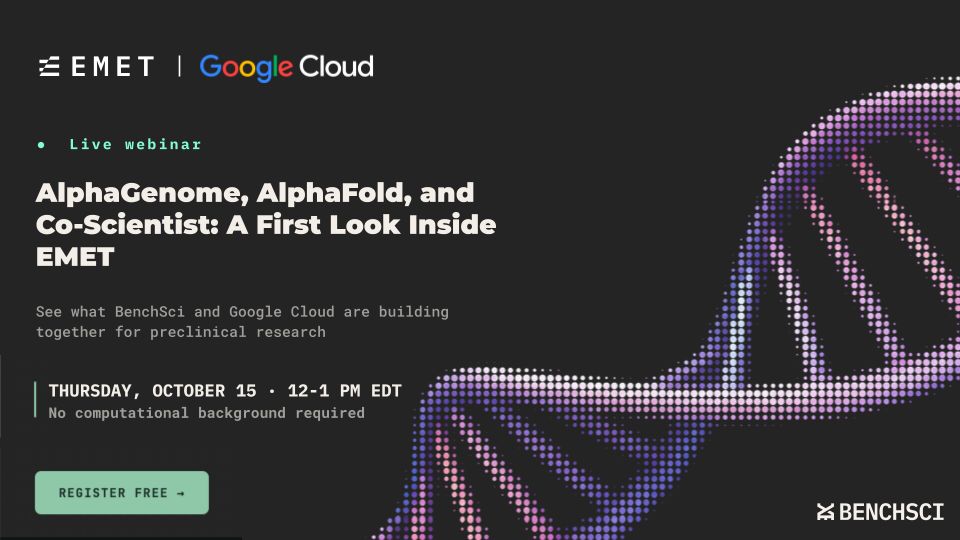
📍 Register here https://lnkd.in/gGgp3V-x for EMET x Google Cloud AI Webinar 🗓️ Thursday October 15, 12pm - 1pm EDT AlphaFold. AlphaGenome. Gemini Enterprise. Google’s AI Co-Scientist. All meeting the evidence behind world's leading agentic research environment for the AI workbench connecting 16 million closed-access papers, in one research environment. On Thursday, October 15 at 12pm ET, John Jackson (Chief Technology Officer, BenchSci) and Tom Beyer (Product Manager, Google Cloud AI for Science) are giving a live look at what our Google Cloud partnership is building for preclinical R&D, with a demo from Luca Delfinis, PhD (Scientific Solutions Architect, BenchSci) covering: → Google’s frontier life science models inside EMET — AlphaFold and AlphaGenome alongside the literature, omics, and reagent evidence behind a target → EMET as the enterprise research agent in Gemini Enterprise, through an agent-to-agent approach → An early look at Google’s AI Co-Scientist working with EMET, still in development Come see what’s coming #DrugDiscovery #AI #GoogleCloud #PreclinicalResearch
- LINKEDIN · IMAGERecorded 8 Oct 2026
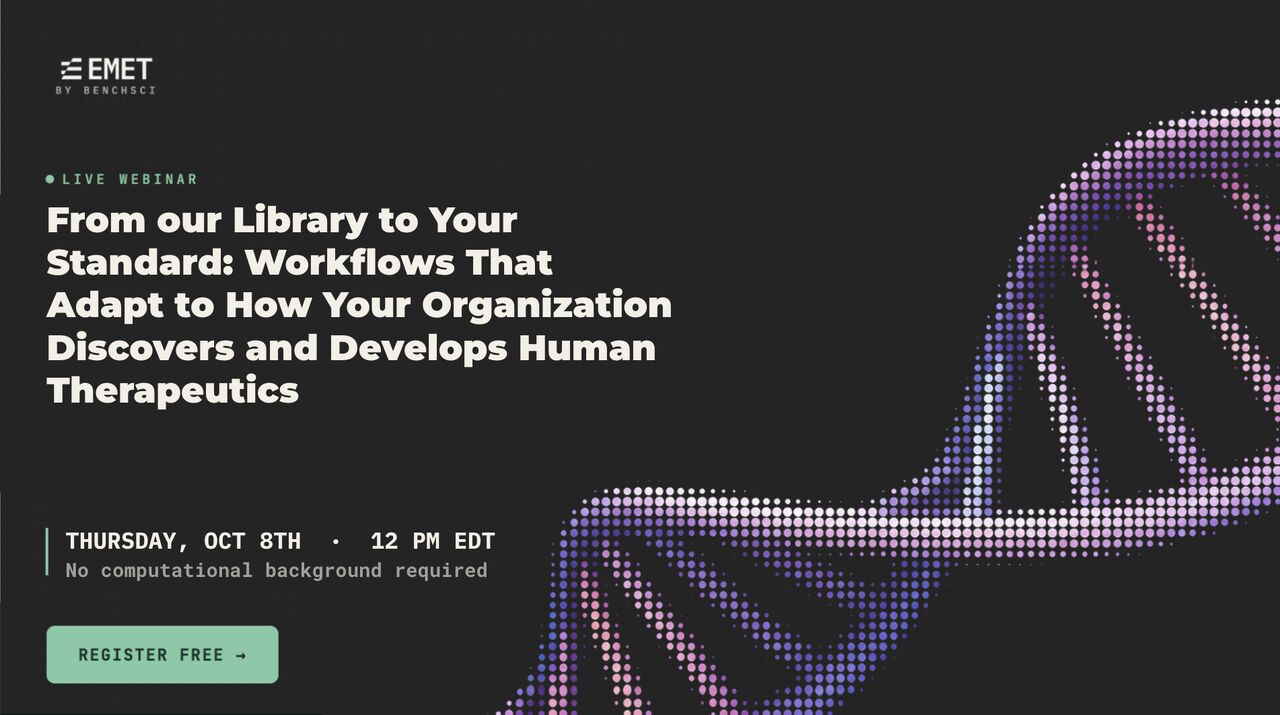
Register here https://lnkd.in/gg-rm7VS for October 8th's webinar From our Library to Your Standard: Workflows That Adapt to How Your Organization Discovers and Develops Human Therapeutics Every preclinical organization already runs through the same questions over and over — target safety assessments, developability profiles, dose-selection rationales, biomarker strategies. The expertise behind the answers is real and hard-won. It just isn't written down anywhere, so every team reaches them differently, and no two answers line up when they reach a committee. The EMET workflow library encodes that work. Not a vendor's idea of how research should be done, but a decomposition of the function, stage, and decision points pharma already uses. The library spans preclinical R&D: discovery biology, small molecule and biologics, instrumental analytics, quantitative pharmacology, DMPK, safety, translational and biomarker, data science, portfolio management, and regulatory. A shipped workflow is a starting point, not the finish. The value arrives when a company adapts one to its own data, its own sequence of skills, and its own definition of sufficient evidence. The general science is already done, so your teams spend their effort on the part only they can supply. Join Peter Grandsard (Senior Vice President, Strategy), who spent decades in biopharma leading both dry- and wet lab research technology organizations, on why AI adoption stalls in preclinical research when it isn't aligned to the workflows teams already run. Cino (Catriona) Ling (Scientific Solutions Architect) then presents the library and runs the workflows live. #DrugDiscovery #AIinDrugDiscovery #AIforScience #ScientificWorkflows #TargetValidation #DMPK #Biomarkers #ComputationalBiology
- LINKEDIN · IMAGERecorded 8 Oct 2026
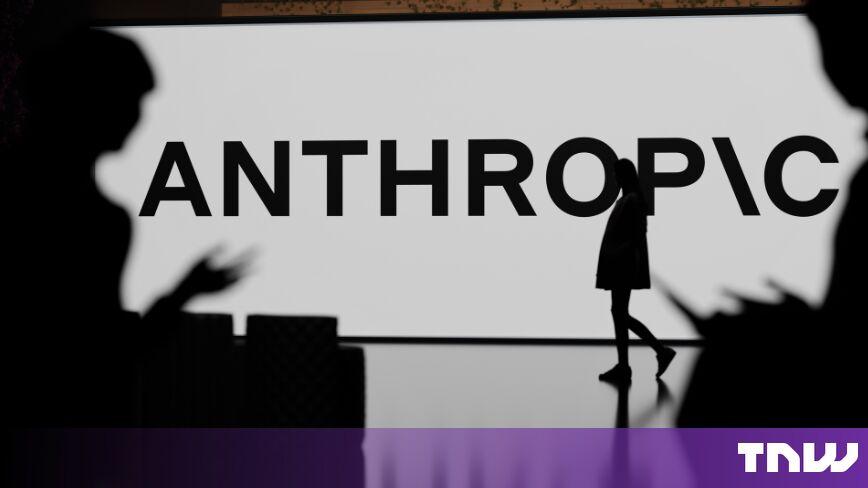
This is every Claude Science customer's worst nightmare. A scientist fed Claude his unpublished research for three years. Then Anthropic announced it as Claude's discovery. Here's the case Mario Rodríguez Mestre is making. Last week, Anthropic said its AI agents took "the first steps of a biological discovery on its own." They found a new family of enzymes in jumbo phages and called them ARTs. Mestre, a computational biologist at the University of Copenhagen, says he's studied those same enzymes since 2022. His team calls them "jumbotrons." He's a co-inventor on a 2023 patent that covers them. "They are the same systems we have been studying for years." Then he lays out what he says he gave Claude along the way: His dissertation draft. Shared with Claude. His unpublished manuscript on jumbotrons. Shared with Claude. The key finding. Anthropic says Claude's main contribution was linking an array of RNA molecules to the enzyme. Mestre says his team made that connection more than a year ago and shared it with Claude. The supporting data. Anthropic's agents pulled a 2022 dataset showing high levels of those RNA molecules. Mestre's team analyzed that same dataset a year ago to find the same RNA genes, and they shared that analysis with Claude. "The resemblance was striking to us." He also questions how fast it happened. Jumbotrons are rare, and their RNA genes are hard to tell apart from random sequences. He doubts agents could have found them so quickly without a map. His conclusion: "The most important question is not 'Were ARTs already known?' They were." The real question is whether Claude reasoned its way there or was steered by his work. His worry is that his conversations went into training future models. "It's already happened," he said, pointing to artists and writers. Anthropic's answer: Claude wasn't trained on user transcripts, and its molecular biology team has no access to them. https://lnkd.in/gJYu5Nyc
- LINKEDIN · IMAGERecorded 8 Oct 2026
Reuters confirms Anthropic has a wet lab — and Anthropic won't say what it's for. I wonder why... "Anthropic has set up a wet lab in the San Francisco Bay Area, a place to run physical biology experiments rather than simulate them. The company confirms it exists, yet it will not say what it is for, beyond ruling out the obvious answer, which is drug discovery." "Life sciences is now among Anthropic’s largest areas by headcount and spending, and it has been recruiting a procurement lead and a biochemical specialist." “We absolutely are doing that today, and I would describe our approach as being typical of what you would see in most biotech companies" "Reuters has linked part of the campaign to Dario Amodei personally since the disease killed his father before a cure was found." https://lnkd.in/gMk8vTQn https://lnkd.in/gvcdBrbe

6 of 28 adsSign up to see every BenchSci ad, filter by format and date, and get alerts on new ones.
See all 28 adsWatch the companies you care about.
Filter every ad by industry, country, format and network, and get alerts when a company you watch starts running new ads.