Not on air · 2 of 3 networks checked
Bemakers
- bemakers.com
- Logistics & Transportation
- DK
- 29 employees
Bemakers’s ads on LinkedIn, Meta and Google, recorded by adsrunning. Browse the latest here for free. Sign up free to see all 26. Watch Bemakers with Starter to get each new one in your feed.
Watchlist with Starter · $49/mo
| Network | Status | Live ads | Nov 2025LinkedIn activity · 52 weeksOct 2026 | Checked | Next step |
|---|---|---|---|---|---|
| None recorded | 0 | Checked 30 Oct 2026 | See all 26 ads → | ||
| Meta | Not checked | — | |||
| None recorded | 0 | No ads found on the Google Ads Transparency Center | Checked 10 Oct 2026 | Collect them with the API → |
Bemakers has no live LinkedIn ads. We recorded no Google ads on 10 Oct 2026.
Latest ads
- LINKEDIN · ARTICLESince 29 Sept 2026
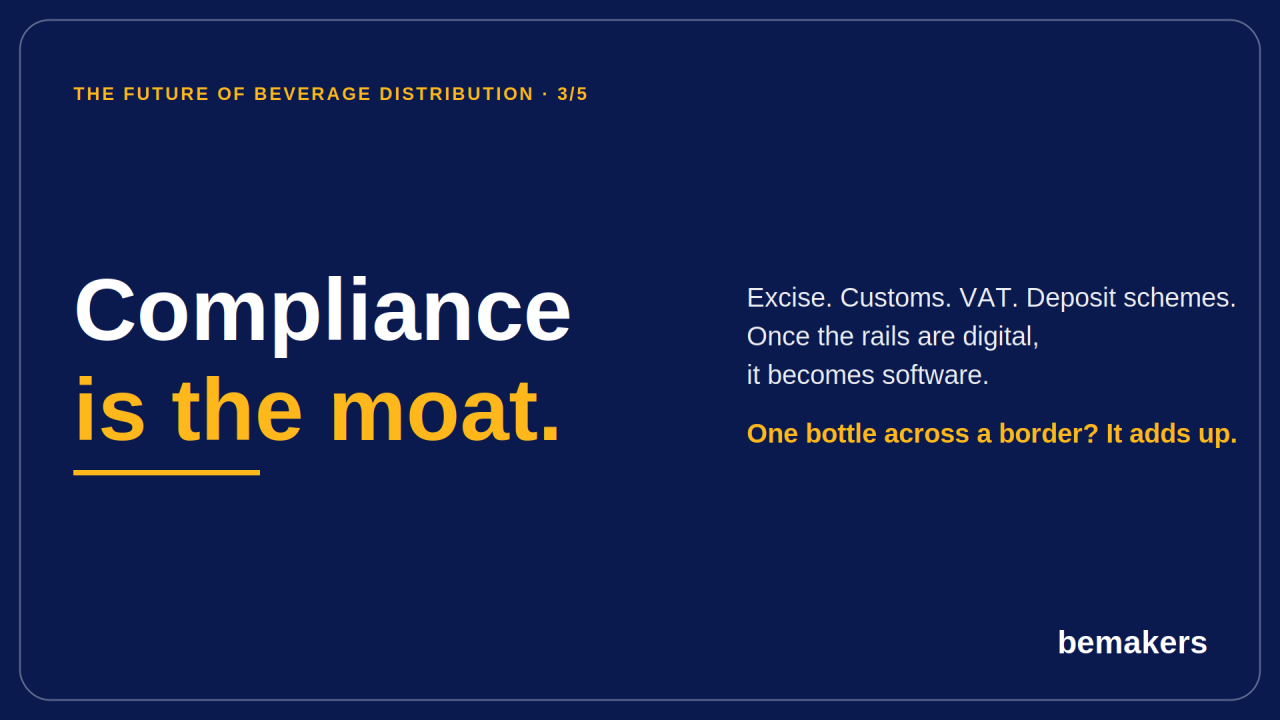
Nobody ever founded a beverage brand because they love excise paperwork. Which is exactly why it needs saying: compliance is the strategic centre of this industry. Not logistics. Not sales. Logistics can be bought from a dozen capable providers. Demand generation is moving back to the brands. But someone must hold the tax warehouse authorisation, stand behind the excise guarantee, and answer to the authorities when a movement doesn't close. That "someone" must be licensed and liable. It cannot be outsourced to enthusiasm. Then the regulators — of all people — changed the game. Since 2023, every intra-EU excise movement runs fully electronically. Once the rails are digital, compliance is machine-readable. And machine-readable compliance is a software problem. Software changes the economics completely. Under the manual regime, the paperwork for one case cost the same as for forty — so the minimum viable shipment was a pallet, and the minimum viable brand was one that could fill pallets. When compliance runs as software, it makes sense to ship a single bottle across a border, fully duty-declared. The volume threshold from yesterday's piece doesn't shrink. It dissolves. Regulation, so often cast as the enemy of innovation, turns out to be the substrate for it. Read on below ...
- LINKEDIN · ARTICLESince 29 Sept 2026
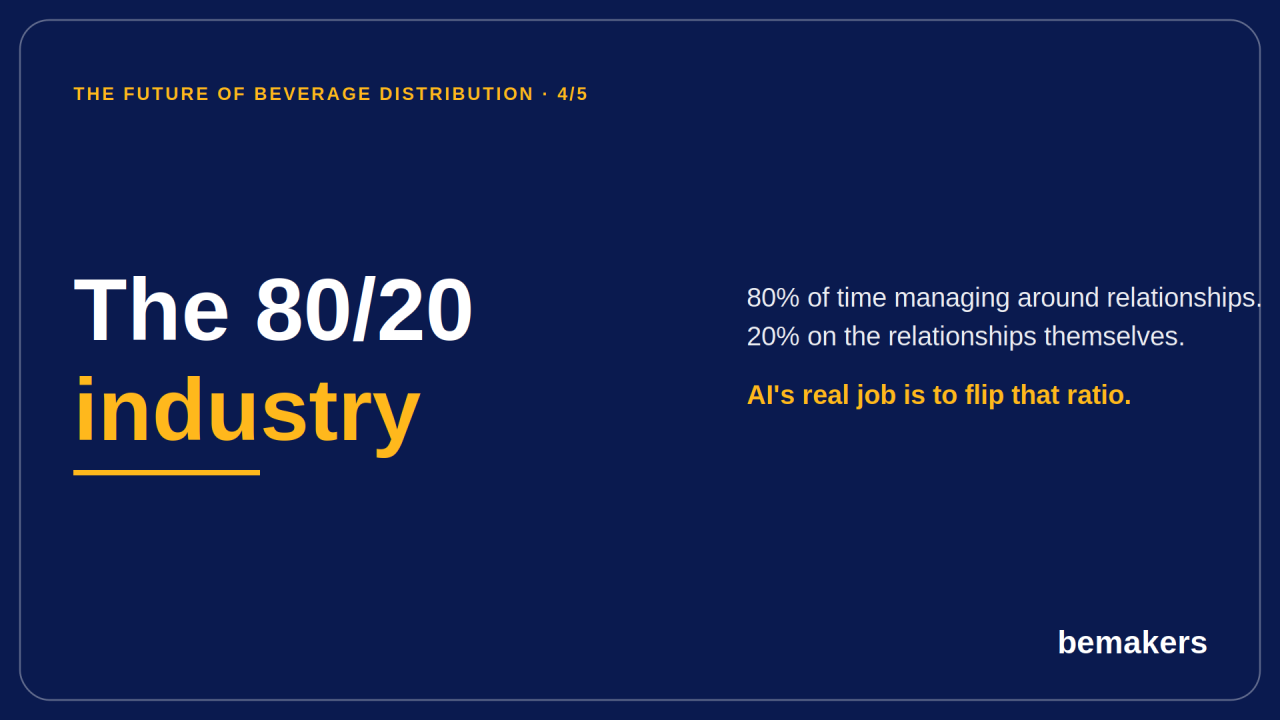
This month, North America's largest wine and spirits distributor confirmed layoffs as it moves to AI-supported customer service. The easy headline: AI is coming for distribution jobs. I think that's the wrong reading. Here's the ratio I keep coming back to (and discussed with The Spirits Business last week): people in this value chain spend roughly 80% of their time managing everything AROUND relationships — orders, documents, reconciliation, reporting — and maybe 20% on the relationships themselves. AI's real job is to flip that ratio. The most ordinary scene in our industry: a bartender texts his rep at 11pm — six more bottles of that gin before the weekend. Today, that message becomes tomorrow morning's manual work. With AI in the workflow, the message IS the order: read, confirmed, scheduled within a minute. Nothing human was removed. The relationship — a bartender who trusts a brand enough to text at night — stays exactly what it was. The administration around it simply vanishes. And there's a second effect: when attention stops being expensive, serving a thousand small brands well stops being a contradiction. AI doesn't disintermediate the middle of this industry. It changes what the middle is made of. Yes, tasks will disappear — pretending otherwise insults everyone's intelligence. But nobody ever sold a case of gin to a bartender who didn't trust them. Read more below ... #AI #BeverageIndustry
- LINKEDIN · ARTICLESince 29 Sept 2026
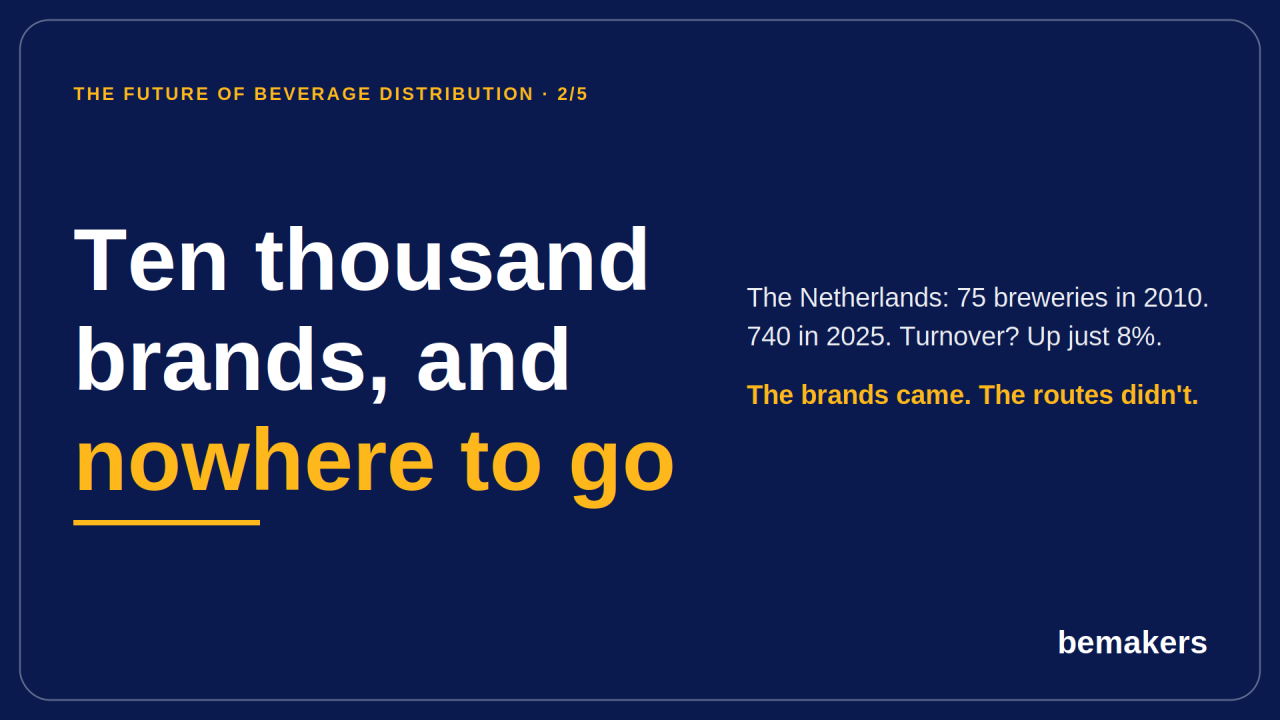
In 2010, the Netherlands had 75 breweries. Today it has 740. Now the number that should worry everyone: between 2016 and 2022, Dutch breweries grew 179%. Sector turnover grew 8%. That is the whole story of European beverage in three numbers. An explosion of brands chasing roughly the same volume. France went from ~500 breweries to 2,500+. The UK added over two thousand. Europe now has more than 10,000 — and openings are now mirrored by closures. Here's what I see every week: those brands are rarely dying because the liquid is bad. They're dying because the route to market never materialised. A traditional distributor's cost structure — reps, back office, credit desk — is largely fixed per brand. So distributors rationally concentrate on volume, and new brands are told to come back when they're bigger. You can't get bigger without distribution. You can't get distribution without being bigger. And the obvious escape — crossing a border — runs straight into excise, EMCS and VAT, fixed costs only volume justifies. The brands that most need to internationalise are exactly the ones nobody will internationalise. The gap isn't more distributors. It's distribution economics that work at small scale. Read more below ... If you run a brand: what is your honest experience finding distribution in a new market?
- LINKEDIN · ARTICLESince 29 Sept 2026
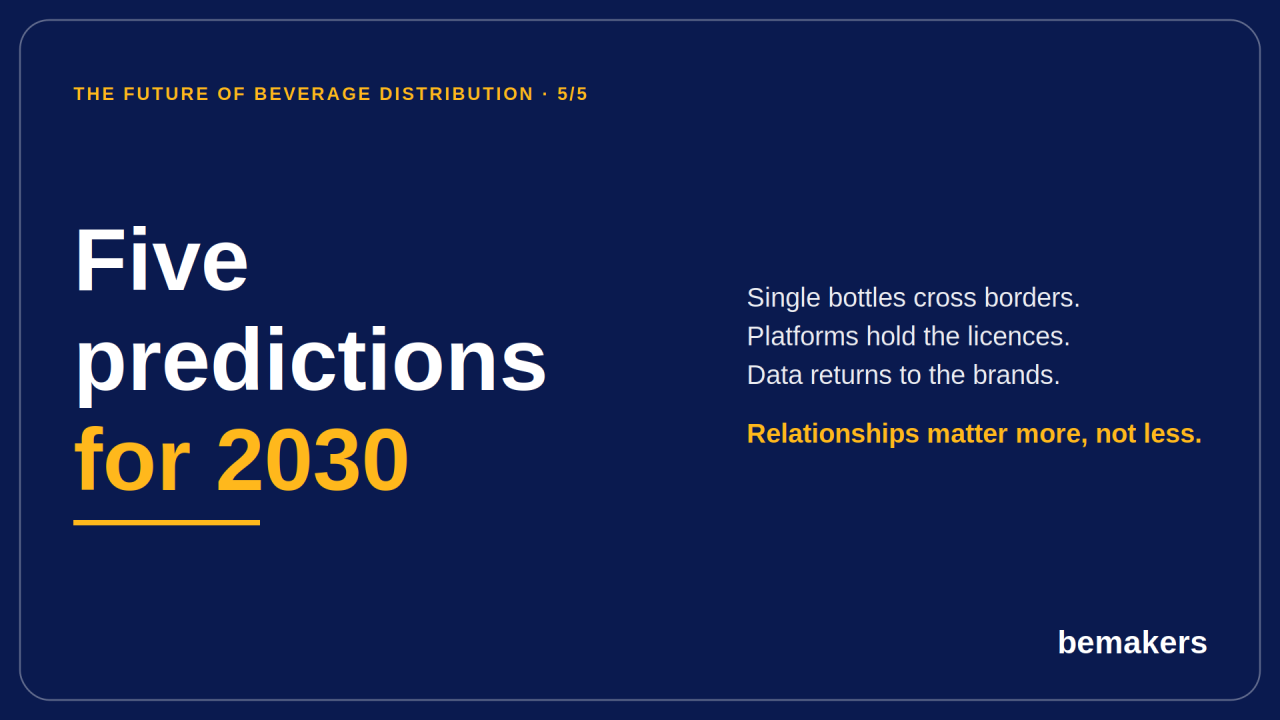
Five predictions for European beverage distribution by 2030. Hold me to them. 1 — The pallet stops being the unit of trade. When compliance runs as software, shipping one bottle across a border is routine. Market entry becomes a test measured in bottles, not a bet measured in pallets. 2 — The importer of record becomes a platform role. A handful of pan-European infrastructure players hold authorisations across many markets, serving hundreds or even thousands of brands on shared software — while traditional importers consolidate upward around big volumes. 3 — Brands take back their data. By 2030, a serious brand expects to see its own sell-through and pricing in every market, and picks partners on transparency, not just reach. 4 — The first fully agentic transactions become normal. A bar's system notices it's running low and places the order — no human on either side. What stays human is the decision to stock the brand at all. 5 — The relationship premium goes UP. When everyone has efficient administration, the differentiator is what you do with the freed time. The winners redeploy it into the market. The losers take it purely as a cost cut. One thread ties them together: the century-old link between volume and viability in this industry is breaking. That concludes the week — all five pieces on my profile. Thank you for reading along. Now: which prediction is wrong? The comments are open, and it's Friday. 🥂 #BeverageIndustry #FutureOfDistribution
- LINKEDIN · ARTICLESince 29 Sept 2026
Nobody wakes up in the morning wanting a distributor. Brands want customers. Retailers want products. Governments want their taxes. The distributor exists because those three wants collide with one of the most regulated product categories on earth — and someone has to stand in the middle, take responsibility, and make it all work. What that someone actually sells is not the moving of goods. It is five different businesses, wrapped into one margin. The interesting part: the US and Europe built the same structure from opposite directions. America mandated the middle tier by law after Prohibition. Europe never did — but excise, EMCS, VAT and packaging rules created one anyway. A structure held up by law changes when the law changes, which is slow. A structure held up by complexity changes when technology absorbs the complexity. Which can be fast. This week I'm publishing five pieces on where beverage distribution goes next. Today: what a distributor actually does — unbundled. Read more below ...
- LINKEDIN · ARTICLESince 28 Sept 2026
Almost everything I've written in this series so far required a car and comfortable shoes. This one runs from a laptop. Three digital shelves need no gatekeeper's permission: your own webshop, online drinks resellers, and Amazon where the market allows it. The revenue matters. But the second output is worth more — every consumer order carries a postcode, and postcodes are a map of where your demand actually lives. A few months of D2C sales regularly points to a different beachhead city than the one everyone assumed. Sell first, land second. Two more things the laptop does better than anything else: it owns the audience (a social following is rented; an email list is yours — feed it from every tasting and every order), and it keeps the score. Points of distribution. Reorders per account. Tasting-to-reorder conversion. D2C by postcode. One page, tracked weekly — the page a professional buyer actually reads. One warning, though: digital amplifies demand. The fieldwork still creates it. Article 4 of Creating Demand is out. Read more below.
6 of 26 adsSign up to see every Bemakers ad, filter by format and date, and get alerts on new ones.
See all 26 adsWatch the companies you care about.
Filter every ad by industry, country, format and network, and get alerts when a company you watch starts running new ads.