On air · 1 of 3 networks
Beaconcure
- beaconcure.com
- Healthcare & Life Sciences
- US
- 37 employees
Beaconcure’s ads on LinkedIn, Meta and Google, recorded by adsrunning. Browse the latest here for free. Sign up free to see all 60. Watch Beaconcure with Starter to get each new one in your feed.
Watchlist with Starter · $49/mo
| Network | Status | Live ads | Nov 2025LinkedIn activity · 52 weeksOct 2026 | Checked | Next step |
|---|---|---|---|---|---|
| Running | 3 | Checked 30 Oct 2026 | See all 60 ads → | ||
| Meta | Not checked | — | |||
| None recorded | 0 | No ads found on the Google Ads Transparency Center | Checked 9 Oct 2026 | Collect them with the API → |
Beaconcure has 3 live LinkedIn ads. We recorded no Google ads on 9 Oct 2026.
Latest ads
- LINKEDIN · IMAGESince 26 Oct 2026
Two programmers agreeing doesn't necessarily mean the results are correct. For decades, double programming has been the gold standard for validating clinical trial outputs. But what happens when both programmers make the same assumption or interpret a specification incorrectly? Agreement isn't always accuracy. As clinical trials become more complex, traditional validation methods are becoming increasingly costly, time-consuming, and difficult to scale. Our latest white paper, "The Quality Layer You Can Defend to an Auditor," explores: 🔹 Why double programming alone cannot guarantee accuracy 🔹 The hidden costs and risks of conventional validation 🔹 How independent, AI-enabled validation can identify discrepancies and explain their underlying causes 🔹 Why traceability and evidence are essential to audit-ready quality The future of clinical data validation isn't about checking the same work twice. It's about independently verifying what's right. 📄 Read the full white paper: https://lnkd.in/eRbFY7aG/?utm_campaign=WhitePaper:TheQualityLayerYouCanDefendtoanAuditor%255BOct26,2026%255D&utm_source=linkedin&utm_medium=paid&utm_id=1243186334&hsa_acc=511108803&hsa_cam=1243186334&hsa_grp=905662794&hsa_ad=1611948584&hsa_net=linkedin&hsa_ver=3 #ClinicalTrials #ClinicalDataValidation #GenerativeAI #Biostatistics #StatisticalProgramming #LifeSciences
- LINKEDIN · IMAGESince 6 Oct 2026
Verify Intelligence is now live in production at a Top 10 biopharmaceutical company. Every regulatory submission depends on hundreds or thousands of tables, listings, and figures. Most teams check them with double programming plus manual review. Both methods work from the same specification, so they can miss the same errors. Verify Intelligence adds an independent review. It produces its own version of each output, compares it with your team's, and traces every difference back to the source. Each step is recorded, so reviewers can see how every result was reached. The AI flags. Your statisticians and programmers decide. We built Verify Intelligence with direct feedback from two Top 10 biopharma customers. Three more companies begin pilots early next year. 📌 Read the full announcement: https://lnkd.in/gE6UMb2U 🔗 Explainer video in the comments. #ClinicalTrials #Biometrics #GenerativeAI #StatisticalProgramming #ClinicalData #LifeSciences
- LINKEDIN · IMAGESince 2 Oct 2026
For decades, double programming has been the gold standard for validating clinical tables. It earned that position because it provided an independent way to verify results and protect quality. That hasn't changed. What has changed is the environment in which biometrics teams work. Today, teams face: • More studies and increasingly complex data • Shorter timelines and higher delivery expectations • Growing workloads with limited programming resources • Faster regulatory and submission cycles Yet quality control remains one of the biggest bottlenecks on the path to submission-ready outputs. Traditional double programming and manual validation create repetitive, siloed workflows that demand significant expert time. Verify Intelligence introduces a new approach to independent validation. Using GenAI, it interprets study documents, including SAPs, mock shells, specifications, and structured ADaM datasets, to independently generate validation tables for expert review. Each generated table is supported by: ➝ Transparent metadata interpretation ➝ Explainable AI reasoning ➝ SQL logic behind the generated result ➝ Confidence and gap analysis ➝ Complete traceability and audit history Instead of duplicating programming effort, biometrics teams gain an independently generated set of validation tables that supports faster comparison, validation, and review within a transparent, governed workflow. Independent validation remains the standard. What's changing is how it's achieved. GenAI. Verified.
- LINKEDIN · IMAGESince 21 Sept 2026
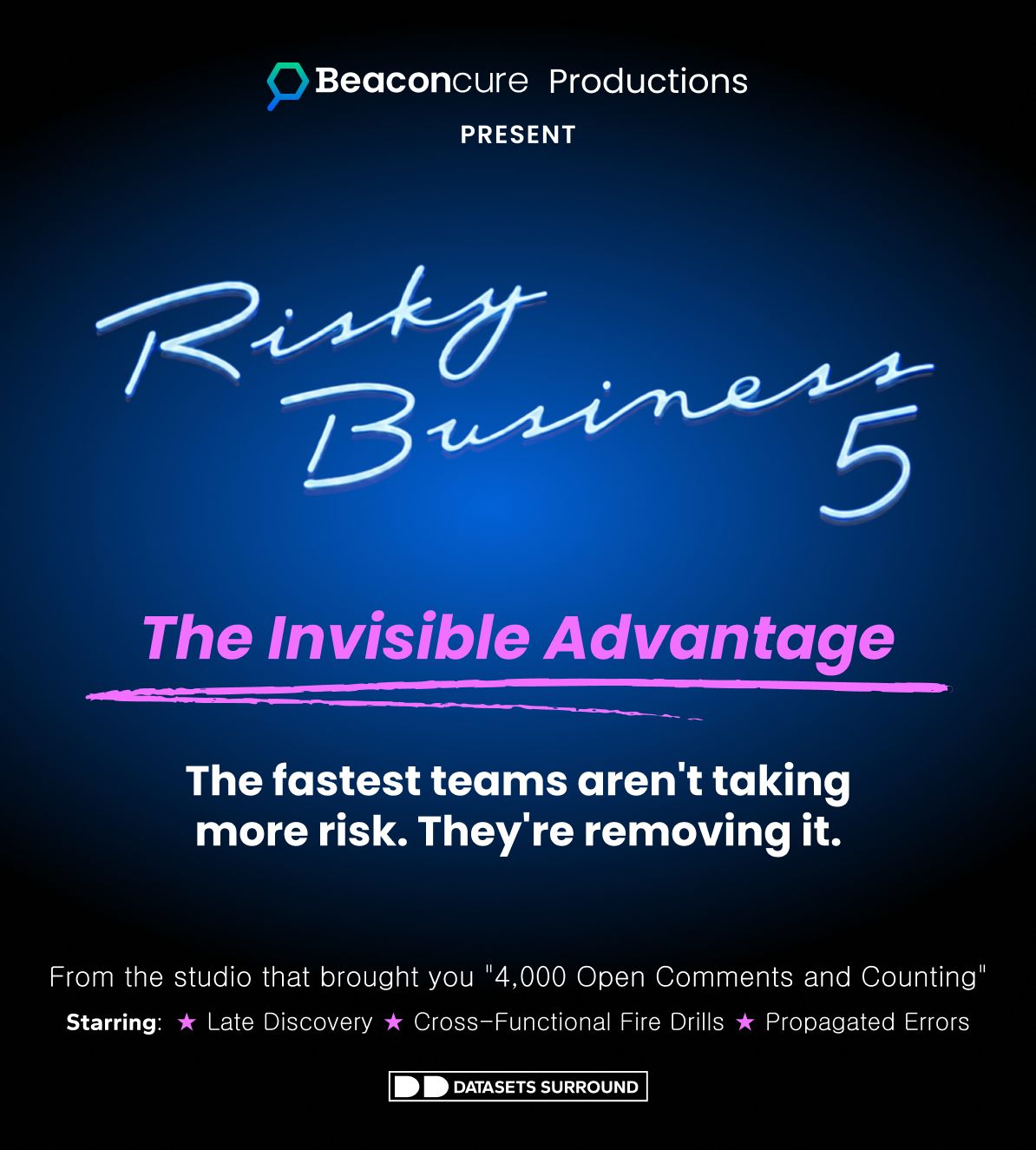
The fastest teams aren’t taking more risks. They’re removing them. That’s the invisible advantage. Traditional approaches often identify risk after it has already entered the process, creating more review, more rework, and more opportunities for delays. Modern teams are changing the equation. Automation catches inconsistencies earlier. AI-enabled validation surfaces issues before they compound. Proactive quality controls move risk detection upstream, where it is easier and faster to address. The result isn’t less rigor. It’s less uncertainty. Because the real opportunity isn’t learning to move faster with risk. It’s engineering risk out of the process from the start. #RiskyBusiness #ClinicalTrials #ClinicalData #AI #Automation #Quality #DigitalTransformation
- LINKEDIN · IMAGESince 31 Aug 2026
What happens to quality when AI makes clinical development faster? If AI accelerates production but confidence still depends on the same downstream QC cycles, we haven't solved the whole problem. That's why independent validation matters. As clinical data moves through analysis, TLF generation, validation, review, and ultimately toward submission-ready outputs, quality can't be an afterthought. We believe it needs to move with the work. That's the direction we're building toward with Beaconcure Verify: an evergreen quality layer designed for the evolving clinical data lifecycle.
- LINKEDIN · IMAGESince 31 Aug 2026
Clinical development doesn't have a generic AI problem. It has a trust problem. AI can accelerate code, analyses, TLF generation, review, and other clinical workflows. But clinical development requires more than a powerful model. It requires an understanding of the clinical, statistical, and regulatory context behind the work. That's why we believe clinical AI needs to be expert-led. At Beaconcure, that perspective has been shaped by seven years of experience and thousands of real clinical trials. The technology matters. The expertise behind it matters just as much.


6 of 60 adsSign up to see every Beaconcure ad, filter by format and date, and get alerts on new ones.
See all 60 adsWatch the companies you care about.
Filter every ad by industry, country, format and network, and get alerts when a company you watch starts running new ads.