On air · 1 of 3 networks
Axelerant
- axelerant.com
- IT Services & Consulting
- US
- 179 employees
Axelerant’s ads on LinkedIn, Meta and Google, recorded by adsrunning. Browse the latest here for free. Sign up free to see all 169. Watch Axelerant with Starter to get each new one in your feed.
Watchlist with Starter · $49/mo
| Network | Status | Live ads | Nov 2025LinkedIn activity · 52 weeksOct 2026 | Checked | Next step |
|---|---|---|---|---|---|
| Running | 152 | Checked 30 Oct 2026 | See all 169 ads → | ||
| Meta | None recorded | 0 | No active ads recorded on the Meta Ad Library | Checked 17 Oct 2026 | Collect them with the API → |
| Recently | 4 | Ads on the Google Ads Transparency Center | Checked 7 Oct 2026 | Collect them with the API → |
Axelerant has 152 live LinkedIn ads. Its Facebook page had no active ads on 17 Oct 2026, and we recorded 4 Google ads on 7 Oct 2026.
Latest ads
- LINKEDIN · IMAGESince 19 Oct 2026
Three out of four US PE deals last year were add-ons. The median hold just hit 5.3 years, up from 4.2 in 2021. Fourth straight year it’s gone up. And only 15% of the 2021 vintage had exited by year four. Normal is 25–30%. Sponsors are holding longer, buying more, and eventually have to prove the add-ons became one company. Year three of a buy-and-build usually looks like this: → Six websites, and four domains nobody can log into → Two marketing automation platforms doing the same job → Three CRMs and one “master” spreadsheet → Brands outranking each other on search engines, and in AI searches → A board report that takes three weeks to assemble On paper, it’s one company. In the market, it’s six. Now every sponsor wants an AI story for the portfolio. Here’s the catch: AI is only as smart as the context it can reach. Point an agent at that estate and it doesn’t see one customer buying from three brands. It sees three strangers. It doesn’t know the account is mid-renewal, that a sister brand just quoted them, or which pricing applies. So it gives confident, fluent, wrong answers, at scale. The model isn’t the hard part anymore. Every company can rent the same one. The advantage is the context engine underneath: one connected layer that knows who the customer is across every brand, what they’ve bought, what’s open, and what was said. That’s what turns AI from a demo into a margin lever. It’s also exactly what a buy-and-build destroys by default, and what a buyer pays a premium for at exit. We built one to run our own business. The model was the easy part. Three questions for any sponsor 18 months into a hold: →Can you see cross-sell pipeline across brands today, without an analyst? →If you pointed an AI agent at your customer base tomorrow, would it know a customer buys from three of your brands? →If a buyer asked for customer data by entity, how long would it take? If any answer starts with “well…”, the AI roadmap is premature. Build the context first. I’ll be at ACG Philadelphia's M&A East next week (Oct 20–21). Operating partners and deal teams: what’s actually breaking first when you try to put AI into your add-ons? #ACGPhiladelphia #PrivateEquity #MergersAndAcquisition Axelerant #MAEast
- LINKEDIN · IMAGESince 16 Oct 2026
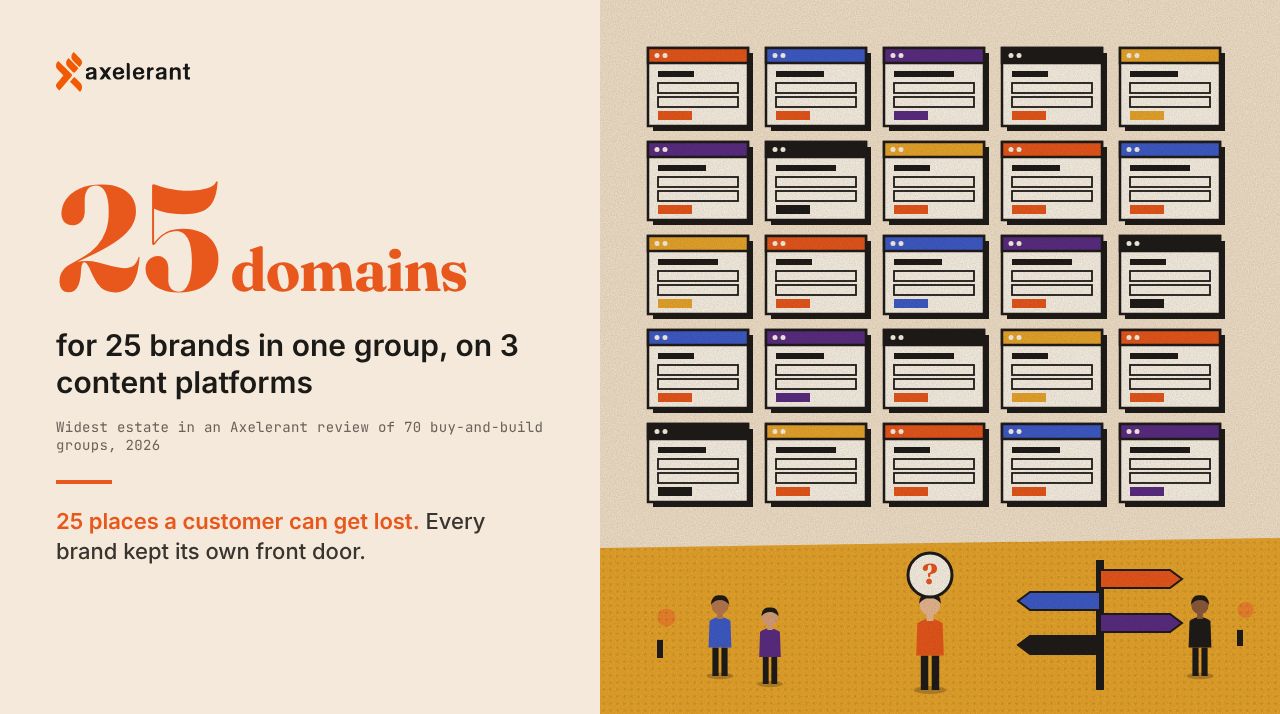
The widest estate in our review of 70 buy-and-build groups: 25 brands on 25 domains, run on 3 content platforms. That is 25 places a customer can get lost. Others weren’t far behind. One group runs 20 brands with 20 sites and 20 quote forms. Another has 150+ firms using email tools from at least 5 vendors. Keeping the brands is a sound choice. Running every brand as its own front end isn’t. See how multi-brand groups keep their brands and still get one customer view ⤵
- LINKEDIN · IMAGESince 16 Oct 2026
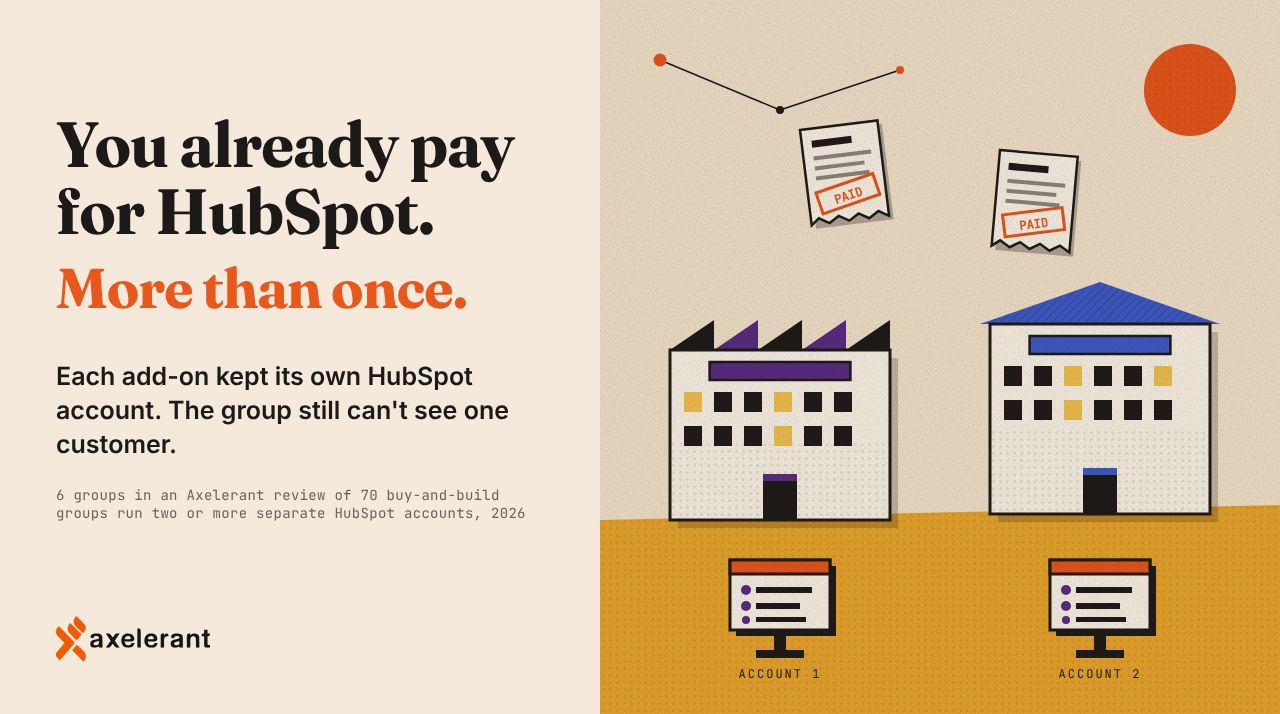
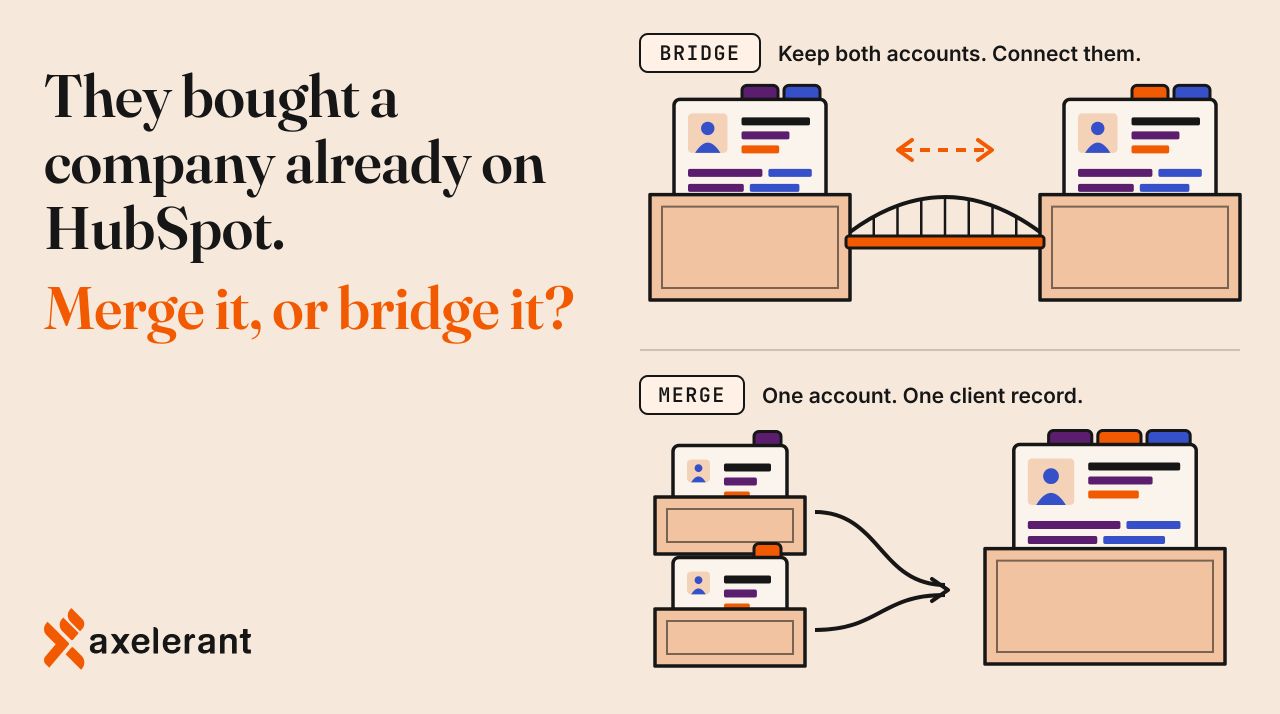
Buy a company already on HubSpot, and its account usually comes with it. Then the next deal brings another. In 6 of the groups we reviewed, we found two or more separate HubSpot accounts across the brands. The group pays for HubSpot more than once and still can’t see one customer across them. There are two ways to fix it. Bridge: keep the accounts and connect them. Merge: one account, with each brand set up as a HubSpot Brand. Decide on purpose, not by default. See which fits your group⤵
- LINKEDIN · IMAGESince 16 Oct 2026
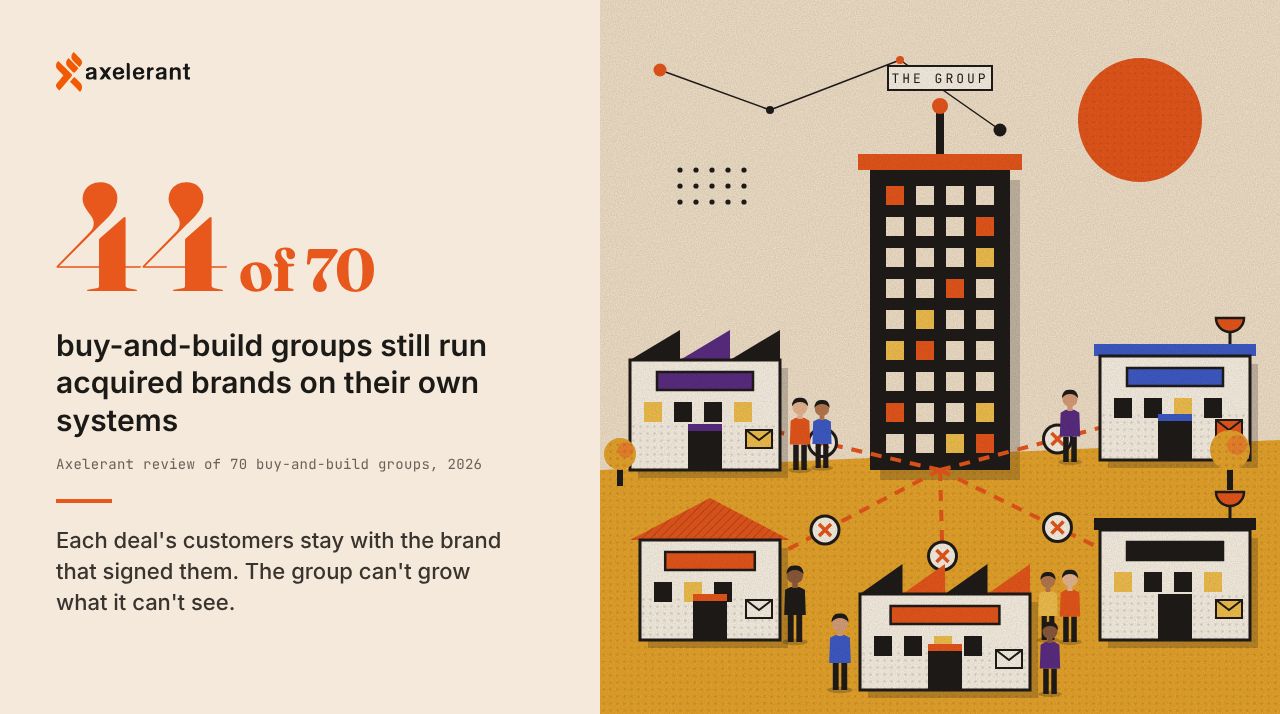
Every acquisition brings a brand, a website, forms, an email tool and often its own CRM. In our review of 70 buy-and-build groups, 44 still run acquired brands on their own sites or systems. 32 say growth now has to come from inside the group. Only 9 show a group-wide CRM. Whether you fold brands into one name or keep them, the group only grows as one if it can see its customers as one. See the findings and where to start ⤵
- LINKEDIN · IMAGESince 12 Oct 2026
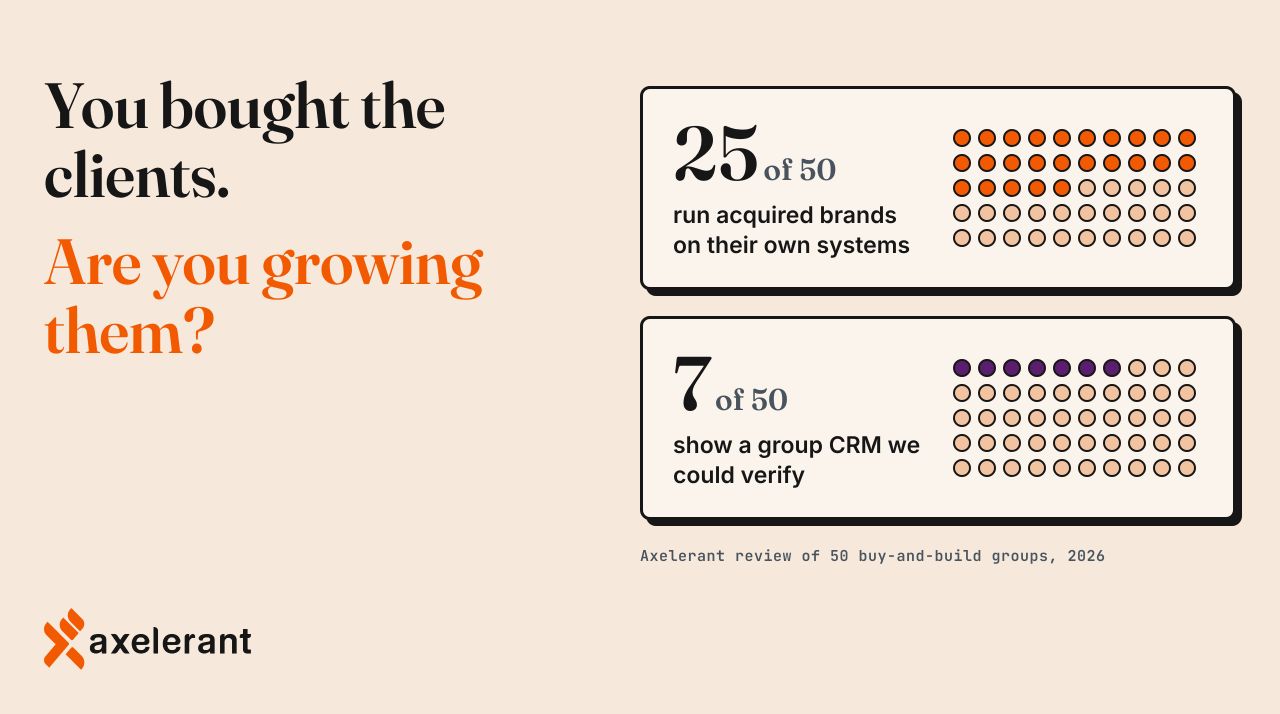
We reviewed 50 buy-and-build groups. At least 25 still run acquired brands on their own systems. Only 7 had a group CRM we could verify. Yet 30 of the 50 say organic growth or cross-sell is a priority. That growth sits in the clients each deal brought in. When every brand keeps its own forms, email tools and CRM, those clients stay with the brand that signed them, and no one else in the group can see them. See how multi-brand groups bring every acquired brand onto one HubSpot client record, and book a consolidation assessment.
- LINKEDIN · IMAGESince 10 Oct 2026
They bought a company already on HubSpot. Do you merge it, or bridge it? Bridge: Keep both accounts and connect them. Data mirrors across, and workflows and reports run across accounts. Merge: One account, with each firm set up as a HubSpot Brand. In a four-brand group, we bridged first and documented the path to one record. Bridge on purpose, with a date to merge.

6 of 169 adsSign up to see every Axelerant ad, filter by format and date, and get alerts on new ones.
See all 169 adsWatch the companies you care about.
Filter every ad by industry, country, format and network, and get alerts when a company you watch starts running new ads.