Not on air · 2 of 3 networks checked
Assent (formerly IPOINT)
- ipoint-systems.com
- Industry & Manufacturing
- DE
- 147 employees
Assent (formerly IPOINT)’s ads on LinkedIn, Meta and Google, recorded by adsrunning. Browse the latest here for free. Sign up free to see all 214. Watch Assent (formerly IPOINT) with Starter to get each new one in your feed.
Watchlist with Starter · $49/mo
| Network | Status | Live ads | Nov 2025LinkedIn activity · 52 weeksOct 2026 | Checked | Next step |
|---|---|---|---|---|---|
| None recorded | 0 | Checked 29 Oct 2026 | See all 214 ads → | ||
| Meta | Not checked | — | |||
| Recently | 100+ | Ads on the Google Ads Transparency Center | Checked 1 Oct 2026 | Collect them with the API → |
Assent (formerly IPOINT) has no live LinkedIn ads. We recorded 100+ Google ads on 1 Oct 2026.
Latest ads
- LINKEDIN · VIDEOSince 23 Apr 2026
Ford Motor Company just announced they are collecting product carbon footprint data from their supply chain for the Ford Kuga. This is a systematic approach to get primary data for a vehicle with several thousand parts and components. Every OEM talks about decarbonization. But to actually decarbonize, you need to understand what component contributes how much impact to the overall vehicle PCF. And you can only understand that with primary data from your supply chain, not with industry averages. Ford is taking exactly this approach. They selected a specific vehicle and are now asking suppliers to provide product carbon footprints based on actual data. The goal is full transparency on where the emissions sit, so they can work collaboratively with the supply chain on decarbonization. A car has 20,000+ parts and components to be assessed. You cannot do that in one step. So Ford is slicing the elephant in pieces. There is a first phase of supplier requests happening now, and more phases will follow through the end of this year and into next year to complete the picture. Ford has been active in Catena-X for quite a while, including a steering role in the Catena-X Sustainability Committee. André Kremer from Ford is very active there. This pre-competitive activity in the Catena-X association now materializes also in the product carbon footprint use case. In the Catena-X PCF use case, as an automotive supplier being required to provide a PCF you can encounter two basic scenarios : 1. You already have calculated a product carbon footprint. Then the task is to connect technically via the Catena-X ecosystem to share this PCF dataset. Maybe you are already connected because you have started to share data in another use case, for example certificate management or demand and capacity management. Then the general connection with the data space is already done. The questions in this scenario are: Did I calculate my PCF already according to the Catena-X rulebook? And do I have a PCF Exchange Application in place? 2. You have never calculated a product carbon footprint. You have not been onboarded to any Catena-X use case. Then it is two topics: PCF calculation, and PCF sharing it with your customer. Ford and IPOINT have been especially partnering for that second scenario. Our Product Sustainability Core Solution provides a dedicated setup to fully enable small and medium-sized suppliers with low and medium complex products to calculate PCFs easy and fast. IPOINT Product Sustainability is a Catena-X certified PCF calculation application. If you are a Ford Kuga supplier and have received or will receive this request: the technical and service infrastructure exists. The PCF calculation solutions exist. The sharing mechanism within a trusted data space exists. Ready to scale PCF together.
- LINKEDIN · VIDEOSince 23 Apr 2026
Ford Motor Company decided to make the Kuga their first car line with a product carbon footprint calculated 100% on primary supplier data. And it is a great example of where the automotive industry is heading. For a vehicle like the Ford Kuga, 70 to 90% of the carbon footprint happens before the car even reaches the assembly line. That is the upstream supply chain. Every material sourced, every component produced, every delivery to the factory. By the time Ford puts the car together, the vast majority of the environmental impact has already occurred. So if you are an OEM with a net zero commitment and you want to actually manage your impact, not just measure it at a high level, you need granular, bottom-up primary data from your suppliers. That is exactly what Ford is doing here. We have been partners with Ford for years, first on compliance, then on sustainability. So when they came to us with this initiative, it was kind of a natural next step. I think what made it particularly attractive for the suppliers is that our solution, iPoint Product Sustainability Core, is Catena-X certified. That means the PCF calculation a supplier does with our tool is OEM agnostic. You calculate once, and you can provide that footprint in a standardized way to any OEM out there. The solution itself does not require LCA expertise. It is not an expert tool. It is a standard SaaS solution, no IT implementation needed, works out of the box with a standardized automotive model already built in. And as part of this partnership with Ford, we provide it free of charge to participating Ford suppliers for six months. Now, some suppliers ask us: do we really need to act now? Can we not just wait and see? Let's be honest, I understand the hesitation. Suppliers are busy, they have a lot on their plate. But we have seen this pattern before in the industry. These things start as voluntary asks and very quickly become compulsory. At that point, if you cannot provide this data, you are at risk of no longer being considered as a supplier. It becomes a minimum requirement. And you are on the hook for the accuracy of that data. Which is exactly why using a Catena-X certified, standardized methodology matters. You can rest assured the numbers you provide are calculated correctly. Ford is clearly just getting started with the Kuga. They have articulated this as the beginning, and we are hearing from other OEMs that they are heading in the same direction with their own initiatives. The industry is moving. The question for suppliers is not if this becomes the standard, but when.
- LINKEDIN · VIDEOSince 23 Apr 2026
One of the biggest problems in manufacturing right now is that compliance and sustainability live in completely separate worlds inside most companies. Different teams use different data, with different reporting exercises and tools. And the moment something changes on one side, the other side is immediately out of sync. Every material you choose, every supplier you work with, every process you run creates an environmental impact, a regulatory impact, and ultimately a business impact. The question is whether you can actually see it and steer it. Most companies can't. A lot of tools out there tell you to do it top down, spend-based, with rough estimates. You get a number, sure. But it's a theoretical number. It gives you a sense of your impact but doesn't let you manage your impact. Big difference. With IPOINT's impact intelligence, that means you put compliance and sustainability on one shared data foundation. Material data, supply chain data, process information, all connected by one logic. From that core, you generate whatever the world asks for: product carbon footprints, imds professional GmbH & Co KG submissions, digital product passports, CSRD reporting. You're not scrambling to assemble these things from scratch every time. Once you understand where exactly your impact comes from at the material and substance level, you can actually go manage it, source differently, choose different materials and shift geographies to change energy consumption or transportation impacts. You move from proving impact after the fact to actively shaping it. A simple way to think about it: 1. Connect material-level data across compliance and sustainability 2. Build one shared foundation instead of parallel reporting silos 3. Generate any required output from that single source of truth 4. Use the model to identify where impact actually lives 5. Make sourcing and design decisions that change the outcome That's what real impact intelligence looks like, and iPoint is building exactly that. If you're in manufacturing and tired of stitching together disconnected reports, I'd highly recommend taking a closer look at what Impact Intelligence can do for you.
- LINKEDIN · VIDEOSince 23 Apr 2026
One of the things I find fascinating about what's happening in compliance and sustainability right now is how far apart these two worlds still sit in most companies. The compliance team has PhDs in chemistry, sitting in a lab coat next to the manufacturing line. The sustainability team sits with the CFO because they need to report to auditors and banks. Completely different floors, different org charts, different realities. And yet they're working off the same foundation. The same material data, the same supplier information, the same product-level details. They just don't know it because they've never talked to each other. Two years ago at our big annual event, we gave a keynote about compliance and sustainability converging. Some people in the audience genuinely thought it was blasphemy. "We don't talk to our compliance counterparts." That was the actual reaction. But companies started with these spent-based, relatively cheap approaches to hit their reporting requirements. Now they're realizing that's not enough. Regulations are scaling every year. OEMs are asking suppliers not just for material compliance data through IMDS but also for product carbon footprints. And to provide your PCF, you actually need to understand the carbon footprint of every material in your product. A steering wheel alone has thousands of parts. Most companies still run this manually or across separate systems. And separate solutions can work at small scale, one product, one PCF in Excel. But as soon as you try to scale that, it breaks. You end up with two versions of reality. Every time a material changes or a new regulation hits, teams scramble to reconcile everything by hand. You lose speed, clarity and control. What we believe at IPOINT is that there should be one shared data core, one governance logic and many outputs. Whether it's IMDS, Catena-X, CSRD reporting or internal KPIs, it all comes from the same source. The data sustainability managers desperately need already exists on the compliance side. It's already formatted, already checked, already there. But because these teams sit so far apart organizationally, they simply don't know it. Showing companies that connection and making it usable is a big part of what we do.
- LINKEDIN · IMAGESince 1 Apr 2026
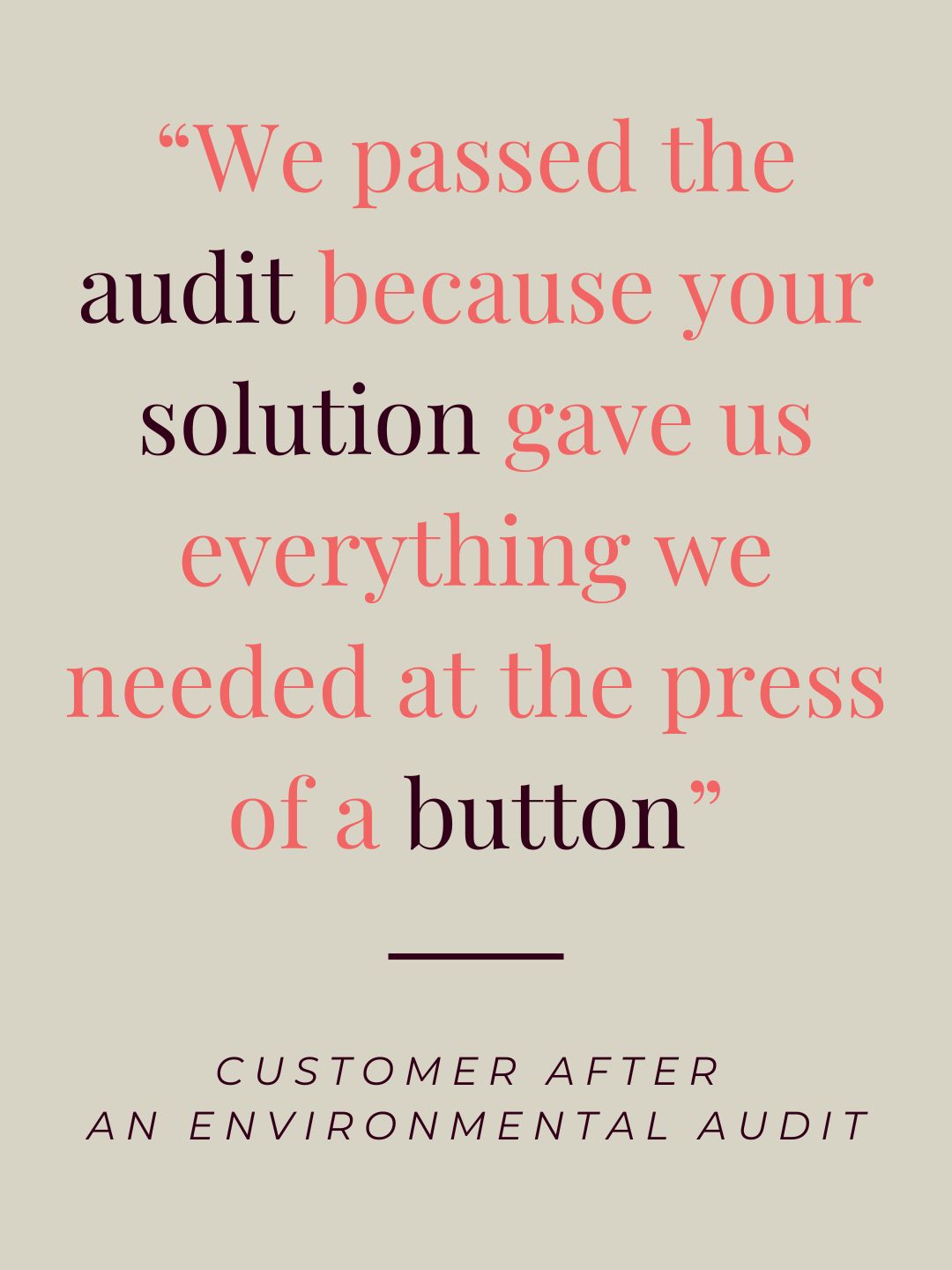
One of our customers was facing an environmental audit from the institution of Tübingen. They needed to prove compliance with regulations, and they were able to do it by pressing a button in our solution. Our projects usually run 3-6 months. During that time, customers prepare for something most teams dread: an environmental audit. The kind that determines whether they stay compliant or face bigger problems. The customer wrote after their audit in Tübingen: "We passed the audit - and we got all we needed at the press of a button using your solution." They could walk the regulators step by step through the process. Full visibility, zero stress. And that’s not the only feedback we’ve received. Our customers around the globe have had the same experience: “We had the information at hand and could deliver on the spot.” The real value shows up on audit day. That’s when pressing a single button turns months of worry into one line of proof: "We passed." So when you ask yourself, “How do we know it will work?”, ask for the proof - speak to IPOINT.
- LINKEDIN · VIDEOSince 31 Mar 2026
Understanding Maturity Assessment using the example of PCF or LCA verification. At iPoint, we use a framework of 11 key perspectives to assess an organization's readiness for LCA automation. One way to better understand this is by looking at how we evaluate maturity levels — from Level 1 (no experience) to Level 5 (fully systematic and verified). Today we are looking at the mid-range maturity level, level 3. Let’s take the example of Product Carbon Footprint (PCF) verification. Level 3 represents a company that already has first-hand experience with PCF verification—perhaps for one or a few products. More importantly, the company shows a solid understanding of documentation and data handling requirements. This structure allows us to evaluate where an organization stands: Level 1: No experience, no clear understanding of requirements. Level 3: First verifications completed, with a growing grasp of what’s needed. Level 5: Systematic documentation, embedded standards, and an infrastructure that enables smooth and fast verification. 💡 Why does this matter? Because the better the internal documentation, the smoother the certification process becomes. Verifiers can move more efficiently when data flows are transparent and aligned with the rulebooks. In contrast, unclear documentation and buried code slow everything down. 👉 Well-prepared organizations don’t just pass verification—they accelerate it. PCF verification is used as an example to illustrate how maturity levels for LCA or PCF automation can be assessed. How are you getting started into the journey towards PCF and LCA automation? Which role plays getting prepared for PCF verification in your organization? #LCA #PCF #Sustainability #Verification #CarbonFootprint #DigitalProductPassport #Automation
6 of 214 adsSign up to see every Assent (formerly IPOINT) ad, filter by format and date, and get alerts on new ones.
See all 214 adsWatch the companies you care about.
Filter every ad by industry, country, format and network, and get alerts when a company you watch starts running new ads.