On air · 1 of 3 networks
Arta Finance
- artafinance.com
- Fintech & Financial Services
- US
- 107 employees
Arta Finance’s ads on LinkedIn, Meta and Google, recorded by adsrunning. Browse the latest here for free. Sign up free to see all 104. Watch Arta Finance with Starter to get each new one in your feed.
Watchlist with Starter · $49/mo
| Network | Status | Live ads | Nov 2025LinkedIn activity · 52 weeksOct 2026 | Checked | Next step |
|---|---|---|---|---|---|
| Running | 85 | Checked 30 Oct 2026 | See all 104 ads → | ||
| Meta | Not checked | — | |||
| None recorded | 0 | No ads found on the Google Ads Transparency Center | Checked 4 Oct 2026 | Collect them with the API → |
Arta Finance has 85 live LinkedIn ads. We recorded no Google ads on 4 Oct 2026.
Latest ads
- LINKEDIN · VIDEOSince 24 Aug 2026
The biggest AI risk in wealth management isn't the obvious error. It's the "quiet fail" — advice that looks plausible but isn't right. Ralph Hamers, former CEO of UBS and ING, on why AI that works flawlessly in the lab breaks in front of clients, and why banks that care about their reputation need AI built for wealth management, with controls that prevent hallucinations rather than just manage them.
- LINKEDIN · VIDEOSince 24 Aug 2026
A few weeks ago I spoke at SuperAI in Singapore about why so many AI programs in wealth management stall between a successful pilot and something an institution can actually deploy, to advisors, and to clients directly. Sharing the full talk below, since a few people have asked. The core argument: the hardest part of deploying AI in wealth management isn't making the model more intelligent. It's engineering everything around it so that intelligence can be trusted. Prompts alone won't get you there. Bolting deterministic rules onto a probabilistic system doesn't just fail at governance, it flattens the very thing that made the model useful. The controls have to be architectural. Identity and permissions. Grounded retrieval, so numbers are looked up rather than generated. Deterministic engines for anything that constitutes a financial decision. Suitability enforced on every conversation. A boundary between education and advice that holds by design. Full audit trails. That is most of the real engineering work. The visible AI is maybe 15% of it. Two things become possible once it exists. Advisor designed portfolio recaps and client-ready material within minutes, so they carry more relationships without service quality slipping, and stay in control of every recommendation. And the same capability can go directly to clients. Accurate, cited answers about their own holdings and much more, anytime they want. Those two compound. Together they change the economics and experience of who a bank can profitably serve, which is a strategic question rather than a technology one. The talk covers the specific architecture choices. If you're working through the same questions inside an institution, I'd be glad to compare notes.
- LINKEDIN · VIDEOSince 21 Aug 2026
“AI is never the strategy. The business outcome is always the starting point.” Ralph Hamers, former CEO of UBS and ING and advisor to Arta, built his reputation modernising some of the world’s largest banks through periods of technological disruption. One mistake he sees banks making with AI: responding to the pressure to act, and letting that pressure set the direction instead of letting strategy lead. The banks pulling ahead are the ones with the clearest vision of what kind of institution they want to become, and use AI to get there. Not the ones with the best models. Strategy is still about the business outcome: increasing adviser productivity. Making the experience more personal. Reaching segments the old model couldn’t serve profitably. Meeting a generation of clients who expect something different. Without that direction, banks end up bolting AI onto the same old processes, creating pockets of efficiency instead of real change. AI doesn’t decide where you’re going. It changes the economics of getting there and opens up new possibilities along the way.
- LINKEDIN · VIDEOSince 24 Jul 2026
At one of the world's largest AI conferences, Arta's Head of AI, Chirag Yagnik, asked the room: who here would let an AI agent move their money? One hand went up. Despite everything LLMs can do now, and in a room full of AI experts, why only one hand? Because the agent layer everyone demos is only 15% of the work. The other 85% — guardrails, audit trail, the logic that catches a wrong answer — is what makes AI trustworthy enough to act. "Plausibly right" isn't good enough when failure isn't an option. That's the gap Chirag broke down at SuperAI Singapore. From his keynote, "The 85% You Don't See."
- LINKEDIN · VIDEOSince 23 Jul 2026
"The worst AI programs create more friction — they're just another tool on top of other tools." Ralph Hamers, former CEO of UBS and ING, on why most advisor AI becomes shelfware - and what the programs that actually stick do differently: they take tasks away instead of adding them - things like pulling together a single client view across fragmented systems, or catching missing or incomplete KYC or suitability info before it turns into weeks of back-and-forth - handled inside the workflow advisors already use. The result: more time with clients, better advice.
- LINKEDIN · IMAGESince 21 Jul 2026
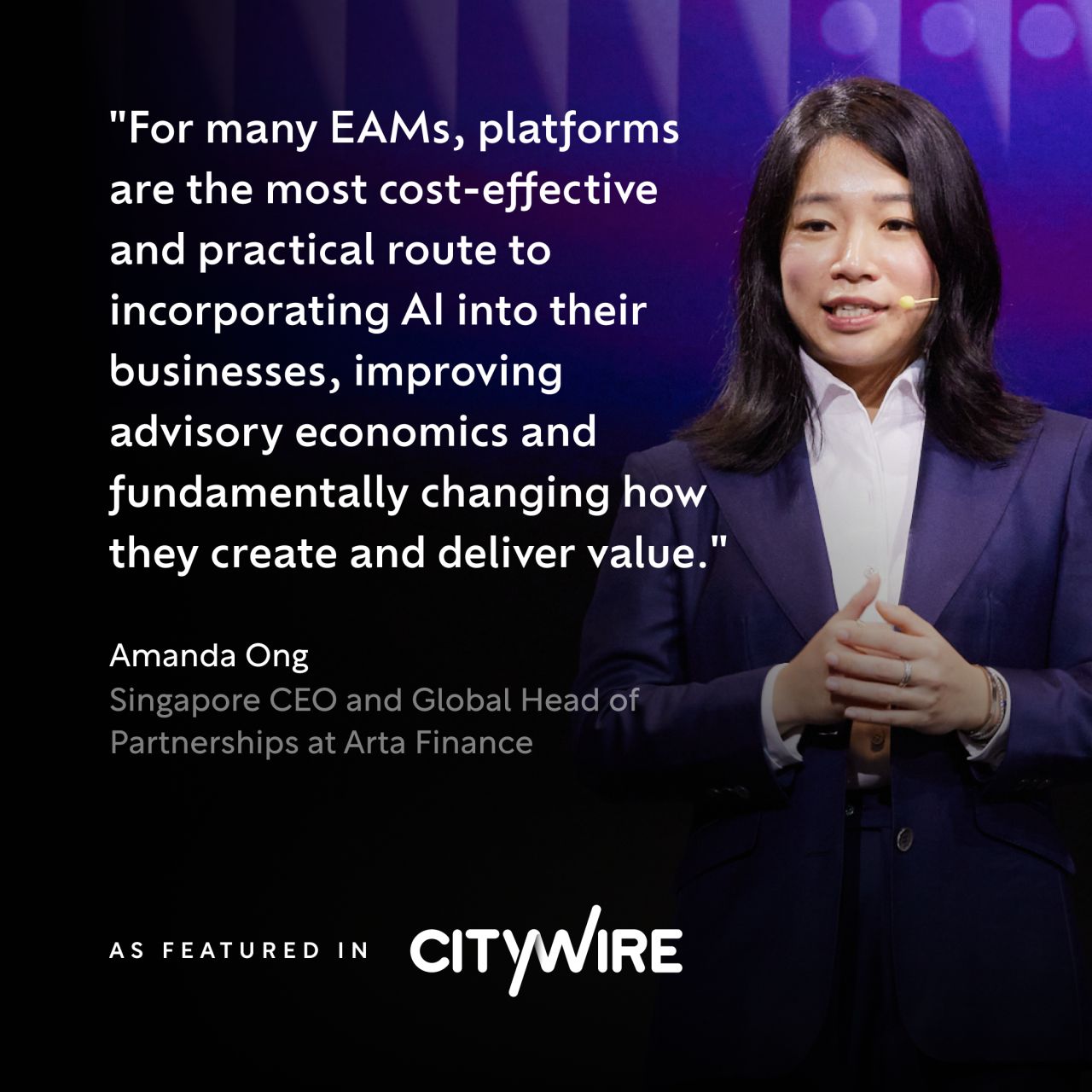
Many EAMs already work with platforms for custody and execution. But a surprising new reason is emerging. Increasingly, platforms are evolving beyond custody and execution into technology partners, becoming the fastest and most practical way for EAMs and family offices to access AI they can't easily build in house. The result is streamlined operations, stronger client reporting, and more time for advisors to focus on advice instead of administrative work. It's something we're hearing consistently from EAMs and family offices. Their advisors are already using general purpose AI and understand its potential. But when it comes to advising clients, they know generic tools aren't enough. They want AI built by people who understand investing, wealth management, and regulated environments, then shaped around the way advisors actually work. It's a shift we've been building towards at Arta for several years because delivering AI for wealth management requires far more than a powerful language model. The AI agent is the visible 15% of the system and gets most of the attention. The other 85% is the infrastructure underneath: guardrails, deterministic workflows, evaluation frameworks, governance, and auditability. That's what enables firms to safely put AI in front of clients and advisors in a regulated environment. For most EAMs, platform partnerships provide the fastest path to AI capabilities that would otherwise take years to build, allowing them to compete with firms many times their size. Link to this Citywire Asia article in the comments below 👇
6 of 104 adsSign up to see every Arta Finance ad, filter by format and date, and get alerts on new ones.
See all 104 adsWatch the companies you care about.
Filter every ad by industry, country, format and network, and get alerts when a company you watch starts running new ads.