On air · 1 of 3 networks
ArcticZymes Technologies ASA
- arcticzymes.com
- Healthcare & Life Sciences
- NO
- 52 employees
ArcticZymes Technologies ASA’s ads on LinkedIn, Meta and Google, recorded by adsrunning. Browse the latest here for free. Sign up free to see all 64. Watch ArcticZymes Technologies ASA with Starter to get each new one in your feed.
Watchlist with Starter · $49/mo
| Network | Status | Live ads | Nov 2025LinkedIn activity · 52 weeksOct 2026 | Checked | Next step |
|---|---|---|---|---|---|
| Running | 20 | Checked 30 Oct 2026 | See all 64 ads → | ||
| Meta | Not checked | — | |||
| Recently | 1 | Ads on the Google Ads Transparency Center | Checked 4 Oct 2026 | Collect them with the API → |
ArcticZymes Technologies ASA has 20 live LinkedIn ads. We recorded 1 Google ad on 4 Oct 2026.
Latest ads
- LINKEDIN · VIDEOSince 26 Oct 2026
🎙️ RNA quality is measurable. But how well does it predict biological function? In Episode 1 of RNA on Air, our panel asks a fundamental question: Are we measuring the right things? The discussion explores why it’s still challenging to connect RNA quality attributes with biological performance, and where today’s QC workflows may be falling short. From assay standardization and analytical sensitivity to structural characterization, there’s plenty to unpack. Join Francis Combes, Mark Dickman and Ashish Dhir for the conversation. 🎧 Listen to Episode 1: From RNA quality to biological function: https://lnkd.in/eqNkdbyY What needs to change to better connect RNA quality with function?
- LINKEDIN · VIDEOSince 26 Oct 2026
Does every stage of RNA development need the same level of analytical resolution? Probably not. In our latest discussion on RNA manufacturing, Ashish Dhir, Mark Dickman and Francis Combes explore why a tiered approach to analytics could help teams balance speed, cost and analytical depth. For 5′ cap analysis, rapid or semi-quantitative methods can support process development, while higher-resolution approaches such as LC-MS can provide deeper characterisation later in development. The same trade-offs appear in residual DNA control. qPCR and ddPCR offer powerful detection capabilities, while DNase treatment introduces its own process considerations, from enzyme removal to performance under IVT conditions. The recurring question throughout the conversation: How can we generate analytical data quickly enough to improve the manufacturing process, without compromising the depth of information needed later? 🎧 Explore the full discussion: https://lnkd.in/eqNkdbyY
- LINKEDIN · VIDEOSince 26 Oct 2026
Does RNA manufacturing really need more assays, or do we need to get more from the ones we already have? That question came through strongly in our latest podcast, with three different perspectives: 🔬 Mark Dickman called for greater standardisation, particularly around how we measure mRNA integrity and dsRNA. Without it, how meaningful are comparisons between methods, labs or suppliers? 🧬 Francis Combes questioned whether adding more QC assays is really the answer. Could we instead combine critical quality attributes and better connect them to biological outcomes? ⚙️ Ashish Dhir took the conversation upstream, arguing that DNA template quality needs more attention as a determinant of the RNA we ultimately produce. These aren’t separate challenges. They point towards a broader shift in RNA manufacturing: from measuring quality at the end of the process to understanding and controlling it throughout. From advanced analytical tools and improved enzymes to next-generation process controls, where do the experts think the field is heading? 🎧 Listen to the full conversation: https://lnkd.in/eqNkdbyY
- LINKEDIN · IMAGESince 22 May 2026
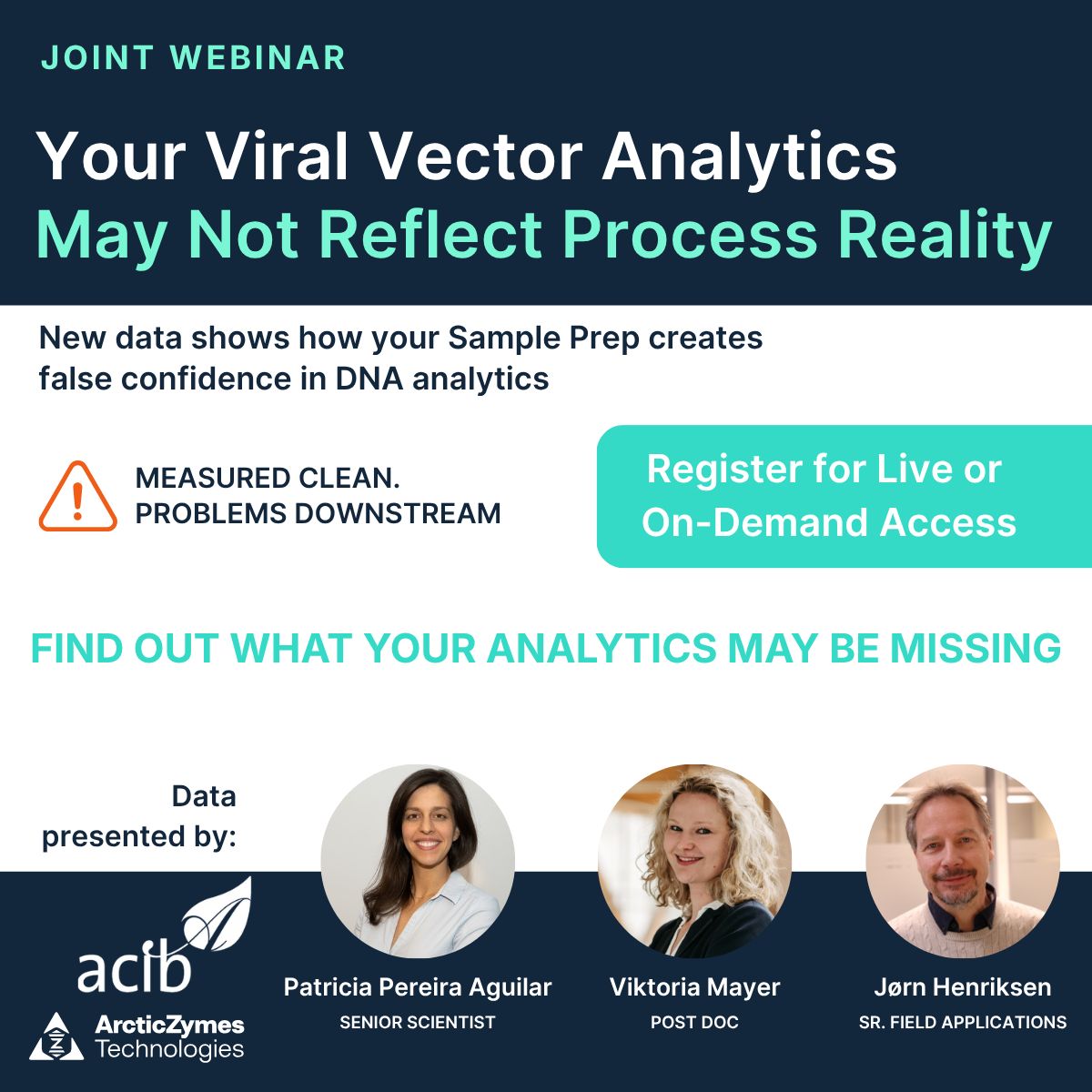
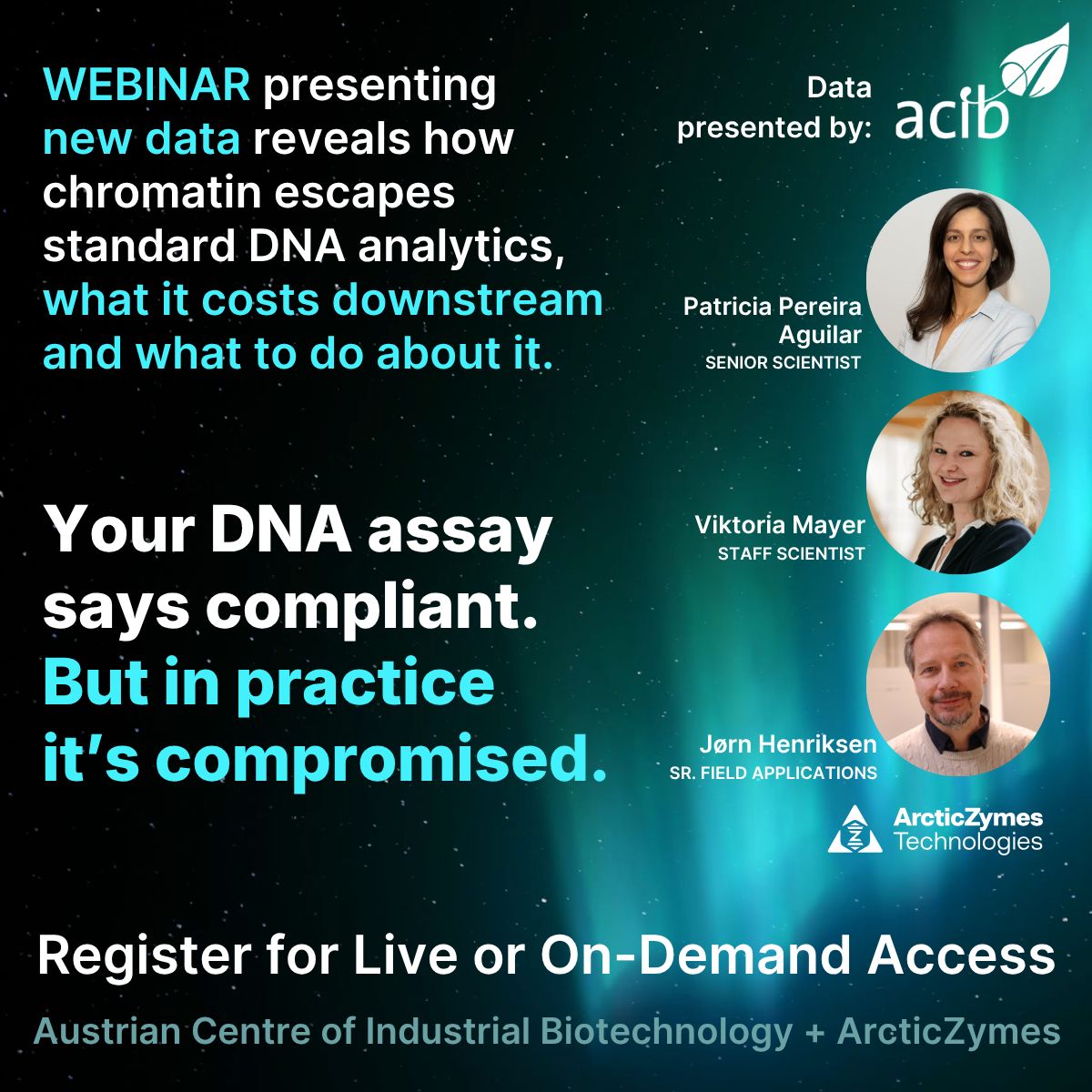
𝗪𝗵𝗮𝘁 𝗶𝗳 𝘆𝗼𝘂𝗿 𝗗𝗡𝗔 𝗮𝗻𝗮𝗹𝘆𝘁𝗶𝗰𝘀 𝗮𝗿𝗲 𝗺𝗲𝗮𝘀𝘂𝗿𝗶𝗻𝗴 𝗰𝗵𝗿𝗼𝗺𝗮𝘁𝗶𝗻 𝗮𝗳𝘁𝗲𝗿 𝗶𝘁 𝗵𝗮𝘀 𝗮𝗹𝗿𝗲𝗮𝗱𝘆 𝗯𝗲𝗲𝗻 𝗮𝗹𝘁𝗲𝗿𝗲𝗱? New data from acib GmbH reveals how analytical sample prep can create confidence in analytically acceptable samples while process-relevant chromatin remains hidden downstream. The consequences may not appear in the assay. They may appear later as filtration challenges, aggregation, purification inefficiencies, or unexplained process inconsistency. Join researchers from ACIB (Patrícia Pereira Aguilar & Viktoria Mayer) and ArcticZymes (Jørn Remi Henriksen) for a webinar examining why chromatin can escape standard DNA analytics, how this creates false confidence in viral vector manufacturing, and what the latest data now reveals. Register for live or on-demand access: https://lnkd.in/eFU7t-8p
- LINKEDIN · IMAGESince 11 May 2026
🚨 New Webinar Alert Your DNA assay says you're compliant. But what if it’s only telling part of the story? 👉 Chromatin can escape standard quantification 👉 Your measurements may be systematically underestimated 👉 And the impact only shows up downstream 📉 Yield loss. Process variability. Hard-to-trace issues. Featuring experimental data from Patrícia Pereira Aguilar and Viktoria Mayer, acib GmbH 📊 Join us to uncover what your analytics might be missing—and how to fix it: https://buff.ly/SQfHGE2 📅 Thursday, 11 June 2026 | 15:00 BST (UK) / 16:00 CEST / 10:00 EDT
- LINKEDIN · EVENTSince 8 May 2026
Filters fouling early? It may not be the filter. In viral vector manufacturing, chromatin-associated host-cell DNA can persist even when standard assays suggest the sample is clean. This analytical blind spot can show up later as clarification, TFF, chromatography, and process consistency challenges. Join our webinar with ACIB and ArcticZymes to see the new data. Register to see the data:

6 of 64 adsSign up to see every ArcticZymes Technologies ASA ad, filter by format and date, and get alerts on new ones.
See all 64 adsWatch the companies you care about.
Filter every ad by industry, country, format and network, and get alerts when a company you watch starts running new ads.