On air · 1 of 3 networks
Alphalyse
- alphalyse.com
- Healthcare & Life Sciences
- DK
- 47 employees
Alphalyse’s ads on LinkedIn, Meta and Google, recorded by adsrunning. Browse the latest here for free. Sign up free to see all 146. Watch Alphalyse with Starter to get each new one in your feed.
Watchlist with Starter · $49/mo
| Network | Status | Live ads | Nov 2025LinkedIn activity · 52 weeksOct 2026 | Checked | Next step |
|---|---|---|---|---|---|
| Running | 18 | Checked 30 Oct 2026 | See all 146 ads → | ||
| Meta | Not checked | — | |||
| Recently | 61 | Ads on the Google Ads Transparency Center | Checked 2 Oct 2026 | Collect them with the API → |
Alphalyse has 18 live LinkedIn ads. We recorded 61 Google ads on 2 Oct 2026.
Latest ads
- LINKEDIN · IMAGESince 10 May 2026
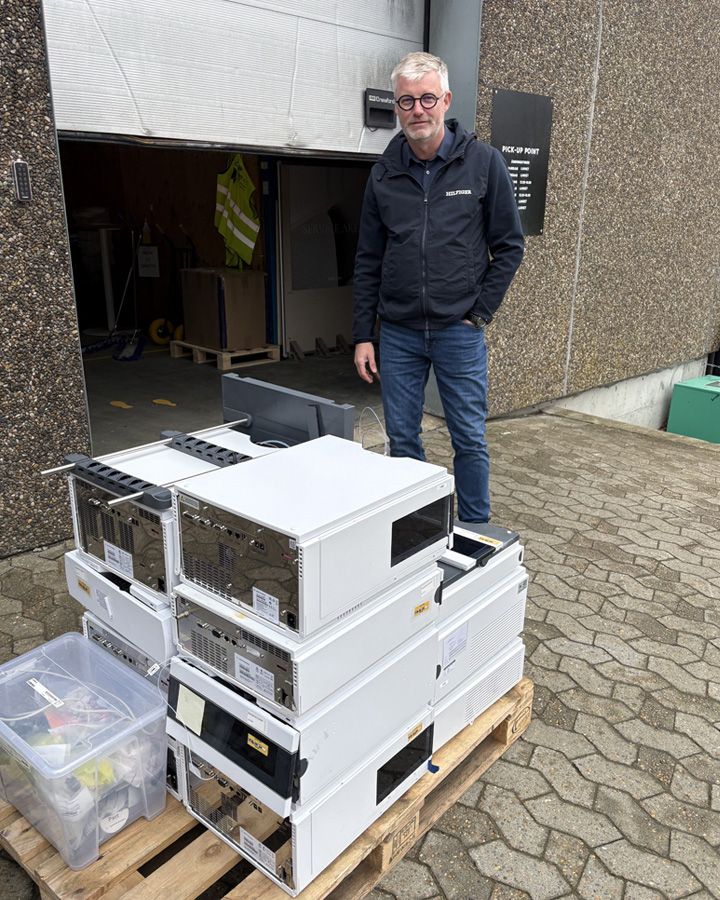
Two of our HPLC systems have found a new home. 🧪 We recently donated two Agilent HPLC systems to the Institute of Medical Chemistry at the University of Belgrade, Faculty of Medicine in Serbia – where a group of talented young researchers is building a new lab from the ground up. Their research spans everything from enzyme biochemistry and post-translational modifications to bioactive natural products and disease biomarkers. Our instruments will support both cutting-edge research and training the next generation of scientists. That's exactly the kind of impact we love to be part of. Of course, moving two HPLC systems across Europe is no small feat. A big thank‑you to Dennis Just and the team at Logistik Centralen A/S for handling the packaging and logistics with great professionalism. 🙏 To Zorana Lopandic and her colleagues in Belgrade: we hope the instruments are soon up and running and can be used for teaching and research.
- LINKEDIN · VIDEOSince 9 Dec 2025
The new USP General Chapter <1132.1> outlines three strategies for quantifying host cell proteins (HCPs). Thanks to the sensitivity and specificity of mass spectrometry (LC-MS), these approaches provide a more comprehensive assessment of HCP impurities than traditional methods. For decades, the enzyme-linked immunosorbent assay (ELISA) has been the industry standard for HCP detection. However, ELISAs may leave low-abundance or weakly immunogenic proteins in a sample undetected. By contrast, LC-MS enables direct identification and quantification of individual HCPs, offering a more detailed impurity profile. The suitability of each method depends on the specific product and the goal of the analysis: early discovery, process development, or a targeted approach. With the new USP chapter, LC-MS-based strategies are further established as essential tools for ensuring drug purity, efficacy, and safety – driving improvements in biomanufacturing and regulatory oversight. 💡 Have you implemented LC-MS for HCP analysis in your workflows? Which quantification method have you found most effective? Watch webinar: https://lnkd.in/dxZRjemm
- LINKEDIN · VIDEOSince 9 Dec 2025
A leading vaccine developer faced challenges in documenting Host Cell Protein (HCP) clearance in an E. coli-expressed vaccine – critical for advancing to Phase 3 clinical trials. To overcome this, they implemented the Alphalyse LC-MS method as an orthogonal approach to ELISA – enabling detailed monitoring of process consistency and product purity. Looking to strengthen your ELISA strategy and meet regulatory expectations? 📺 Watch our webinar on best practices for HCP analysis in vaccines using LC-MS: alphalyse.com/cmc-webinars
- LINKEDIN · VIDEOSince 9 Dec 2025
US Pharmacopeia <1132.1> outlines LC-MS best practices for HCP analysis – but how do you actually apply them? While USP General Chapter <1132.1> affirms the suitability of mass spectrometry (LC-MS)-based methods for Host Cell Protein (HCP) analysis, it stops short of providing detailed instructions for their implementation. To bridge this gap, USP invited Alphalyse to perform a practical demonstration of the quantitation methods described in the chapter. The result is a co-publication between USP and Alphalyse, offering practical guidance for applying LC-MS techniques in line with regulatory expectations. 📖 Read the open-access article here: https://lnkd.in/dMfuCSdN
- LINKEDIN · VIDEOSince 9 Dec 2025
What is the risk of relying on commercial ELISA kits in vaccine development? Vaccines are among the most complex biologics to analyze. They often contain multiple components – viral vectors, adjuvants, carrier proteins, residual enzymes, and host cell proteins (HCPs) from uncommon expression systems – each introducing distinct impurities. Yet, many vaccine developers still rely on commercial HCP-ELISA kits designed for standard expression systems and product types like monoclonal antibodies (mAbs). This approach carries real risk. If an ELISA kit doesn’t adequately cover the process-specific HCPs in a vaccine, critical impurities may go undetected, leading to inconsistent product quality. In our recent webinar on vaccine purity and consistency, Ejvind Mørtz and Martin Rask Johansen discussed why off-the-shelf ELISA kits often fall short for vaccines. If you work in vaccine analytics or process development, this discussion is worth watching. 👇
- LINKEDIN · VIDEOSince 9 Dec 2025
Mass spectrometry (LC-MS)-based Host Cell Protein (HCP) analysis is not a regulatory requirement – yet. But that may be changing sooner than many expect. Increasingly, clients are turning to us after presenting data to regulators such as the FDA, EMA, or Chinese NMPA – because they have been asked for additional LC-MS data to strengthen their submissions. 🎥 In this short video, Ejvind Mørtz, COO of Alphalyse, shares three client cases where regulatory authorities requested LC-MS-based HCP analysis. Is your submission strategy keeping pace with evolving regulatory expectations?
6 of 146 adsSign up to see every Alphalyse ad, filter by format and date, and get alerts on new ones.
See all 146 adsWatch the companies you care about.
Filter every ad by industry, country, format and network, and get alerts when a company you watch starts running new ads.