On air · 1 of 3 networks
Aampe
- aampe.com
- Marketing & Advertising
- US
- 30 employees
Aampe’s ads on LinkedIn, Meta and Google, recorded by adsrunning. Browse the latest here for free. Sign up free to see all 643. Watch Aampe with Starter to get each new one in your feed.
Watchlist with Starter · $49/mo
| Network | Status | Live ads | Nov 2025LinkedIn activity · 52 weeksOct 2026 | Checked | Next step |
|---|---|---|---|---|---|
| Running | 34 | Checked 29 Oct 2026 | See all 643 ads → | ||
| Meta | Not checked | — | |||
| None recorded | 0 | No ads found on the Google Ads Transparency Center | Checked 28 Oct 2026 | Collect them with the API → |
Aampe has 34 live LinkedIn ads. We recorded no Google ads on 28 Oct 2026.
Latest ads
- LINKEDIN · IMAGESince 18 Apr 2026
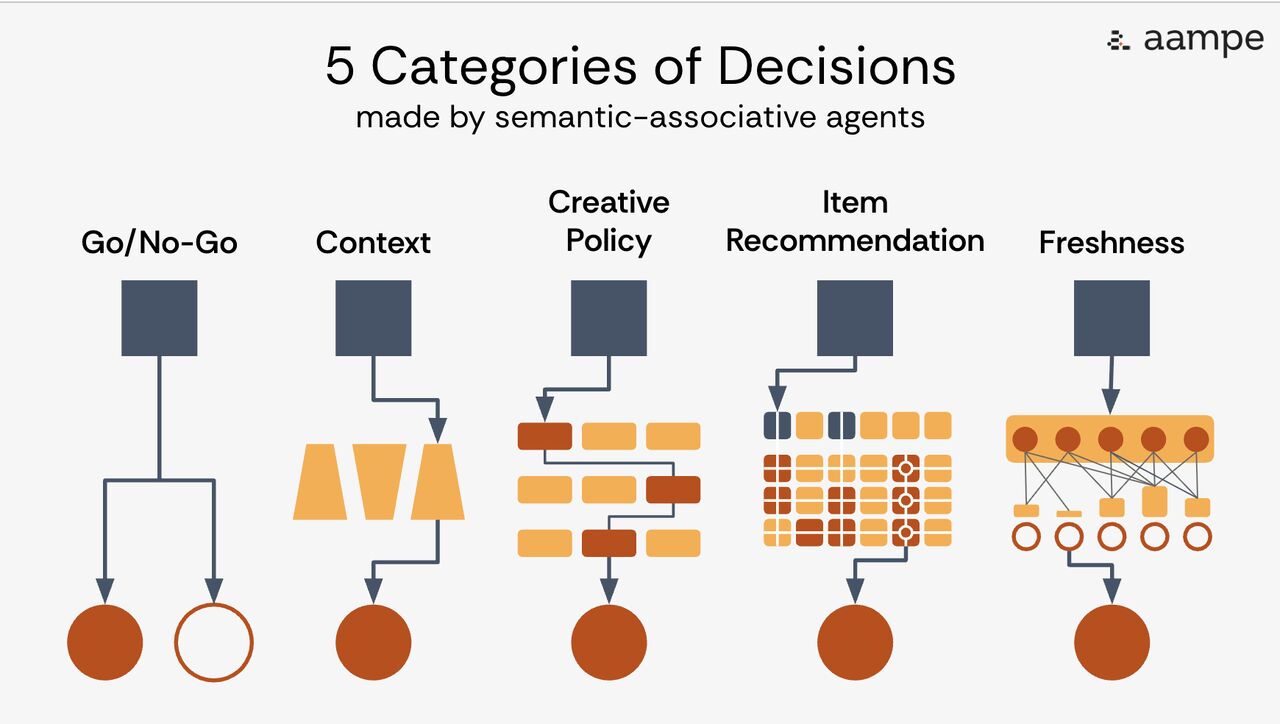
In agentic systems, what counts as a “decision”? That can be a hard question to answer in regards to humans, let alone agents. By some estimates, adult humans make around 35,000 decisions a day. Other estimates put our food-related decisions alone at over two-hundred per day. (Links in comments). It comes down to what kind of cognition you’re modeling. Are we talking about conscious deliberation? Or the automatic, procedural choices we make to keep moving through the world? This kind of question is foundational when designing agentic systems. We don’t try to model every micro-fluctuation in user behavior as a “decision.” Instead, we draw a boundary around actionable choices — moments where our agents must commit to one option over another, and where outcomes are observable. For every interaction each dedicated agent has with its assigned user, the agent makes five distinct classes of decisions: 1️⃣ Go/No-Go. Should we send something now? Agents evaluate timing: time of day, day of week, recency of prior messages, etc. 2️⃣ Context. What is the user doing? First app open, abandoned cart, wishlist edit — context filters the set of eligible content. 3️⃣ Creative Policy. Agents form a ranked policy across creative dimensions: category, value prop, incentive, CTA, tone, visuals. These aren't “templates” — they’re compositional decisions from primitives. 4️⃣ Item Recommendation. When catalogs are large, agents call a recommender — but only after creative policy is set, so the recommendation aligns with the core message (not the other way around). 5️⃣ Freshness. Even within a valid set, agents prioritize content the user hasn’t seen before, to avoid repetition and keep interactions from feeling stale. Each of these is a point of real choice — measurable, consequential, and improvable. That’s where agentic systems need to focus: not on simulating every twitch of user behavior, but on choosing well when choice matters. Want to learn how you can leverage Agentic AI to improve decisioning? Book a free strategy session with one of Aampe's experts. 👉 https://lnkd.in/eCeZgi_b
- LINKEDIN · IMAGESince 14 Apr 2026
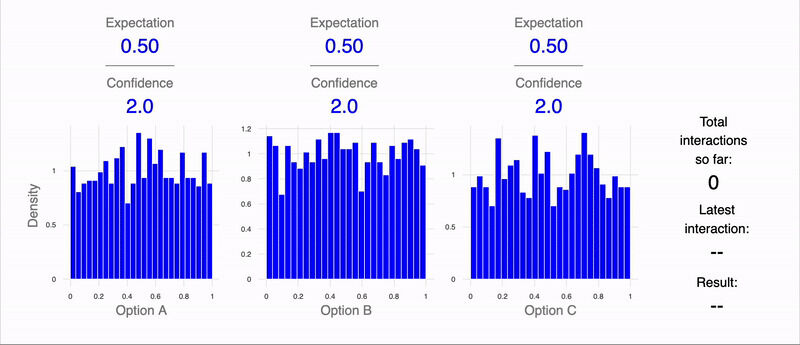
In an agentic architecture, that balance between exploration and exploitation emerges naturally from the system’s structure — no need for hand-tuned ratios. Thompson Sampling is a convenient tool for navigating that tradeoff. Early on, when every option is uncertain, the system explores widely: flat distributions mean random draws lead to random choices. As the system gathers signal, those distributions sharpen. The same selection mechanism starts tilting behavior toward higher-confidence actions — exploration fades, exploitation grows. No hard-coded switches needed. You can always layer in an “epsilon-greedy” override to force occasional exploration — especially useful for catching preference shifts in long-tail segments. This is all standard bandit architecture, but agentic systems diverge from basic bandits in that they estimate and sample from distributions on a per-user basis. That requires an enriched reward signal that makes use of every bit of information available, since individual user behavior is sparse by nature. Bandits aggregate wins and losses across users. Agents *simulate* a win/loss ratio for each interaction with each individual user, and then aggregate those ratios across interactions for each user. Bandits focus on which message wins *on average*. Agentic systems focus on which message is likely to advance *this user* right now. The question isn’t “what’s the likelihood of conversion?” It’s “What gives me the best chance of progress for this individual?” There are no fixed explore/exploit ratios. Agents explore almost constantly for silent users, exploit heavily when preferences are clear, and adapt fluidly as user behavior evolves. That’s what real balance looks like — not some artificial midpoint, but continuous responsiveness to real-time signals. Want to learn how you can leverage Agentic AI for better decisioning? Book a strategy session with one of Aampe's experts. 👉 https://lnkd.in/eCeZgi_b
- LINKEDIN · IMAGESince 14 Apr 2026
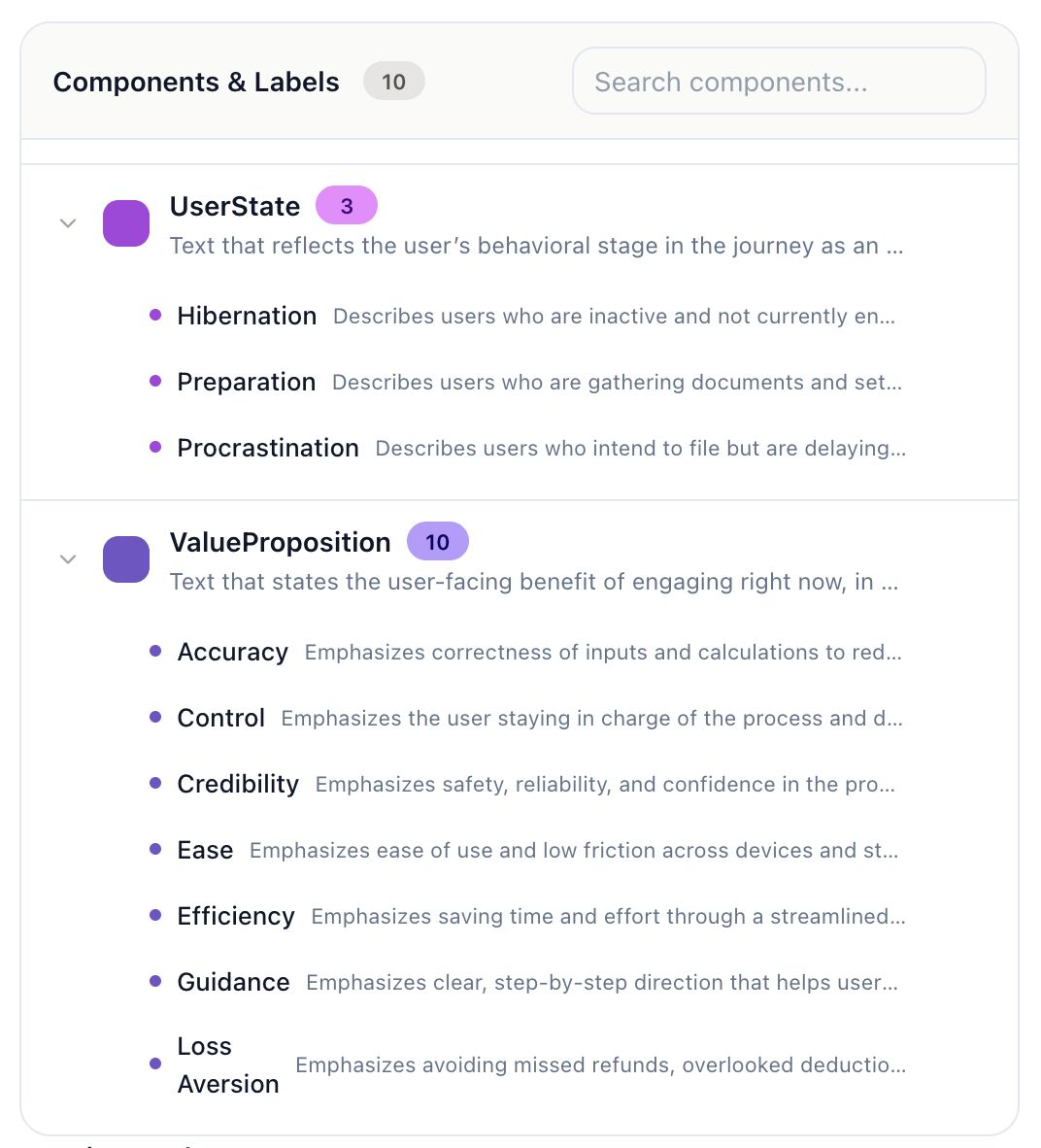
A label called "convenience" seems self-explanatory. It’s not. When developing Relay (see link in comments if you haven’t heard yet), users would create labels like "convenience" or "savings" or "urgency," and the LLM would generate content expressing those concepts. The outputs were inconsistent in ways that were hard to pin down. Some "convenience" messages emphasized time savings. Others emphasized reduced effort. Others drifted toward ease of use, which was supposed to be a separate concept entirely. The LLM wasn't doing anything wrong. It was working with what it had. "Convenience" is a word with a broad semantic range, and the model was sampling from that range. Without a definition constraining the meaning, each generation was a fresh interpretation. We quickly realized we needed full definitions before labels could be used. No definition, no label. That doesn’t make users hugely happy - writing definitions feels like bureaucratic overhead. But the generation quality difference is hard to argue with. A good definition gives an LLM a target to hit instead of a general direction to wander in, and crafting those definitions is a big part of the work to be done if you’re really going to invest in LLM-enabled content generation. A single word is a pointer. The definition is what it points to. Without the definition, you're letting the LLM decide what the pointer means, and it will decide differently every time, and the agents using that content to learn are going to learn a lot of noise. Definitions aren’t busy work. Want to learn how you can leverage Agentic AI to improve decisioning? Book a strategy session with one of Aampe's experts. 👉 https://lnkd.in/eCeZgi_b
- LINKEDIN · IMAGESince 9 Apr 2026
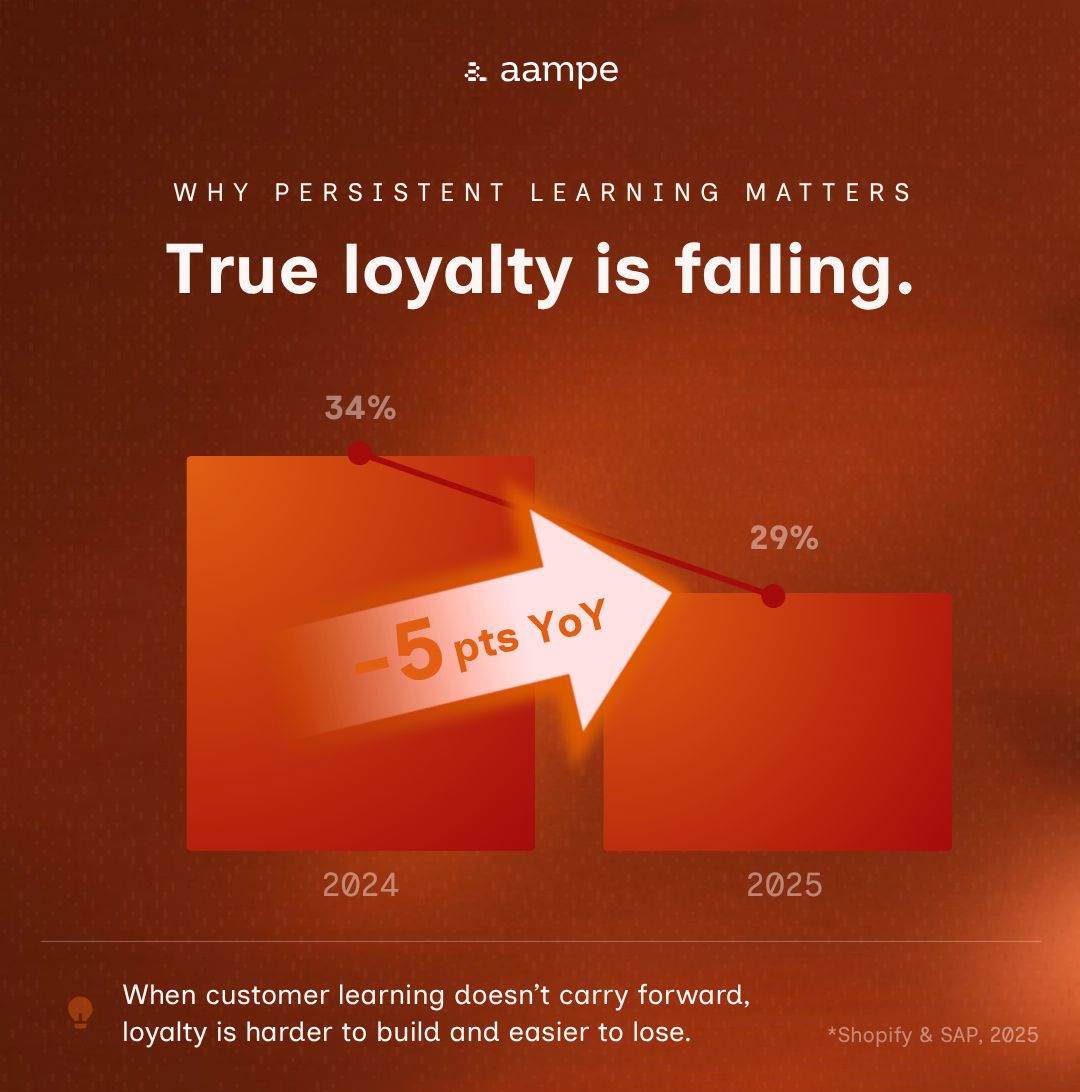
True loyalty is falling. 34% → 29% in a year. For ecommerce brands, that’s a warning sign. Loyalty doesn’t come from one good campaign. It comes from a customer experience that keeps getting smarter over time. But when personalization can’t retain and apply what it learns across the individual customer lifecycle, every touchpoint starts closer to zero: less context, less relevance, less momentum. We wrote about why ecommerce personalization still breaks down, and why persistent customer memory is key to reversing the trend. Check out our full thoughts via the link in the comments!
- LINKEDIN · IMAGESince 8 Apr 2026
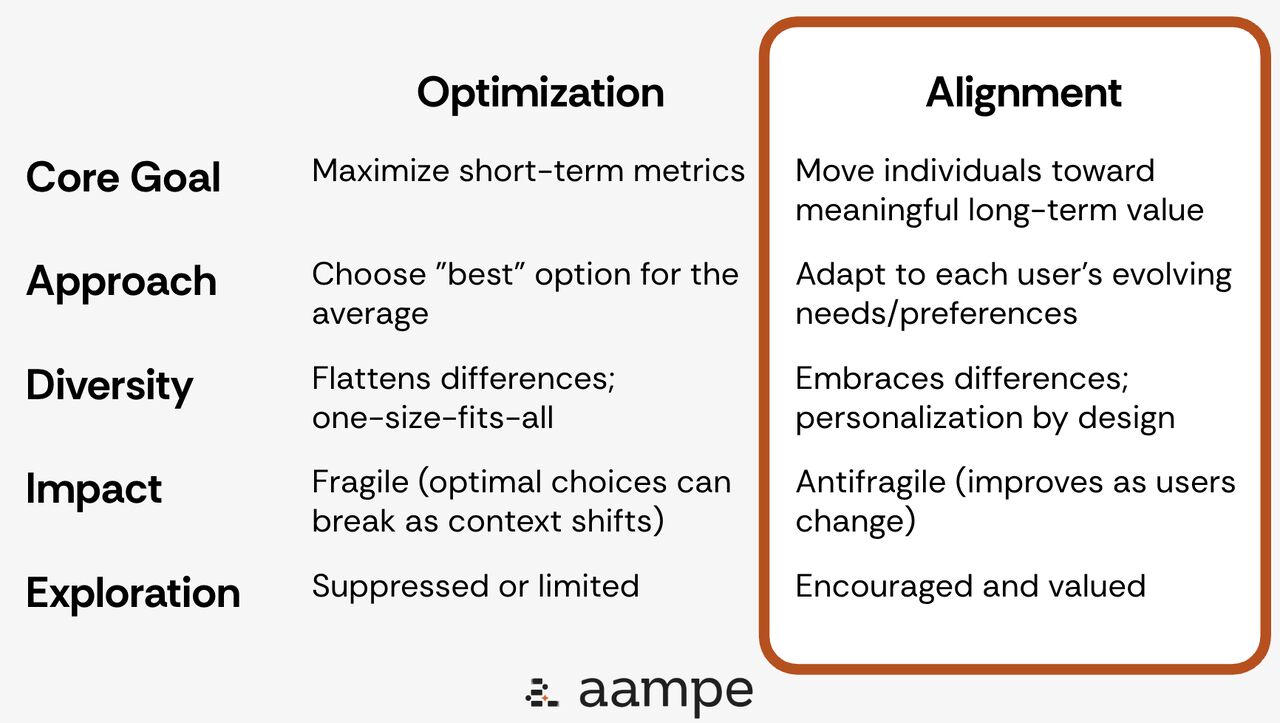
We need to stop thinking about user engagement in terms of optimization and start thinking in terms of alignment. ➡️ Optimization is fragile. If you test option A vs. option B and A wins, so you roll out A for everyone because it's "optimal," what have you actually done? ❌ You've destroyed the experience for every user who preferred B. ❌ You've flattened the experience for users who liked both A and B - less variety, less richness. ❌ You've killed off most chance of discovering C, D, or E - things that might have been even better for some people or better later. You've taken what was a living, breathing, dynamic experience and turned it into a monolith. And here's the kicker: the very act of "optimizing" changes the conditions that made your optimal choice optimal in the first place. I repeat: by optimizing, you make your optimal choice no longer optimal. The system shifts under you. What worked breaks. And sure, you can slap on a bandit approach or some fancier algorithm, but that just makes your fragility probabilistic instead of deterministic. It doesn’t solve the core problem. Alignment, on the other hand, isn’t just more robust. It’s antifragile. It doesn’t chase immediate bang-for-the-buck. It’s about moving each individual user in the direction of some desired end state, even if they’re not there yet. It embraces the fact that users change. That they don’t all want the same thing. That discovery matters. All that individual noise? That’s actually the signal. Every time a user changes their mind (or stumbles onto something new they like, or figures out a preference they didn’t know they had), you can follow them there. And when you do, their experience gets richer. And when their experience gets richer, every single business metric - conversion, retention, re-engagement, whatever - gets stronger over time. ➡️ Optimization is seeing how big of a splash you can make by throwing a rock in the water. ➡️ Alignment is about steadily dropping pebbles in the right places at the right times to raise the water level. Optimization freezes and ultimately destroys the dynamics that made it make sense in the first place. Alignment adapts as dynamics evolve - it always makes sense, because it lets users decide what they want rather than trying to lock in choice for the convenience of the business. Users don’t want systems that optimize. They want systems that align.
- LINKEDIN · IMAGESince 8 Apr 2026
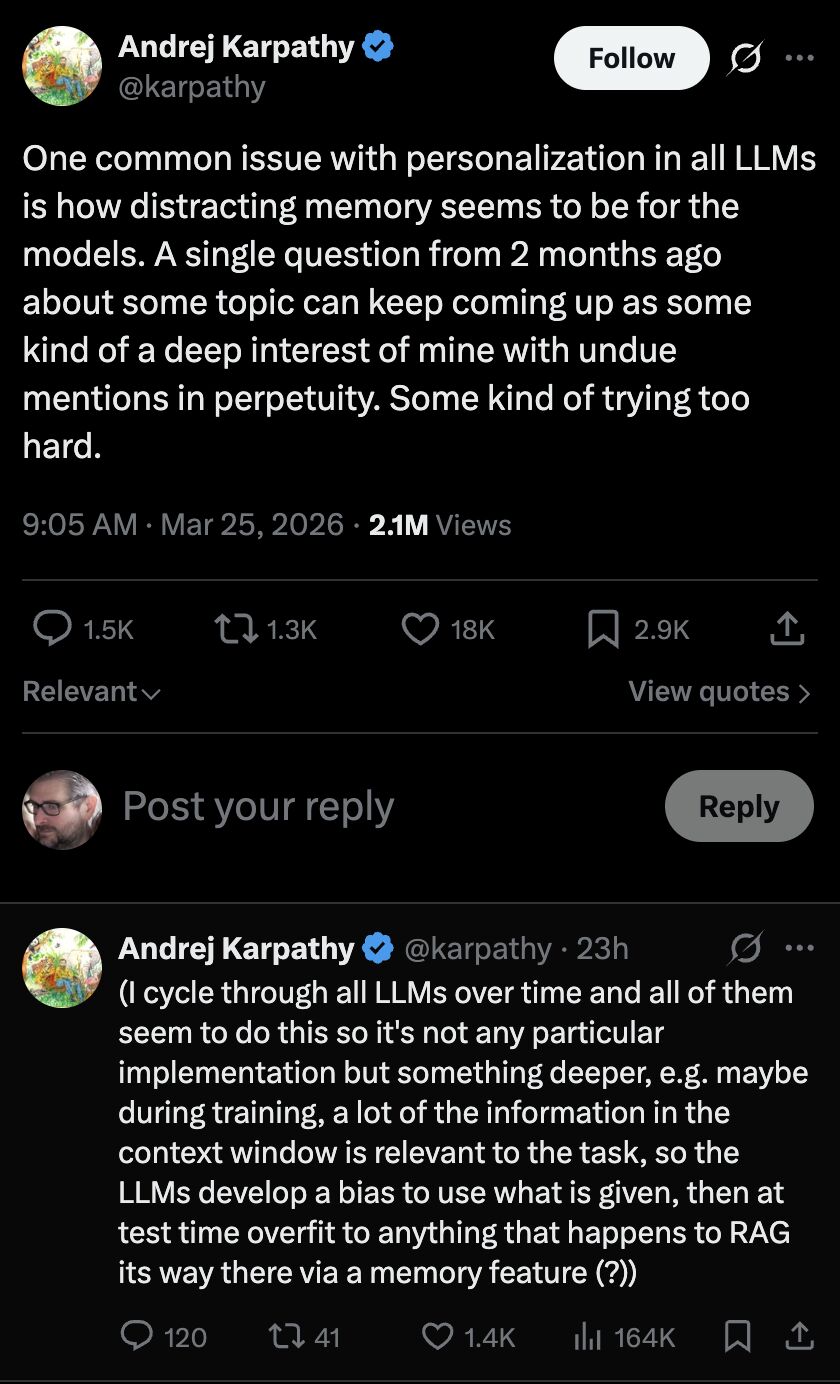
If the LLM application you're developing is ONLY an LLM application, you're setting yourself and your users up for a lot of pain. Take a look at the X post below from Andrej Karpathy. He pointed out that personalization features in LLMs tend to "try too hard." You ask one question about a topic months ago, and the model keeps bringing it up like it's a core part of your identity. Every LLM does this. Karpathy's hypothesis is that during training, most context is relevant to the task, so models develop a bias to use whatever they're given. At inference time, that bias makes them overfit to anything in memory. Karpathy's observation is a precise description of what happens when you have a system optimized to exploit context without any theory of what context means. Think about how you listen to a colleague. They mention motorcycles once, and you don't file "motorcycles" as a core personality trait. You know the difference between an offhand comment and something that matters because you've absorbed frameworks for how conversations work and what identity looks like. You learned these from growing up in a culture, not from word patterns. LLMs have fuzzy approximations of these frameworks because cultural knowledge shows up implicitly in training data, but nothing in the architecture explicitly represents them. The model can't distinguish "asked about motorcycles out of curiosity" from "motorcycles are central to this user's identity" because that distinction requires a theory of relevance that lives outside the words themselves. This is why LLMs fall out of alignment with both too little context and too much. Without enough they lack signal, but with too much they treat everything as signal because they can't sort wheat from chaff. You and I handle variable input because we bring stable frameworks that tell us how to weight and interpret. LLMs don't have that layer. The fix isn't more context, better retrieval, or a bigger window. You need a separate system that evaluates what matters before the LLM ever sees it, one that learns which signals predict outcomes worth caring about and organizes observations into categories humans can inspect and adjust. We've been building toward Artificial Intelligence, but we also need something like Artificial Culture, the scaffolding that tells a system what categories exist and how to interpret signals it receives. LLMs can't solve LLMs' context problem. If your AI strategy is a bigger model with longer memory, you will hit this wall. The path forward is modular architectures where different components handle different jobs, with humans providing the cultural scaffolding. That's the investment most organizations haven't made yet, and it's where the real gains live. Want to learn how you can leverage Agentic AI for better personalization? Book a strategy session with one of Aampe's experts. 👉 https://lnkd.in/eCeZgi_b
6 of 643 adsSign up to see every Aampe ad, filter by format and date, and get alerts on new ones.
See all 643 adsWatch the companies you care about.
Filter every ad by industry, country, format and network, and get alerts when a company you watch starts running new ads.