Not on air · 2 of 3 networks checked
28Stone
- 28stone.com
- Fintech & Financial Services
- US
- 185 employees
28Stone’s ads on LinkedIn, Meta and Google, recorded by adsrunning. Browse the latest here for free. Sign up free to see all 26. Watch 28Stone with Starter to get each new one in your feed.
Watchlist with Starter · $49/mo
| Network | Status | Live ads | Nov 2025LinkedIn activity · 52 weeksOct 2026 | Checked | Next step |
|---|---|---|---|---|---|
| None recorded | 0 | Checked 29 Oct 2026 | See all 26 ads → | ||
| Meta | Not checked | — | |||
| None recorded | 0 | No ads found on the Google Ads Transparency Center | Checked 27 Oct 2026 | Collect them with the API → |
28Stone has no live LinkedIn ads. We recorded no Google ads on 27 Oct 2026.
Latest ads
- LINKEDIN · IMAGESince 11 Jun 2026
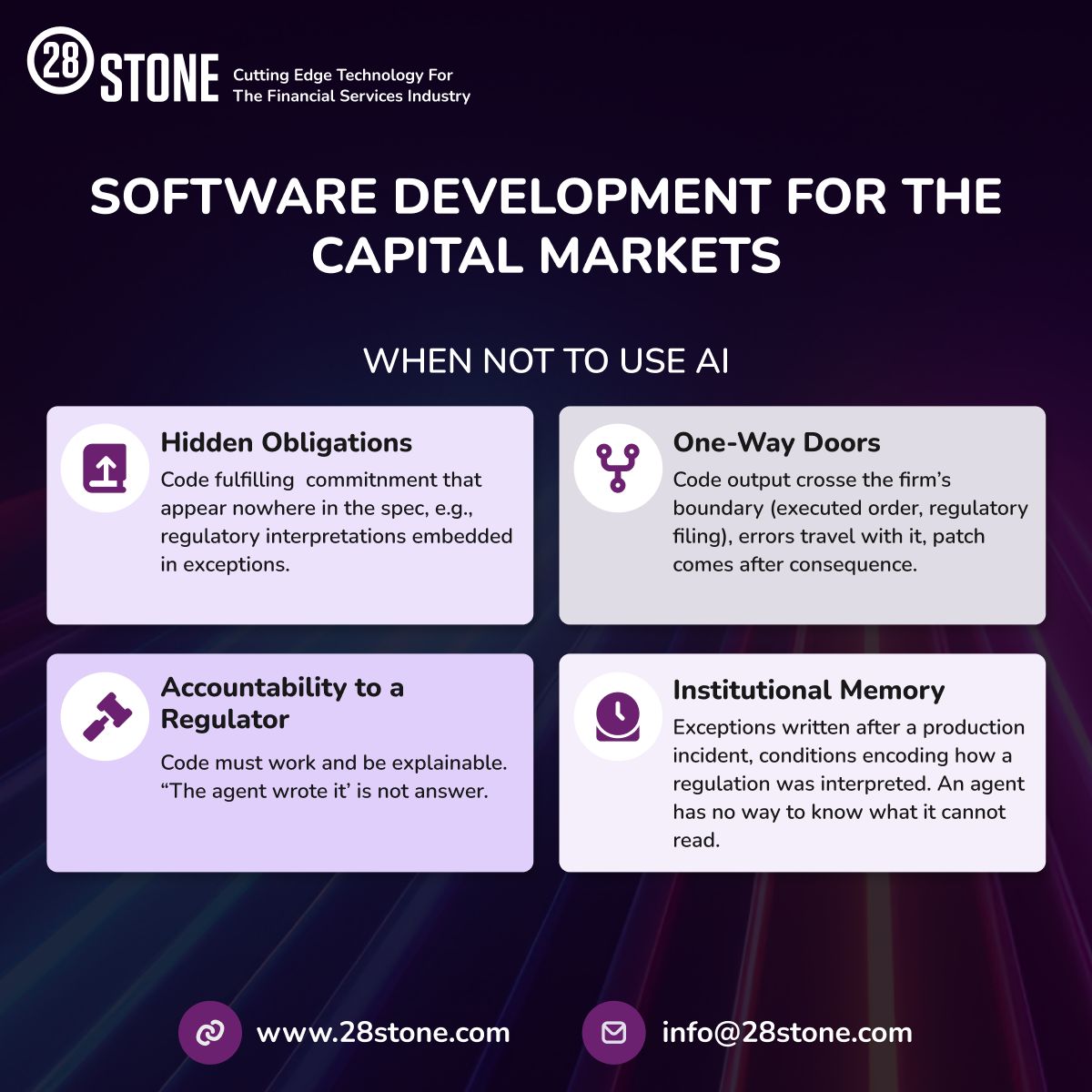
A general-purpose development team with AI tools is fast. A team with AI tools and deep capital markets expertise is accurate. In regulated environments, the gap between those two is where production incidents live. AI agents might refactor well-thought-out exceptions because the code looks inelegant. They treat regulatory edge cases as bugs because they don't carry the institutional memory of why that exception exists. Our AI-First SDLC is built on a principle: humans are accountable for all code, no matter the author. Four categories that demand domain-specific scrutiny - and a human who owns the outcome at every level of our framework: Hidden Obligations — code fulfilling commitments that appear nowhere in the spec. Regulatory interpretations embedded in exceptions. One-Way Doors — when code’s output crosses the firm’s boundary. An order executed, a regulatory filing submitted. Accountability to a Regulator — code that must not only work, but be explainable. “The agent wrote it” is not an answer. Institutional Memory — exceptions written after a production incident, conditions encoding how a regulation was interpreted. An agent has no way to know what it cannot read. This is why domain expertise matters more in an AI-first world, not less. Link to the full framework: https://lnkd.in/dgxyy77w
- LINKEDIN · IMAGESince 4 Jun 2026
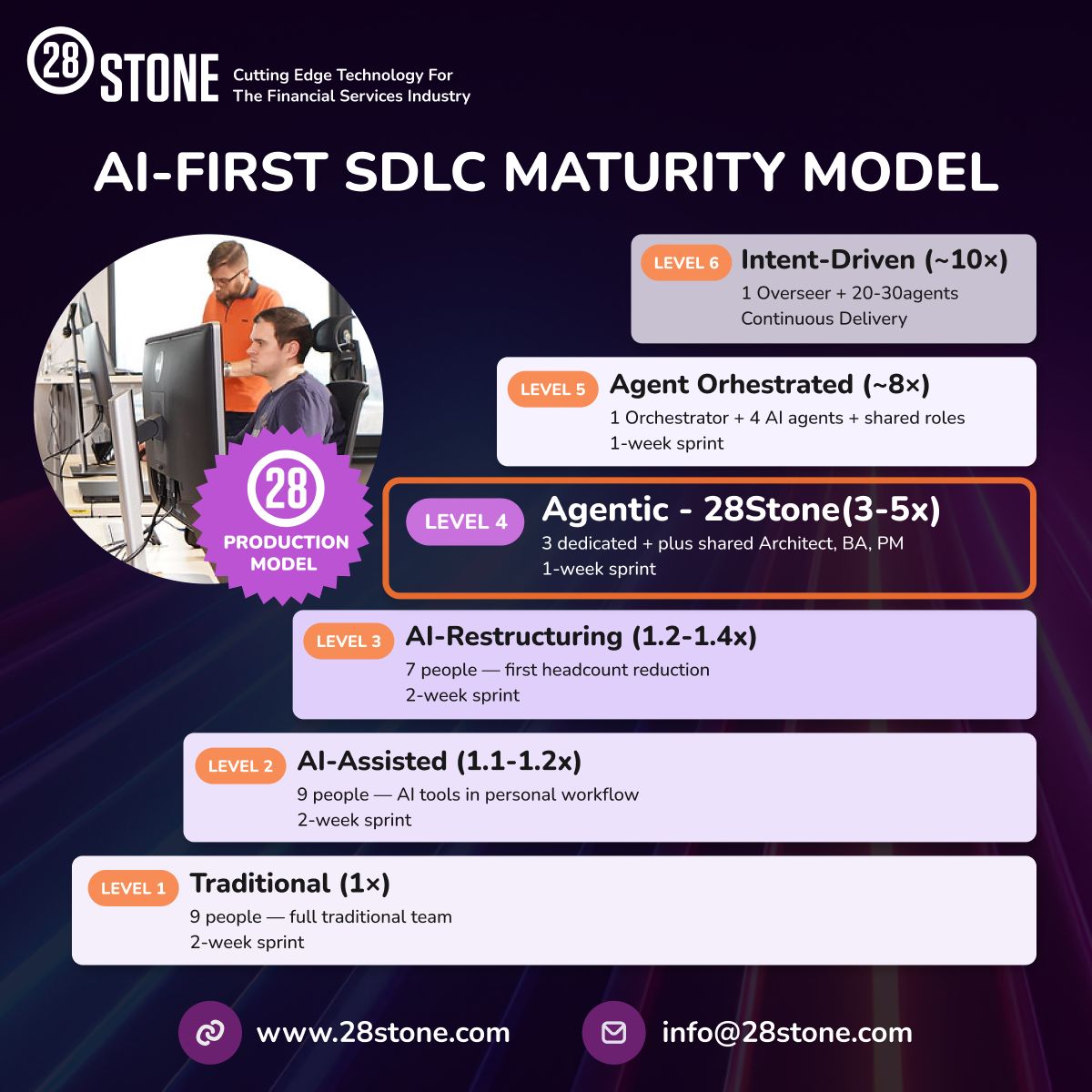
AI adoption is up. Delivery performance is not. Google’s DORA report found that as AI adoption increased across organizations, delivery throughput declined 1.5% and stability dropped 7.2%. Not stagnated. Declined. A Stanford study tracking 120,000 engineers confirmed it: the median net productivity gain from AI tooling is roughly 10%. Not the 40–60% vendors promise. And teams without the right processes see zero. The problem isn’t the tools. It’s that most teams upgraded the tools without redesigning the work. Same team structure. Same two-week sprint. Same sequential handoffs. A Copilot license on top of an unchanged process is a 10% improvement at best. We spent the past year studying this gap and building a framework around it: a six-level model for AI-first software delivery, built specifically for capital markets. From traditional agile (Level 1) through AI-assisted (Level 2) to agentic development (Level 4) and beyond — each level is defined by what actually changes: team composition, sprint cadence, throughput, and the compliance boundary where human authorship stays non-negotiable. The full framework is live, get it here: https://lnkd.in/dgxyy77w
- LINKEDIN · IMAGESince 3 Jun 2026
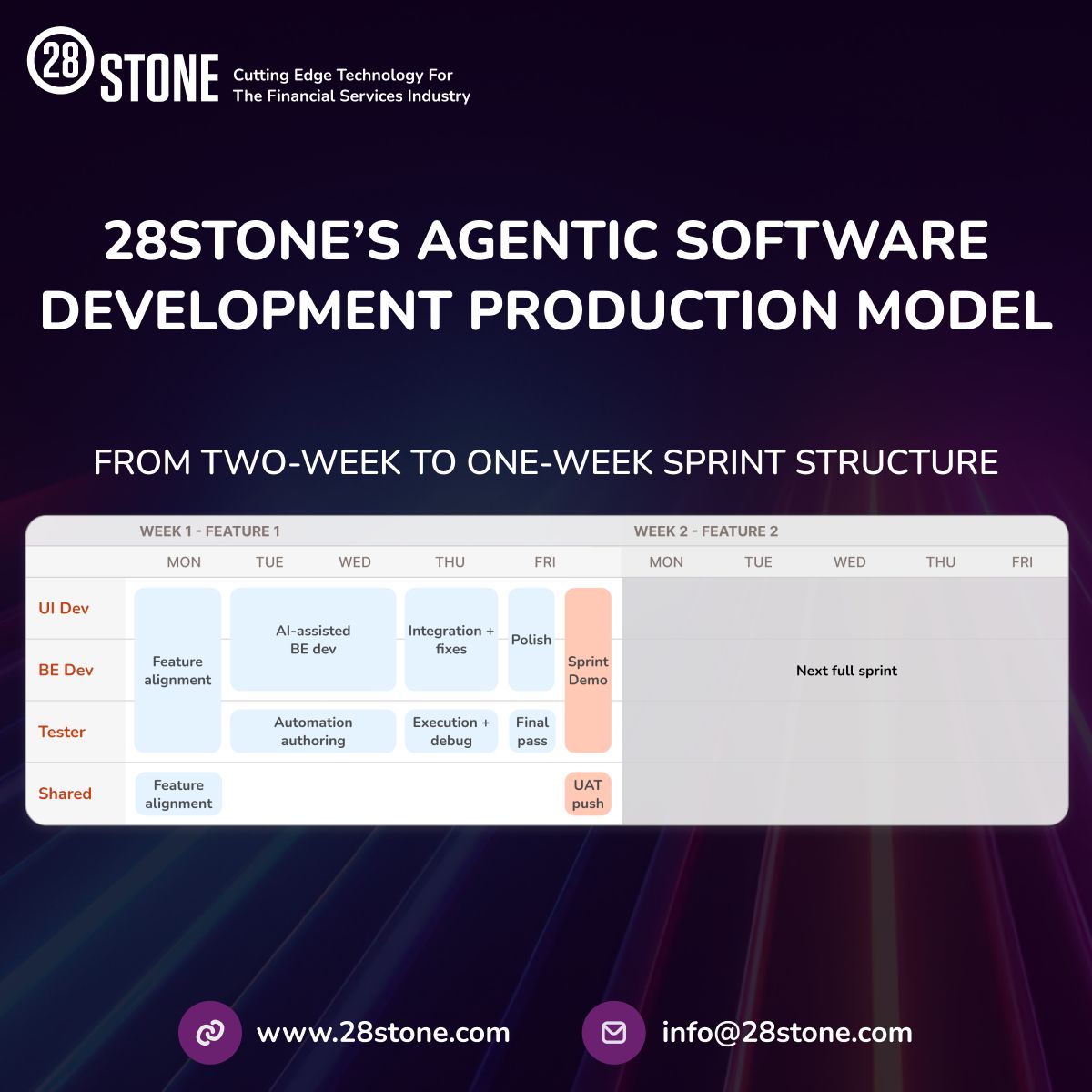
We restructured how we deliver software. Not “added AI tools.” Restructured. Different team size. Different sprint cadence. Different roles. Re-imagining what a developer actually does all day. Our model for capital markets engagements runs a team of three dedicated people — UI developer, backend developer, automation tester — plus shared architect, BA, and PM across parallel feature streams. One-week sprints. 3–5× throughput versus a conventional team. The developers don’t write code in the traditional sense. They direct AI agents and review everything the agents produce - applying domain-specific scrutiny to the paths that carry the most risk: compliance-sensitive paths, architectural decisions, domain-specific edge cases. It’s not “vibe coding.” The developer-agent relationship is a disciplined cycle of specification, directed generation, and expert review. It requires more expertise than traditional coding, not less. We wrote up the full framework — six levels of maturity, the team structures, the compliance boundaries, and where we’re experimenting next. Download our full whitepaper on AI-first SDLC: https://lnkd.in/dgxyy77w
- LINKEDIN · IMAGESince 3 Feb 2026
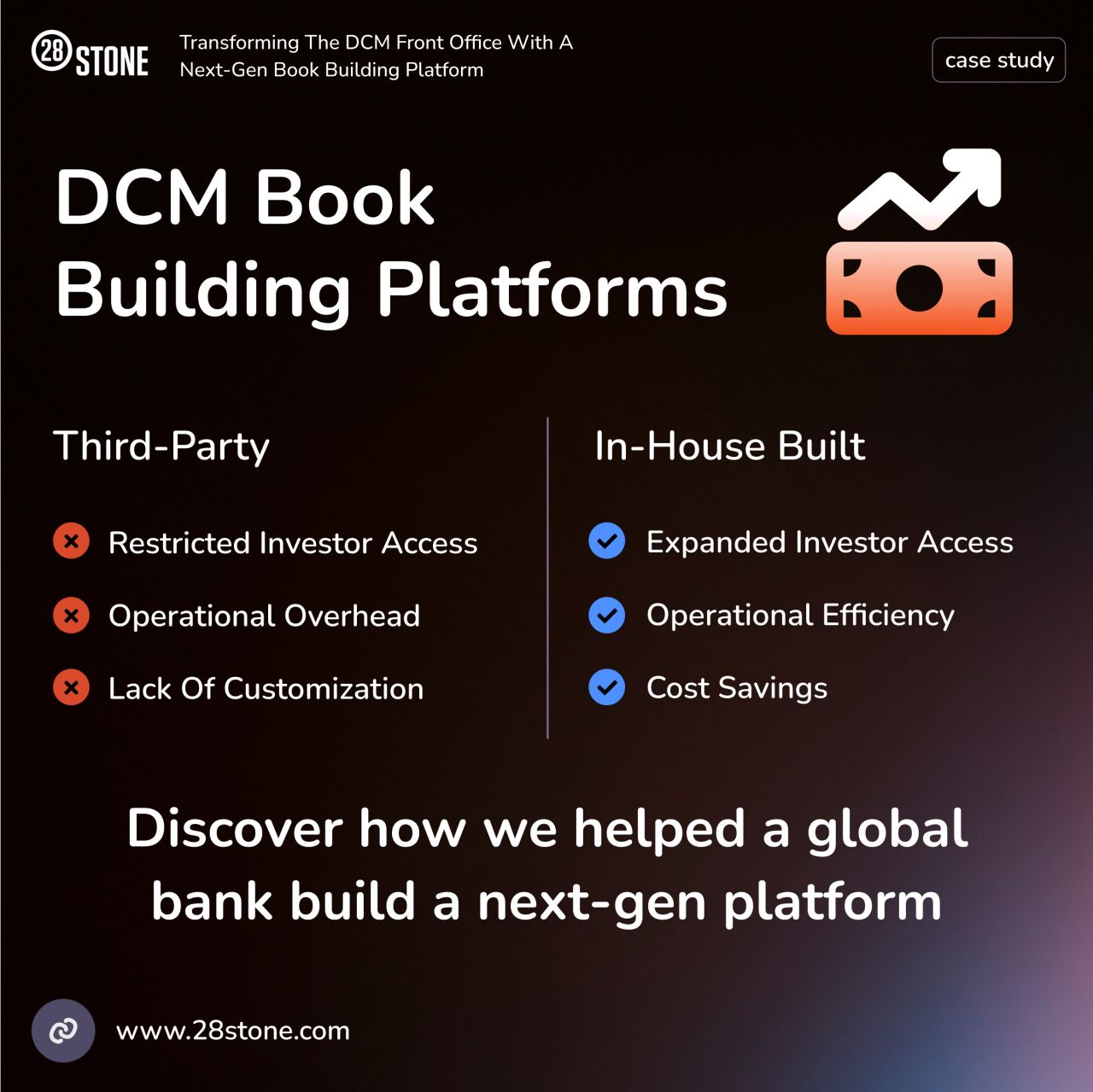
Are third-party book builder limitations impacting your syndicate desk? Restricted investor access, manual reconciliations, and lack of customization are costing banks efficiency and opportunity. How do we know it? Our client, leading global investment bank, was facing this challenges along with significant licensing costs for years. They embarked on a strategic initiative to modernize its Debt Capital Markets operations by building an in-house Book Builder platform. The new fully integrated, internally governed platform capable of managing the entire DCM lifecycle became a core front-office tool for fixed income syndicate desks across North America, EMEA, and APAC. Discover how we helped a global bank build the solution from scratch, read the full case study here: https://lnkd.in/d8g9Gfyq #dcm #debtcapitalmarkets #capitalmarkets #finance #bondissuance #syndicatedesk #bookbuilding #fixedincome #bonds #finance
- LINKEDIN · IMAGESince 3 Feb 2026
In Debt Capital Markets, agility is everything. Yet, many firms are still stuck with rigid vendor solutions that dictate how they trade, rather than supporting how they want to trade. At 28Stone, we architect fully bespoke Bookbuilder platforms that eliminate vendor dependencies and put you back in control. We build high-performance, cost-effective solutions tailored specifically to your front-office workflows. ✅ Eliminate vendor lock-in ✅ Enhanced, custom functionality ✅ Seamless integration with your existing stack Build software that adapts to your business, not the other way around. Read more: https://lnkd.in/drg85iJi
- LINKEDIN · IMAGESince 3 Feb 2026
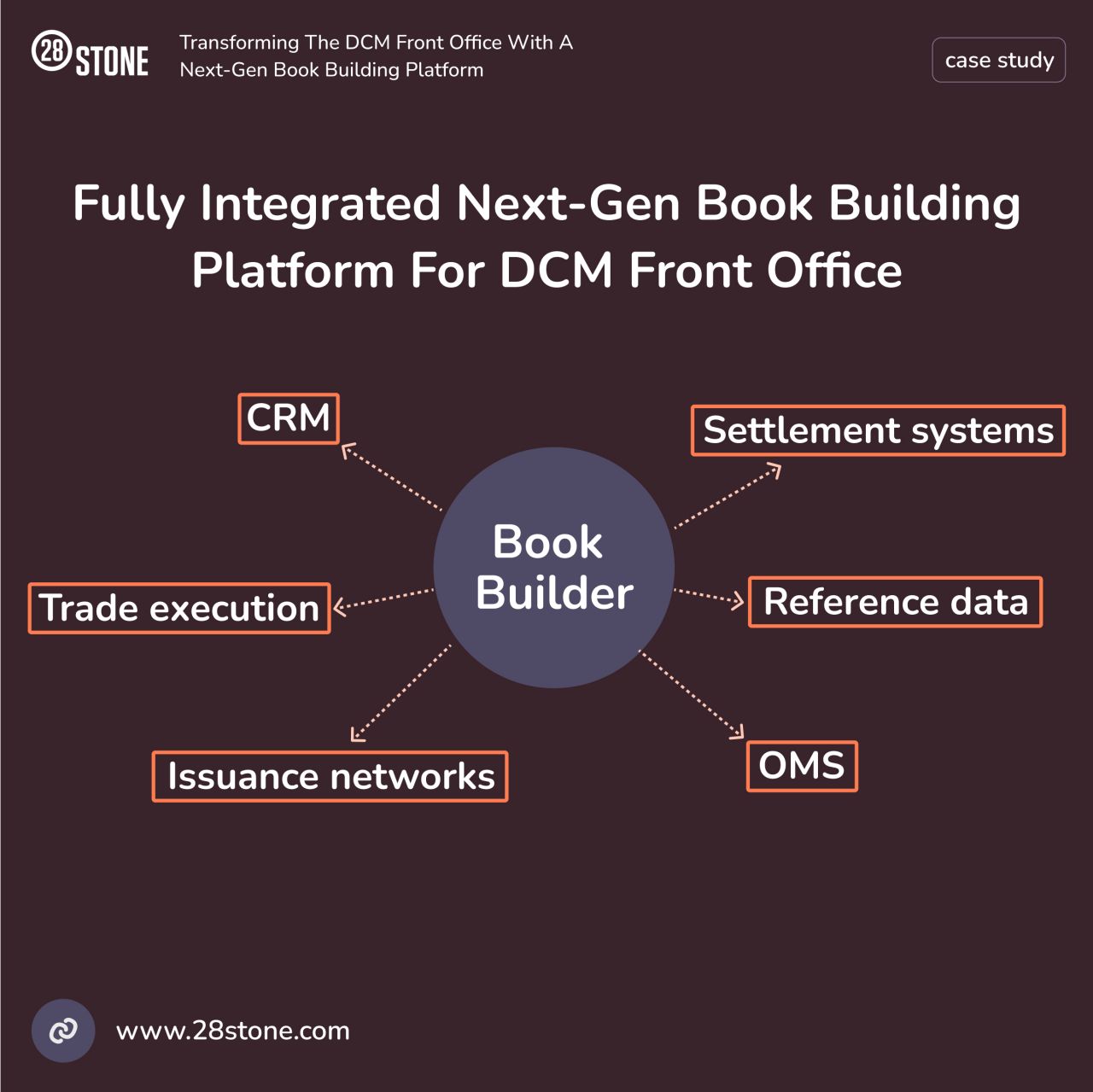
28Stone built a DCM Book Builder platform from the ground up for a leading international investment bank. We worked closely with the bank’s technologists to make critical server-side architectural decisions, delivering a scalable, secure, cloud-native solution built on the Microsoft technology stack. The platform was engineered for global use, supporting real-time collaboration across syndicate desks in multiple time zones and jurisdictions. Key features include: - Full integration with major issuance networks like DirectBooks and IssueNet for seamless order capture and allocation - Robust APIs connecting upstream CRM and downstream OMS, reference data, trade execution, and settlement systems See how 28Stone helped design and deliver this powerful DCM platform: https://lnkd.in/dEaCNg9V #dcm #debtcapitalmarkets #capitalmarkets #finance #bondissuance #syndicatedesk #bookbuilding #fixedincome #bonds #finance #cloud #integration
6 of 26 adsSign up to see every 28Stone ad, filter by format and date, and get alerts on new ones.
See all 26 adsWatch the companies you care about.
Filter every ad by industry, country, format and network, and get alerts when a company you watch starts running new ads.