Not on air · 2 of 3 networks checked
21st.BIO
- 21st.bio
- Healthcare & Life Sciences
- DK
- 70 employees
21st.BIO’s ads on LinkedIn, Meta and Google, recorded by adsrunning. Browse the latest here for free. Sign up free to see all 27. Watch 21st.BIO with Starter to get each new one in your feed.
Watchlist with Starter · $49/mo
| Network | Status | Live ads | Nov 2025LinkedIn activity · 52 weeksOct 2026 | Checked | Next step |
|---|---|---|---|---|---|
| None recorded | 0 | Checked 29 Oct 2026 | See all 27 ads → | ||
| Meta | Not checked | — | |||
| None recorded | 0 | No ads found on the Google Ads Transparency Center | Checked 27 Oct 2026 | Collect them with the API → |
21st.BIO has no live LinkedIn ads. We recorded no Google ads on 27 Oct 2026.
Latest ads
- LINKEDIN · IMAGESince 21 Oct 2026
If you were packing food for a mission to Mars, what would you bring? Nutrition per gram would matter! What if the future of food is not about producing more, but about delivering complete nutrition with less? The ability to pack complete nutrition effectively in few grams and in attractive, easy to consume, well tasting formats will be imperative for getting space goers all the way to Mars in good shape. With BLG Essential+ from 21st.Bio you can now reach WHO’s daily recommended intake of nutrients with almost 30% less grams than the best available whey protein (WPI). On top of this, it holds a higher level of leucine which is the most important amino acid for supporting muscle health and recovery. Space exploration is an extreme example, but principle of more complete nutrition with less is becoming increasingly relevant here on Earth. The principle is already today important for example for ageing populations, people on GLP-1 treatment, people who are seeking to consume high-quality protein solutions easily, people in medical treatment with less appetite. For protein, that means looking beyond the grams listed on a label. The future will be defined by proteins with the right amino acid profiles, functionality, and nutritional properties for specific applications. Precision fermentation of the best proteins does not only ensure access, but it expands what is possible, enabling the development of proteins that can deliver more nutritional value, functionality, and sustainability from every serving. At 21st.BIO, we have developed strain and fermentation technology for making this happen cost-effectively. Contact us for more information. #FoodInnovation #PrecisionFermentation #Nutrition #FoodTech #Protein #FutureOfFood #Biosolutions #HealthAndNutrition
- LINKEDIN · IMAGESince 12 Aug 2026
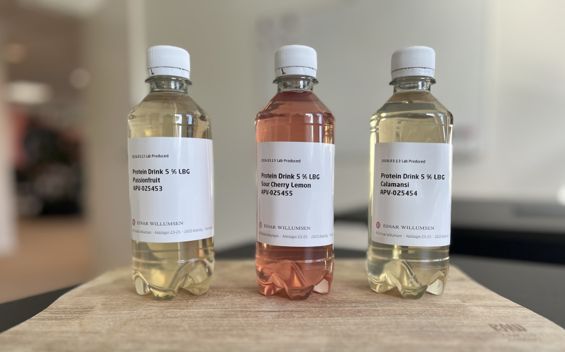
The beverage industry is quietly being entirely reshaped. As consumption habits drift towards healthier choices, growth in alcohol and soda is declining. Functional sodas now hold 6% of total beverage market share but are driving 27% of category growth. Alcohol's own numbers tell the same story: volumes are down for the third year running, with no-alcohol as basically the only category still growing. New high-protein sodas and beers are now hitting the market. The better-for-you transition is more than a niche: it is where the volume is going. The challenge for brands isn’t to sell more, but to stay relevant. Where some see risk, others see opportunity. Brewers already run precision bioprocess facilities. Controlled fermentation, sterile handling, yield optimization, downstream separation: these skills are as valuable in biomanufacturing as they are in brewing. Precision fermentation, producing functional proteins by programming microorganisms to express them, runs on exactly this infrastructure logic. The capital barrier to entry is meaningfully lower for a brewer than for almost anyone else considering this space. And the application that sits right at the intersection of both trends is BLG, beta-lactoglobulin. The winning whey protein with a superior leucine response and amino acid profile, with ever growing demand in overall foods and specialized nutrition. Unlike whey (even high purity WPI), BLG is fully water-soluble. No chalky texture, no cloudiness, no compromise on taste. A high-protein soda that actually drinks like a soda. Fresh, clean, juicy. That format does not exist yet at scale, and it does not work without the right protein. Our world-leading technology enables production at scale, and cost-parity with WPI. Brewers, in our view, are among the most natural partners for where this is heading. Connect with our team to know more.
- LINKEDIN · IMAGESince 12 Jun 2026
Demand for high-quality whey proteins is accelerating faster than the system designed to produce them. One question keeps coming up in conversations with dairy leaders, ingredient suppliers, and investors: where will future whey protein capacity come from? Dairy companies are investing heavily in whey processing, and the demand signals are clear: performance nutrition, healthy aging, medical nutrition, GLP‑1 supporting diets, functional foods. The market is real. And it is scaling fast. But whey remains a by-product of cheese production. Supply is tied to milk volumes, land use, and increasingly complex downstream fractionation. There’s also a structural challenge that rarely gets stated directly: Every additional purification step creates a new side stream that needs its own business case. Whey and cheese work because their economics are interdependent. Push fractionation further, and you rapidly move into territory where not everything naturally “finds a home.” This is why some dairy leaders are starting to ask a more fundamental question: should precision fermentation be part of the capex conversation - not just something to monitor from a distance? The case is increasingly clear: 🛠️ Pure protein, no side streams. Precision fermentation produces targeted proteins like beta-lactoglobulin (BLG) or alpha-lactalbumin (α‑LAC) directly. No residual fractions. No secondary value chains to solve for. ⏱️ Favorable economics, right now. Fermentation runs on sugar, not milk. Sugar prices are near historic lows, while protein prices are at record highs. The spread is unusually attractive. 💪 Superior nutritional efficiency. BLG delivers one of the most concentrated essential amino acid profiles available. Its leucine response matches WPI at 2/3 of the dose. Some call it maximum nutrition in minimum volume. Others call it the protein you would bring to Mars. The companies best positioned for the next decade won’t choose dairy ‘or’ fermentation. They will build parallel supply streams: combining existing dairy scale with the flexibility to grow beyond its constraints. Next week, 21st.BIO will be at the Global Dairy Congress in Barcelona. If this question is on your radar, come tell Mathilde Pinon how you’re thinking about it. FoodBev Events #GlobalDairyCongress
- LINKEDIN · IMAGESince 1 May 2026
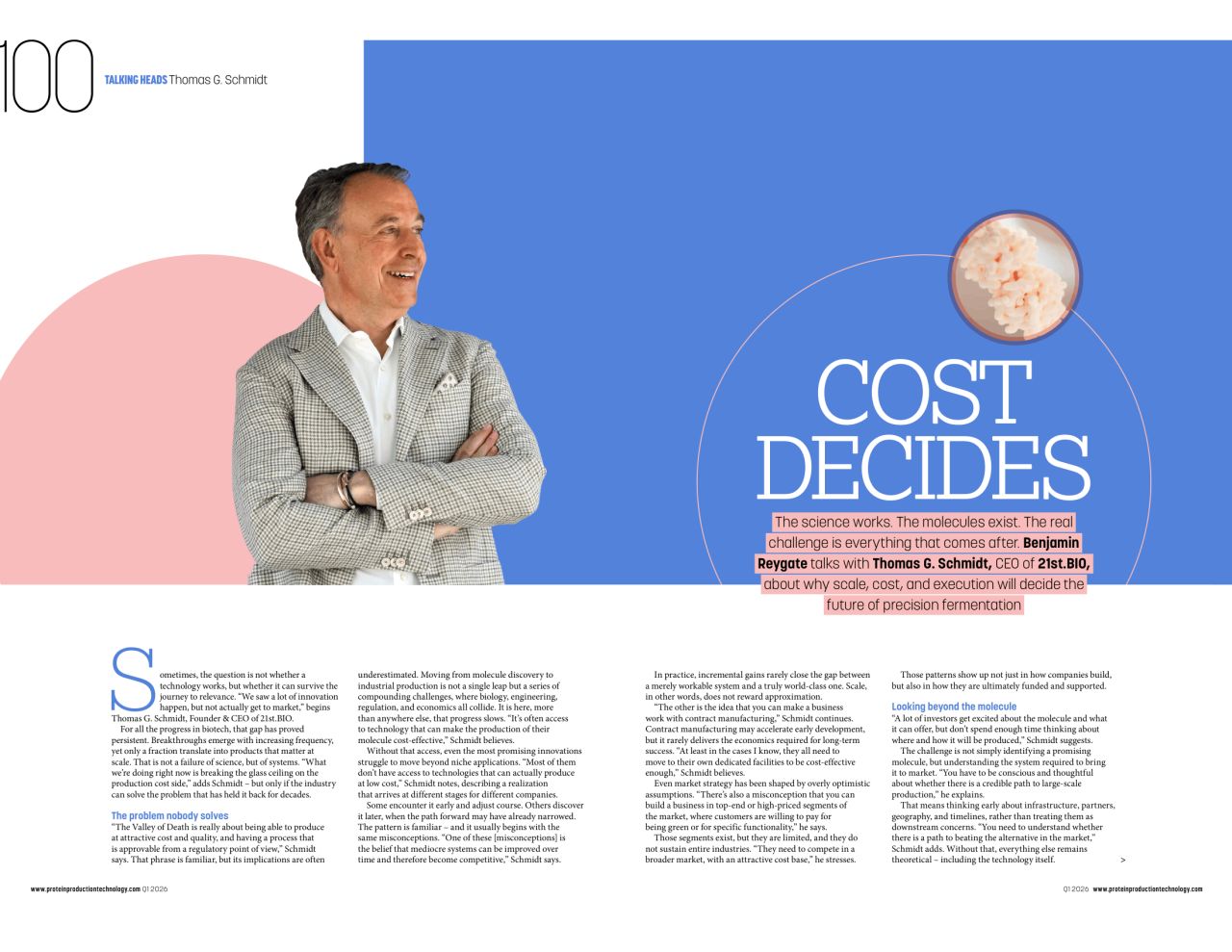
Tons of molecule innovation. So why do so few make it to market in the industrial biotech space? Our CEO Thomas G. Schmidt sat down with Nick Bradley 🌱🥩 from Protein Production Technology International to talk about what it actually takes to bring precision fermentation from lab to market, and why cost, scale, and execution will decide the future of the industry. Major highlights from this conversation: 1️⃣ Cost leadership is no longer out of reach for precision fermentation companies. With beta-lactoglobulin (BLG), 21st.BIO has already reached price parity with animal-derived WPI. The question is no longer feasibility: it's building out global capacity. 2️⃣ The ‘Valley of Death’ for biotech innovators is very real. It's rarely a science problem. It's most often about access to production technology that can deliver at attractive cost and quality, and that can survive regulatory scrutiny. 3️⃣ Investors in food-biotech often got excited about the molecule, but didn’t spend enough time thinking about where and how it will be produced. A credible path to large-scale production is non-negotiable. 4️⃣ Some assumptions don’t hold at scale and for the long term: contract manufacturing, premium-only positioning, or the idea that a mediocre system will improve over time. 5️⃣ We're only scratching the surface of the promise of precision fermentation: a core technology for the future. The long-term trajectory is clear. Industry observers expect the world to need about 50% more protein for nutrition by 2035. Conventional systems alone won’t get us there. We’re building the production platform that will. 📰 Access the article and full video interview here: https://lnkd.in/eQavAqbT
- LINKEDIN · IMAGESince 25 Feb 2026
Alpha-lactalbumin has always been considered a premium protein. This whey protein is one of the most biologically important, yet one of the most supply-constrained. But why do we need it? 🥛 It makes up around 25% of the protein in human milk, yet only about 3% in cow’s milk. That difference matters. 🍼 In infant nutrition, its amino acid profile enables lower total protein levels while maintaining high nutritional quality, bringing formulations closer to human milk. 💤 Beyond early life, alpha-lactalbumin is naturally rich in tryptophan, a precursor to serotonin and melatonin. This links it to emerging applications in sleep quality, stress resilience, cognitive performance and recovery. In other words, its potential goes far beyond being just another whey fraction. And yet, for decades, its use has been limited. Not because the opportunity wasn’t here. Simply because supply was insufficient. Extracting high-purity alpha-lactalbumin from milk is complex, expensive and constrained by its low natural abundance. Scarcity has shaped formulation strategies more than biology ever should have. That dynamic is now changing. Precision fermentation makes it possible to produce alpha-lactalbumin independently of milk supply. ▶️ The protein is identical ▶️ Purity is higher ▶️ Volumes are predictable ▶️ Cost structures become more stable When supply constraints ease, nutrition innovation accelerates. At 21st.BIO, we develop a licensable precision fermentation platform for industrial-scale production of alpha-lactalbumin – enabling ingredient producers and food brands to manufacture it within their own ecosystems. Alpha-lactalbumin is more than a scarce milk fraction. It is becoming a strategic nutrition ingredient across life stages. Explore the alpha-lactalbumin opportunity here: https://lnkd.in/dXA4Y4c6
- LINKEDIN · IMAGESince 23 Feb 2026
Stop designing around scarcity. What if product formulation was no longer dictated by milk supply? Alpha-lactalbumin has always been limited by how little of it exists in cow’s milk and how hard it is to purify. That scarcity has shaped availability, pricing, and product choices for decades. Good news: we’re unlocking alpha-lactalbumin. Decoupled from milk supply. Same protein. High purity. Predictable volumes. Lower protein cost. When supply becomes reliable, formulation decisions change. Explore the alpha-lactalbumin gap and license our precision fermentation technology.


6 of 27 adsSign up to see every 21st.BIO ad, filter by format and date, and get alerts on new ones.
See all 27 adsWatch the companies you care about.
Filter every ad by industry, country, format and network, and get alerts when a company you watch starts running new ads.