Not on air · 2 of 3 networks checked
Wynter
- wynter.com
- Market Research
- US
- 186 employees
Wynter’s ads on LinkedIn, Meta and Google, recorded by adsrunning. Browse the latest here for free. Sign up free to see all 398. Watch Wynter on any plan to get each new one in your feed.
Watchlist included in every plan
| Network | Status | Live ads | Nov 2025LinkedIn activity · 52 weeksNov 2026 | Checked | Next step |
|---|---|---|---|---|---|
| None recorded | 0 | Checked 3 Nov 2026 | See all 398 ads → | ||
| Meta | Not checked | — | |||
| Recently | 2 | Ads on the Google Ads Transparency Center | Checked 15 Oct 2026 | Collect them with the API → |
Wynter has no live LinkedIn ads. We recorded 2 Google ads on 15 Oct 2026.
Latest ads
- LINKEDIN · IMAGESince 25 Aug 2026
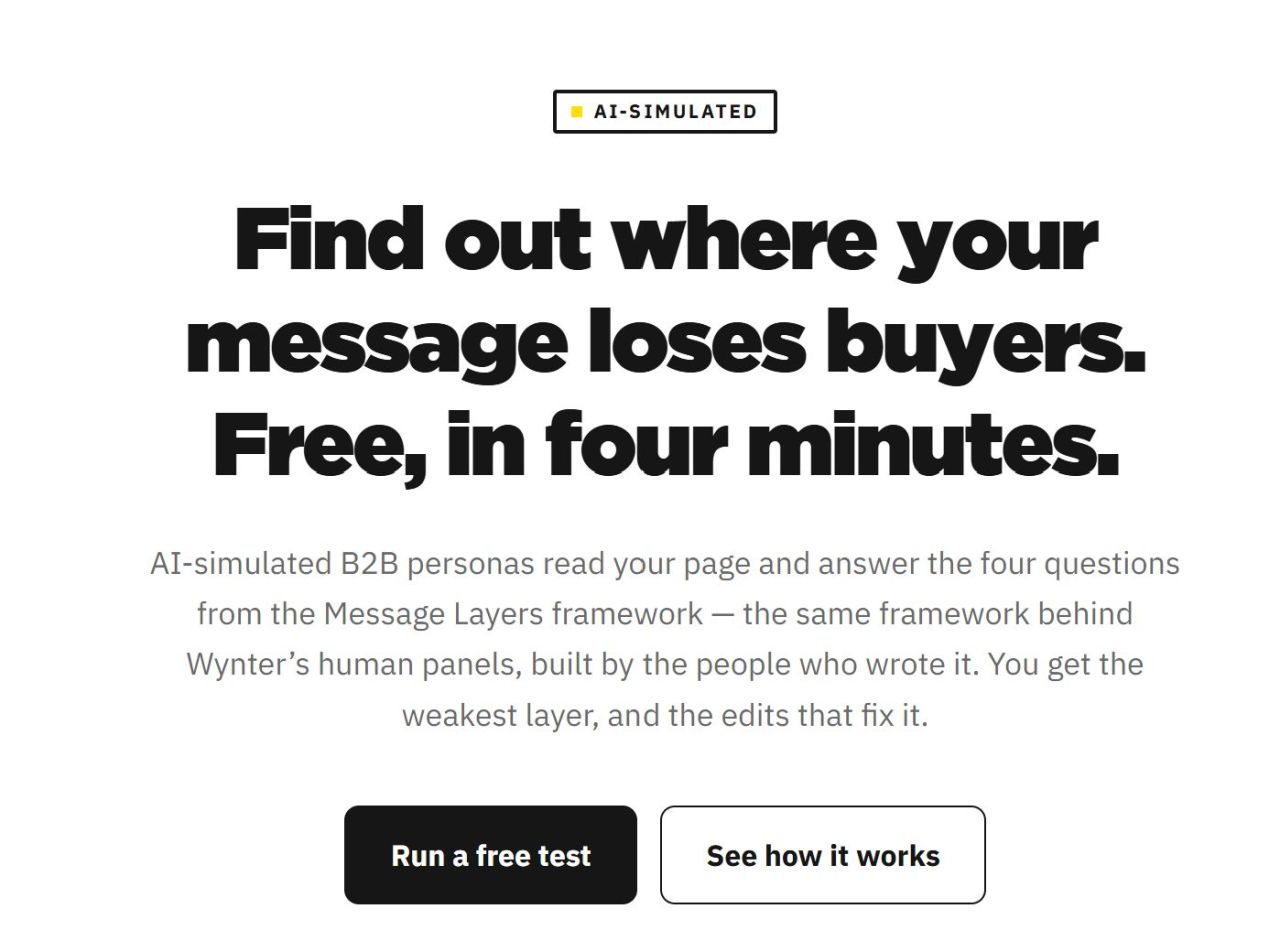
I've seen various AI-based Wynter alternatives pop up. It's things like testing your messaging with AI personas instead of actual humans (real ICPs). And they charge like $199/mo for it, etc. We built one that's available completely free. What makes this one better than the rest is not only its price, but its methodology. The AI personas are sampled across firmographics, Big Five traits, adoption stance and buyer modality - with dispersion measured. This way genuine consensus is distinguished from a collapsed simulation. Measured 0.13-0.23 prose overlap on real runs. The methodology is real, and it will find a vague headline or an undifferentiated value proposition reliably — for nothing. (What it cannot have is a real budget, a renewal coming up, or a boss asking about this quarter. For anything you’re actually betting on, test with humans who are in-market). Got a B2B site? Give it a try https://grader.wynter.com
- LINKEDIN · IMAGESince 27 Jul 2026
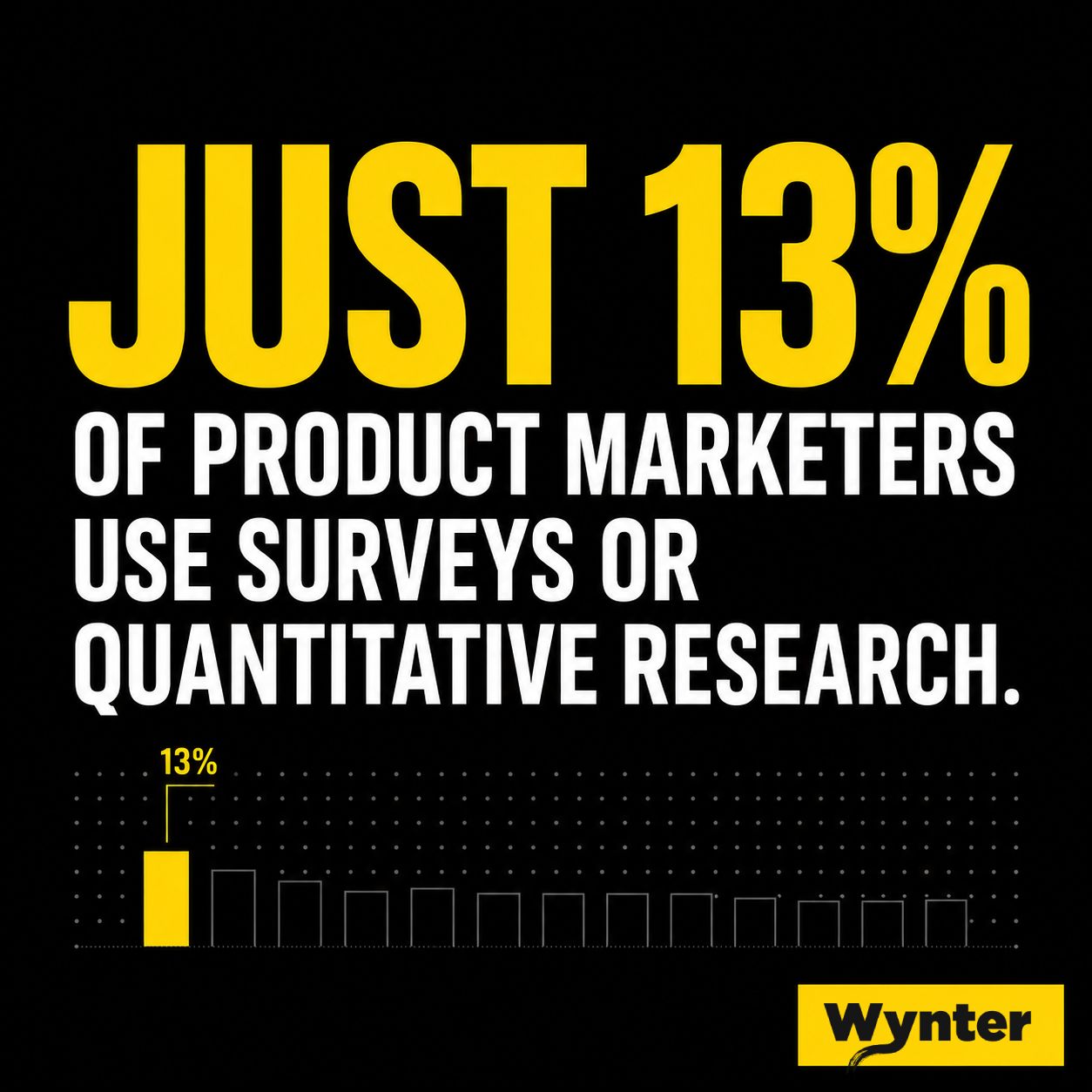
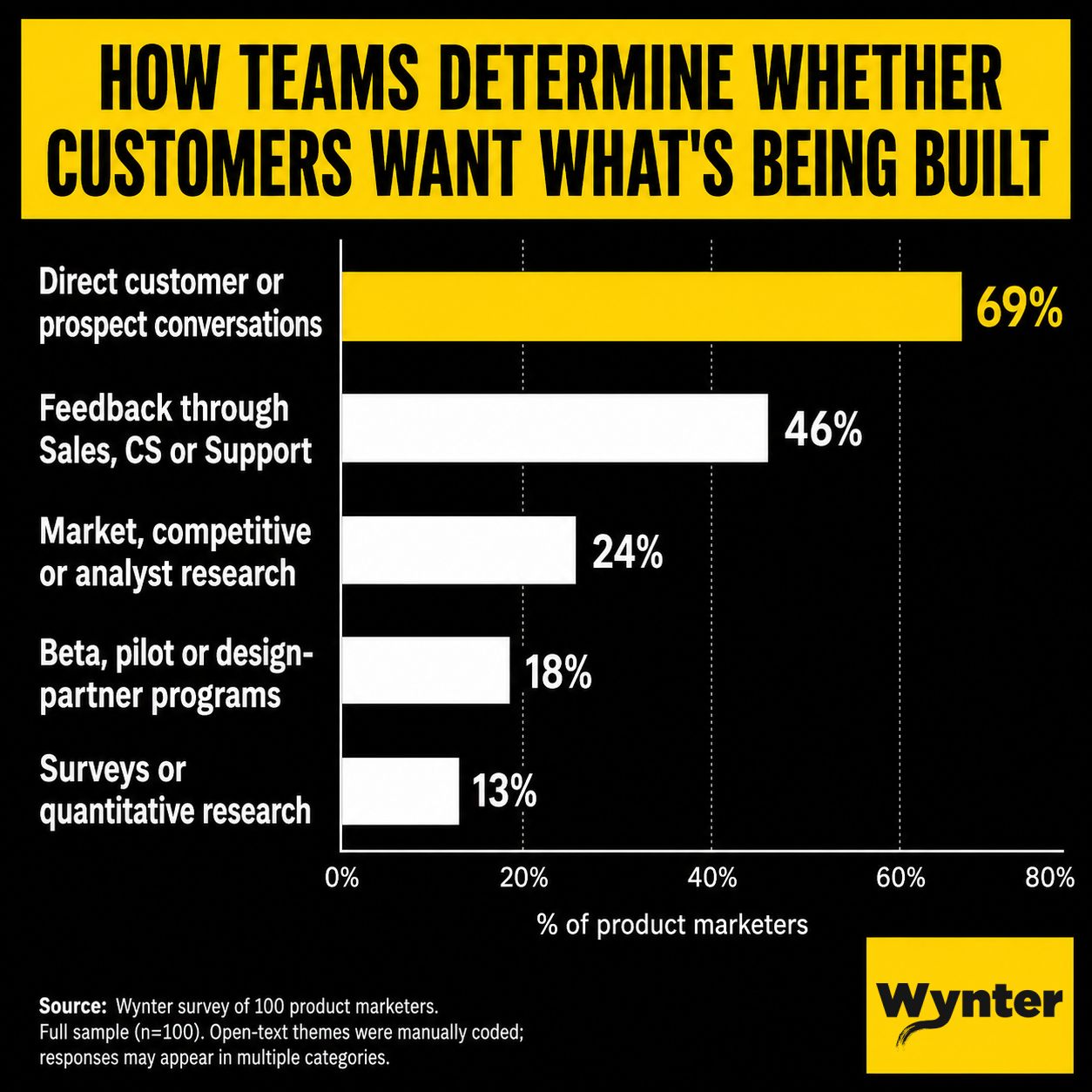
JUST 13% OF PRODUCT MARKETERS USE SURVEYS OR QUANTITATIVE RESEARCH. That is... suboptimal, to say the least. I just surveyed 100 product marketers in B2B SaaS. And when I asked what their teams currently do to understand whether customers actually want what's being built, here's what came back: → 69% mentioned direct customer or prospect conversations → 46% mentioned feedback through sales, CS or support → 24% mentioned market, competitive or analyst research → 18% mentioned beta / pilot / design partner programs → Just 13% mentioned surveys or quantitative research Now to be clear: I am NOT anti customer calls. Customer calls are great. Interviews are great. Advisory conversations are great. Sales call learnings are useful. Support tickets are useful. But those things are not the same as target market / target buyer / ICP evidence. Why? Because they are often: → a handful of existing customers → the loudest accounts → the most recent calls → secondhand via Sales or CS → heavily shaped by who you already sold to That can be useful signal if used well But if you're trying to answer questions like: a) Does this problem actually matter across our target market? b) Which ICP or segment cares most? c) How common is this pain? d) Do buyers want THIS solution, or just some solution? e) Will this actually change behavior, adoption or pipeline? ...then 5 calls and a few feature requests ain't enough. One participant said it perfectly: "Your existing customer base doesn't always reflect the buying appetite of the market you're going after." Yep! A lot of B2B SaaS companies have customer feedback. Far fewer have a repeatable way to get qual + quant evidence from their actual target buyers before product commits, before engineering builds, and before PMM gets handed the launch. Which means our friends in product marketing ends up trying to do serious go-to-market work on top of: → anecdotes → internal opinions → feature requests → one big customer yelling loudly → "well, we talked to a few users" That's not enough. More PMM teams should be doing fast qual + quant with the target market, because that's how you get beyond: "some customers said this" ...to: "we have evidence this matters, for this ICP, for these reasons, and here's what they actually want." That makes PMM better at: → prioritization → positioning → launch planning → proof creation → segment focus → pushing back on weak ideas → helping product make better build decisions Wynter helps Product and PMM teams get exactly that kind of evidence from their target ICP in 24-48 hours. Qual and quant. Before the company confuses customer noise with market demand. See what your buyers think right now: https://wynter.com Or DM me and I'll show you how.
- LINKEDIN · IMAGESince 22 Jul 2026
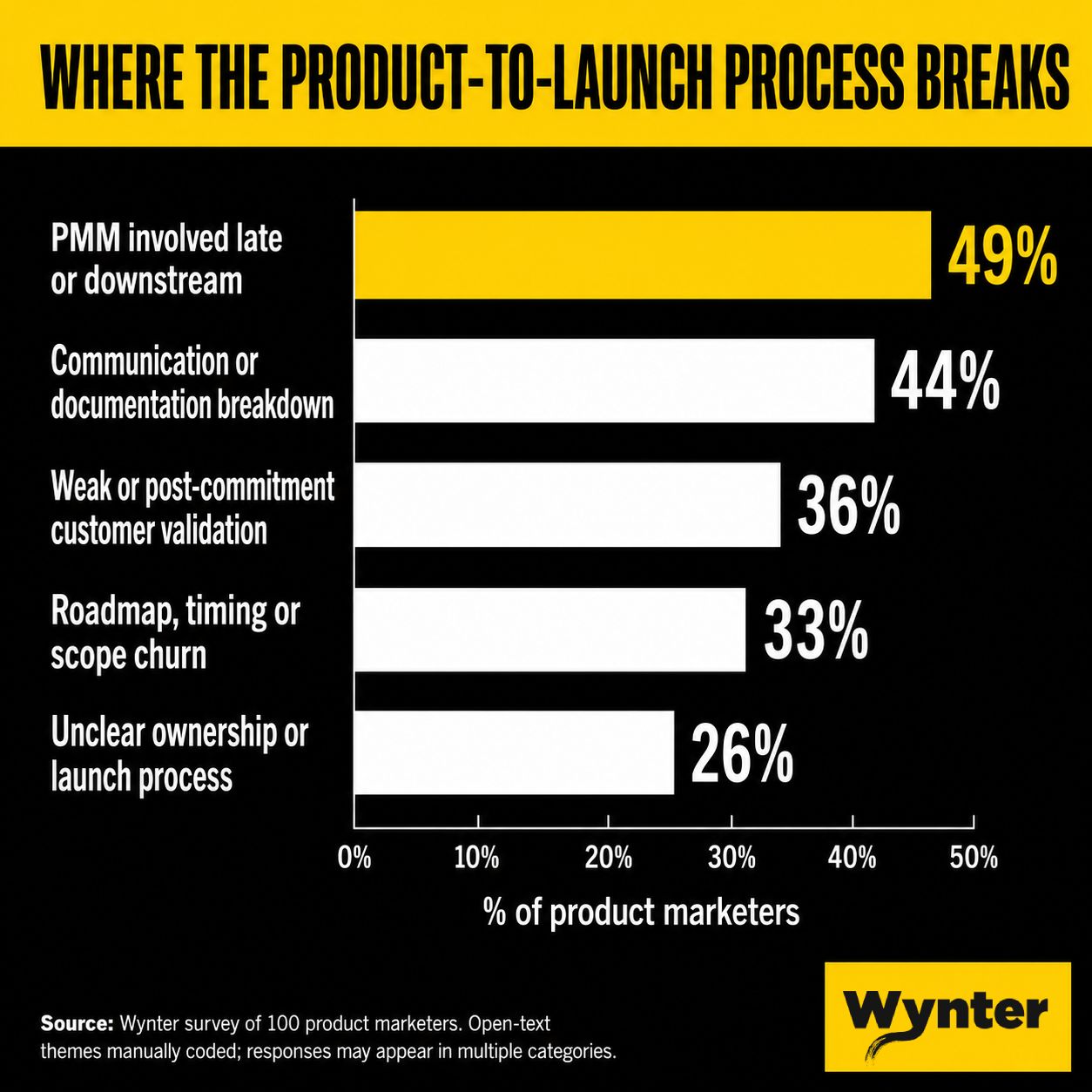
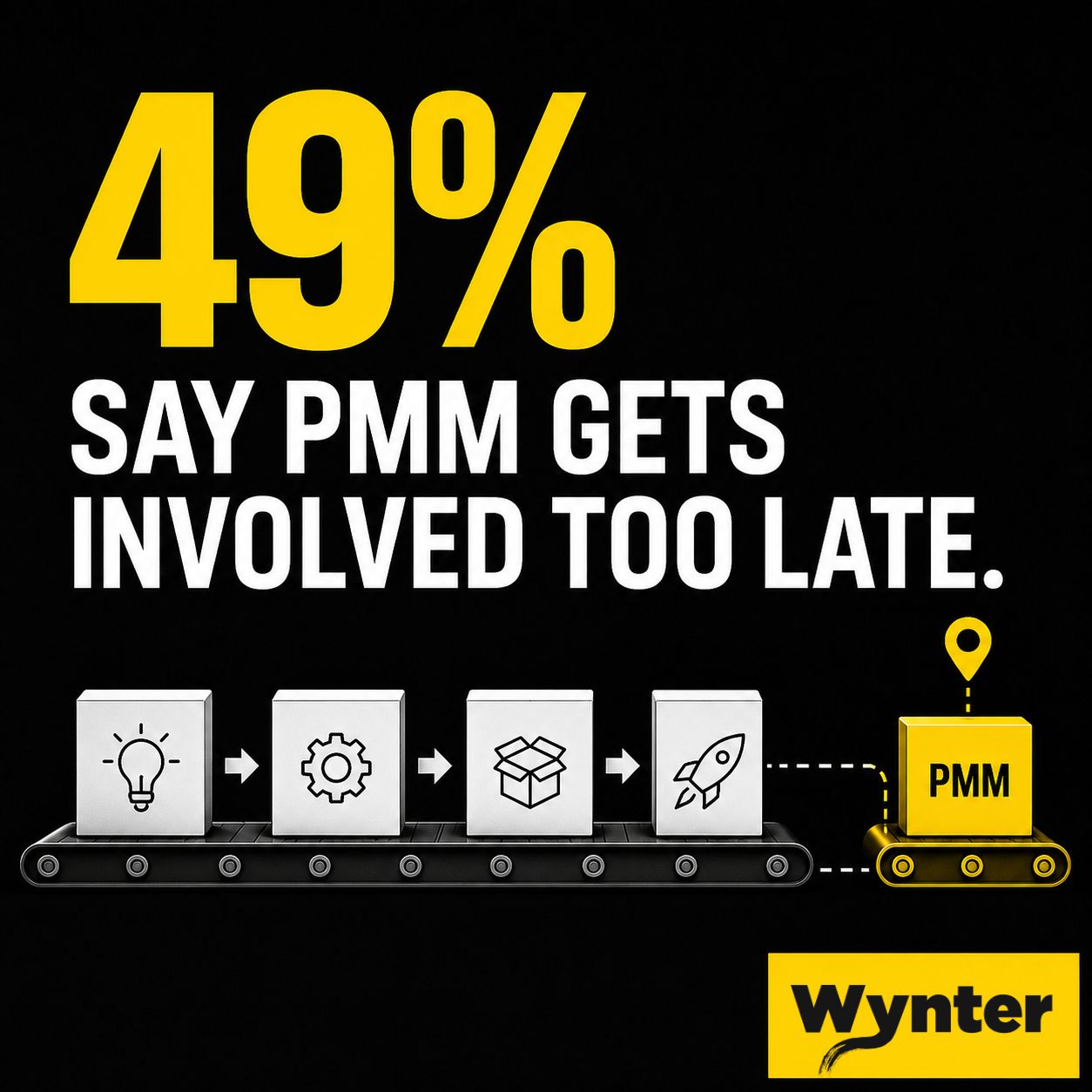
BY THE TIME PRODUCT MARKETING GETS INVOLVED, THE LAUNCH IS ALREADY IN TROUBLE. Then everyone acts surprised!! I asked 100 product marketers in B2B SaaS to walk me through what happens between product deciding to build something and the PMM team launching it. Then I coded the open-text answers. Where does the process break? → 49% said PMM gets involved late or downstream → 44% described communication or documentation breakdowns → 36% described weak or post-commitment customer validation → 33% dealt with roadmap, timing or scope churn → 26% pointed to unclear ownership or launch processes (themes overlap because one answer can contain multiple problems) Now... that list. These are not really "launch problems", are they? To me they read like product decision, validation and communication problems that finally become VISIBLE at launch. One participant described the handoff like this: "We are tossed a finished feature at the very end and told to market it and enable sales." What a sentence lmao By that point: The code = written The scope = mostly locked The launch date = announced The internal expectations = set The commercial assumptions = somehow still unclear (!!) So now our friendly neighborhood product marketer, or the entire PMM team, gets dragged in to figure out: a) Who is this actually for? b) What problem does it solve? c) Why should anyone care? d) What is the strongest use case? e) What proof do we have? f) How should Sales sell it? g) How do we drive adoption? Another product marketer told me: "I usually validate the new feature against customer requests, sales calls, and support tickets once it's already built." ONCE IT'S ALREADY BUILT!! what the I mean, if you're lucky that research might help improve the message and hey, it might even help rescue the launch. But it cannot meaningfully challenge the original build decision anymore. ALL the expensive decisions are already behind you. Product Marketing is brought in late, handed a moving target, given incomplete information and then measured on whether the market responds. In a lot of orgs, the PMM becomes the person standing closest to the explosion, so everyone assumes they caused it. Okay Erik, we get it. Launch problems begin months before the launch plan exists. So what's the fix then mr. expert?? One thing I can tell you from our data: the fix is NOT yet-another-launch-checklist. It is getting PMM, product and target market insights/evidence into the process before: → the solution is locked → development is underway → the launch date becomes political → everyone is too invested to hear "the market doesn't want this" Wynter gives PMM teams qual + quant evidence from their exact target market in 24-48 hours. So you can test the demand before development, test the concept before implementation locks, test the story before launch. See what your buyers think right now: https://wynter.com Or DM me and I'll hook you up with a demo.
- LINKEDIN · IMAGESince 22 Jul 2026
YOUR CURRENT CUSTOMERS ARE NOT THE SAME THING AS YOUR TARGET MARKET. But most B2B SaaS companies are still asking people already inside their orbit what the whole market wants. I asked 100 product marketers what their teams currently do to figure out whether people actually want what's being built. Then I coded the open-text answers: → 69% use direct customer or prospect conversations → 46% rely on feedback through Sales, CS or Support → 24% use market, competitive or analyst research → 18% use beta, pilot or design-partner programs → just 13% mentioned surveys or quantitative research (doesn't sum to 100 because I found some overlaps in the themes) To be clear: customer interviews are great. Please continue talking to customers!!! BUT Most of these methods pull evidence from people already inside the company's orbit: → current customers → active opportunities → strategic accounts → design partners → people submitting feature requests → people experiencing support problems That creates some pretty obvious bias as you might imagine Your customers already bought the product, your active prospects have already entered your funnel, sales hears from deals that are live, CS hears from accounts you managed to retain, support hears from the people with the loudest immediate problems. (these are all valuable signals) BUT! they do not automatically tell you what the TARGET MARKET wants. One product marketer said: "Your existing customer base doesn't always reflect the buying appetite of the market you're going after." Exactly. Another put it even more simply: "One-off customer calls are invaluable but not scalable." Customer research can tell you a person has a problem. Target market research, buyer insights, tell you: a) How widespread is the problem? b) Which ICP or segment feels it most? c) Do prospects care as much as customers? d) Does one loud request represent broad demand? e) Will enough buyers actually change behavior? f) Does the idea have commercial legs outside your current accounts? This distinction matters a LOT when you're: → entering a new segment → building for prospects instead of current users → expanding upmarket → launching a new category → testing something existing customers never asked for You can conduct ten amazing customer interviews and still reach the wrong conclusion about the rest of the market. That doesn't mean the interviews were bad! It means the sample was biased by who already knows you. Wynter gives Product and PMM teams qual + quant evidence from their exact target ICP in 24-48 hours. Not just the people already in your CRM, but the actual market you're trying to win. See what your buyers think right now: https://wynter.com Or DM me and I'll show you how.
- LINKEDIN · IMAGESince 22 Jul 2026
49% OF PRODUCT MARKETERS GET INVOLVED TOO LATE. (then of course everyone starts wondering why the launch is a total mess) I asked 100 product marketers in B2B SaaS to walk me through what happens between product deciding to build something and PMM launching it. → 49% said PMM gets involved late or downstream → 44% described communication or documentation breakdowns → 36% described weak or post-commitment customer validation → 33% dealt with roadmap, timing or scope churn → 26% pointed to unclear ownership or launch processes (themes overlap because one answer could contain multiple problems) Look at that list. These aren't really "launch problems" right? They're upstream product, validation and communication problems that finally become VISIBLE at launch. One participant said: "Product marketing is usually involved way too late and the team doesn't fully understand all the steps that it takes to properly launch a product." (lol raise your hand if that's ever happened) Another was slightly less diplomatic: "We are handed an unrealistic date, the team starts cutting features to make the date, and we have a shit product to launch. But since we skip the beta or alpha, there is no user data telling us our approach is wrong until revenue projections miss by a mile." Absolutely diabolical. Also... kinda predictable? Here's the sequence I'm seeing: First, product decides what to build, then engineering starts, then scope and dates move around, and now important context lives in someone's head or a random Slack thread, then PMM gets looped in, and before you know it launch is somehow imminent, and then WHAM now product marketing needs to figure out: a) Who is this for? b) What problem does it solve? c) Why should the market care? d) What is the strongest use case? e) What proof do we have? f) Is the product actually ready? g) How do we drive adoption? Sometimes with weeks to work. Sometimes DAYS. (you call this a HANDOFF?!? more like hostage situation) By the time PMM gets involved, the expensive decisions are often locked. "The market doesn't want this" = no longer an acceptable answer So PMM gets measured on the launch while being excluded from the decisions that made the launch difficult in the first place. At that point, their "influence" mostly means choosing the headlines, making the deck look sane and trying to build a compelling story around whatever landed in their lap. OK GREAT so how do we fix it? You bring actual target market and buyer evidence into the process while it can still change something: → test demand before development → test concepts before implementation locks → test positioning before launch Wynter gives Product and PMM teams qual + quant evidence from their exact ICP in 24-48 hours. BEFORE PMM is handed a finished feature and told to make people want it. See what your buyers think right now: https://wynter.com
- LINKEDIN · IMAGESince 21 Jul 2026
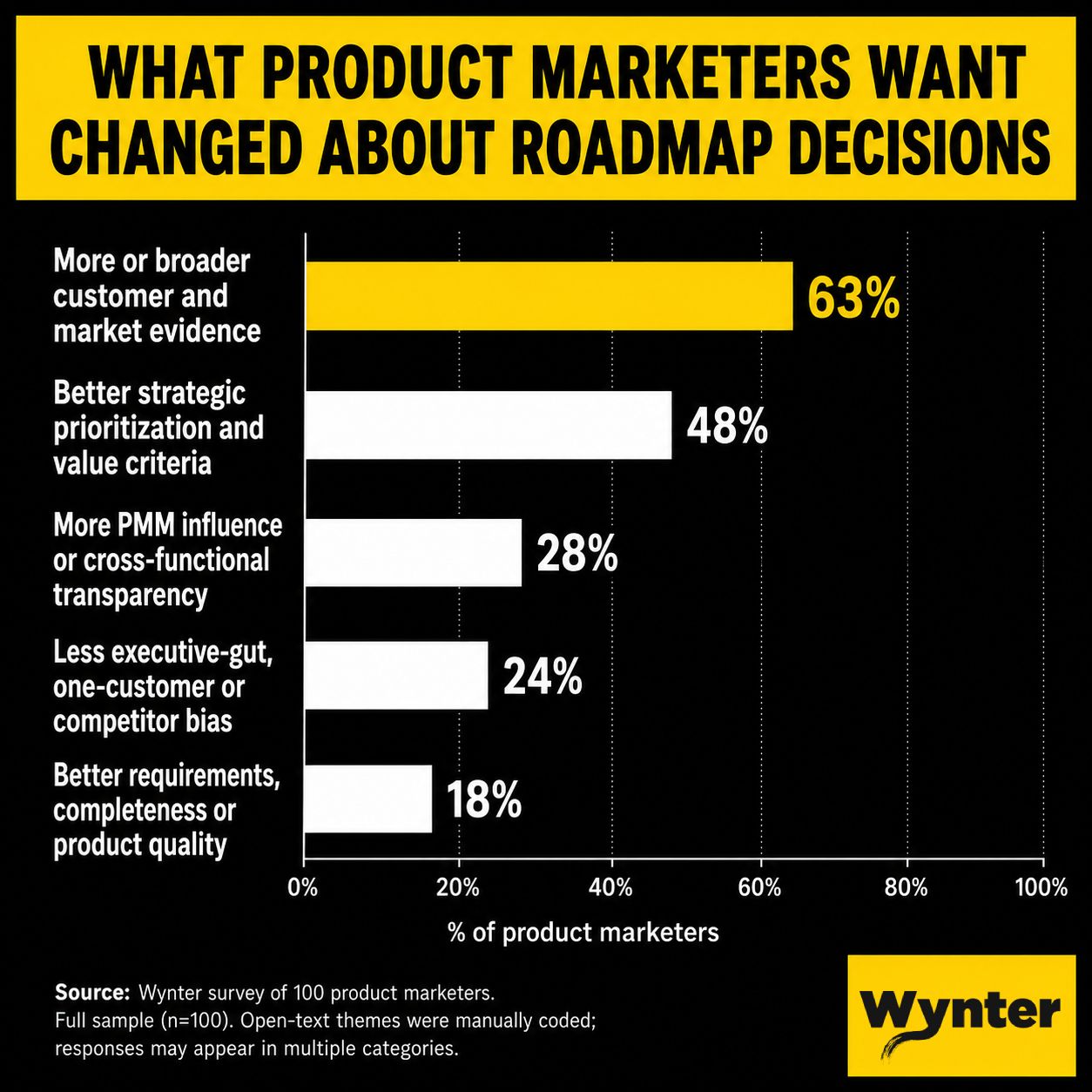
PRODUCT MARKETERS AREN'T ASKING TO RUN THE ROADMAP. THEY'RE ASKING THE ROADMAP TO STOP RUNNING ON VIBES. I asked 100 product marketers in B2B SaaS: What's the ONE thing you'd change about how your company decides what gets built? Then I coded their open-text answers. The top responses: → 63% wanted more or broader customer + market evidence → 48% wanted better strategic prioritization and value criteria → 28% wanted more PMM influence or cross-functional transparency → 24% wanted less executive "gut or competitor-driven decision making → 18% wanted better requirements, completeness or product quality (one caveat: these themes overlap because one answer could contain multiple problems so... yeah. they don't sum to 100) Anyway did you notice that "Give PMMs more influence" came third? The top two were: better evidence and better prioritization Probably no surprise that product marketers are not asking to become product dictators. They're asking their companies to put a remotely serious burden of proof on roadmap decisions BEFORE product/dev/engineering commits. One participant said: "We decide a lot based on twitter vibes which is really a shame. That's such a small audience and market and we miss a lot of opportunity to speak to and resonate with other audiences" lmao what even is this Imagine committing entire engineering quarters based on the people yelling loudest on Twitter. Absolute lunacy Another participant went a little further: "I would make PMM-validated market demand and a list of committed beta customers a mandatory prerequisite before engineering writes a single line of code." I'm not in either department but it sounds legit. Based on my data, right now, a lot of roadmap decisions are driven by some combination of: → one strategic customer asking loudly → a competitor shipping something → an executive having a cool idea → sales losing one deal → "AI" being somewhere in the pitch → somebody vibe coding up an MVP in an afternoon of course, none of those signals are useless, but none of them alone proves there is a real market. Imagine if every meaningful roadmap bet had to answer: a) Which ICP has this problem? b) How painful and frequent is it? c) What are they doing instead? d) DO THEY EVEN WANT THIS SOLUTION? e) What would block adoption? f) Will they pay, switch or change behavior? g) What evidence supports the investment? Where i'm from, this is a reasonable MINIMUM viable case for spending months building something. And it doesn't mean a six month research project. Wynter can get you this data in 24-48 hours. That's right. Qual + quant answers from your exact target market in HOURS. See what your buyers think right now: https://wynter.com Or DM me and I'll hook you up with a demo.
6 of 398 adsSign up to see every Wynter ad, filter by format and date, and get alerts on new ones.
See all 398 adsWatch the companies you care about.
Filter every ad by industry, country, format and network, and get alerts when a company you watch starts running new ads.