On air · 1 of 3 networks
Wise Pirates
- wisepirates.com
- Advertising Services
- PT
- 135 employees
Wise Pirates’s ads on LinkedIn, Meta and Google, recorded by adsrunning. Browse the latest here for free. Sign up free to see all 129. Watch Wise Pirates with Starter to get each new one in your feed.
Watchlist with Starter · $49/mo
| Network | Status | Live ads | Nov 2025LinkedIn activity · 52 weeksNov 2026 | Checked | Next step |
|---|---|---|---|---|---|
| Running | 1 | Checked 30 Oct 2026 | See all 129 ads → | ||
| Meta | None recorded | 0 | No active ads recorded on the Meta Ad Library | Checked 28 Oct 2026 | Collect them with the API → |
| Recently | 10 | Ads on the Google Ads Transparency Center | Checked 15 Oct 2026 | Collect them with the API → |
Wise Pirates has 1 live LinkedIn ad. Its Facebook page had no active ads on 28 Oct 2026, and we recorded 10 Google ads on 15 Oct 2026.
Latest ads
- LINKEDIN · IMAGESince 29 Oct 2026
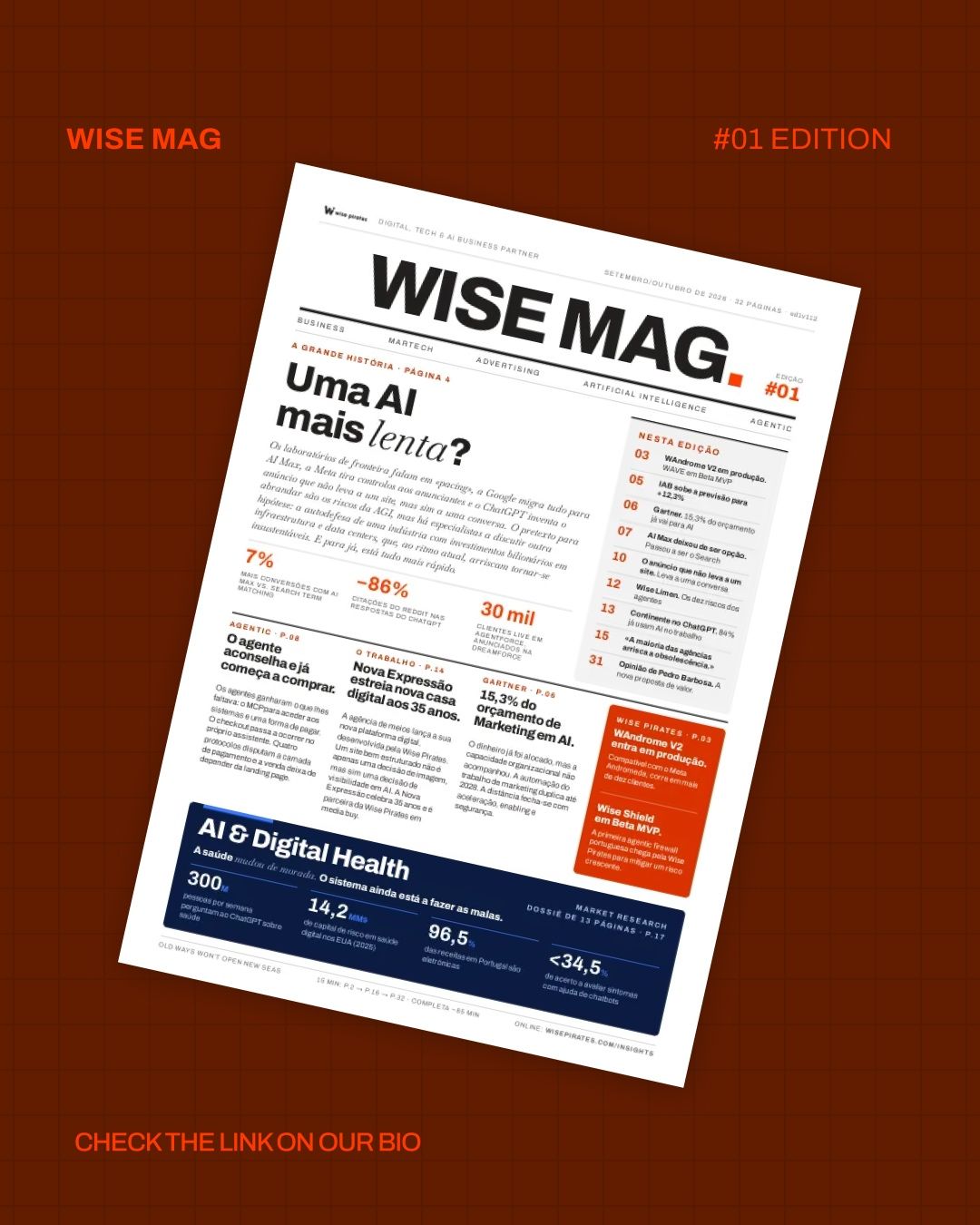
🏴☠️ The first edition of Wise Mag is here. Our new bi-monthly magazine brings together what we’re reading, testing and measuring across the digital landscape. Each edition also features original research exploring a specific industry. In this first edition: ▪️ Is AI slowing down? What research labs say versus what platforms are doing ▪️ AI Max, Meta’s move away from manual controls, and ads that open conversations in ChatGPT ▪️ AI agents are already shopping. What does this mean for online retailers? ▪️ AI & Digital Health special report: insights from our first industry study, Digital Health 2026 Three key findings from the report: → 39.6% of people in Portugal access their health records online, compared with 27.7% across the EU → Only 28.1% book appointments through a website or app, compared with 61.4% in Spain → Around 2.6 million people in Portugal already use AI to ask health-related questions 📖 Read online or download the PDF: https://lnkd.in/e9UJvaF6 #WiseMag #MarketingDigital #InteligênciaArtificial #SaúdeDigital #WisePirates
- LINKEDIN · IMAGESince 1 Sept 2026
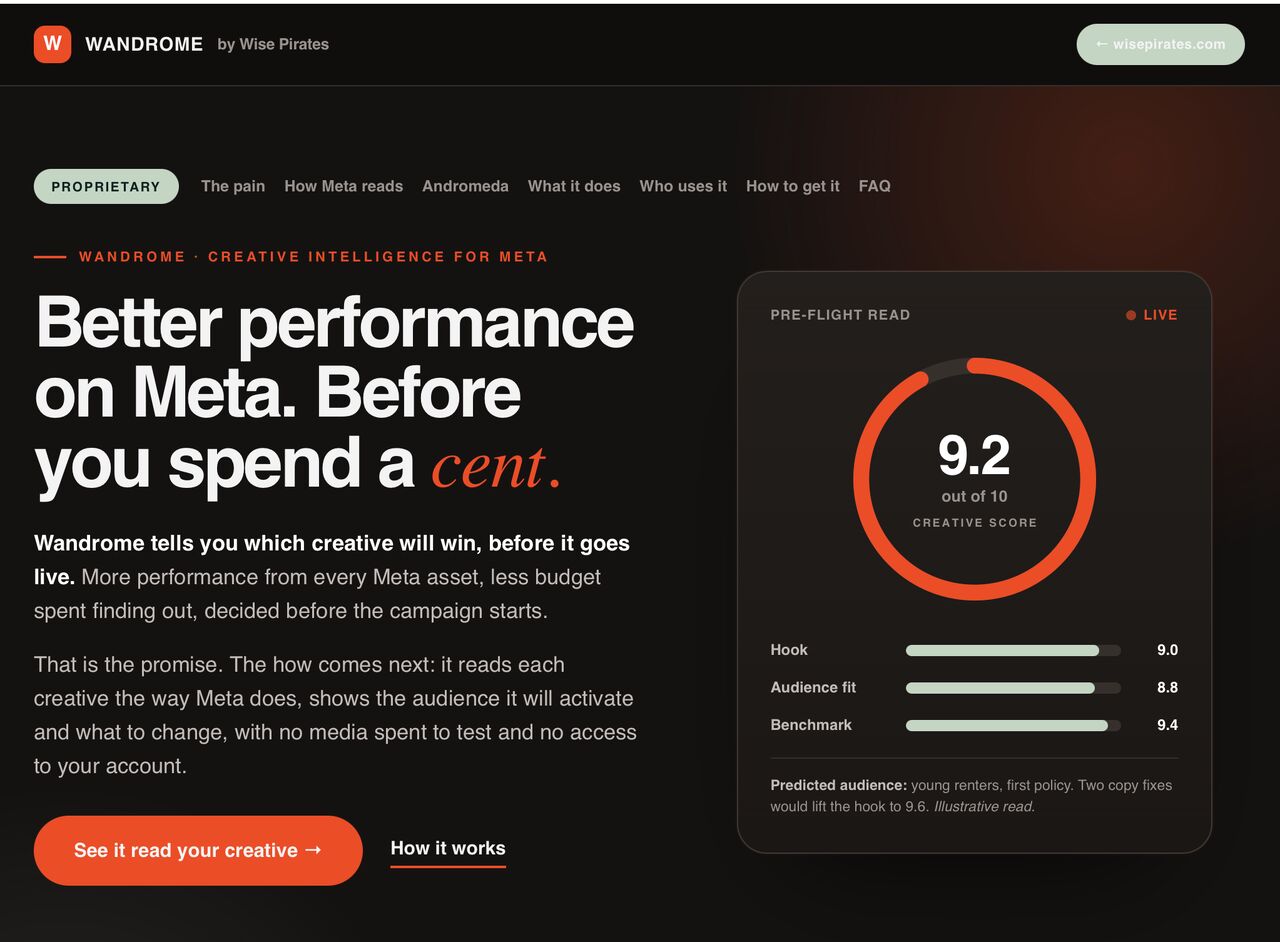
Wise Pirates is launching next week the new, updated version of WAndrome, including an AI Assistant that talks with creative assets, access to custom competitive intelligence data, and a fully integrated In Brief Coherence extension, 100% proprietary. The Meta Andromeda angles framework is now integrated in a much more extensive way, analyzing distinct creative angles to predict audience retrieval and score asset performance before going live. WAndrome is already working across over 17 markets for Wise Pirates clients and different ICOM Network partners.
- LINKEDIN · IMAGESince 31 Jul 2026
In Google AI Mode, 1 in 3 commercial queries now shows a paid ad. And in 88% of those same queries, the advertiser paying for that slot is not among the sources the AI cites. That is not a bug. That is the architecture we're seing for quite some time at Wise Pirates. Google has built AI Mode with two completely separate systems running in parallel. The ad auction fires within 60 milliseconds of a query. The AI response takes 6 or more seconds to generate. They do not talk to each other. Paid placement does not influence citation. Citation does not influence ad eligibility. You need to win both, and you win them in completely different ways. The data is unambiguous. SE Ranking studied 50,032 commercial keywords with US AI Mode data. Only 11.53% of domains that ran an ad for a keyword also appeared as a cited source for that same keyword. At the URL level, the overlap falls to 1.95%. The researchers then controlled for domain authority, backlinks, and organic visibility: buying the ad still gave no citation advantage. Zero. This matters because most search budgets are still being managed as if visibility is one game. It is not anymore. It is three simultaneous games: ranking, citation, and paid placement. Each has different rules, different signals, and different success metrics. The paid game: AI Mode ads concentrate heavily on high cost keywords. Ad presence is 24% for keywords under $2 CPC, and jumps to 53% for keywords above $10. The auction has followed the money. If you are running Performance Max or AI Max for Search, you are already eligible. But asset quality and landing page relevance determine whether you actually show. The citation game: this is an authority and content decision. Being cited inside an AI generated answer is editorial validation that no budget can buy directly. It is built through structured content, topical depth, and the kind of clarity that lets a model trust your source. Brands already cited organically see 35% more organic clicks and 91% more paid clicks. Citation creates a halo that paid cannot replicate. The practical implication: your search team needs to manage two separate budgets with two separate success metrics and stop expecting one to move the other. At Wise Pirates, this is not a theoretical shift. We are already separating paid search measurement from AI citation tracking for clients, building the baseline data now, before AI Mode reporting in Google Ads becomes granular enough to make the split obvious. By then, the brands that started measuring both will have a six month head start. #AIMode #SEO #GEO #GoogleAds #DigitalMarketing
- LINKEDIN · IMAGESince 31 Jul 2026
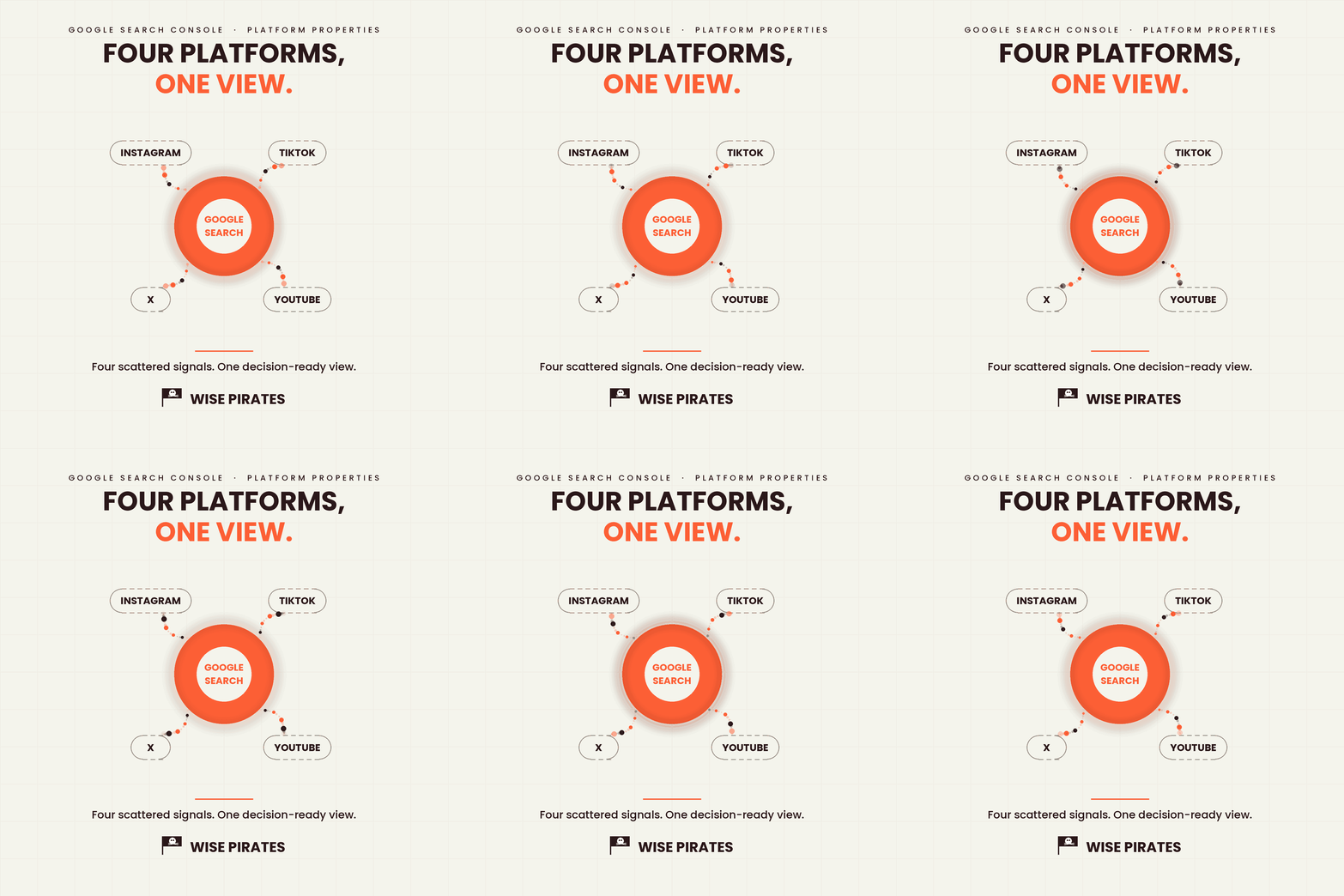
Google just removed a wall that stood for twenty years. From this week, Search Console reports on how your Instagram, TikTok, X and YouTube content performs on Google Search. Clicks, impressions, and the exact queries leading people to your posts. Data that used to sit in four separate rooms is now readable in one. Most teams will file this as just an SEO update. We read it differently. The boundary between social and search is dissolving, and measurement is finally catching up to that reality. What Google calls "platform properties" is really an admission that discovery no longer respects channel borders. Your best-performing TikTok is a search asset. Your X thread is a query magnet. And until this week, almost nobody could prove it. At Wise Pirates, this is ground we have been standing on for years. We don't wait for platforms to connect the dots for us. We build the integrations, unify the signals across channels, and enrich the data before the native reporting arrives, because that gap is exactly where client results are won or lost. A few things worth sitting with: Social content now competes for search visibility, so it should be planned, measured and optimised like any other search asset, not treated as a separate world. Fragmented reporting was never really a data problem. It was an integration problem. Google just made it visible to everyone. As one of Google's most full-stack partners, we've sat at the frontline of every major integration and turned it into real value for our clients, The edge will not go to whoever collects the most dashboards. It goes to whoever turns scattered signals into one decision-ready picture, faster than the competition. Every platform will eventually hand you the report. Only integration gives you the head start, and the head start is what raises the probability of results. 🏴☠️ #SEO #SocialSearch #DataIntegration #PerformanceMarketing #DigitalIntelligence
- LINKEDIN · IMAGESince 31 Jul 2026
For every dollar spent on programmatic advertising in Q1 2026, only 43 cents reached a quality impression. That is not a rounding error. That is the structural condition of the channel that carries 90% of all global digital display budgets. The ANA benchmark puts a precise number on what many media teams have suspected for years: the open programmatic ecosystem is fundamentally inefficient. Not occasionally. Persistently. The TrueAdSpend Index dropped again last quarter. Waste grew 34% in two years. And the composition of that waste has shifted from obvious fraud toward something harder to fix: indirect supply paths, inventory that cannot be viewed, and placements that are technically valid but practically worthless. (The Drum) This is the context in which DV360 needs to be operated. Not as a machine you configure once and trust. As a platform that rewards active, intelligent management. The difference between the top and bottom performers in the ANA benchmark is not budget. It is discipline. The higher cohort converted 54% of spend into quality impressions. The lower cohort converted 32%. Same channel, same auction dynamics, very different outcomes. The gap is supply curation, placement screening, and the willingness to constrain reach in exchange for quality. The Drum DV360 gives you the tools to close that gap. But most teams are not using them at the level the platform allows. Google is overhauling DV360 brand safety controls this year. Legacy digital content labels and category exclusions are being deprecated in August 2026. Advertisers who have not migrated to content themes and inventory Modes will lose their existing protections without automatic migration. This is not an incremental update. It is a structural change to how placement screening works. What this means in practice: placement screening can no longer function as a single configuration. It needs to run as a continuous, AI powered audit loop. Reading placement reports, flagging inventory drift, refreshing exclusion logic, and tightening supply paths based on actual performance data, not default settings. AI makes this possible at a scale manual review never could. Filtering that screens inventory requests before a bid is placed. Analysis that reconciles actual delivery against quality signals. Reporting that surfaces the supply path, not just the headline CPM. At Wise Pirates, operating DV360 with this level of intelligence is not optional. It is how we protect client budgets from a channel that will waste over half of a passive buyer's investment. The platform rewards those who ask it hard questions. The brands that will get more from programmatic in 2026 are not the ones spending more. They are the ones screening better. #ProgrammaticAdvertising #DV360 #PerformanceMarketing #BrandSafety #DigitalMedia
- LINKEDIN · IMAGESince 31 Jul 2026
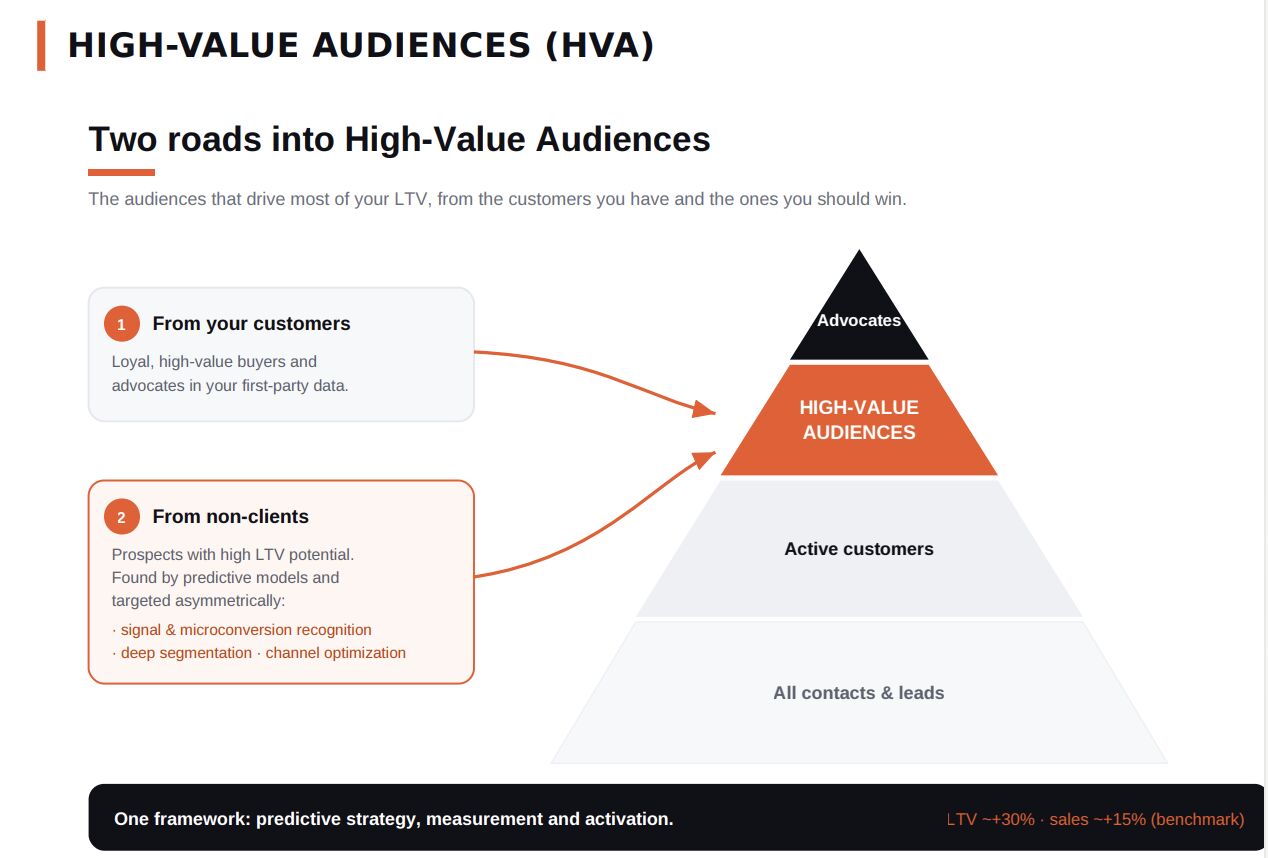
For almost 9 years, one question has shaped how we work at Wise Pirates: which audiences actually drive a client's lifetime value, and how do we find more of them? Most brands still spend against everyone. The math rarely holds. A small share of customers generates the majority of long-term value, yet the budget gets spread evenly across a funnel that treats a one-time buyer and a future advocate as the same person. So we built a methodology around High-Value Audiences. It works on two fronts: 🏴☠️ From your own customers. The loyal, high-value buyers and advocates already sitting inside your first-party data. Most companies underuse this. It's the most predictable growth you own. 🏴☠️ From non-clients. Prospects with high LTV potential, found through predictive modelling and targeted asymmetrically: signal and microconversion recognition, deep segmentation, channel optimization. One framework, three moves: predictive strategy, measurement, activation. On our benchmarks it moves incremental LTV by around 30% and sales by around 15%. What changed recently is the layer underneath it. We've folded agentic AI into the methodology, so the modelling, the segmentation and the activation loop run faster and adapt in near real time, instead of waiting on the next monthly review. The strategy didn't change. The speed and precision did. Nine years in, the goal is exactly what it was on day one: contribute to the optimization of our clients' results. Every framework we build is measured against that, and nothing else. The technology keeps moving. The obsession with client results doesn't. #HighValueAudiences #LTV #PredictiveMarketing #AgenticAI #PerformanceMarketing


6 of 129 adsSign up to see every Wise Pirates ad, filter by format and date, and get alerts on new ones.
See all 129 adsWatch the companies you care about.
Filter every ad by industry, country, format and network, and get alerts when a company you watch starts running new ads.