On air · 1 of 3 networks
Weissr
- weissr.com
- SE
- 32 employees
Weissr’s ads on LinkedIn, Meta and Google, recorded by adsrunning. Browse the latest here for free. Sign up free to see all 388. Watch Weissr with Starter to get each new one in your feed.
Watchlist with Starter · $49/mo
| Network | Status | Live ads | Nov 2025LinkedIn activity · 52 weeksOct 2026 | Checked | Next step |
|---|---|---|---|---|---|
| Running | 12 | Checked 30 Oct 2026 | See all 388 ads → | ||
| Meta | Not checked | — | |||
| Recently | 8 | Ads on the Google Ads Transparency Center | Checked 15 Oct 2026 | Collect them with the API → |
Weissr has 12 live LinkedIn ads. We recorded 8 Google ads on 15 Oct 2026.
Latest ads
- LINKEDIN · IMAGESince 28 Oct 2026
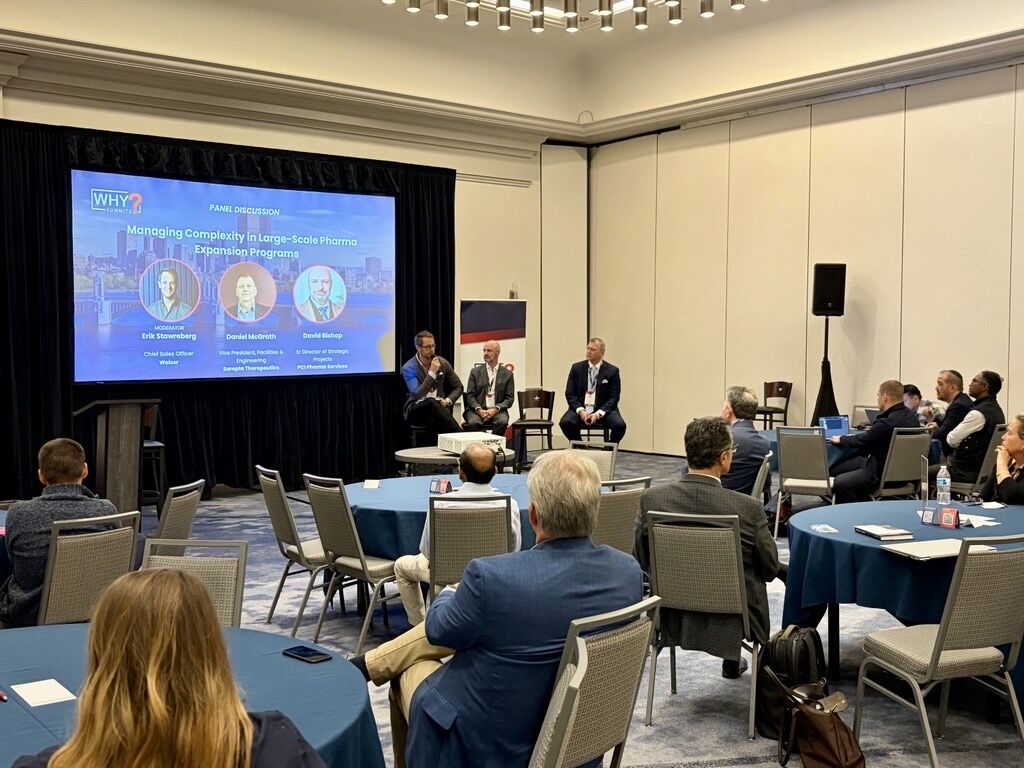
"Everything in the pharma sector is driven by regulations." That’s how a former Capex finance lead summed up pharma when we talked at the Why summit Capex Conference in Boston in middle of October. That raises questions most Capex processes struggle to answer: → How do you compare a compliance project with a capacity project that has a strong NPV? → When regulatory work jumps the queue, which growth investments move back, and who sees the knock-on effect? → Does the business case show the cost of waiting, as well as the price of the project? AI was the other topic everyone wanted to discuss. The most practical uses we heard start with data companies already have: turning demand forecasts into capacity needs, and learning from past projects, so a step that always took twice as long is planned that way next time. The Capex questions here are just as concrete: → Is our project history clean enough for AI to learn from? → Who checks an AI-supported recommendation before capital is committed? Regulation decides what must be done. AI can help decide what comes next. Both need one connected view of the Capex portfolio. Curious how ready your process is for both? Our Capex Maturity Assessment takes about three minutes: https://lnkd.in/dXg5MSHf
- LINKEDIN · IMAGESince 27 Oct 2026
Most companies rate their capex maturity at level 4. Most operate at level 2. Four questions show which one you are.
- LINKEDIN · IMAGESince 24 Oct 2026
During the last 6 months I’ve spoken to more than 30 teams managing billions in Capex. Thats what I saw: every Capex project looks profitable, so profitability stops telling you which ones to actually fund. You can ask a CFO if an investment is good and they can show you the business case. You can ask if the full plan is the best use of the capital the company has and the answer gets much harder. Three habits make it hard: → Each project is judged on its own, against its own baseline → The group plan is the sum of what the sites asked for → Closing or consolidating a site rarely appears as an option, so nobody prices it Leadership ends up approving a list of good projects that nobody has compared as a whole!!! You only get an answer when you compare complete and company-wide alternatives on total cash flow, using one model and the same assumptions. That is why we built Weissr. If you want to see how this would work for your asset base, book a personalized 30 min demo: https://lnkd.in/dRFWmbSv
- LINKEDIN · IMAGESince 24 Oct 2026
Just left a call with the finance team at a €850M specialty chemicals group. 14 plants across 5 countries. €120M annual capex. Every site tracking projects in its own Excel template. I asked one question: "Can you show me your full portfolio right now?" They opened four spreadsheets and said: "This is roughly it" Roughly. When you're allocating €120M across 14 sites, "roughly" is a strategic risk. One site underspends and doesn't flag it. Another is 20% over budget and nobody finds out until Q3 close. And when the board asks how much of this year's capex advanced their decarbonisation targets - that answer takes two more weeks to compile. It's a real visibility problem. P.S. If you’re a Capex or Finance leader in chemicals managing multi-site investments and “roughly” is still part of your portfolio answer, how mature is your Capex process really? Take the 3-minute Capex Maturity Assessment. Answer four questions and get your report instantly: https://lnkd.in/dXg5MSHf
- LINKEDIN · IMAGESince 24 Oct 2026
At a company I visited, the entire €500M capex portfolio lives in one person's personal spreadsheets. Everyone knows this. In meetings, it has become a running joke that the capex process has a first name. The joke has been running for years, and the portfolio has kept growing the whole time. Here’s the thing nobody really says out loud. Your colleague from the Finance team could hand in their notice tomorrow, and suddenly everyone would be lost. That is because of all the information that lives in one person’s head: → Why the numbers are what they are →Which assumptions matter → What was agreed in that meeting three months ago. All the little bits of context that somehow never make it into the spreadsheet. A company runs perfectly well like this for years. Then one person leaves, and suddenly you realize half the process left with them. And the answer isn’t to hire another colleague for your Finance team. It’s to have a process that actually holds the knowledge, so people can focus on using their judgement rather than remembering how everything works. If your capex process depends a little too much on one person’s memory, happy to show you what we’re doing about it: https://weissr.com
- LINKEDIN · IMAGESince 24 Oct 2026
This utility company had about €900M of good projects competing for €600M of capital. Every one of those projects deserved funding, and that was exactly the problem. I keep seeing the same pattern across energy and utilities. It is rarely a shortage of good ideas. The real constraint is the inability to compare them properly. One business case lives in a slide deck, the next in a spreadsheet built by someone who has since left, and a third in a model that only one analyst really understands. So when the money finally has to be allocated, it doesn't always go to the strongest return. More often, it goes to the project with the most confident sponsor in the room. The loudest case wins, not necessarily the best one. The hard part is that nobody quite sees it happen because there is no single place where every project can be compared side by side, on the same terms, at the same moment. And you cannot prioritize what you cannot compare. A question worth asking: are you funding your best projects, or simply your loudest ones? That is why we built Weissr: to give leadership a single live view where every project sits side by side, on the same terms, so capital follows the strongest case, not the loudest voice. Book a 30-minute walkthrough 👉 https://weissr.com/contact



6 of 388 adsSign up to see every Weissr ad, filter by format and date, and get alerts on new ones.
See all 388 adsWatch the companies you care about.
Filter every ad by industry, country, format and network, and get alerts when a company you watch starts running new ads.