Not on air · 2 of 3 networks checked
up to data
- uptodata.com
- Software Development
- DE
- 35 employees
up to data’s ads on LinkedIn, Meta and Google, recorded by adsrunning. Browse the latest here for free. Sign up free to see all 20. Watch up to data on any plan to get each new one in your feed.
Watchlist included in every plan
| Network | Status | Live ads | Nov 2025LinkedIn activity · 52 weeksNov 2026 | Checked | Next step |
|---|---|---|---|---|---|
| None recorded | 0 | Checked 3 Nov 2026 | See all 20 ads → | ||
| Meta | Not checked | — | |||
| Recently | 25 | Ads on the Google Ads Transparency Center | Checked 13 Oct 2026 | Collect them with the API → |
up to data has no live LinkedIn ads. We recorded 25 Google ads on 13 Oct 2026.
Latest ads
- LINKEDIN · VIDEOSince 8 Oct 2026
From sample to GxP report: how many copy-and-pastes? In many bioanalytical labs, values travel from instrument software into Excel, then from Excel into Word. A second person checks every copied number by hand — and compiling one final report can take weeks. The risk isn't just losing time. Every manual transfer creates another opportunity for transcription errors, version confusion, and incomplete traceability. It does not have to be that way — even without a full LIMS. Our article shows where manual steps put ICH M10 compliance at risk and what an end-to-end, submission-ready data flow looks like: from sample planning and analytical runs to automated report generation. Read our article: https://bit.ly/3THSS0e #Bioanalysis #GxP #ICHM10 #CRO
- LINKEDIN · VIDEOSince 8 Oct 2026
Can you prove where every sample has been? Inspectors ask exactly that. At one CRO, they identified near-identical concentrations from different subjects and incorrect room temperatures logged during sample processing. At another, deficiencies in the computerized systems used to manage study data led to regulatory action: EMA recommended suspending affected medicines, while FDA declared the studies unacceptable. The issue is rarely a single missing record. It is an untraceable sample journey. Our article explains what ICH M10 and GxP data-integrity expectations mean across the sample lifecycle—from receipt and storage to reintegration, reanalysis, and reviewer sign-off—and what changes when every step is documented. Read what inspectors check first: https://bit.ly/3VwwwPW #Bioanalysis #DataIntegrity #ICHM10 #GxP
- LINKEDIN · VIDEOSince 8 Oct 2026
Can you prove where every sample has been? Inspectors ask exactly that. At one CRO, they identified near-identical concentrations from different subjects and incorrect room temperatures logged during sample processing. At another, deficiencies in the computerized systems used to manage study data led to regulatory action: EMA recommended suspending affected medicines, while FDA declared the studies unacceptable. The issue is rarely a single missing record. It is an untraceable sample journey. Our article explains what ICH M10 and GxP data-integrity expectations mean across the sample lifecycle—from receipt and storage to reintegration, reanalysis, and reviewer sign-off—and what changes when every step is documented. Read what inspectors check first: https://bit.ly/47FstmY #Bioanalysis #DataIntegrity #ICHM10 #GxP
- LINKEDIN · VIDEOSince 8 Oct 2026
From sample to GxP report: how many copy-and-pastes? In many bioanalytical labs, values travel from instrument software into Excel, then from Excel into Word. A second person checks every copied number by hand — and compiling one final report can take weeks. The risk isn't just losing time. Every manual transfer creates another opportunity for transcription errors, version confusion, and incomplete traceability. It does not have to be that way — even without a full LIMS. Our article shows where manual steps put ICH M10 compliance at risk and what an end-to-end, submission-ready data flow looks like: from sample planning and analytical runs to automated report generation. Read our article: https://bit.ly/470RuJb #Bioanalysis #GxP #ICHM10 #CRO
- LINKEDIN · CAROUSELSince 18 Jun 2026
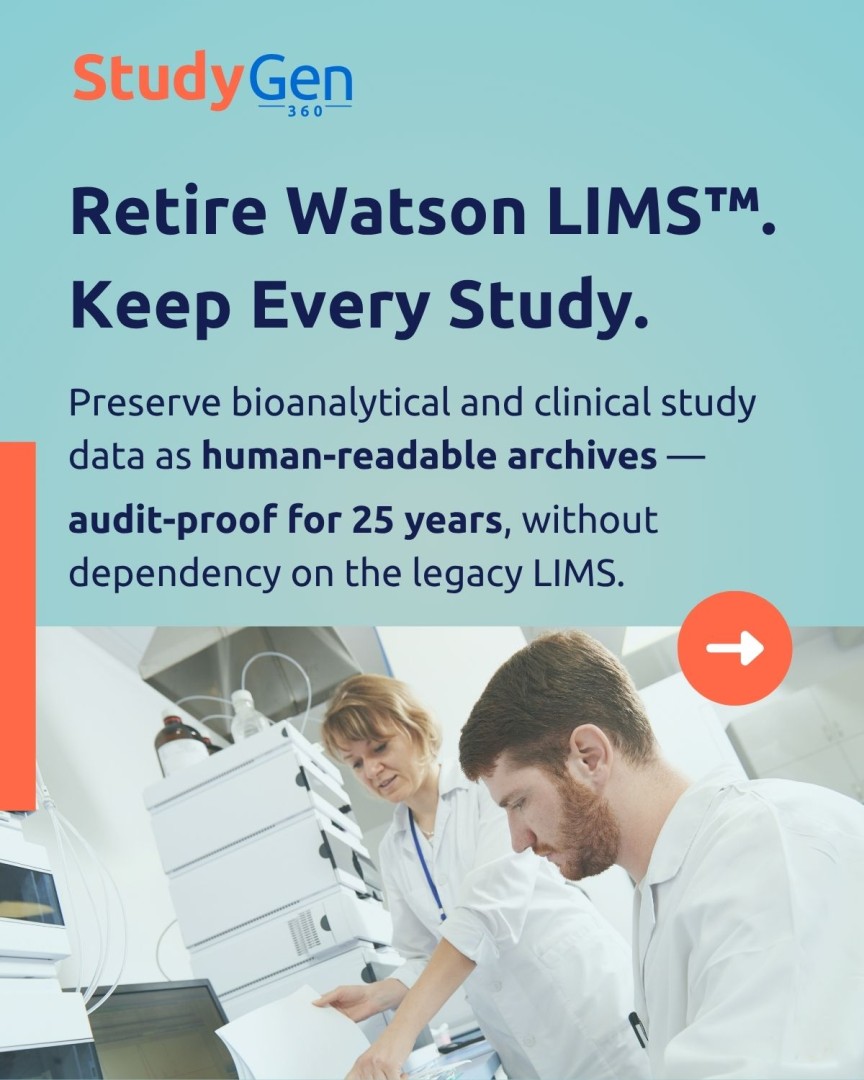
Bioanalytical study data has to outlive the software that created it. 15 years from now, can someone still open your bioanalytical study data and read it without the original Watson LIMS™?
- LINKEDIN · VIDEOSince 20 May 2026
Long-term study archiving is a decision every bioanalytical lab has to address. The regulations are clear: records must be accurate, complete, human-readable, and verifiable across the full retention period. They don't say records must remain in the system that generated them. A format-independent archive — PDF/A, CSV, or XML, secured with SHA-256 verification — meets that obligation, independent of Watson™, Oracle™, or any future infrastructure decision. Read our regulatory perspective.
6 of 20 adsSign up to see every up to data ad, filter by format and date, and get alerts on new ones.
See all 20 adsWatch the companies you care about.
Filter every ad by industry, country, format and network, and get alerts when a company you watch starts running new ads.