On air · 2 of 3 networks
Tealium
- tealium.com
- US
- 545 employees
Tealium’s ads on LinkedIn, Meta and Google, recorded by adsrunning. Browse the latest here for free. Sign up free to see all 445. Watch Tealium with Starter to get each new one in your feed.
Watchlist with Starter · $49/mo
| Network | Status | Live ads | Nov 2025LinkedIn activity · 52 weeksOct 2026 | Checked | Next step |
|---|---|---|---|---|---|
| Running | 299 | Checked 29 Oct 2026 | See all 445 ads → | ||
| Meta | Running | 14 | Active ads on the Meta Ad Library, all countries | Checked 27 Oct 2026 | Collect them with the API → |
| Recently | 100+ | Ads on the Google Ads Transparency Center | Checked 11 Oct 2026 | Collect them with the API → |
Tealium has 299 live LinkedIn ads. Its Facebook page had 14 active ads on 27 Oct 2026, and we recorded 100+ Google ads on 11 Oct 2026.
Latest ads
- LINKEDIN · FOLLOWSince 23 Sept 2026
Get the latest jobs and industry news
- LINKEDIN · IMAGESince 18 Sept 2026
Happy New Year! From my Tealium colleague Bart Goormans, here's a good take on what you may wish to think about when planning your data strategy for AI and advertising and considering refreshing your digital data collection capabilities. https://lnkd.in/eN4B-atC
- LINKEDIN · VIDEOSince 18 Sept 2026
Most personalization conversations start at the recommendation engine. Which model. What signals. How to rank. How to serve. We built one for Tealium.com. But an engine can only recommend from a library it can understand, and that is where personalization actually starts. Each visitor arrives with a specific question and a specific level of context. Someone three visits deep into CDP architecture should not get the same next resource as a first-time visitor. For a system to make that call, it has to query every asset in the library: topic, product, depth, journey stage. Our library did not read that way. It read as an archive. Browseable by a human, opaque to a system. So before we touched a recommendation model, we consolidated the resource catalog and applied structured metadata to every piece: topic of interest, depth of content, format, the signals a model needs to reason about it. That changed what the library was. It stopped being an archive that visitors had to scan, filter, and hope through. It became a structured data asset that can be matched, queried, and served in real time. Only then did the recommendation loop do what you would expect. Capture behavior. Build a living visitor profile. Use AI to select the most relevant next resource. Deliver through dynamic content blocks. Measure clicks, downstream engagement, and conversion. New visitors start on high-performing content. As the profile fills in, the recommendations adapt. The lesson: Better recommendations require better inputs. If your content is not consistently structured and labeled, no model can reliably match the right asset to the right person, no matter how good the engine is. We built this using the same Tealium capabilities we help customers put to work every day. Read the full write-up here: https://lnkd.in/gWsNAz8Q What’s holding your personalization back: the platform, the data, or the way your content is organized?
- LINKEDIN · VIDEOSince 17 Aug 2026
Most brands do not have a customer data problem. They have a customer identity problem. A customer visits your website, uses your app, signs in, makes a purchase, or contacts support. But when those interactions happen across different devices and channels, they often look like separate people. Visitor stitching connects those signals into one customer profile. Imagine an insurance customer who files a roadside assistance claim through a separate chat experience, then visits the company website. The two channels do not share a domain or cookies, so normally these channel experiences would be disconnected, each unable to read and respond to the other. Once Tealium identifies a shared customer identifier, those interactions can be stitched together in real time. The website can recognize the customer’s situation and respond with a more relevant experience. That is the value of a CDP: not simply collecting more data, but making fragmented behavior useful when identity becomes clear. How well does your organization connect customer activity across channels? Learn more here 👉 https://lnkd.in/gStxe3dH
- LINKEDIN · VIDEOSince 17 Aug 2026
Most machine learning models are smarter than the customer experiences they support. Not because the models are weak. Because they are disconnected from the moments where customer decisions actually happen. A lot of organizations have powerful models running in environments like Snowflake, Databricks, or SageMaker. They have invested in data science. They have built the warehouse. They have the scoring logic. But when a real customer moment happens, those models are often too far away from the interaction to influence it. That is where a CDP changes the equation. Instead of moving data or rebuilding your architecture, a CDP can act as the orchestration layer. It captures live session behavior, assembles current customer context, invokes your external model through serverless functions, and applies the returned score immediately to drive action. Here is what that really solves: • The context gap: historical warehouse data rarely reflects what a customer is doing right now • The activation gap: even strong model outputs often fail to make it into live channels quickly enough • The consent gap: using data intelligently still requires governance and respect for customer consent This is also an important mindset shift. Your data warehouse should remain the system of record. Your CDP should become the system of action. That combination gives teams the ability to keep trusted data centralized while still activating predictive intelligence in the moment it matters most. This is exactly why more organizations are treating the CDP as the operational layer between AI models and customer experiences. The goal isn't building better models, it's making sure the intelligence you've already built actually shows up when customers are making decisions. That's the thinking behind Tealium's Invoke Your Own Model capability. This order keeps the focus on the industry insight with the product then naturally reinforcing it. https://lnkd.in/dJANqrMh
- LINKEDIN · IMAGESince 17 Jul 2026
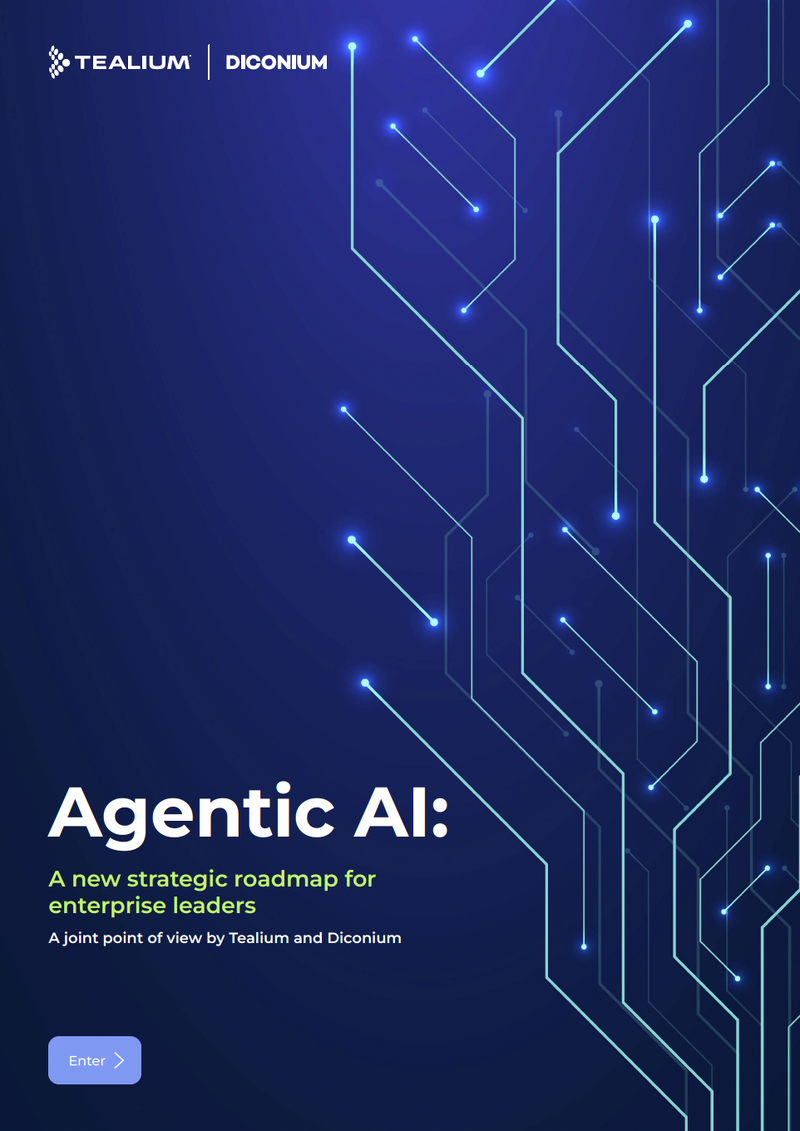
💡 By now, you already know that AI has moved beyond experimentation. 👀 Across EMEA, I see the same pattern: organisations are no longer asking whether AI matters. They are asking how to move from isolated productivity gains to real, governed business outcomes. That is where the conversation becomes more interesting. Generative AI has already changed how teams create, analyse, summarise, and accelerate work. But Agentic AI introduces a different level of ambition. It is not only about generating output, but about pursuing goals, using tools, interpreting context, and supporting execution across workflows under human oversight. For enterprise leaders, that distinction matters. We shouldn't rush into autonomy at any cost, but introduce trusted autonomy in the right order, for the right scenarios, and with the proper guardrails in place. That means asking some harder questions: 🤨 Is our data foundation real-time, governed, and usable? 🤔 Do we have the right operating model to support AI at scale? 🤫 Are we building with accountability, oversight, and measurable value in mind? Building the right data foundations first is crucial. That is why I found this ebook valuable: Agentic AI: https://lnkd.in/eiAESdSn It offers a practical perspective on what Agentic AI is, how it differs from Generative AI, and what enterprise leaders should prioritise next. For any leader thinking about AI transformation in 2026, it is well worth the read. #AgenticAI #GenerativeAI #EnterpriseAI #DigitalTransformation #Tealium


6 of 445 adsSign up to see every Tealium ad, filter by format and date, and get alerts on new ones.
See all 445 adsWatch the companies you care about.
Filter every ad by industry, country, format and network, and get alerts when a company you watch starts running new ads.