Not on air · 2 of 3 networks checked
Taxbit
- taxbit.com
- Financial Services
- US
- 143 employees
Taxbit’s ads on LinkedIn, Meta and Google, recorded by adsrunning. Browse the latest here for free. Sign up free to see all 143. Watch Taxbit with Starter to get each new one in your feed.
Watchlist with Starter · $49/mo
| Network | Status | Live ads | Nov 2025LinkedIn activity · 52 weeksNov 2026 | Checked | Next step |
|---|---|---|---|---|---|
| None recorded | 0 | Checked 1 Nov 2026 | See all 143 ads → | ||
| Meta | Not checked | — | |||
| Recently | 90 | Ads on the Google Ads Transparency Center | Checked 11 Oct 2026 | Collect them with the API → |
Taxbit has no live LinkedIn ads. We recorded 90 Google ads on 11 Oct 2026.
Latest ads
- LINKEDIN · VIDEOSince 29 Oct 2026
Times are changing! On November 19, 2026, the IRS stops accepting Forms 1042-S through FIRE. Next season, every 1042-S your team files goes through IRIS instead. That’s one of three changes happening this season: 1 → FIRE is being retired and IRIS requires a separate TCC. If your team hasn’t sent a test submission yet, schedule one before the end of the year. 2 → Box 3a is changing. Starting with 2026 forms, a reduced withholding rate needs a Chapter 3 exemption code. “00” no longer works. 3 → Your totals on Form 1042 must match the totals across your 1042-S Maintaining accurate documentation is a year round task, and if the documentation is wrong every form built on it is wrong too. Our tax team put together a readiness checklist: ten boxes to check before March 15, from W-8 validity to treaty-rate support and IRIS test filing: https://lnkd.in/g5cMixbe. If your 1042-S process still involves a spreadsheet named “FINAL_v7_actually_final,” this checklist is definitely for you.
- LINKEDIN · IMAGESince 21 Oct 2026
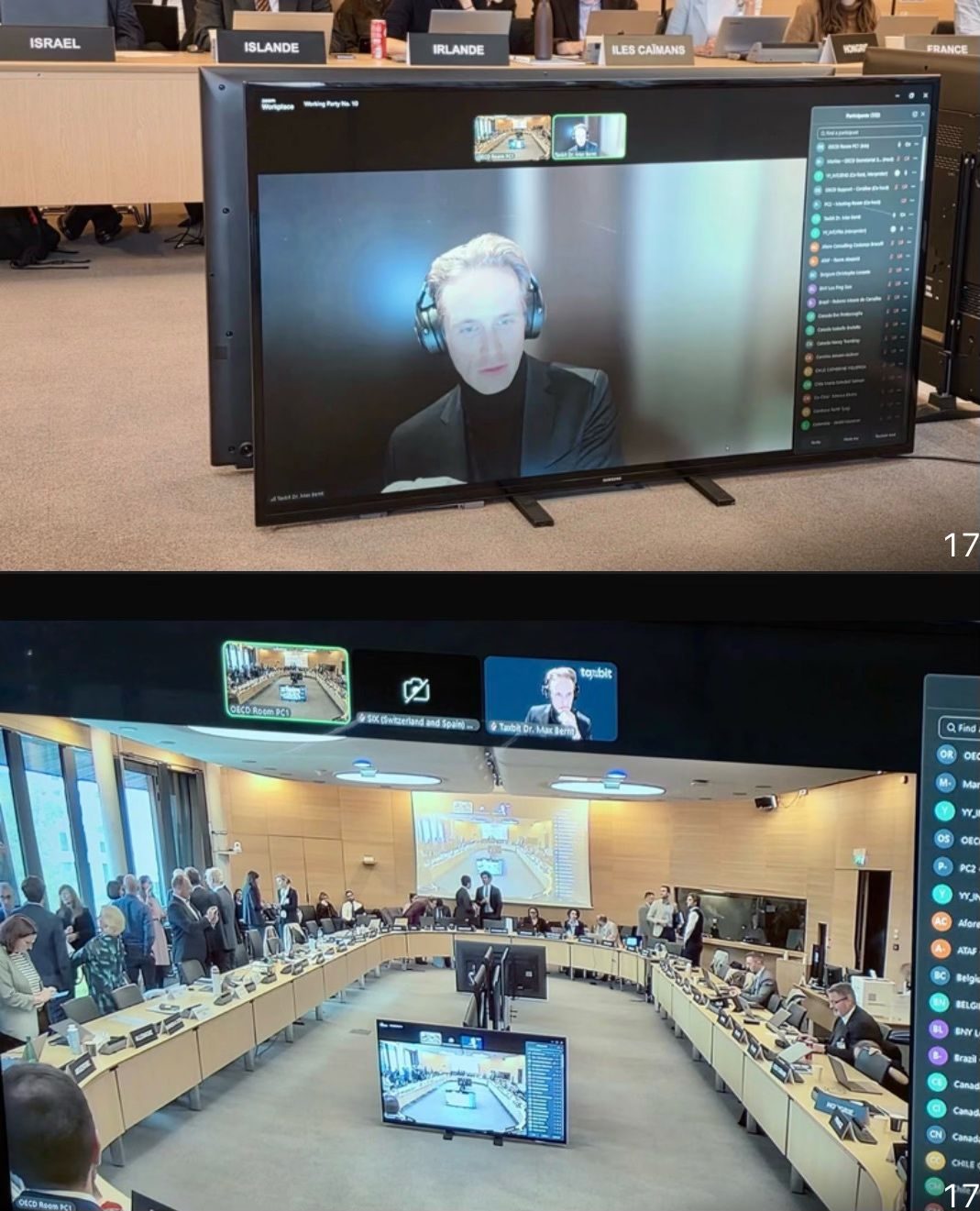
🔄 CARF is anything but a static rulebook: just wrapped up another excellent session with the OECD - OCDE Working Party 10 this week, discussing the practical implementation of the Crypto-Asset Reporting Framework and CRS 2.0 together with the Business at OECD Group. 💡 Without going into the substance of our discussions, one thing continues to become very clear: CARF & CRS 2.0 remain evolving subject matters. As implementation moves from policy into operations, new questions inevitably emerge. 🏗️ Most importantly, the core objective of our work as the BAG is to help make CARF & CRS 2.0 genuinely workable for industry. That can easily get lost in highly technical discussions, but in the end the industry needs rules that can be implemented efficiently, consistently and at scale, while still achieving the transparency CARF is designed to deliver. At Taxbit, working at the forefront of CARF & CRS2.0 implementation globally, we see these practical challenges first-hand across markets and institutions. ⚙️ That is why the practical implementation questions matter so much. Current areas of focus include multi-provider / multiple-RCASP structures, the treatment of tokenised securities, the boundary between CARF and CRS for stablecoins and SEMPs, cross-border branch structures, and the treatment of tokenised deposits and deposit tokens. 🎯 None of this is about weakening the standard. Quite the opposite. A global framework only works if the rules can be translated into operational processes without unnecessary duplication, conflicting classifications or requirements that cannot realistically be performed. 🤝 And this is exactly why the continued engagement from industry is so important. A huge thank you to everyone contributing expertise, examples and practical feedback to these discussions. That input is what allows us to move from an elegant policy framework on paper to something that actually works in the real world. 🧭 It is a real privilege to co-chair the BAG together with Dion Seymour and to contribute alongside such an engaged group of industry experts, the Business at OECD team, and the OECD Secretariat. 🙏 A big thank you in particular to Philip Kerfs, Paul Hondius, Marco Gesualdi, Nicole Primmer and Mariana Alter for supporting another thoughtful and constructive exchange. 🚀 There is still a lot of implementation work ahead, and that is precisely what makes this stage so important. We are now moving beyond the question of what CARF says on paper and into the much harder question of how it actually works across jurisdictions, products and operating models. 🚨⏰And this is also why the time to act is now. CARF introduces transaction-based reporting, which requires a fundamentally different data and operational set-up from the account-based reporting we know from FATCA and CRS. The market is already starting to move, and we are seeing more and more institutions shift from understanding the rules to actually building for implementation.
- LINKEDIN · IMAGESince 14 Oct 2026
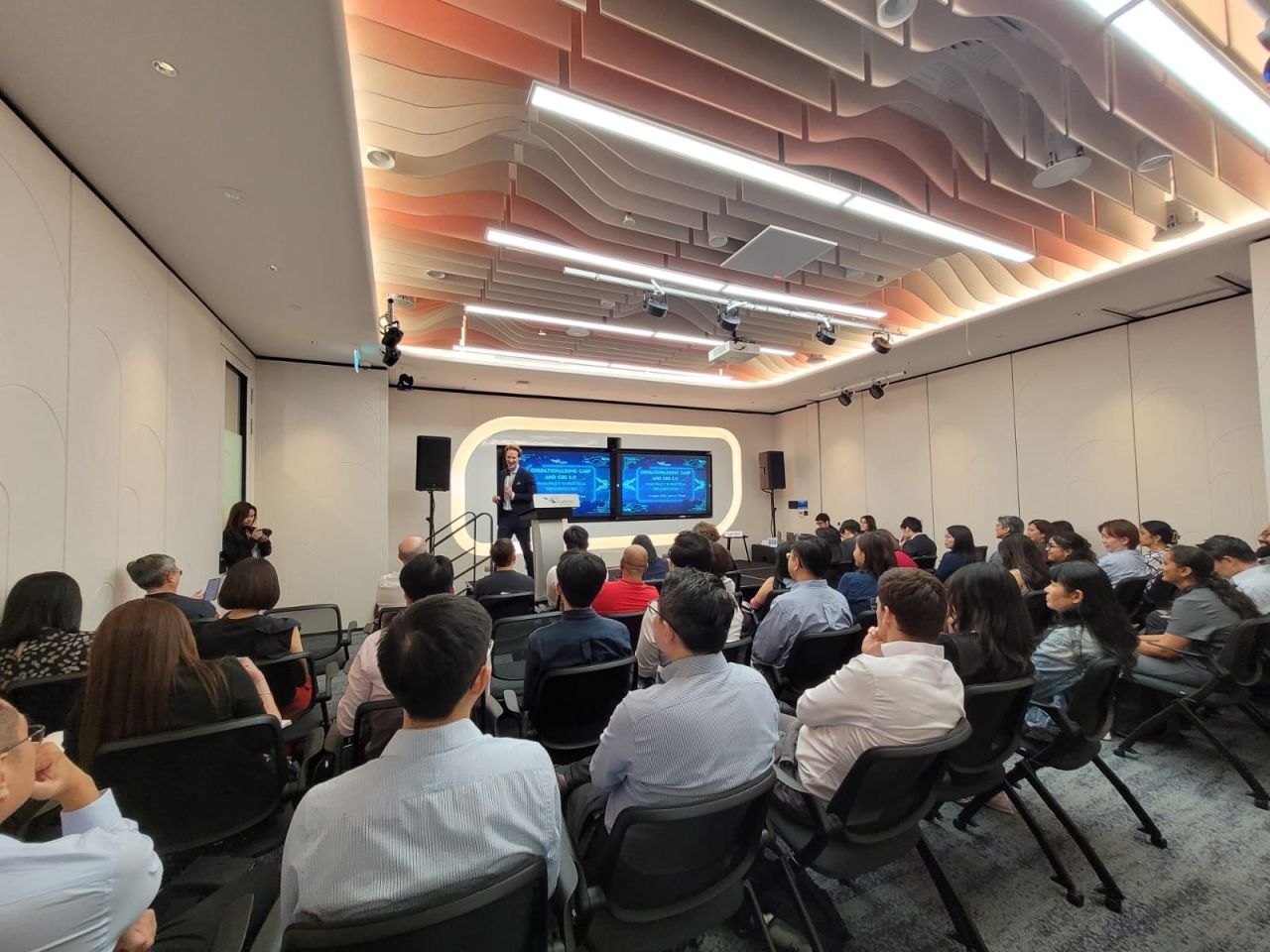
🌏 TOKEN2049. After an incredibly busy (and fruitful!) week with our team in my new hometown of Singapore, I finally found a moment to reflect. And one thought kept coming back: Wow, our industry is really growing up! 🥂 It's not just the conference that's changing. The people, the conversations, even the side events have shifted from flashy parties towards more sophisticated gatherings and genuine discussions. And it makes me particularly proud of what we're building at Taxbit: a team that brings the expertise, maturity, and trust this next chapter demands. 🤝 Throughout the week, we met with leaders from across the ecosystem, from leading crypto-asset service providers to banks, regulators, and financial institutions. What struck me most was how much the conversation has evolved. Less speculation, more focus on using blockchain technology to improve financial products and services. Stablecoins, tokenized deposits, digital securities, on-chain settlement, and AI-driven payments are becoming real business priorities. As traditional finance moves on-chain and crypto-native businesses expand into mainstream financial services, one question becomes increasingly important: How do we make compliance work at scale? 📊 With CARF and CRS 2.0 implementation approaching, institutions are realizing that digital asset reporting isn't something you can simply bolt onto an existing FATCA/CRS stack. CARF introduces transaction-based reporting obligations, bringing entirely new challenges around asset classification, transaction mapping, due diligence, data quality, and reporting across jurisdictions. Getting these foundations right from the outset is far easier than reconstructing millions of transactions retrospectively. 🚀 At Taxbit, we're seeing this shift firsthand. Our work now extends beyond traditional crypto exchanges to payment providers, stablecoin issuers, and financial institutions embracing digital assets. It's exciting to see the industry recognizing that the next generation of financial infrastructure needs an equally sophisticated compliance infrastructure. 🍸 For our team, TOKEN2049 was less about the conference floor and more about everything happening across Singapore. From meeting clients and partners to hosting our banking roundtable and dinner, and joining fantastic discussions, it was a genuinely rewarding week. And yes, of course, I got to speak a couple of times again - at the end of the day, people do love to learn about CARF & CRS 2.0 😄 Having our growing APAC team together made it even more special. Seeing the relationships we've been building across the region come to life was fantastic. 🙏 A huge thank you to everyone who made time to connect. I'm incredibly proud of the momentum we're building across APAC and excited about what's next for Taxbit! ..p.s.: who knew a conference in your own hometown could be more exhausting than travelling halfway around the world for one? I certainly didn't! 🫨
- LINKEDIN · IMAGESince 14 Oct 2026
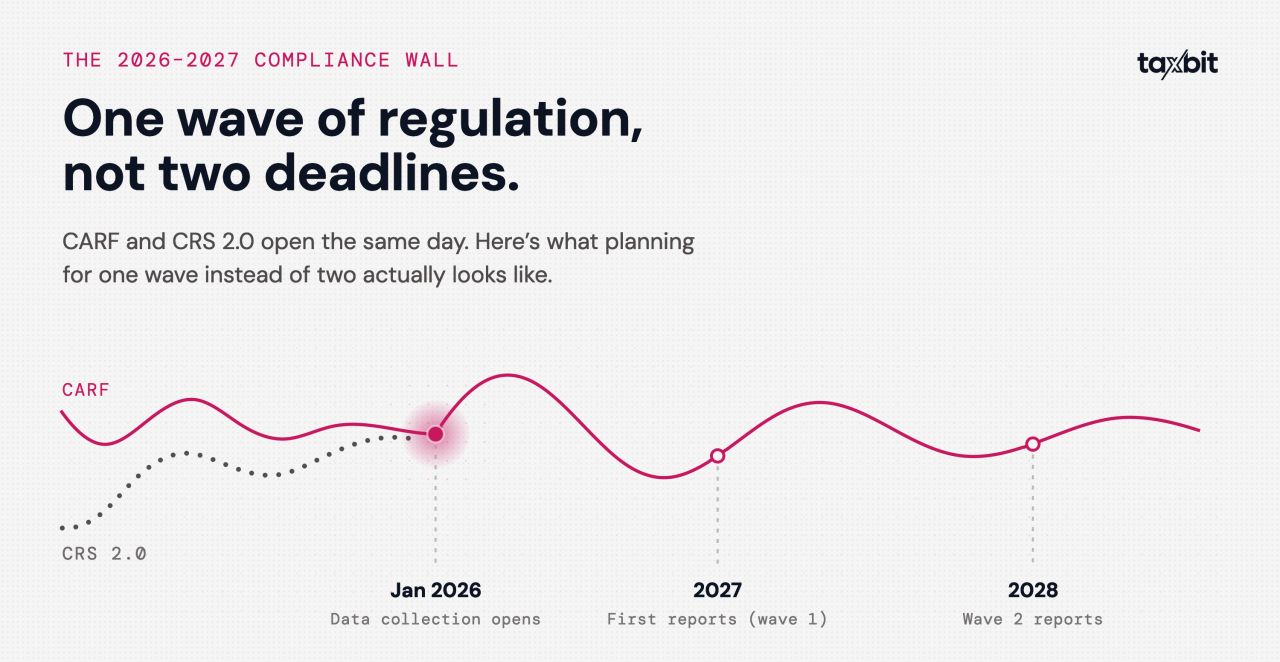
🚨 𝗖𝗢𝗠𝗣𝗟𝗜𝗔𝗡𝗖𝗘 𝗖𝗛𝗘𝗖𝗞: CARF + CRS 2.0 are coming at the same time. But treating them as two completely separate compliance projects may be the wrong approach. Taxbit argues companies should think about this as one regulatory wave, not two deadlines. Here’s why: CARF and CRS 2.0 are legally different frameworks. But operationally, much of the preparation overlaps. Both require companies to understand: → Where they operate → What type of entities they have → Which products they offer → What customer data they collect → Where transaction/account data sits → Who internally owns the reporting process The starting point isn’t simply: “Are we subject to CARF? ”or“Are we subject to CRS 2.0?” It’s: Jurisdiction × Entity type × Product activity A crypto exchange might fall primarily under CARF. A bank, EMI or fund administrator might fall under CRS 2.0. And increasingly, businesses operating across both traditional finance + digital assets may need to deal with both. That’s where the operational argument becomes interesting. Instead of creating two separate data projects, companies can build one shared data foundation and use it to produce the different reporting outputs required under each regime. The clock is already running. 📅 2026 — data collection 📅 2027 — Wave 1 reporting 📅 2028 — Wave 2 reporting I highly recommend reading this article where Taxbit breaks down the full compliance roadmap : https://lnkd.in/dE_UuRfR Find this helpful? [ 𝗿𝗲𝗽𝗼𝘀𝘁 ] Anything to add about this subject? [𝗶𝗻𝘃𝗶𝘁𝗲𝗱 𝘁𝗼 𝗰𝗼𝗺𝗺𝗲𝗻𝘁] Nice story, Marcel. Next! [ 𝗹𝗶𝗸𝗲 ]nbsp;
- LINKEDIN · VIDEOSince 14 Oct 2026
No one can manage tax information reporting alone. The rules are hard to put into practice, and the work isn’t a once-a-year project. Community is critical to keeping pace. That was one of the clearest takeaways when we brought senior tax and compliance professionals together in New York for City Sessions to discuss where reporting is heading across the digital economy. A few more that stuck with us: ▪️ Requirements are changing worldwide, and enforcement is stepping up. Think FIRE to IRIS, shifting 1099-K and 1099-MISC thresholds, 1099-DA cost-basis gaps, and peak IRS audits, plus CARF, CRS 2.0, and DAC7. ▪️ Lean teams win by focusing on what matters most and choosing the right partners. ▪️ With the right guardrails, AI delivers with analysis and reconciliation. The real value is in the room: comparing approaches and pressure-testing what the rules actually mean. Thank you to our partners, speakers, and practitioners. Missed this one? Let’s connect another time soon. See where we'll be over the next few months: taxbit.com/events
- LINKEDIN · IMAGESince 6 Oct 2026
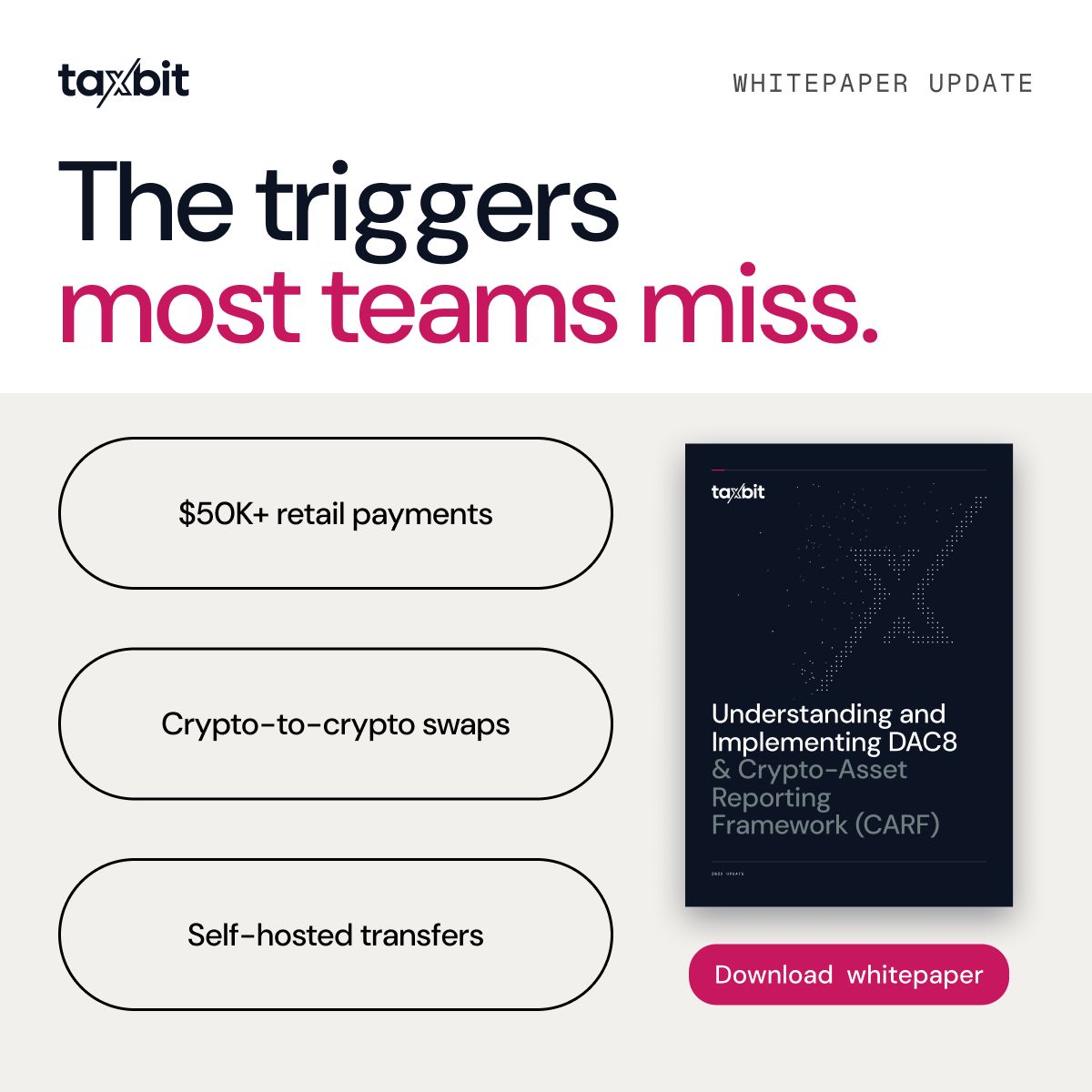
3 steps crypto providers should take now for DAC8 and CARF: update onboarding, prep IT systems, and confirm local registration rules.
6 of 143 adsSign up to see every Taxbit ad, filter by format and date, and get alerts on new ones.
See all 143 adsWatch the companies you care about.
Filter every ad by industry, country, format and network, and get alerts when a company you watch starts running new ads.