Not on air · 2 of 3 networks checked
Taquanta Asset Managers
- taquanta.co.za
- Financial Services
- 62 employees
Taquanta Asset Managers’s ads on LinkedIn, Meta and Google, recorded by adsrunning. Browse the latest here for free. Sign up free to see all 42. Watch Taquanta Asset Managers with Starter to get each new one in your feed.
Watchlist with Starter · $49/mo
| Network | Status | Live ads | Nov 2025LinkedIn activity · 52 weeksNov 2026 | Checked | Next step |
|---|---|---|---|---|---|
| None recorded | 0 | Checked 1 Nov 2026 | See all 42 ads → | ||
| Meta | Not checked | — | |||
| None recorded | 0 | No ads found on the Google Ads Transparency Center | Checked 11 Oct 2026 | Collect them with the API → |
Taquanta Asset Managers has no live LinkedIn ads. We recorded no Google ads on 11 Oct 2026.
Latest ads
- LINKEDIN · IMAGERecorded 29 Oct 2026
Who Is Taquanta? I do not mean what we do. I mean who we are. I have been part of Taquanta long enough to see what remains. Somewhere along the way, I stopped thinking of it simply as the company I work for. If you have been part of an organisation for long enough, you start to notice something. People come and go. Leadership, technology and strategies change. Yet somehow, Taquanta remains recognisably Taquanta. So where does that identity actually live? It is not in our systems, I have replaced enough of those to know. It is not in a building or an organisational chart and it certainly does not belong to one person. I think it exists somewhere between all of us. Perhaps that’s what an organisation really is: a kind of collective memory. Thousands of decisions, conversations, successes, failures, friendships and lessons accumulate until they become something none of us individually created. A culture. A character. An identity. From where I sit in IT, I get an unusual view of this. You see people arrive and set them up for their first day; when they leave, you are there again, disabling their accounts. You see how departments connect and how knowledge moves from person to person, sometimes formally, sometimes through years of working together. After watching that for long enough, I have learnt that technology works best because of the people around it: those who understand the business, share knowledge, challenge assumptions, solve problems and find better ways of doing things. Technology is part of our infrastructure. So are our relationships, our knowledge and the trust we build with one another. But not everything that holds an organisation together can be documented. Maybe that is where Taquanta actually lives, not in any one of us, but between us. That leads me to an even stranger thought. We spend years believing we are helping to shape the organisations we work for. We make decisions, build things, solve problems, challenge assumptions and improve what we can. We leave a little piece of ourselves behind. But perhaps the opposite is happening at the same time. Perhaps the organisation is shaping us too. The people I’ve worked with, the difficult days, the successes and everything we have built together have changed how I think about technology, business, leadership and people. So, who is Taquanta? I do not think I can answer that with a sentence. Maybe none of us can. Taquanta is not one person, one team or one moment in time. It is everyone who has helped shape it, everyone shaping it today and the people who will take it somewhere we have not imagined yet. We belong to it for a while. We change it. It changes us. And the story continues. POV: This is Taquanta, as I see IT 😜 .
- LINKEDIN · IMAGERecorded 1 Oct 2026
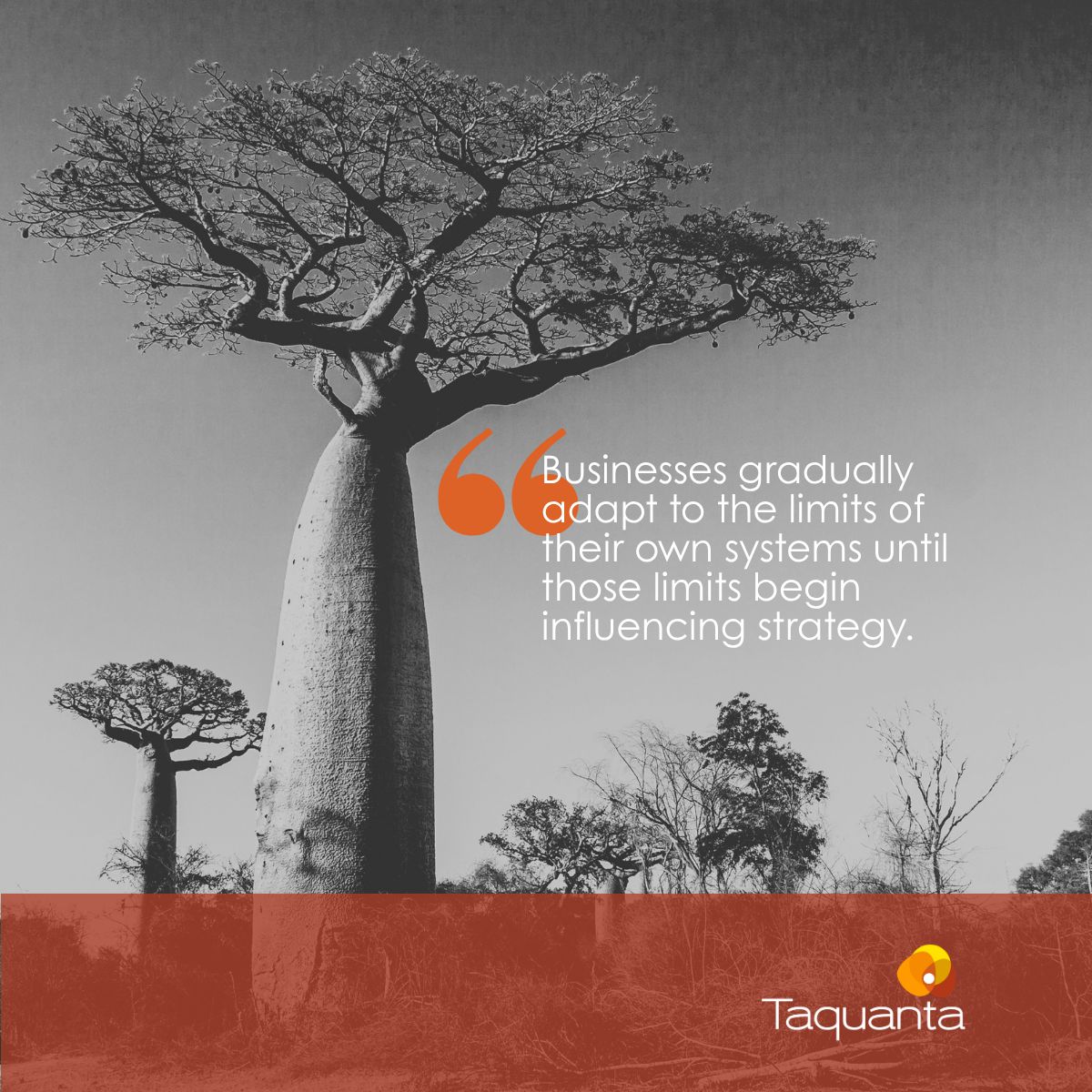
▪️ Your operating model may be making investment decisions before you do. Most investment managers believe their strategy drives their operating model. The real question is not whether administration is in-house or outsourced. The real question is whether the operating model expands what the investment team can do or slowly teaches the team where the boundaries are. ▪️ The limits you stop seeing start deciding what is possible. The danger is not the constraints we can see. The danger is the constraints we stop seeing. Most discussions about administration focus on cost, efficiency and service levels. Those matter, but they miss a bigger point: administration is where investment ideas become operational reality. Trades are settled. Assets are valued. Cash moves. Reports are produced. Compliance is monitored. Without these activities, an investment strategy is still just an idea. ▪️ Every “we cannot support that” limits what the investment team can offer. This is where in-house administration becomes interesting. It is not simply about control. It is about freedom to support new instruments, structures and solutions without first asking whether somebody else's operating model can accommodate them. From an IT perspective, this matters because technology does not only record business activity. It often determines how quickly the business can change. When administration sits inside the business, systems, data and operational teams are closer together. Issues are identified earlier. Improvements happen faster. Automation opportunities are easier to spot. Knowledge stays within the organisation instead of being spread across multiple parties. ▪️ “This is how we normally do it” is the red flag. Over time, organisations adapt to their constraints. The risk is that those constraints become so familiar that they stop looking like constraints at all. The question quietly shifts from: What is the best solution for the client? to What can we practically support? ▪️ When what we can support starts deciding what the client gets. Most people never notice the change. That is usually how these constraints work. They rarely arrive as formal decisions. They become normal through repetition. ▪️ The real advantage is keeping strategy ahead of limitation. Perhaps the biggest benefit of in-house administration is not efficiency, cost or control. Perhaps it is reducing the distance between an idea and its implementation.
- LINKEDIN · IMAGERecorded 1 Oct 2026
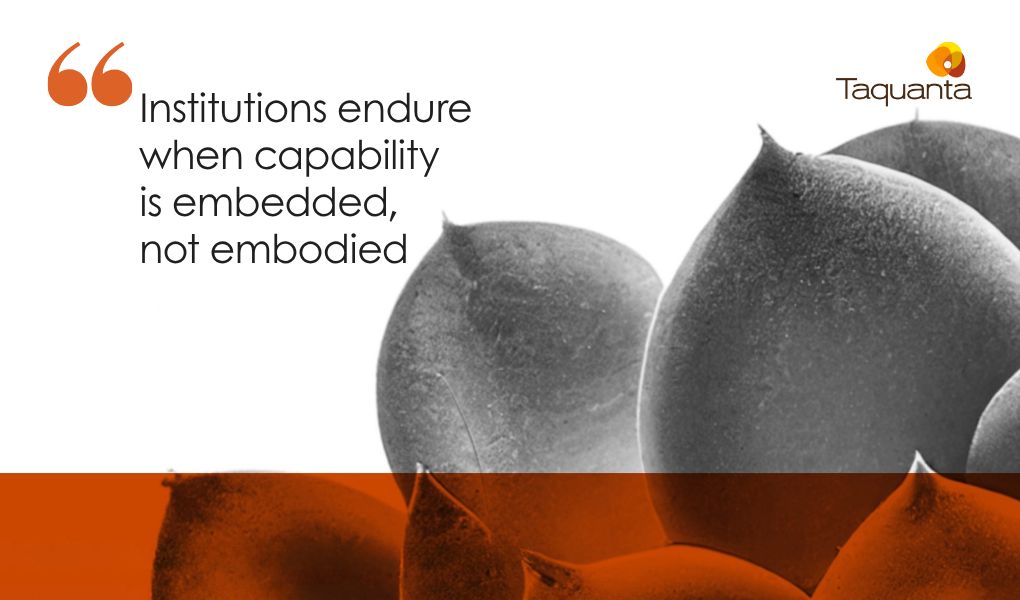
Working in IT gives you an unusual perspective on an organisation. You spend less time thinking about personalities and more time thinking about systems, resilience and continuity. Over time, it’s changed the way I think about one question that comes up surprisingly often: how much should an organisation depend on any one person? ◾ People create success. Operational discipline makes success repeatable. We naturally focus on the people we can see, while overlooking the systems, processes and disciplines that make consistent success possible. Our instinct is to judge organisations by the people we can see rather than the systems we cannot. Who are the leaders? Who are the key decision-makers? What happens if someone leaves? These are all reasonable questions. But I sometimes wonder if we are focusing on the wrong thing. ◾ The organisation behind the organisation. Working in IT, I get to see behind the scenes. Not just the presentations, policies and governance structures, but the day-to-day reality of how organisations actually operate. And I have come to believe that one of the most important characteristics of a successful asset manager is also one of the least visible: operational discipline. ◾ Success is only real when repeatable. Operational discipline may be one of the least visible but most important characteristics of a successful asset management firm. It is reflected in the consistency of processes, the quality of documentation, the reliability of controls and the ability to execute repeatedly without failure. ◾ Institutions must outlast individuals. The strongest organisations are not those that depend on exceptional individuals. They are the ones that continue to operate effectively regardless of who occupies a particular role. Processes are followed. Controls are executed.
- LINKEDIN · ARTICLERecorded 1 Oct 2026
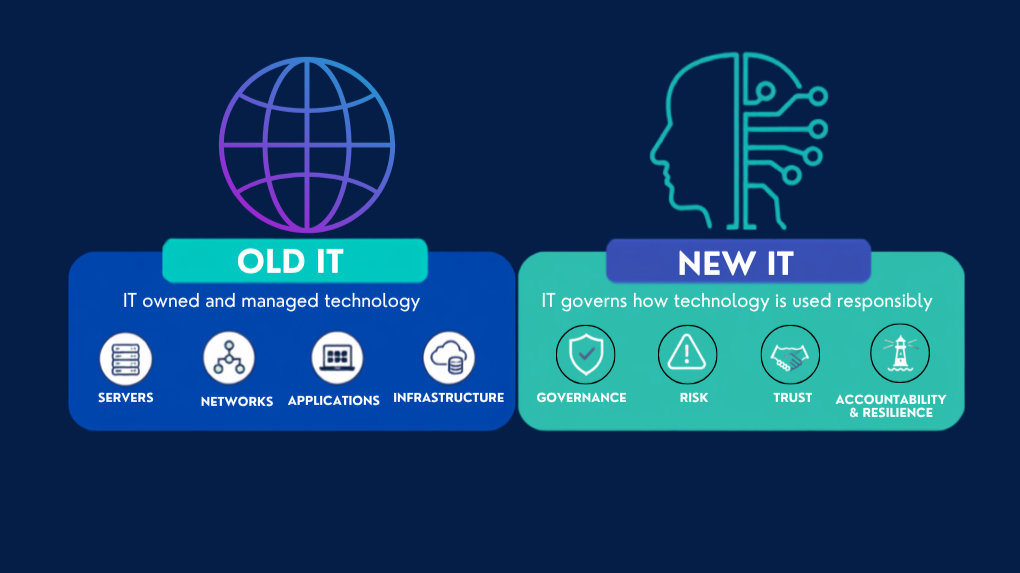
The only thing we know currently is that the future IT department may own nothing and govern everything. Responsibility is going to become the job and it is going to be immense. This is more than risk management. IT leaders will increasingly help the firm decide what it is prepared to delegate to machines and what consequences it is prepared to own. IT can no longer control every tool at the point of entry. Technology will sit everywhere. IT’s value will come from defining how the firm uses it rather than possessing it. That is why governance becomes IT’s central role. The CIO is becoming the firm’s philosopher of consequence. The CIO’s role is therefore no longer limited to whether the technology works. Less time debating systems. More time shaping risk decisions. The machines will make more of the decisions. The CIO will have to understand the consequences before the rest of the firm experiences them. Less time debating systems. More time shaping risk decisions. Worry is easy. Definition is hard. The firms that win this decade will be the ones who did the hard part first.
- LINKEDIN · IMAGERecorded 1 Oct 2026
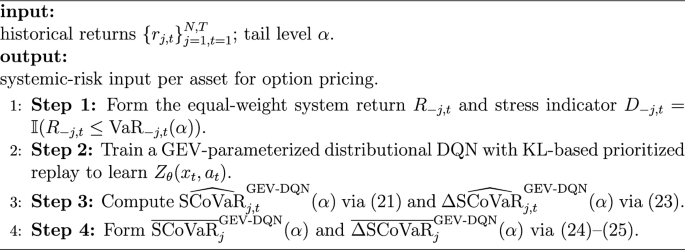
What if option prices reflected not just volatility, but an asset’s contribution to system-wide financial stress? Most traditional option-pricing models are built around stand-alone risk. But in real markets, downside shocks rarely remain isolated. During crisis periods, losses tend to spread across asset classes through tail dependence, contagion, and amplification effects — meaning that an asset’s value may depend not only on its own volatility, but also on how strongly it contributes to broader systemic distress. In our recently published article, we develop a stress-consistent macroprudential overlay for European option pricing that brings this system-wide perspective into valuation. Using the System CoVaR (S-CoVaR) as a core tail-risk input, we compare a conventional econometric framework with a more adaptive machine-learning approach to estimate how systemic downside exposure differs across major asset classes. Our findings point to clear cross-asset heterogeneity. Equities and commodities show materially stronger systemic tail exposure than bonds, and the machine-learning estimator produces consistently more conservative downside-risk estimates than the econometric benchmark. When these systemic risk measures are incorporated into pricing, the effects are economically intuitive: call prices fall, put prices rise, and the size of the adjustment depends on each asset’s contribution to systemic spillovers. Overall, the study speaks to a broader theme in finance: pricing models may become more informative when they account for how markets behave under stress, not only in normal times. For researchers and practitioners interested in derivatives, systemic risk, macroprudential policy, and tail-risk modelling, this framework offers a practical bridge between risk measurement and asset pricing. #Finance #Derivatives #OptionPricing #SystemicRisk #RiskManagement #MacroprudentialPolicy #MachineLearning #QuantFinance #AssetPricing A special thank you to my supervisor, Professor Jules Clement Mba, and to Springer Nature's Review of Derivatives Research for their continued guidance, support, and partnership throughout this work. https://lnkd.in/dNpRHnm8
- LINKEDIN · ARTICLERecorded 1 Oct 2026
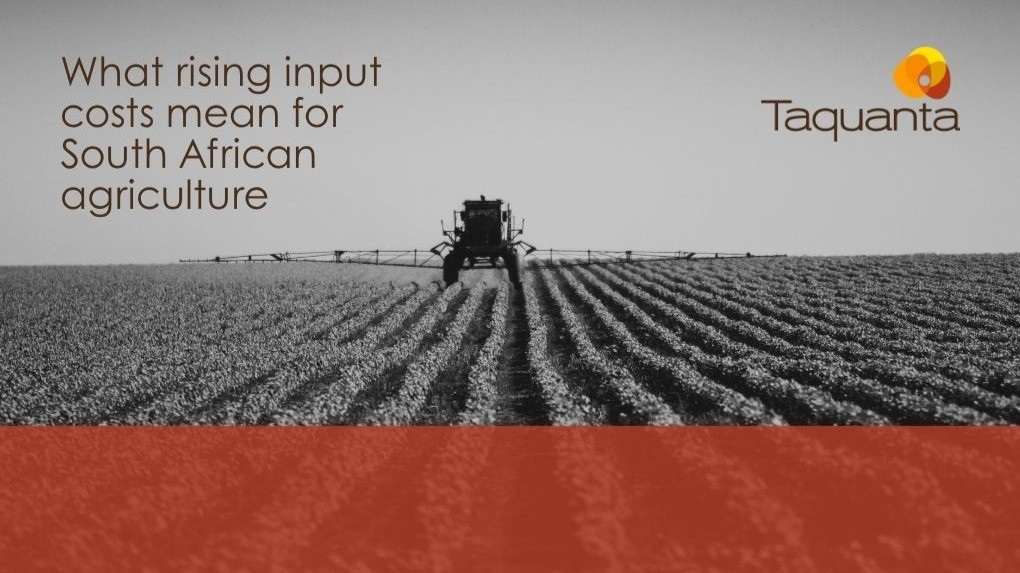
Today, the risk appears more structural in nature. This suggests that while revenues may continue to show resilience, underlying profitability could start to weaken.

6 of 42 adsSign up to see every Taquanta Asset Managers ad, filter by format and date, and get alerts on new ones.
See all 42 adsWatch the companies you care about.
Filter every ad by industry, country, format and network, and get alerts when a company you watch starts running new ads.