Not on air · 2 of 3 networks checked
Tangible Scientific
- tangiblescientific.com
- Research Services
- US
- 6 employees
Tangible Scientific’s ads on LinkedIn, Meta and Google, recorded by adsrunning. Browse the latest here for free. Sign up free to see all 20. Watch Tangible Scientific on any plan to get each new one in your feed.
Watchlist included in every plan
| Network | Status | Live ads | Nov 2025LinkedIn activity · 52 weeksNov 2026 | Checked | Next step |
|---|---|---|---|---|---|
| None recorded | 0 | Checked 3 Nov 2026 | See all 20 ads → | ||
| Meta | Not checked | — | |||
| None recorded | 0 | No ads found on the Google Ads Transparency Center | Checked 11 Oct 2026 | Collect them with the API → |
Tangible Scientific has no live LinkedIn ads. We recorded no Google ads on 11 Oct 2026.
Latest ads
- LINKEDIN · IMAGERecorded 1 Oct 2026
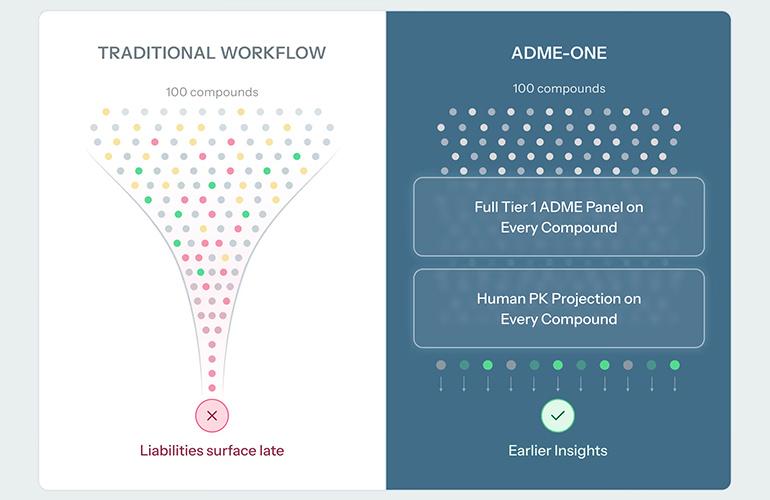
Human PK at hit ID. Read this one. Brian K. Buntz from Drug Discovery and Development on ADME-One and the models the Inductive Bio team has built. The short version: a projected human PK read at hit ID, on most of the compounds coming through, at a price you'd actually pay. All five Tier 1 ADME assays plus that PK projection in one shot, instead of saving the whole workup for lead op. For years this was work you only spent on a handful of leads. Now you can see potency, ADME and human PK before months of synthesis lock a program around the wrong ones. Inductive Bio's models earned the spotlight, the Polaris and OpenADMET results speak for themselves. Ginkgo Datapoints runs the assays. Tangible Scientific handles the compounds and logistics. Proud to be in it with these two. Full coverage below. https://lnkd.in/eb2Tq8FD
- LINKEDIN · IMAGERecorded 1 Oct 2026
We are thrilled to announce ADME-One™ Co-developed through our partnership with Ginkgo Datapoints and Inductive Bio, ADME meets AI in the most powerful way!
- LINKEDIN · IMAGERecorded 1 Oct 2026
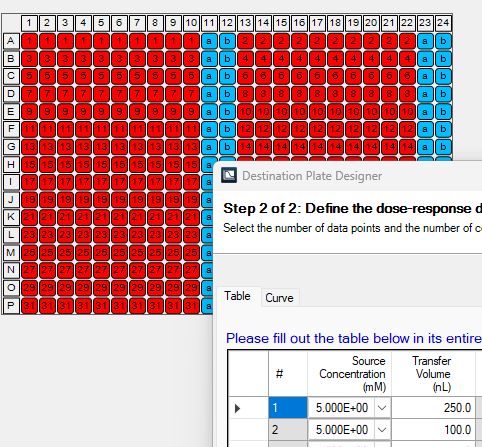
Here is a topic that has been debated upon since the inception of the ECHO. Serial Dilution versus variable volume dispense. Let's hit the basics. Serial dilution: You make a stock solution, pipette a calculated amount into the next well with diluent, mix, pipette from that well into the next, and keep going down the row. Each well is a volume based dilution of the well before it. Variable volume dispense: The ECHO ejects nanoliter size droplets from the source plate and places them into each destination well based on the concentrations you want in each well of your dosing. Let's say you're looking for a 100uM top concentration that translates to 100nL of 10mM compound based on your assay volume for your first point. You need a two fold dilution so your next droplet will be 50nL. Then 25nL. Then 12.5nL, etc. backfilling for homogenous DMSO% of course. Remember the ECHO only delivers 2.5nL so an intermediate (lower) concentrations may have to be made during run time. Here are some of the arguments back and forth in the community. - The ECHO is dispensing such small amount how can I trust it? - Serial dilution is just perpetuating CV% errors down the line based on the manual of automated devise you are using. - You have one pipettor adding the diluent volume and another actually doing the dilution making a calculation for possible CVs impossible to put into error bars. - How can I be sure of proper mixing in either scenario? - What am I reporting to my data analysis tool? I can not tell you which path to choose. The situation calls for the right process for your needs. Some of my thoughts. - If you are using variable volume dispense: Vortex your intermediate plates well. - Centrifuge all of your source plates including the intermediates once they are made. - Check your transfer logs. - Take advantage of your pipettor actually telling whether it performed the liquid transfer or not. - Report the exact/correct assay concentration to your data analysis tool. If you tell it otherwise you are missing out on the benefits. If you are doing a serial dilution: - Mix well and thoughtfully. - Check your tips, makes sure they are droplet free at the end of dispense. - Absolutely, run an absorbance test to see clear step down. - Do not assume a 11-point, 3-fold will perform as well as an 8 point 4 fold. - Do the diligence and run absorbance on each distinct parameter. - Use the right tip size for the volume transfers. - Check for bubbles, make sure there are no dreaded bubbles. - Be consistent, it is hard to miniaturize an assay and expect the same results using serial dilution (yes, that means many replicates to repeat and comparison of historic data.) Let the discussion begin.
- LINKEDIN · IMAGERecorded 1 Oct 2026
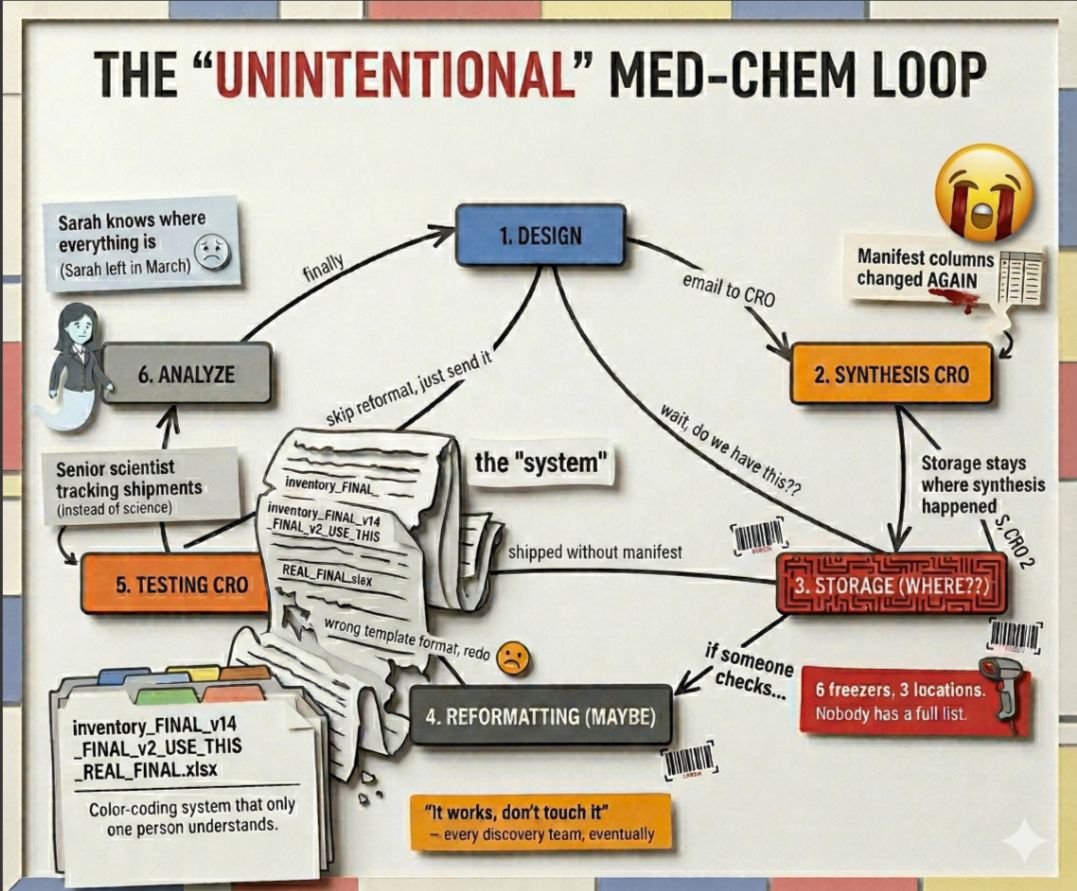
Does the below image look familiar? Nobody at your company designed your med-chem loop. It’s something you let happen to you, one good-enough decision at a time, and now you're stuck with it. Synthesis goes to whoever can deliver fastest. Storage stays wherever synthesis happened. Reformatting gets handled by whoever has bench time. Somebody sets up a spreadsheet to track what's where, and for a while it works fine because there's only one program and twelve compounds and everybody knows what's going on. Then you're running three programs with four CROs and your library is 8000 compounds across six freezers in three locations and that spreadsheet has four tabs and a color-coding system that only Sarah understands. You got here one reasonable decision at a time. You picked the cheapest synthesis vendor. You left compounds where they were because moving them cost money and time you didn't have. You gave compound tracking to a senior scientist because they were the lowest on the totem pole and it needed to get done. Discovery teams wind up here because they are focused on the science, but doing the science requires more than knowing the science. Now a sr. scientist is spending two days a week reconciling manifests and tracking shipments instead of analyzing data. Your CRO sends Excel files with different column headers every time and half the barcodes don't match what's in the freezer. You can't plan next week's experiments because you don't actually know what's available until somebody digs through the inventory. But once something functional is in place, even if it's held together with email threads and good intentions, nobody wants to be the one who disrupts the science to fix the dumpster fire. The switching cost feels higher than the pain, so the pain becomes normal and everybody just assumes this is how compound ops work. IT IS NOT, But you won't see that until your discovery team is being impacted with longer cycle times and now its too much to handle with not enough budget. I've watched it happen to too many organizations, too many times.
- LINKEDIN · IMAGERecorded 1 Oct 2026
Tangible Scientific is redefining R&D operations, combining logistics with digital intelligence to shorten cycle times, reduce wasted effort, and improve the probability of success. Our partnership with Ginkgo Datapoints and Inductive Bio advances our shared vision of leveraging technology to reduce not just cycle times but also the number of cycles required to succeed in each stage of development. Through this partnership, researchers gain access to validated AI chemistry models, rapid ADME profiling, structured decision-support tools, and tech-enabled sample management. This collaboration represents a step toward a future where automation, AI, and human insight converge to dramatically increase the speed, scale, and predictability of drug discovery. Read the full announcement here: https://lnkd.in/esG5tzy9
- LINKEDIN · IMAGERecorded 1 Oct 2026
Med chemists - raise your hand if you’ve ever been guilty of this: You’ve got compounds to put back in storage, but you’ve got more important things to do so you toss them in a box with no positioning, hopefully a label, and roll it on over for ops. When someone opens that box six months later to run a screen, it looks like the package Tom Hanks delivered at the end of Cast Away. I know this box and get why it happens - you actually do have more important things to do. You were hired to design molecules and advance programs, not organize tubes. No one taught you why it matters, it’s not the reason your manager is going to promote you, and your manager’s manager might not know what a plate map is and probably shouldn't. But downstream, someone is eventually going to have to open that box and turn it into useful data before a program can move forward. Figuring out what’s what, registering and positioning it takes too much time, meaning the assay that was supposed to run Tuesday is now running Thursday. These types of delays are so common that they're now baked into the cycle time from tube to assay to data and nobody questions it. Here’s my point: Compound Management is a rate limiting step for drug discovery. It’s what dictates how fast your med-chem loop can run. Outsource it to an expert team. Your scientists don’t need a Compound Management side hustle. Let your Chemists do chemistry!

6 of 20 adsSign up to see every Tangible Scientific ad, filter by format and date, and get alerts on new ones.
See all 20 adsWatch the companies you care about.
Filter every ad by industry, country, format and network, and get alerts when a company you watch starts running new ads.