On air · 1 of 3 networks
Syroco
- syro.co
- FR
- 50 employees
Syroco’s ads on LinkedIn, Meta and Google, recorded by adsrunning. Browse the latest here for free. Sign up free to see all 20. Watch Syroco with Starter to get each new one in your feed.
Watchlist with Starter · $49/mo
| Network | Status | Live ads | Nov 2025LinkedIn activity · 52 weeksOct 2026 | Checked | Next step |
|---|---|---|---|---|---|
| Running | 2 | Checked 29 Oct 2026 | See all 20 ads → | ||
| Meta | Not checked | — | |||
| Recently | 6 | Ads on the Google Ads Transparency Center | Checked 11 Oct 2026 | Collect them with the API → |
Syroco has 2 live LinkedIn ads. We recorded 6 Google ads on 11 Oct 2026.
Latest ads
- LINKEDIN · IMAGESince 23 Oct 2026
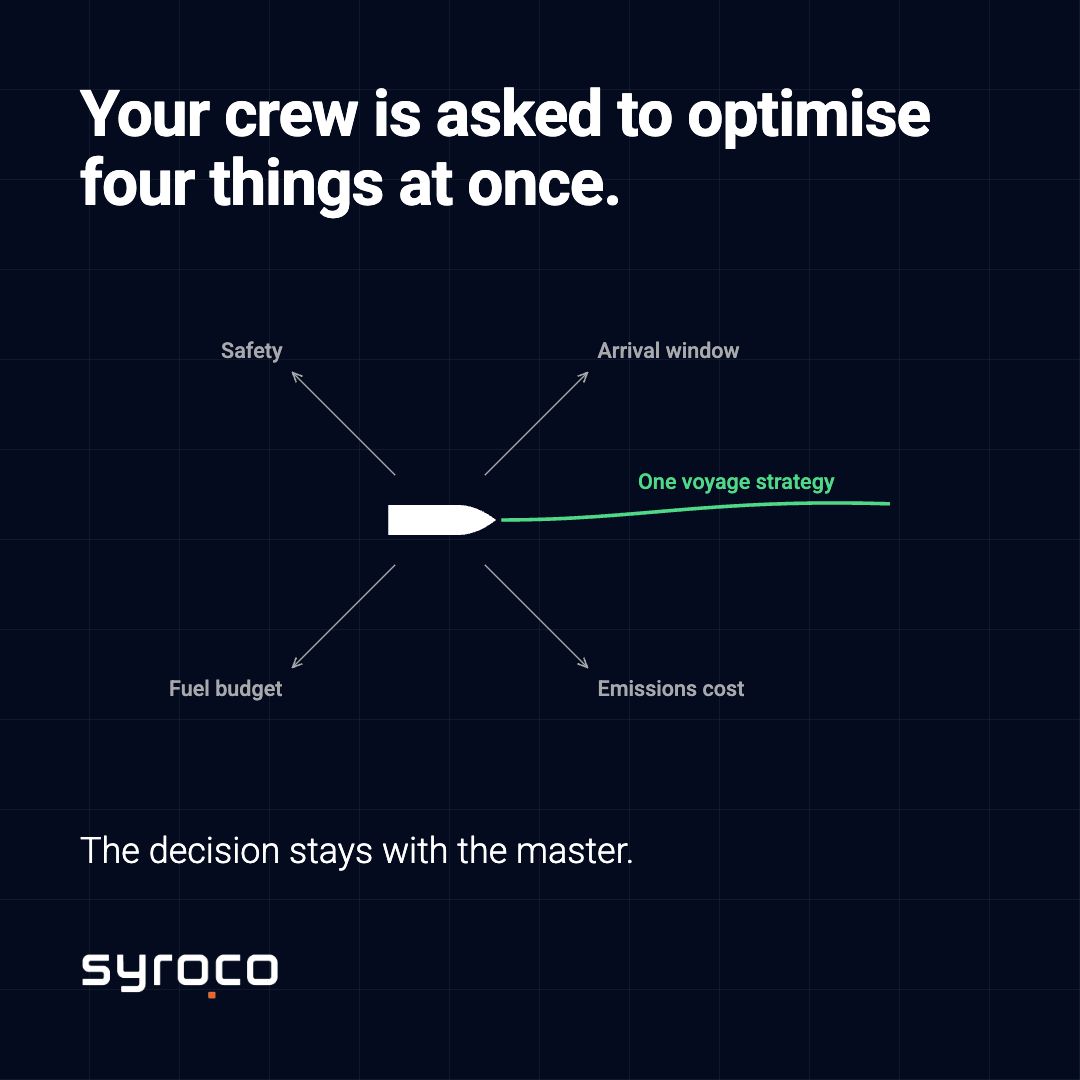
Your crew is asked to optimise four things at once, with no way to compare them 👇 On every voyage, the same arbitration has to be made on the bridge. → Safety first, always → An arrival window the commercial team has committed to → A fuel budget somebody will review afterwards → An emissions profile that now carries a price These objectives pull in different directions. Slow down and you protect the fuel line, but you put the laycan at risk. Hold the speed and you protect the schedule, and you pay for it twice, once in bunker and once in compliance. Today that trade off is made in minutes, with partial information, by people who already have a ship to run. It should not be theirs to calculate. Syroco simulates the possible voyage strategies against the vessel's digital twin and live weather data, then returns the one that holds all four constraints together. Speed, route, ETA, consumption. The recommendation arrives on board ready to use. The decision stays with the master, where it belongs. How captains put it to work on live voyages 👇 → https://lnkd.in/eaFRtdAi
- LINKEDIN · IMAGESince 23 Oct 2026
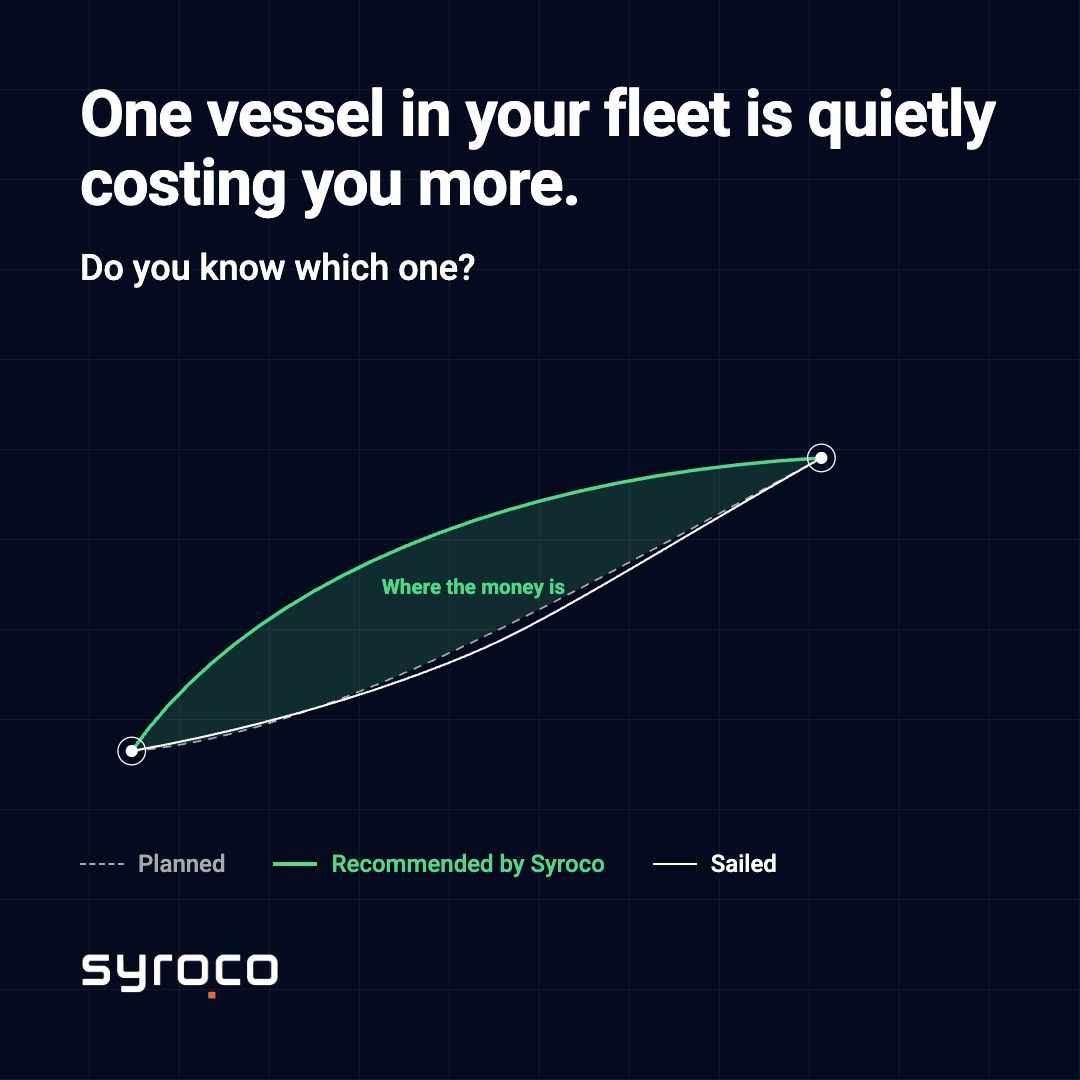
One vessel in your fleet is quietly costing you far more than the others. Do you know which one 👇 A 40-vessel fleet generates millions of data points every month. Almost none of it reaches the person who could act on it in time. The symptoms are familiar. → Two sister ships, same route, a consumption gap nobody can explain → Performance reviewed months later, when the voyage is long gone → Hull fouling noticed through a budget line rather than through data → Every deviation justified after the fact, none of them anticipated The problem is not the volume of data. It is the absence of a reference. Without a model of what each vessel should have consumed in the exact conditions it sailed through, every number is just a number. You can report on it. You cannot decide with it. On every voyage run with Syroco, there are three routes to look at. → The planned route, the master's reference route, set before departure → The route Syroco recommends during the voyage, computed against the vessel's digital twin and live conditions → The route actually sailed The gap between the first and the second is where the money is. It shows, voyage after voyage, how much the original plan was leaving on the table before anyone had left port. The third one tells you whether your fleet captured it. That is the difference between reporting on a fleet and steering one. Syroco is live on more than 150 vessels today. See your own fleet through it 👇 → https://lnkd.in/eigvWHjh
- LINKEDIN · IMAGESince 23 Oct 2026
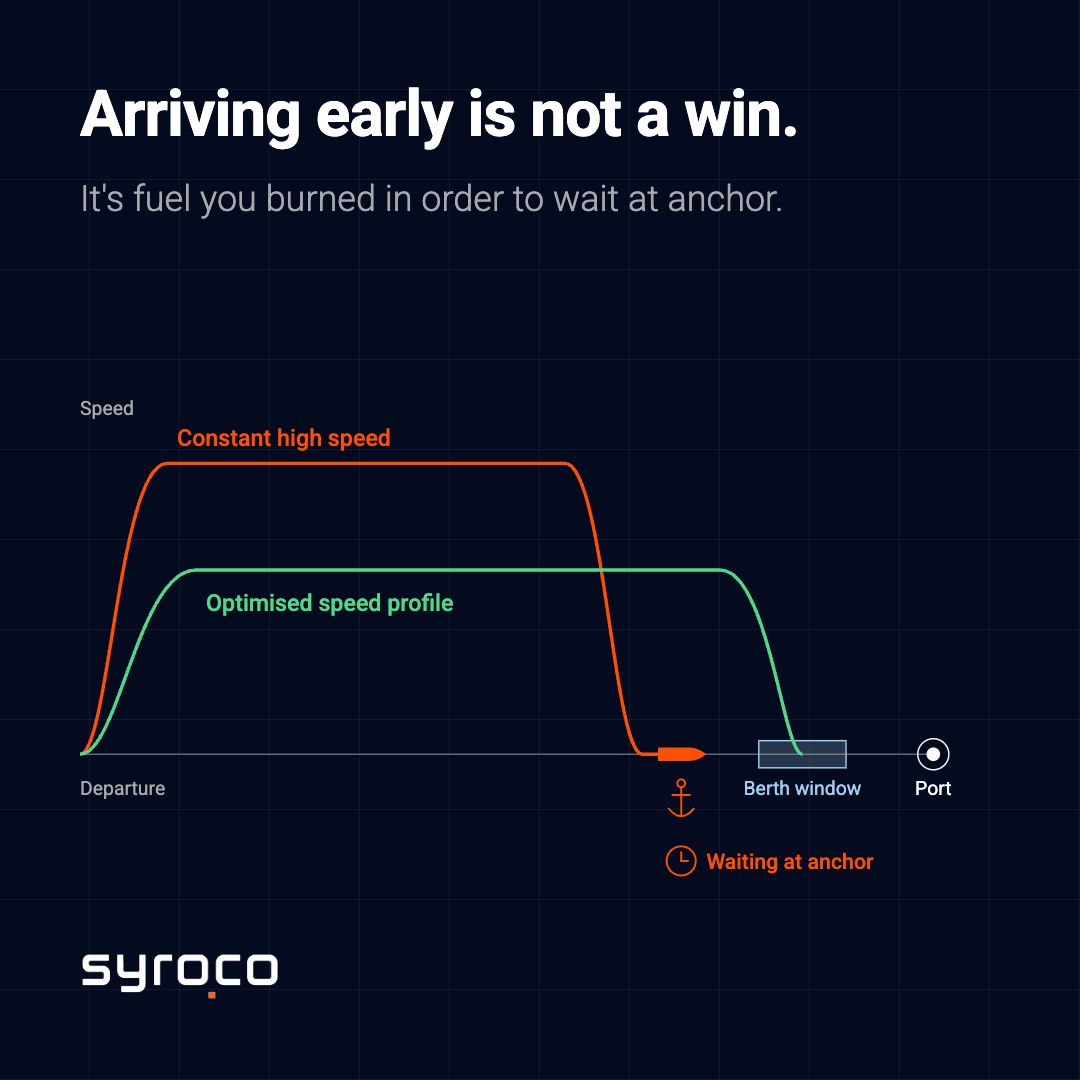
Arriving early is not a win. It is fuel you burned in order to wait at anchor 👇 The pattern repeats on almost every fleet. → The vessel speeds up to protect a laycan → The berth is not free on arrival → The ship waits, having already burned the difference → And nobody prices what that acceleration actually cost The reason is simple. Speed is usually set as an instruction, then the ETA is whatever comes out of it. It should work the other way round. Start from the arrival window you are committed to, then find the speed profile across the voyage that hits it with the least fuel possible. That profile is almost never a constant speed. It changes with the weather ahead, the currents, the sea state and the way this specific hull behaves in each of them. Which is exactly what a digital twin is for. Syroco computes the voyage strategy that respects the ETA you need, and only then minimises what it costs to get there. Same arrival. Less fuel. No commercial risk taken on the schedule. Why arriving early can cost you as much fuel as arriving late 👇 → https://lnkd.in/eq6MEgbf
- LINKEDIN · IMAGESince 23 Oct 2026
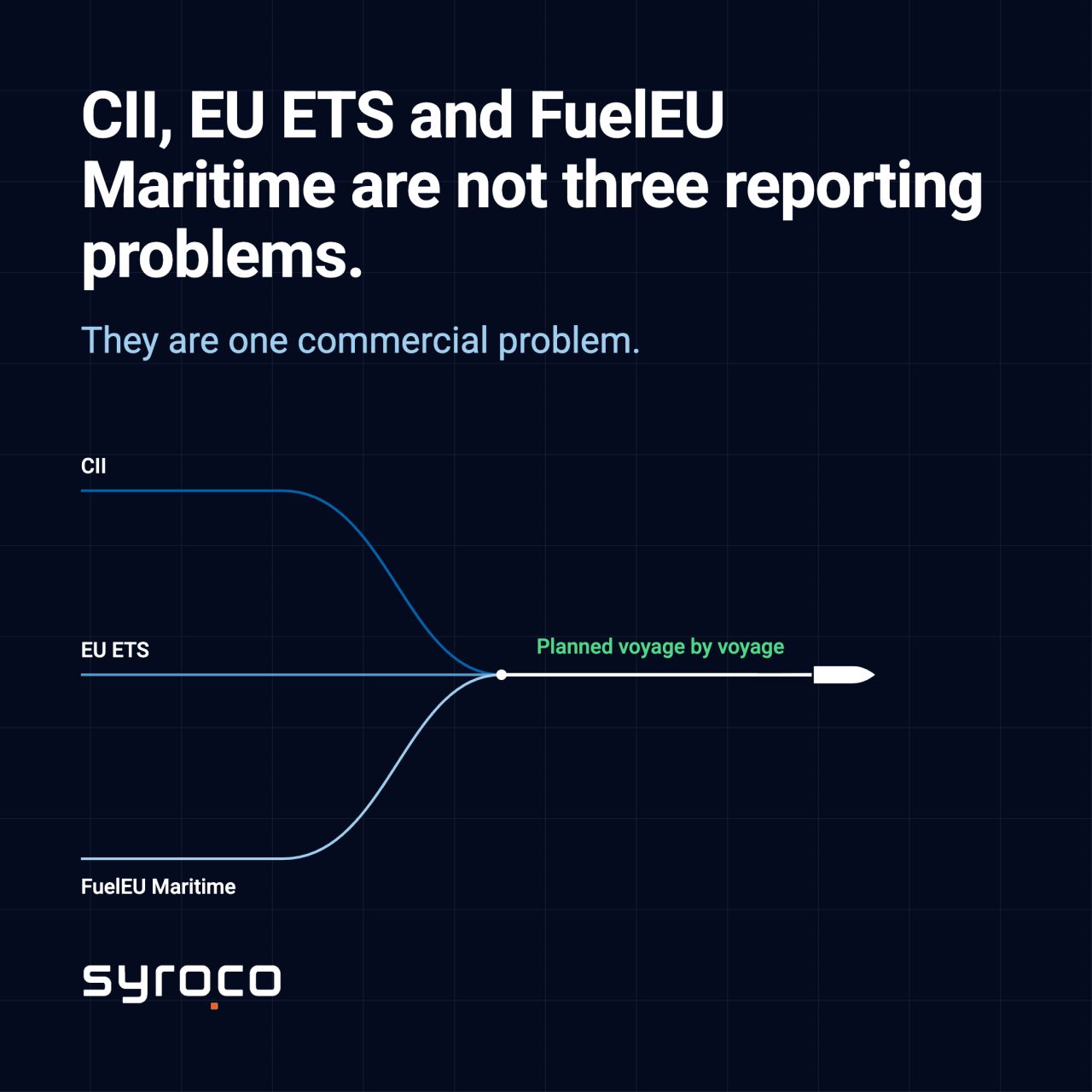
CII, EU ETS and FuelEU Maritime are not three reporting problems. They are one commercial problem 👇 The IMO timeline keeps tightening, and every step of it turns emissions into a line on your P&L. Yet most operators still treat compliance as a separate workflow. A team collects the data, produces the reports, and everyone finds out at the end of the year where the fleet landed. By then the cost is already locked in. → A CII rating that slipped because of a handful of badly optimised legs → Allowances bought at a price nobody planned for → A FuelEU balance managed after the fact instead of across the year → Charterers asking questions your reports answer too late Compliance is not decided in the annual report. It is decided voyage by voyage, at the moment a route and a speed are chosen. Which is why those constraints belong inside voyage planning itself, next to fuel, ETA and commercial obligations. When they sit there, the question changes. It stops being how do we stay compliant, and becomes how do we run this voyage at the lowest total cost, regulation included. Same decision, better information. Less fuel, fewer emissions, fewer surprises at year end. What regulatory exposure actually costs a fleet, and how to plan around it 👇 → https://lnkd.in/e9dCS_TT
- LINKEDIN · IMAGESince 6 Oct 2026
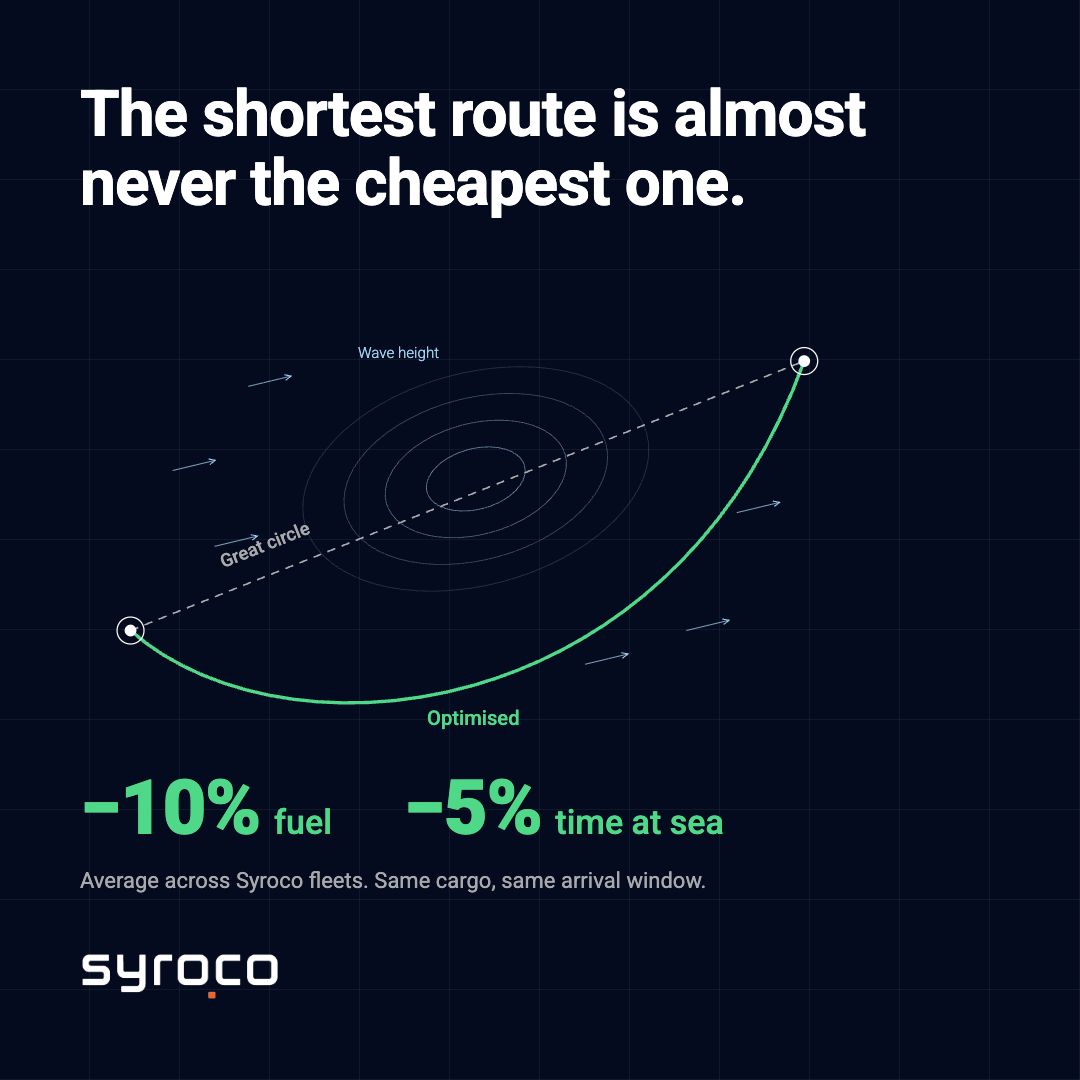
The shortest route is almost never the cheapest one 👇 Every master knows it. Very few have the tools to prove it before departure, so the great circle wins by default. What actually drives the cost of a leg. → Wave height and direction, not just wind → Currents that can give or take a full knot → How this specific hull behaves in this specific sea state → The speed profile across the voyage, not the average speed → The arrival window you are contractually held to Change one of those and the optimal track moves. Change three and the intuitive route becomes the expensive one. This is where standard weather routing stops. It tells you where the storm is. It does not tell you what this vessel, loaded this way, will consume on each of the alternatives. Voyage optimisation does. Syroco simulates the strategies available for the voyage ahead, using a digital twin of the vessel and live weather data, then hands the crew a route and a speed plan they can act on. Average result across our fleets, 10% less fuel and 5% less time at sea. Same cargo, same arrival window. How it works, voyage by voyage 👇 → https://lnkd.in/e4YKS-ED
- LINKEDIN · IMAGESince 6 Oct 2026
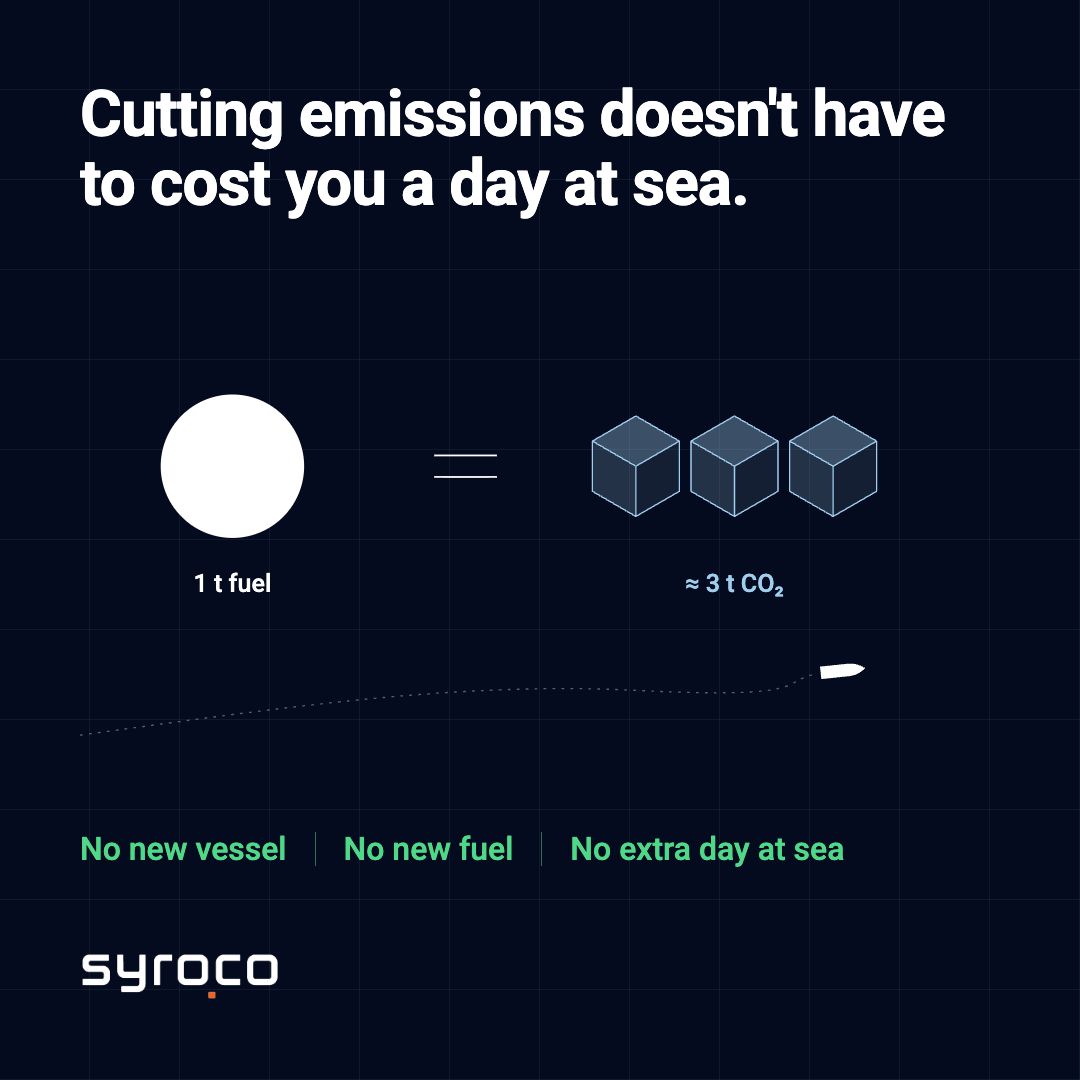
Cutting your fleet's emissions does not have to cost you a single day at sea 👇 Most decarbonisation roadmaps ask you to wait, or to slow down. → Wait for the next generation of vessels → Wait for alternative fuels to be available and affordable → Retrofit, and justify the capex → Or simply slow steam, and hand the schedule problem to your commercial team All of it is real. None of it helps this quarter. There is a lever that does, and it is already on board. Every tonne of fuel you do not burn is roughly three tonnes of CO2 you do not emit. Which means emissions are not a separate project. They are the same optimisation problem as your fuel bill, read from the other side. Optimising the route, the speed and the vessel parameters on each voyage cuts consumption by around 10% on the fleets running Syroco. No new vessel. No new fuel. No extra day at sea. The interesting part is that the two objectives stop competing. The voyage that burns less also emits less, and it still arrives on time. How weather conditions drive both your fuel bill and your emissions 👇 → https://lnkd.in/eqNw37qn
6 of 20 adsSign up to see every Syroco ad, filter by format and date, and get alerts on new ones.
See all 20 adsWatch the companies you care about.
Filter every ad by industry, country, format and network, and get alerts when a company you watch starts running new ads.