Not on air · 2 of 3 networks checked
SyncForce
- syncforce.com
- NL
- 24 employees
SyncForce’s ads on LinkedIn, Meta and Google, recorded by adsrunning. Browse the latest here for free. Sign up free to see all 104. Watch SyncForce with Starter to get each new one in your feed.
Watchlist with Starter · $49/mo
| Network | Status | Live ads | Nov 2025LinkedIn activity · 52 weeksNov 2026 | Checked | Next step |
|---|---|---|---|---|---|
| None recorded | 0 | Checked 29 Oct 2026 | See all 104 ads → | ||
| Meta | Not checked | — | |||
| None recorded | 0 | No ads found on the Google Ads Transparency Center | Checked 11 Oct 2026 | Collect them with the API → |
SyncForce has no live LinkedIn ads. We recorded no Google ads on 11 Oct 2026.
Latest ads
- LINKEDIN · IMAGESince 26 Oct 2026
How often do your teams copy and rework product information your company already has? Once for a trade partner. Again for the website. Again for a catalogue. And again when a new marketplace opens up. Across the food, pet food and CPG manufacturers we work with, the amount of product and packaging data they need to share grows by 20 to 40% a year. More compliance. More customer requirements. More sales channels. That growth does not have to mean more retyping. In SyncForce, the data you maintain once serves Commerce, Customers and Compliance: 𝗖𝗼𝗺𝗺𝗲𝗿𝗰𝗲 your website, webshop, catalogues, price lists and the online product catalogue for your sales team 𝗖𝘂𝘀𝘁𝗼𝗺𝗲𝗿𝘀 complete product data and files for trade partners through GS1 and other datapools,, data ports and digital links 𝗖𝗼𝗺𝗽𝗹𝗶𝗮𝗻𝗰𝗲 product and packaging data reused for PPWR and EPR Marketplaces are the newest part of Commerce. Through the live integration with ChannelEngine, the product content and images you manage in SyncForce can reach more than 1,300 marketplaces and sales channels, including Amazon, bol and Kaufland. ChannelEngine maps the content to each marketplace’s requirements. Some marketplaces will ask for extra attributes or tailored copy. Your team adds those on top of information that already exists, instead of starting from scratch. And when a product changes, the update comes from one place, not from five separate copies. When you evaluate a PIM, ask one question: How much of the product data we maintain can be reused automatically, wherever our business needs it? ChannelEngine
- LINKEDIN · IMAGESince 20 Oct 2026
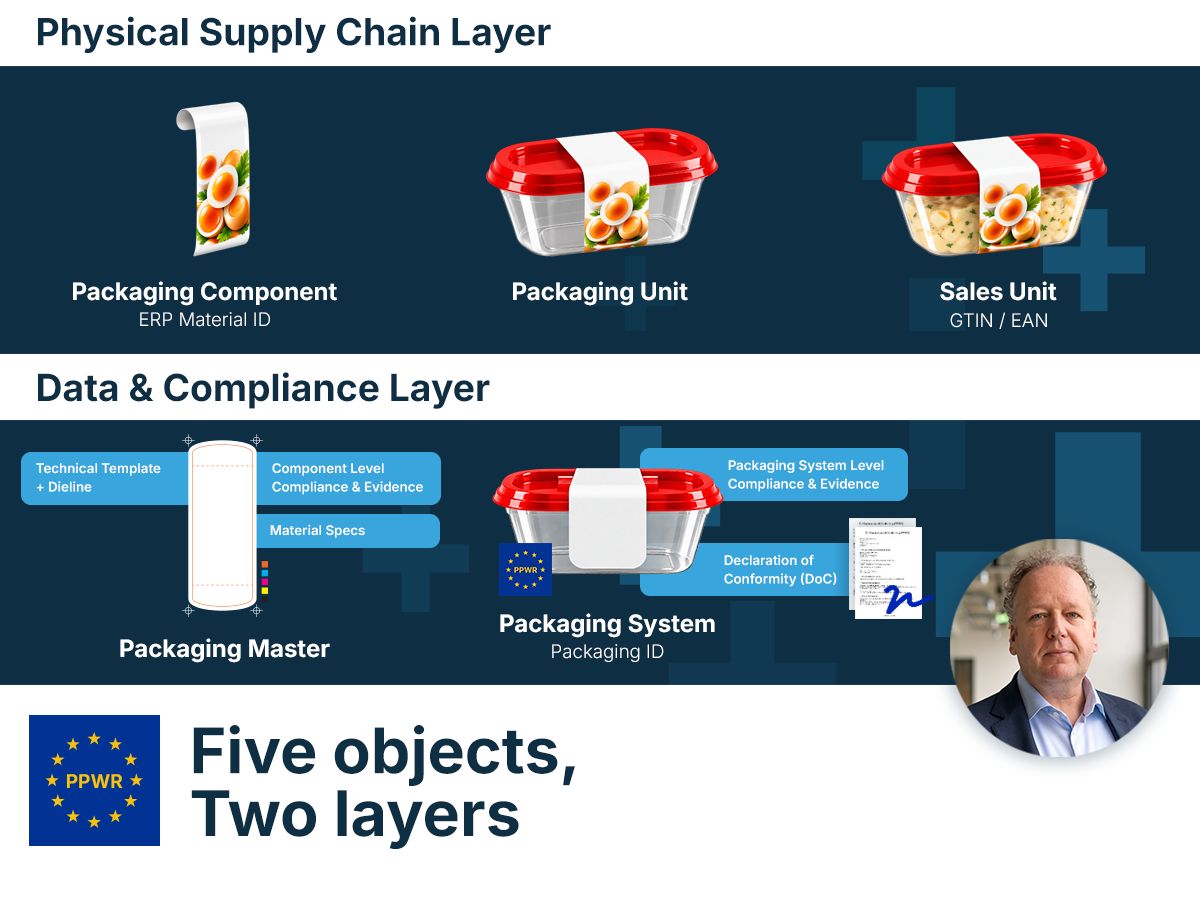
Five objects, Two layers Most PPWR discussions go in circles because two people use the word "packaging" for two different things. Here are the five objects that end the argument. This is the vocabulary we introduced for exactly that reason. It is short, and it settles most of those discussions in one meeting. The physical supply chain layer. What you buy, build and ship. Packaging Component: A single physical item as procured or produced. Film, tray, lid, label, cap, tape. It carries an ERP material ID, a supplier and a stock level. Packaging Unit: The assembly, the BOM, of all components that form one packaging item around the product. At sales, grouped, transport or e-commerce level. Sales Unit: The finished good placed on the market. The product plus its packaging unit. It carries a GTIN. The data and compliance layer. What you assess and declare. Packaging Master: A group of packaging components that share the same material composition, ink system and geometry. Component level compliance and evidence live here. Packaging System: The packaging as placed on the market, identified by the unique combination of Packaging Masters it is built from. It holds the system level assessment and the evidence. This is where the Declaration of Conformity is drafted, once per combination of Packaging System and the manufacturer that places it on the market. Two rules connect the layers. Many components roll up to one master. Many packaging units roll up to one Packaging System. And one rule matters more than the rest: PPWR compliance attaches to the Packaging System, not to the Sales Unit. The Sales Unit still matters, but for a different question. It is what you report per market for EPR, by volume and material. Next in this series: how one label design with 1,251 artwork variants needs exactly one PFAS test.
- LINKEDIN · IMAGESince 16 Oct 2026
"This looks too good to be true. So where’s the catch?” I love that question. Honestly, every buyer should ask it. Yesterday, we got this question again during a meeting. Our industry has earned that scepticism: too many demos that looked perfect, followed by implementations that weren’t. So here is my honest answer: 𝗜𝘁’𝘀 𝗻𝗼𝘁 𝗺𝗮𝗴𝗶𝗰, 𝗶𝘁’𝘀 𝗳𝗼𝗰𝘂𝘀. Generic PIM vendors build for every industry. So the hard parts of food and CPG, the parts that are specific to you, end up as custom work or in a “side Excel” next to the system. Think of label information for mixed products with multiple nutrient tables, mixed displays and pallets, or packaging specs for PPWR. For more than twenty years, SyncForce has worked only for brand and private label manufacturers in food, pet food and CPG. Every hard problem one of our customers ran into, we solved together, and it became part of the product SyncForce. 𝗦𝗼 𝘄𝗵𝗮𝘁 𝗹𝗼𝗼𝗸𝘀 𝘁𝗼𝗼 𝗴𝗼𝗼𝗱 𝘁𝗼 𝗯𝗲 𝘁𝗿𝘂𝗲 𝘁𝗼𝗱𝗮𝘆 𝗶𝘀 𝗮 𝗹𝗲𝗮𝗿𝗻𝗶𝗻𝗴 𝗰𝘂𝗿𝘃𝗲 𝘆𝗼𝘂𝗿 𝗽𝗲𝗲𝗿𝘀 𝗵𝗮𝘃𝗲 𝗮𝗹𝗿𝗲𝗮𝗱𝘆 𝗽𝗮𝗶𝗱 𝗳𝗼𝗿. And the real catch? There is one, and two, actually: 1. We are not a generic PIM. If you’re not a brand or private label manufacturer in CPG, we’re probably not your best choice. 2. Software doesn’t fix data ownership. You still need to decide who owns which data. We help, but it’s your organisation’s job. We ended yesterday’s prospect meeting with an invitation to visit a SyncForce customer and hear about their experience first-hand. As PPWR was central to the discussion, we also invited them to join our PPWR-EPR industry community, with more than 200 members sharing questions and practical insights. Want to hear from a customer or join the conversation with your peers? Happy to connect you.
- LINKEDIN · IMAGESince 12 Oct 2026
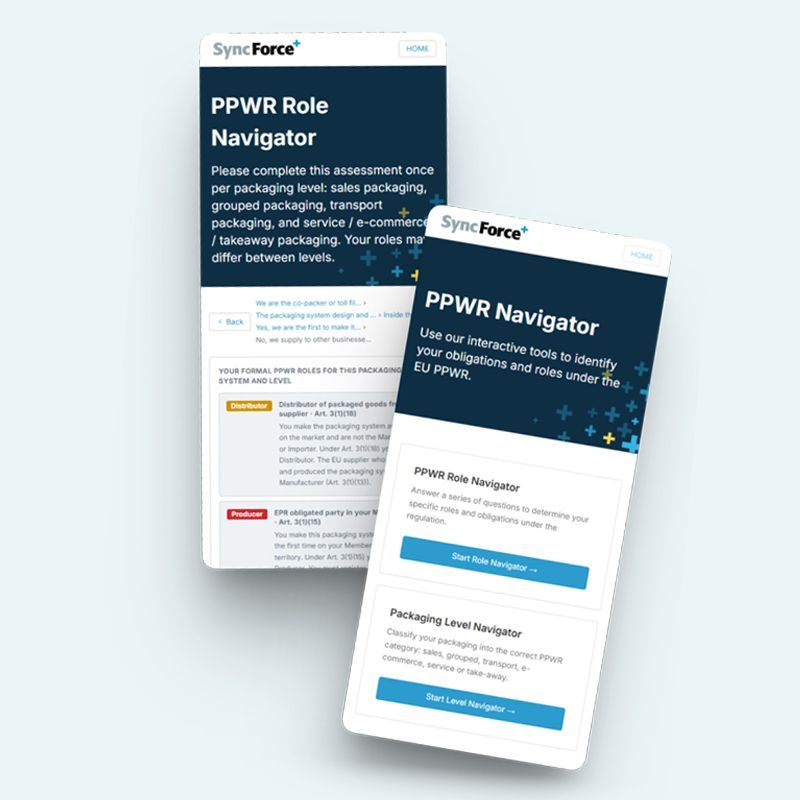
Who signs the PPWR Declaration of Conformity? There is certainly no shortage of webinars, quick scans, events, LinkedIn posts and consultancy offers to help you answer that question. And yes, the definition of “manufacturer” needed clarification. The European Commission’s updated FAQs help. But you can also work through the regulation with a series of questions tailored to your situation. That is what our PPWR Role Navigator helps you do: https://lnkd.in/e2rV_EBF Once you understand your role, the practical work remains. • 𝗛𝗼𝘄 do we exchange packaging data across the entire supply chain, from raw material suppliers to retailers and DIY stores? • 𝗛𝗼𝘄 do you avoid doing all of that through spreadsheets, emails and supplier portals where people keep entering the same information again and again? • 𝗛𝗼𝘄 do we bring that data together, with the supporting evidence, into a compliance dataset for each packaging system (https://lnkd.in/p/eQKF2rPC) that needs a Declaration of Conformity? Knowing who signs the declaration matters. But signing it requires the right data and supporting evidence. Whatever your role, the supply chain still has to get that work done. Let’s make it as efficient as possible. Enjoy the PPWR Role Navigator.
- LINKEDIN · IMAGESince 9 Oct 2026
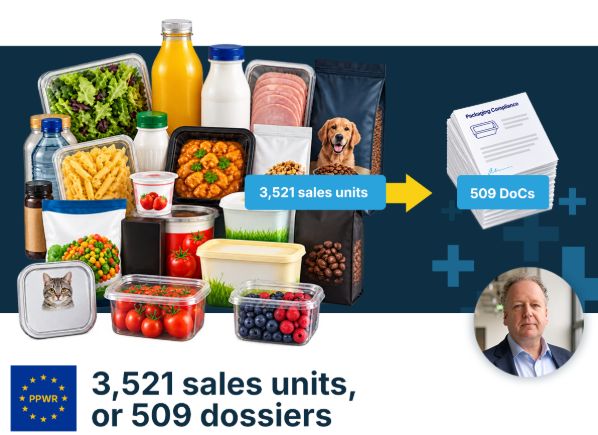
PPWR on 3,521 Sales Units, or PPWR on 509 Packaging Systems. Same portfolio, same law. The only difference is where you attach compliance. If you sell one product, in one flavour, in one market, then packaging equals SKU. One assessment, one declaration, done. Lucky you. Almost nobody in CPG is in that position: One tray, one film, one cap and one label design usually carry dozens of recipes, several languages, a few net contents, own brand and private label. The wider your assortment, the more Sales Units sit on top of the same packaging. Real portfolio, anonymised, German food and pet food manufacturer: • 9,445 packaging components • 3,521 Sales Units • 509 Packaging Systems Attach compliance to the Sales Unit and you sign up for 3,521 assessments. Most of them are copies of each other. The only real difference is the artwork and what is inside. Attach compliance to the Packaging System and you do 509. And they are not evenly spread. The most used Packaging System in that portfolio covers 487 Sales Units on its own. That single dossier brings roughly 14 percent of the whole portfolio into compliance. This is the part that surprises most teams. Assortment width multiplies SKUs. It does not multiply packaging. Every flavour variant you add makes the SKU approach worse and the Packaging System approach better. The work does not disappear. It stops repeating. Next in this series: the five objects you need in your data model, and the two layers they live in.
- LINKEDIN · IMAGESince 2 Oct 2026
𝗔𝗿𝗲 𝘆𝗼𝘂 𝗳𝘂𝗻𝗱𝗶𝗻𝗴 𝗯𝗲𝘁𝘁𝗲𝗿 𝗱𝗲𝗽𝗮𝗿𝘁𝗺𝗲𝗻𝘁𝘀, 𝗼𝗿 𝗹𝗮𝘂𝗻𝗰𝗵𝗲𝘀 𝘁𝗵𝗮𝘁 𝗹𝗮𝗻𝗱 𝗼𝗻 𝘁𝗶𝗺𝗲? Your company wants on-time launches, compliant products and packaging, and tenders submitted on time. None of that happens without the right product and packaging data, artwork and media files. And today they sit in spreadsheets, inboxes and different systems across departments. So when the IT budget round starts, every department asks for its own fix. • Marketing wants a DAM. • Product Management wants a PIM and another DAM. • QA and Sourcing want a supplier portal. • Finance wants more product and packaging data in the ERP. • … I have seen every one of these requests in practice. Each makes sense within its department. But who owns the result across all those departments? Who makes sure the product reaches the market on the date you planned, with the right data in sync? That is a corporate strategy question before it becomes a software selection question. You can choose specialist solutions for each department. There are good reasons to do so. But that choice also needs a plan and a budget for connecting the process: integrations, shared data, handovers and maintenance. Otherwise, a department can become more efficient while the next launch still gets stuck between teams. More chasing, more last-minute fixes, more rekeying, and nobody sees the delay until it is too late. The other approach is to organise around the complete go-to-market process and improve your company's data supply chain. We already apply this thinking to Order-to-Cash: several departments, one connected process, often supported by ERP. Bringing packaged goods to market deserves the same company-wide ownership, from the first idea or customer request through development, approval and launch. As a leadership team, you can set shared priorities and decide where common processes, data and tools would help the whole company move forward. This is the process SyncForce supports: the Operating System for bringing packaged goods to market, with the product and packaging data behind it available On Time In Full (OTIF). 𝗕𝗼𝘁𝗵 𝗮𝗽𝗽𝗿𝗼𝗮𝗰𝗵𝗲𝘀 𝗶𝗻𝘃𝗼𝗹𝘃𝗲 𝘁𝗿𝗮𝗱𝗲-𝗼𝗳𝗳𝘀. 𝗠𝗮𝗸𝗲 𝘁𝗵𝗲 𝗰𝗵𝗼𝗶𝗰𝗲 𝗱𝗲𝗹𝗶𝗯𝗲𝗿𝗮𝘁𝗲𝗹𝘆. 𝗢𝘁𝗵𝗲𝗿𝘄𝗶𝘀𝗲, 𝘆𝗼𝘂𝗿 𝗱𝗲𝗽𝗮𝗿𝘁𝗺𝗲𝗻𝘁𝗮𝗹 𝘀𝗼𝗳𝘁𝘄𝗮𝗿𝗲 𝗯𝘂𝗱𝗴𝗲𝘁𝘀 𝗯𝗲𝗰𝗼𝗺𝗲 𝘆𝗼𝘂𝗿 𝗰𝗼𝗺𝗽𝗮𝗻𝘆'𝘀 𝗜𝗧 𝘀𝘁𝗿𝗮𝘁𝗲𝗴𝘆 𝗯𝘆 𝗱𝗲𝗳𝗮𝘂𝗹𝘁. So, before approving the next departmental investment, ask: Are we improving this department? Or are we improving our ability to bring products to market On Time In Full?



6 of 104 adsSign up to see every SyncForce ad, filter by format and date, and get alerts on new ones.
See all 104 adsWatch the companies you care about.
Filter every ad by industry, country, format and network, and get alerts when a company you watch starts running new ads.