Not on air · 2 of 3 networks checked
Studiosity
- studiosity.com
- Higher Education
- AU
- 362 employees
Studiosity’s ads on LinkedIn, Meta and Google, recorded by adsrunning. Browse the latest here for free. Sign up free to see all 468. Watch Studiosity with Starter to get each new one in your feed.
Watchlist with Starter · $49/mo
| Network | Status | Live ads | Nov 2025LinkedIn activity · 52 weeksNov 2026 | Checked | Next step |
|---|---|---|---|---|---|
| None recorded | 0 | Checked 1 Nov 2026 | See all 468 ads → | ||
| Meta | Not checked | — | |||
| Recently | 1 | Ads on the Google Ads Transparency Center | Checked 10 Oct 2026 | Collect them with the API → |
Studiosity has no live LinkedIn ads. We recorded 1 Google ad on 10 Oct 2026.
Latest ads
- LINKEDIN · VIDEOSince 31 Aug 2026
"The validation process made me feel seen." This student described what it's like to show her own thinking in a multi-layered learning assurance process, instead of being surveilled. Because the biggest challenge in education is: When AI can give the answers, how do we know students did the thinking? Learning assurance in 2026 is confidence that a particular student did the thinking, and can now do what their degree says they can. Including self-validation from the student, rather than guesswork about a document. Because you can try to verify keystrokes in a document, or try to detect cheating, and still know nothing about who was behind it, or how their thinking, learning, and authorship evolved to produce an awarded degree. That's what's changing now. Thank you to the educators and students around the world doing this work right now with us, inside their own institutions.
- LINKEDIN · IMAGESince 22 Jun 2026
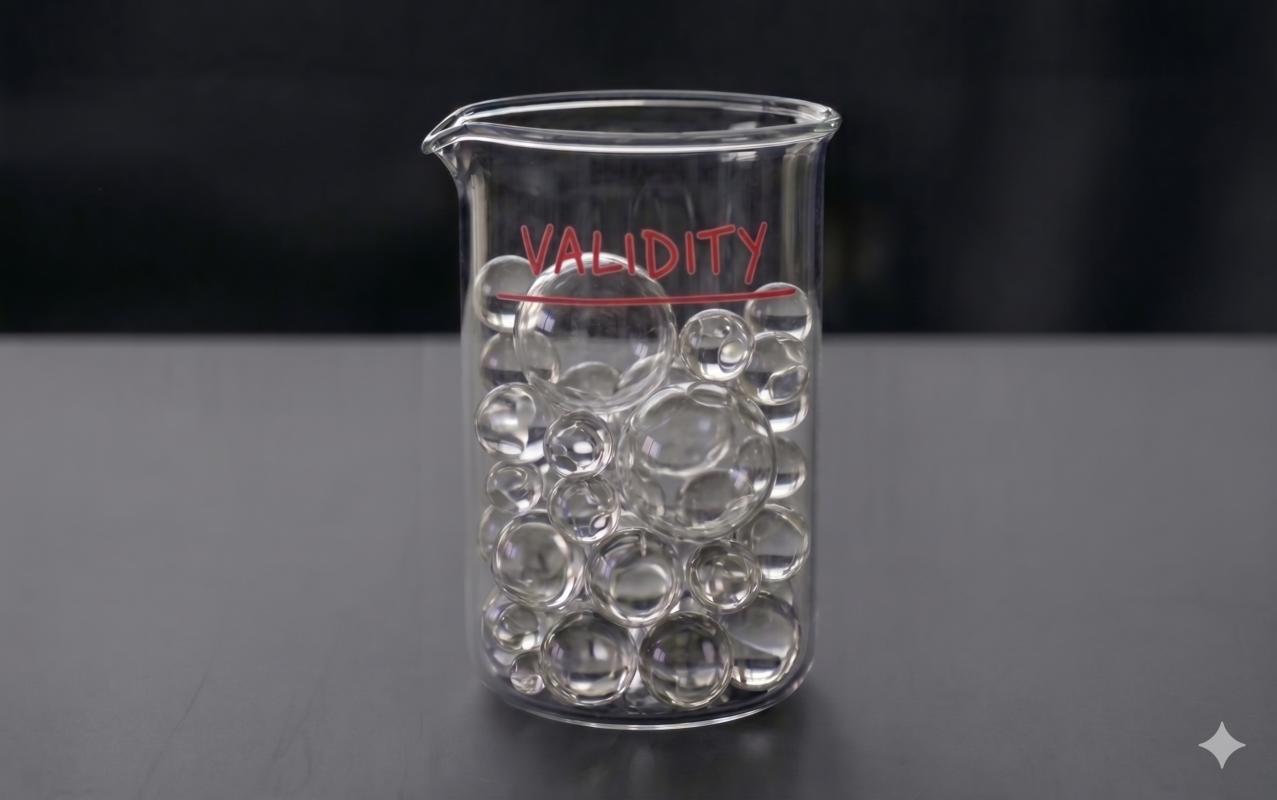
A recent wave of discussion surrounding 'AI for cognitive offloading' in education has brought some leaders to an overdue inflection point for any technology: 'is this tool serving itself, or our learning mission, first?' On the surface, it's a relatively simple question, but one made complicated by status quo, misinformation & marketing from providers, pressure for a quick fix, and/or the optics of needing to adopt 'cognitive-offload AI' because 'students want it'. When - in fact - students' anxiety, fear, and peak confusion about being given tech licences and then being punished for using the same, says otherwise. Politics and change management are no small feat, but strong leadership will always guide the way to put learning first for all students. And the loudest voices for learning-first strategy - rather than tech-first - are those of educators and students. (Fair warning to any commencement speakers seeking to hype up technology at graduation ceremonies...) Graduates need to develop critical thinking skills, and their assessments and overall degree must be a guarantee of that skill and effort. In 2026, the list of universities around the world partnering with Studiosity can say this of their graduates. There's no doubt that regulators globally will be looking for tangible, evidence-based indicators of 'degree guarantees'. #keepthelearningreal
- LINKEDIN · IMAGESince 22 Jun 2026
Right now, both faculty and students are navigating shifting, contradictory rules. Students feel caught: encouraged to use institutional AI tools on one hand, yet villainised by a culture of suspicion on the other hand. (i.e. see YouGov-Studiosity 2026 Student Wellbeing Survey.) At the same time, educators are struggling to make decisions about student authorship and real learning, not to mention becoming overnight assessment design experts. They also are being given the 'freedom' and 'flexibility' from the institution to implement - and give some weight to - AI and Assessment policy. It's not lost on the educators and staff that this choice and experimentation carries the burden of no less than holistic degree and graduate reputation. The purpose of higher education is to graduate critical thinkers. That skill cannot be automated; it can only be developed within the active journey of learning. This is obvious to all our university and education partners around the world, who for decades have used Studiosity to develop measurable skills improvement and critical thinking in their students, their graduates. It's also pedagogically and technologically obvious now that the next step is to actively ensure at an institutional level: 📍 The critical thinking journey, and to, ✅ Validate that journey. These past six months, the overwhelming theme of conversations with leaders, educators, and professionals in the sector globally has been: 🧠 "Keep the learning real." So that's what we're doing: The critical thinking and the student self-validation required for defensible assessment and graduates; and perhaps most immediately, some peace of mind for educators and students. https://lnkd.in/gPBz3DDi
- LINKEDIN · IMAGESince 4 Jun 2026
“As someone whose academic roots are in sociology and anthropology, I tend to look at higher education through the lens of human systems and cultural behaviour. And right now, the system looks broken. Students become critical thinkers in the moments between milestones, through the ongoing work of learning. To restore the learning journey, we have to stop looking at assignments as static digital files to be policed, and start looking at them the way an anthropologist looks at culture: as a living, continuous process of human creation.” Read more from Prof Judyth Sachs: https://lnkd.in/gYesC8AH
- LINKEDIN · IMAGESince 3 Jun 2026
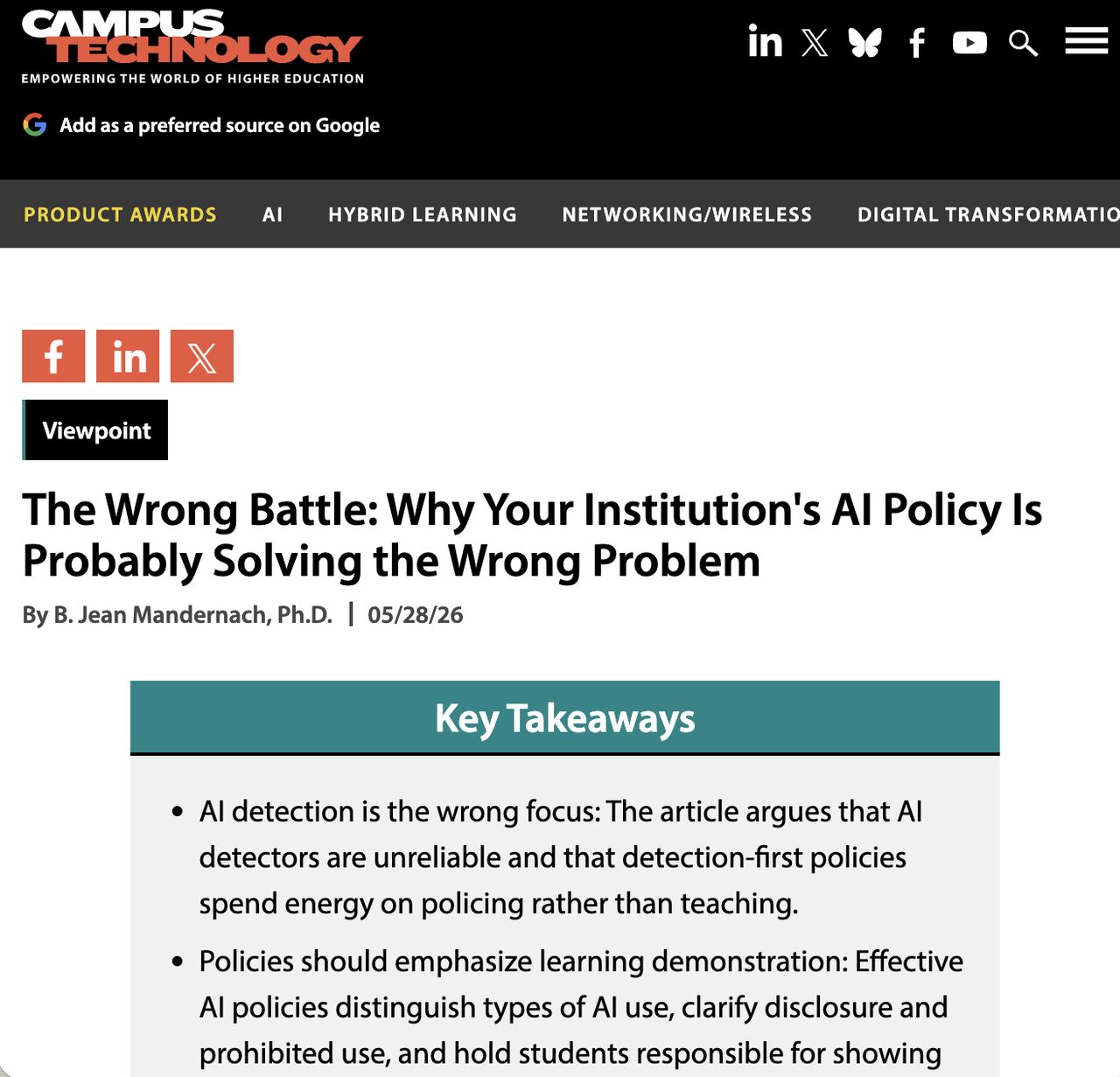
Higher education is fighting the wrong battle. The current focus on detection is an unwinnable arms race that treats the symptom, rather than supporting a true goal of learning. There is emerging consensus on a first step: 📍 Move from artefact and technology first, back to the student's learning first. Because a static document is a flawed proxy for higher order learning. In itself, it doesn't develop or show a journey of critical thinking skills. Also as a consequence, policing this flawed system creates an adversarial T&L culture and fails to protect what it actually intends to: educational integrity. Universities must transition from punitive enforcement as a core strategy - detection and surveillance - to pedagogical validation. And it absolutely must be done in a way that doesn't put the burden on educators to fight a macro, institutional, epistemological crisis, in a piecemeal way. Yet at the moment, institutional policy around the world can read like: ❓ "...giving flexibility for innovation..." ❓"...enabling unit level flexibility..." ❓"...impossible" ❓"...untenable" The ongoing risk is that the institution secures its credibility through benchmarks (e.g. 50% of grades tied to....) as a regulatory shield of sorts. It is then reliant on educators securing the same credibility through innovation and labour. In any other sector, when an organisation sets a top-down kpi, the problem is usually solvable by employees and teams. It is bounded by 'known-knowns'. Ship a product, increase revenue... In the case of higher education, the problem and solution are murky and complex. It feels like educators are being asked to solve a global crisis on an individual or unit level. The shift must be urgently operationalised at scale, to move universities - populations with as much variance and diversity as whole cities - back to student learning, to students' ownership of their learning, and to leave behind the practice of awarding degrees based on what's in - or not in - the artefact, only. That's also why from July, universities around the world will be moving to our 'Support and Validate' model of assessment security. To learn more or participate in a global study, complete the form at studiosity.com/validate.
- LINKEDIN · IMAGESince 27 May 2026
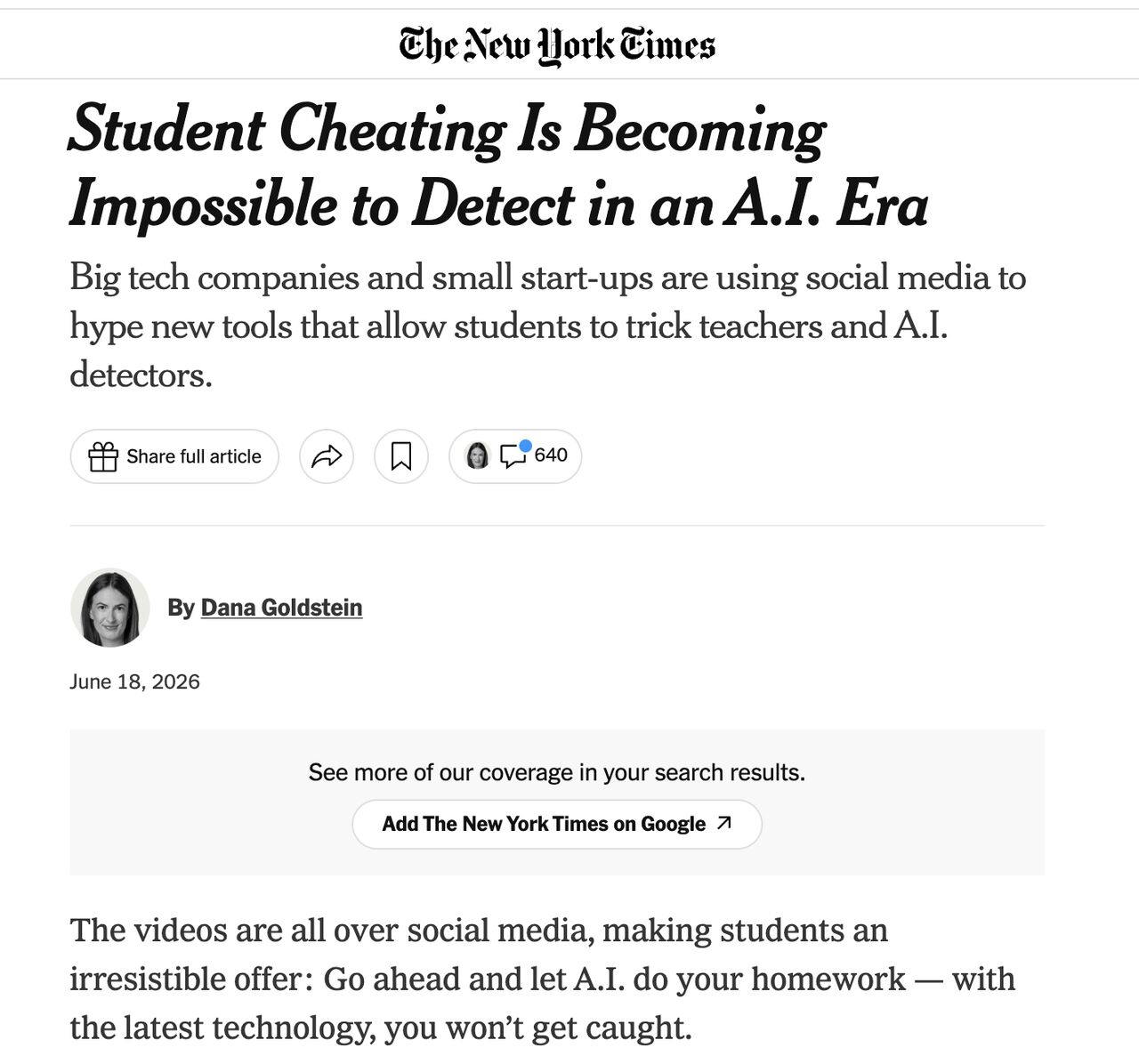
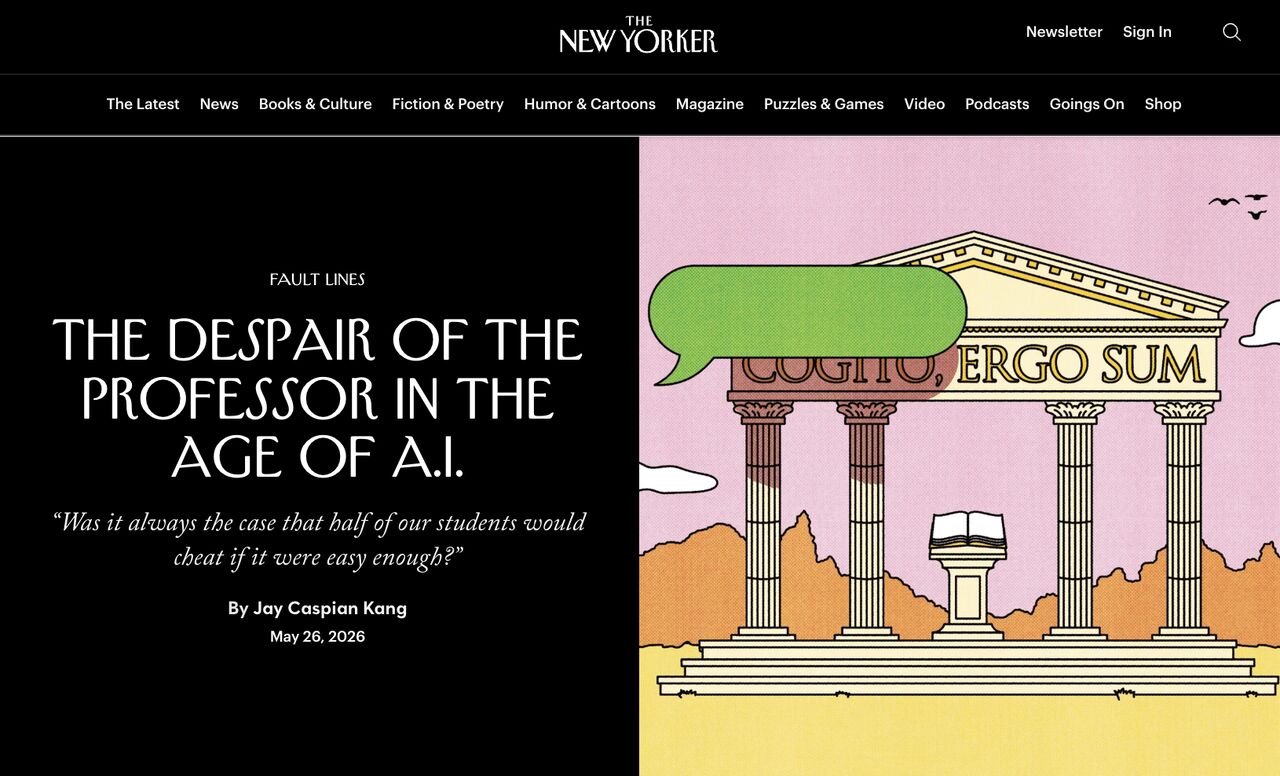
If you’re an educator in higher ed, the New Yorker piece probably feels both familiar and uncomfortable. ("The Despair of the Professor in the Age of A.I.", by Jay Caspian Kang.) It captures well the exhaustion of teaching a university cohort in 2026. And notably, the crisis isn't vague or hypothetical or otherwise unknowable; it's now highly specific. It looks like a continually intertwined pattern of: 📍 forced assessment design, 📍 lack of scale, 📍 uncertainty, and 📍 execution of institutional policy. 📈 The scale barrier: "I was able to do a comprehensive oral final... because it was a small seminar with eleven students... scaling this when you have a hundred and fifty-plus students is impossible." - Susanna F. Boxall, Lecturer in philosophy, California State University, Chico. 🧠 Pedagogy at risk: "...what counts as student work, how assessment should change, and how to preserve the kinds of struggle and independent thinking that learning depends on." - Lauren Aulet, Assistant professor, department of psychological and brain sciences, the University of Massachusetts, Amherst. 🦸 Heroic workload: "...students still would use A.I. in a thoughtless way, as a replacement for their thought and judgment. So I made a point to just call them on it, and make them meet with me personally. I saw dozens of students, often for thirty- to forty-five-minute conversations. I wanted to understand where they were coming from." - Daniel Silver, Professor of sociology, University of Toronto, Scarborough. 🚨 Police and punish: "But there is no definitive way to check, and with fifty students I don’t want to spend my time playing “CSI: Who Wrote This Paper?” - Elizabeth Strom, Associate professor, School of Public Affairs, University of South Florida. Higher education, and educators, need a definitive way forward. And right now. 📍 From July universities will be choosing to #supportandvalidate instead. No percentage scores to sift through, and no forensic guesswork. Your students develop thinking skills, self validate, you keep your usual assessment set up. We look forward to working with our university partners on this shift from detection back to learning, and invite interested educators and leaders to reach out: https://lnkd.in/gW3gvWmm
6 of 468 adsSign up to see every Studiosity ad, filter by format and date, and get alerts on new ones.
See all 468 adsWatch the companies you care about.
Filter every ad by industry, country, format and network, and get alerts when a company you watch starts running new ads.