On air · 2 of 3 networks
SQUAD
- squad.tech
- CY
- 757 employees
SQUAD’s ads on LinkedIn, Meta and Google, recorded by adsrunning. Browse the latest here for free. Sign up free to see all 231. Watch SQUAD with Starter to get each new one in your feed.
Watchlist with Starter · $49/mo
| Network | Status | Live ads | Nov 2025LinkedIn activity · 52 weeksOct 2026 | Checked | Next step |
|---|---|---|---|---|---|
| Running | 77 | Checked 29 Oct 2026 | See all 231 ads → | ||
| Meta | Running | 1 | Active ads on the Meta Ad Library, all countries | Checked 26 Oct 2026 | Collect them with the API → |
| None recorded | 0 | No ads found on the Google Ads Transparency Center | Checked 10 Oct 2026 | Collect them with the API → |
SQUAD has 77 live LinkedIn ads. Its Facebook page had 1 active ad on 26 Oct 2026, and we recorded no Google ads on 10 Oct 2026.
Latest ads
- LINKEDIN · IMAGESince 26 Oct 2026
SQUAD turns 10! As a Formula 1 fan, I can't help seeing some parallels between F1 and what we do at SQUAD. What I find fascinating about F1 is how much engineering happens before a car ever reaches the starting grid. Teams tackling unfamiliar problems, making thousands of decisions, running experiments and tests, and constantly finding ways to improve. All coming together in a few hours on the track. There is something familiar about that. Over the past decade, SQUAD has contributed to 70+ products, from AI-powered cameras to other connected devices. Behind every launch are years of engineering work, countless iterations, and, most importantly, the team figuring out how to make things work reliably in the real world. That's probably my favorite part of the F1 comparison. Great engineering matters, but so does the team behind it. I'm grateful for the people I've worked with, the problems we've solved, and everything we've built together. I took this photo during my first week at SQUAD, a little over seven years ago (hence the quality). Happy 10th anniversary, team! Here's to what's next. #TechAnniversary #F1 #ArtificialIntelligence #MachineLearning #SQUAD
- LINKEDIN · IMAGESince 26 Oct 2026
You know that one guy at your new job who gives you a suspicious look and doesn't seem particularly happy to see you? Well, for me, that was Denys Kuznetsov 😁 Luckily, that first impression couldn't have been more wrong! We've faced some tough challenges, built a lot together, helped each other grow, and I always knew I could count on him. And now I'm genuinely happy to see Denys take this next step. Cycling has been a huge part of his life for as long as I've known him, and seeing him make it part of his career is pretty special. He's now CTO at Echelon Cycling Hub in Mallorca. And if you're ever in Mallorca, you know someone who can show you some great cycling routes! https://lnkd.in/dfwePYsH #CareerGrowth #WorkplaceRelationships #CyclingLife #ProfessionalGrowth #NewBeginnings
- LINKEDIN · IMAGESince 26 Oct 2026
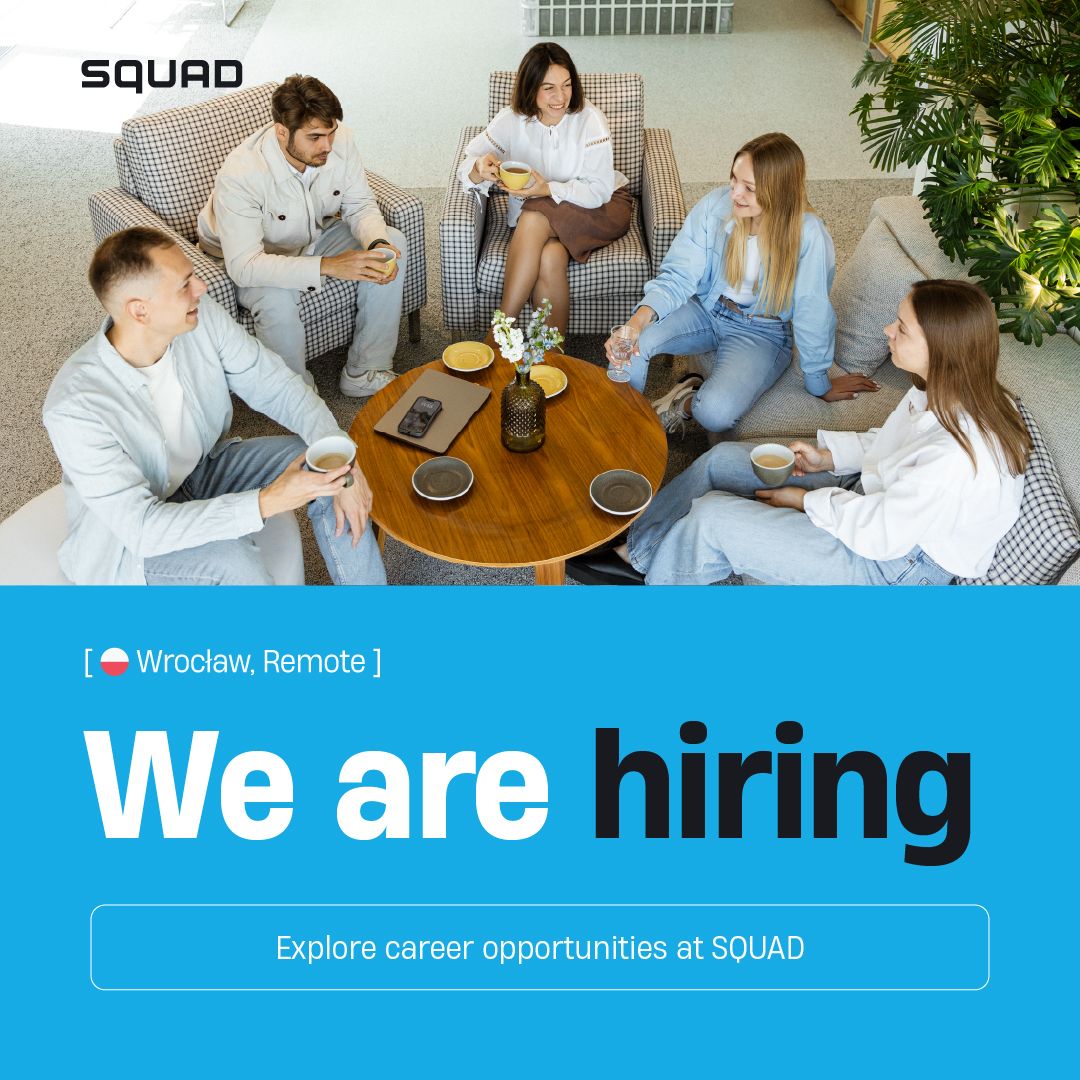
SQUAD develops AI-powered smart camera solutions 🌟 And we are scaling the team with industry’s most forward-thinking minds! Whether in our Wroclaw office or remotely, we invite developers, engineers, and scientists to architect the future of IoT. Explore our open roles — take on a technical challenge that defines a career!
- LINKEDIN · IMAGESince 12 Oct 2026
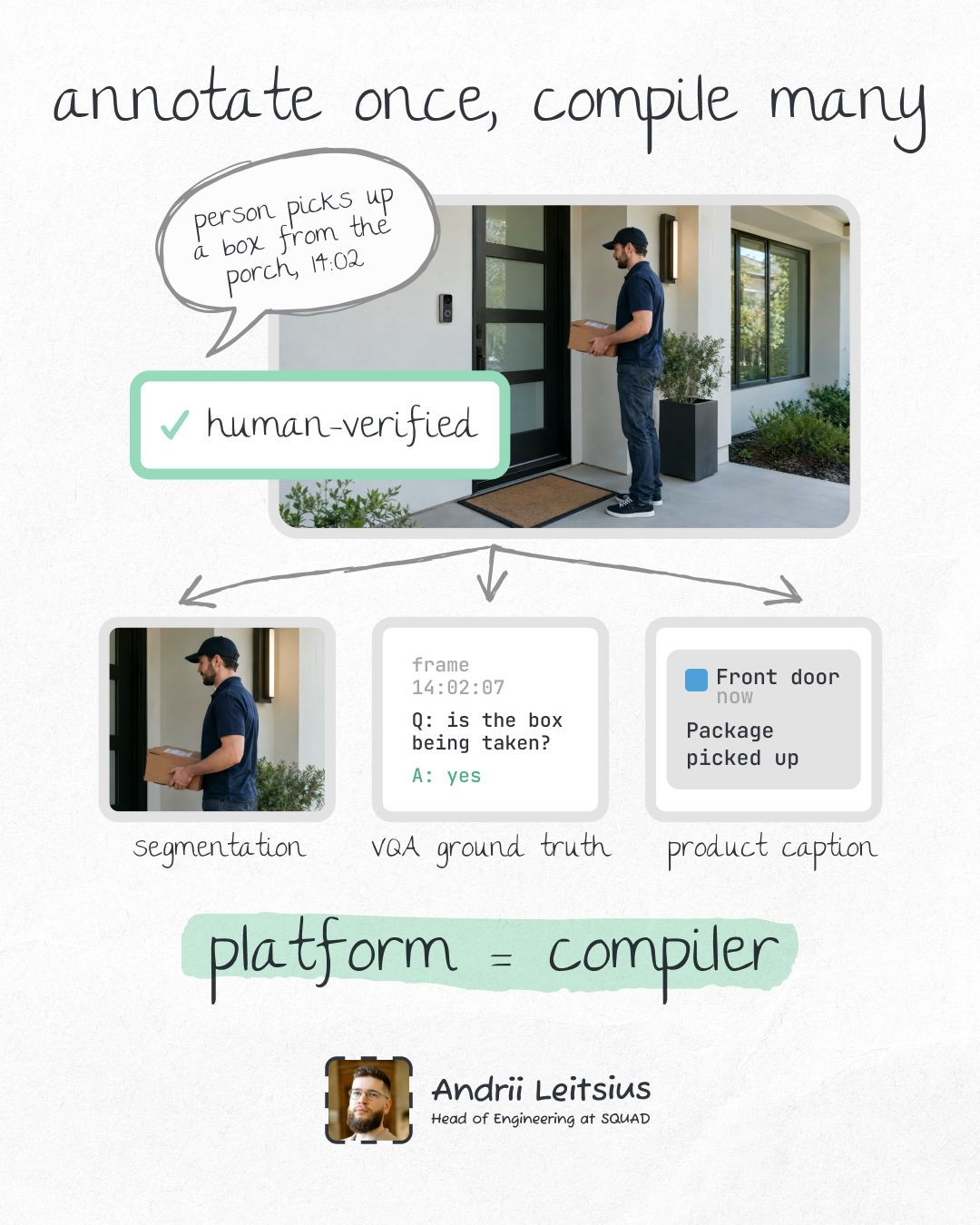
Annotation budgets assume every clip needs every label the model will use. 2 papers question that. 1. UniD trains one video model on 8 dense tasks (depth, normals, segmentation, boundaries, human parts, albedo, shading, materials) using disjoint datasets. No clip carries the full label set. Specialist models pass supervision through lightweight task projectors. 2. LiDAR-SAM2 transfers labels across sensors. A click on an object in video produces a SAM2 mask track, which is then projected into 4D LiDAR. On SemanticKITTI, the authors report results close to full human supervision. I see a similar pattern in captioning workflows. An annotator dictates a rich free-text caption, or a VLM drafts one and a human verifies it. The caption is converted into a structured representation, and VQA ground truth and product-specific captions are deterministically generated from it. One annotation pass feeds several datasets. In this setup, the annotation platform works like a compiler. The input is the richest human-verified signal the budget allows. The outputs are the training views each experiment needs. For that to work, the platform has to store label provenance, the source interaction, the calibration version for cross-modal projections, the transformation behind each view, and the quality gate each label passed. For LiDAR, the path is: video prompt → temporal mask → calibrated projection → LiDAR proposal → review/validation Both papers are early. UniD covers tasks with strong shared visual priors, and it's unclear how it handles semantic events or rare safety behaviors. LiDAR-SAM2 is one workshop paper on one benchmark and still depends on human clicks. Calibration errors, new sensors, and rare classes are untested. A reasonable first test is a small synchronized video-plus-range sample, measured on correction effort and downstream defect rate. #ComputerVision #VideoAI #LiDAR #DataAnnotation #SQUAD
- LINKEDIN · IMAGESince 12 Oct 2026
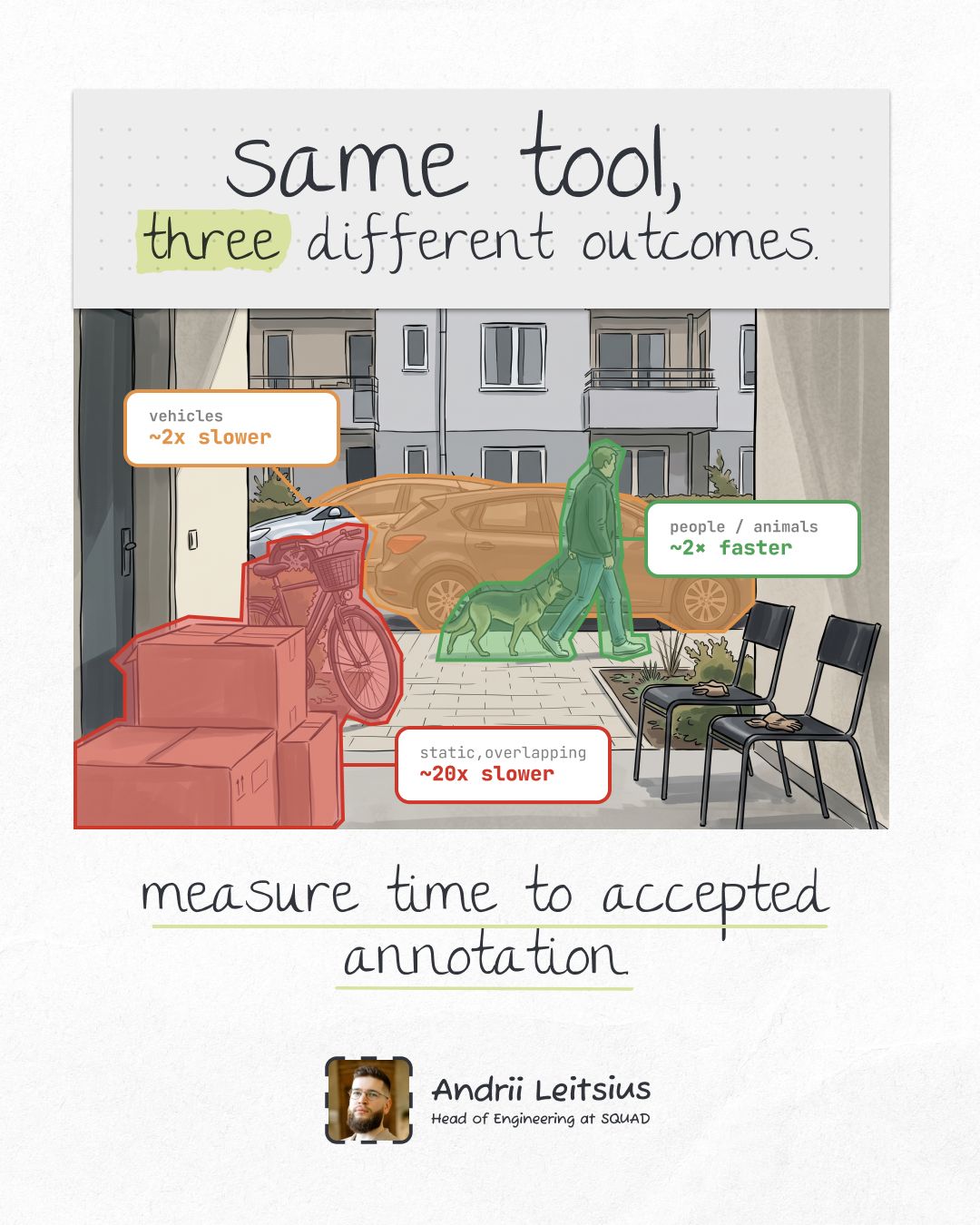
Segment-Anything-style assistance in video annotation looks like an obvious win. Measured per object class, the picture changes fast. In my experience, it looks roughly like this: → People and animals: annotation time drops by about 2×. → Vehicles: annotation time goes up by about 2×. → Static overlapping objects: up to ~20× slower. A blended average can look perfectly acceptable and still hide where the tool adds work. For deformable, well-separated objects, the first mask proposal is close enough. The annotator accepts it or adjusts a boundary. Where instances overlap, or the boundary is ambiguous, proposals merge or split instances, and correcting a bad mask takes longer than manually drawing the polygon. So, the useful question is where SAM works, class by class and workflow by workflow. What's worth tracking per class: → proposal accept/reject/edit rate → correction time against the manual baseline → quality after review, checked in a blind audit → end-to-end time and cost to an accepted annotation Model accuracy on a benchmark tells you very little here. A well-scored model with poorly calibrated proposals can raise correction cost and anchor annotators to the wrong boundary. The unit that matters is the accepted annotation. Every assistance feature has to prove it gets you there faster for that specific class before it becomes the default. #ComputerVision #DataAnnotation #VideoAnnotation #AIProductivity #SQUAD
- LINKEDIN · IMAGESince 2 Oct 2026
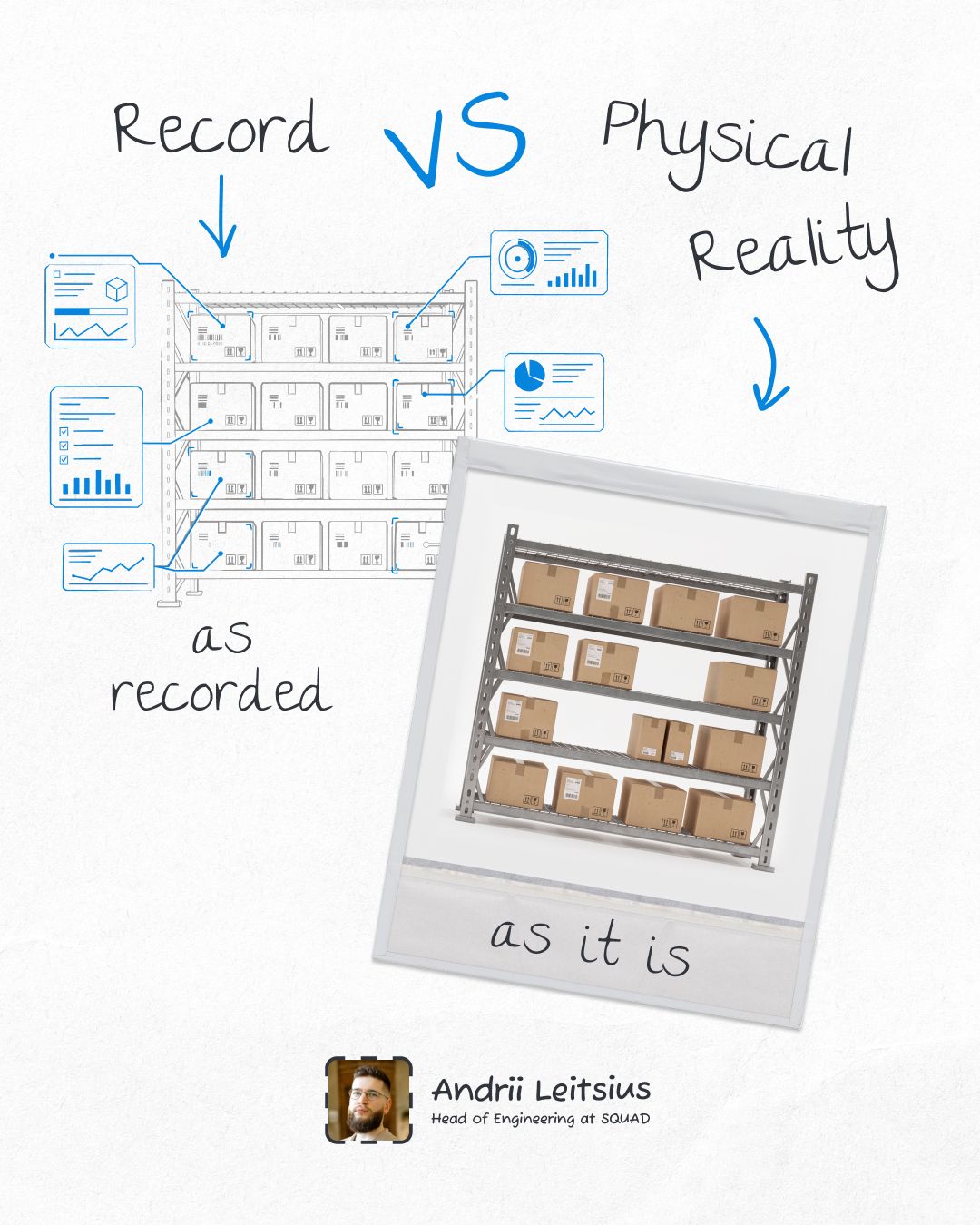
A digital twin of a warehouse is only as honest as the last time a picker looked at the shelf. This may sound obvious. In practice, it’s where digital twin projects start to drift. The model gets built once, from the records, but then reality moves. Pallets end up one bay over or something gets restacked during a busy shift. Months later, the twin still looks good. This failure frequently gets called “data silos,” which makes it sound like an integration problem. I don’t think that’s the main issue anymore. Systems expose decent APIs now. So, the problem is that the inventory system only knows what was recorded. It has no way to look at the shelf and disagree. Nothing in this loop compares the record to the object. I know this problem from the camera side. A detection is a claim about the physical world, and I have learned not to trust one I can’t check. That’s what ground truth work is for. You film the same scene across device types, day and night, indoors and out, and then find out where the system was confidently wrong. On a warehouse floor, it is the same job with different equipment. Somebody has to go and compare the record to the object regularly, as part of running the thing. #DigitalTwin #WarehouseManagement #SupplyChainTech #LogisticsInnovation #ComputerVision
6 of 231 adsSign up to see every SQUAD ad, filter by format and date, and get alerts on new ones.
See all 231 adsWatch the companies you care about.
Filter every ad by industry, country, format and network, and get alerts when a company you watch starts running new ads.