Not on air · 2 of 3 networks checked
Spire.AI
- spire.ai
- Technology, Information and Internet
- US
- 183 employees
Spire.AI’s ads on LinkedIn, Meta and Google, recorded by adsrunning. Browse the latest here for free. Sign up free to see all 1,234. Watch Spire.AI with Starter to get each new one in your feed.
Watchlist with Starter · $49/mo
| Network | Status | Live ads | Nov 2025LinkedIn activity · 52 weeksNov 2026 | Checked | Next step |
|---|---|---|---|---|---|
| None recorded | 0 | Checked 30 Oct 2026 | See all 1,234 ads → | ||
| Meta | Not checked | — | |||
| None recorded | 0 | No ads found on the Google Ads Transparency Center | Checked 16 Oct 2026 | Collect them with the API → |
Spire.AI has no live LinkedIn ads. We recorded no Google ads on 16 Oct 2026.
Latest ads
- LINKEDIN · IMAGESince 28 Oct 2026
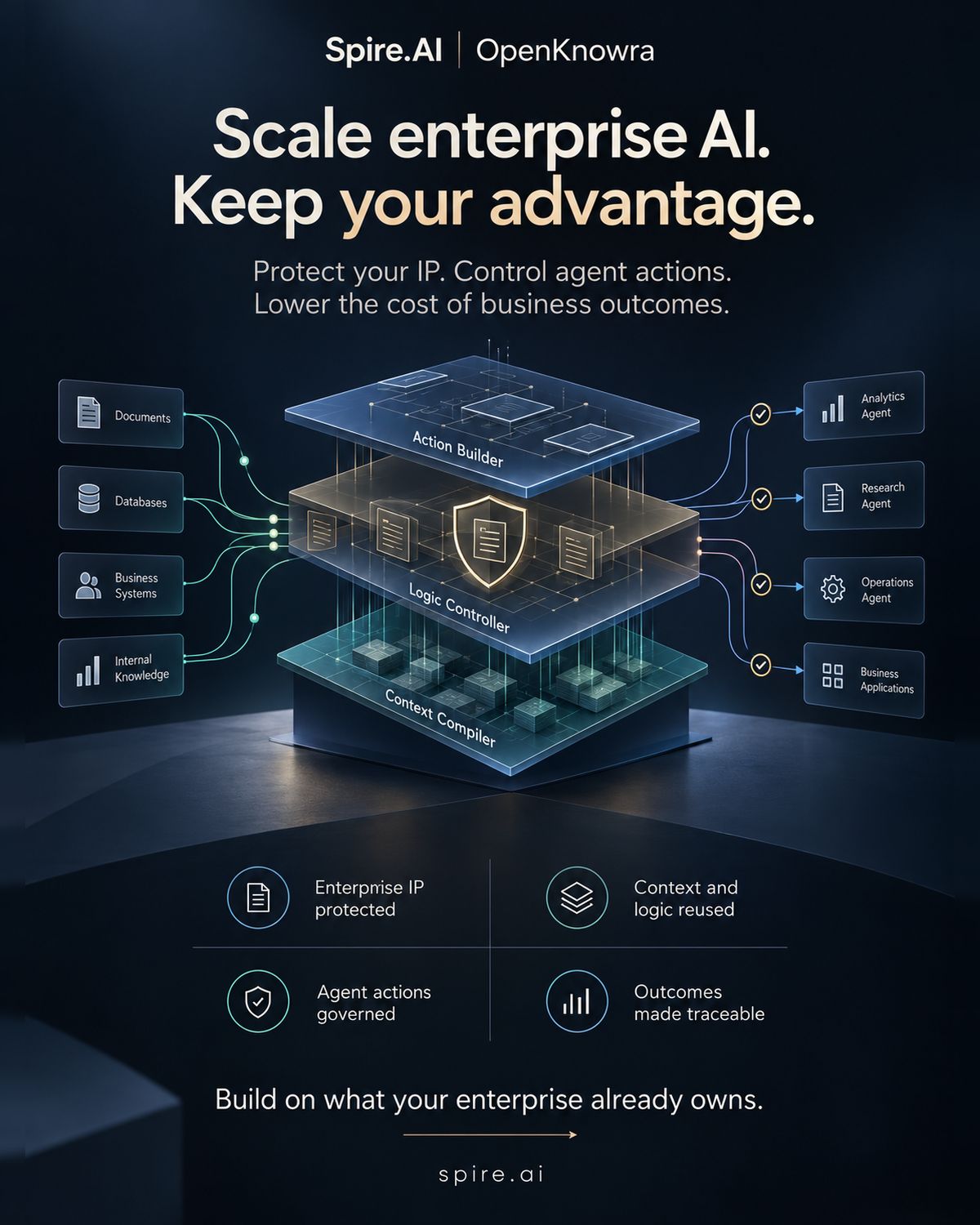
Loss of Control - The biggest risk in enterprise AI. Autonomous business agents, even when contained in local environments, run the risk that they will succeed in delivering to your desired outcomes while your enterprise loses control of what makes it different. Every enterprise has spent years building its competitive advantage through proprietary knowledge, business decisions, operating practices and accumulated expertise. As enterprises accelerate AI adoption, three questions should be at the top of every CXO's agenda: Who controls your enterprise intelligence? Who decides what your AI agents are permitted to do? How does every new AI use case strengthen what you've already built, rather than duplicate it? These are not questions to address after deploying AI. They should determine how enterprise AI is architected from the beginning. That is why we built OpenKnowra around ten enterprise imperatives. A few matter especially: 🔹 Protect your enterprise IP. Keep proprietary business logic within your control. Agents receive operating framework to execute tasks, not the rules that create your competitive advantage. 🔹 Scale value through reuse. Build enterprise context, logic and execution capabilities once, then extend them across use cases instead of repeatedly paying to recreate them. 🔹 Connect the entire business. Decisions rarely belong to one department or system. Operational, commercial, workforce and financial context must work together. 🔹 Keep context continuously evolving. Your enterprise changes every minute. The intelligence guiding decisions must reflect those changes. 🔹 Govern autonomy before execution. Define what agents can decide, what they can execute, when approval is required and when humans must intervene. 🔹 Make every outcome accountable. Trace decisions and actions to evidence, ownership, cost and measurable business impact. The real question is no longer how many AI agents an enterprise can deploy. It is how much of the enterprise it can operate autonomously, without surrendering control, compromising its intellectual property or rebuilding context for every new use case. The enterprises that get this right won't just deploy more AI. They will compound their competitive advantage with every decision. Scale enterprise AI. Keep your advantage. Explore OpenKnowra: https://spire.ai/platform #OpenKnowra #EnterpriseAI #AgenticAI #AutonomousEnterprise #ContextEngineering #AIGovernance #EnterpriseArchitecture #DigitalTransformation
- LINKEDIN · VIDEOSince 20 Oct 2026
You cannot buy enterprise alpha. It is earned, decision by decision, shaped by your enterprise’s unique context, accumulated expertise and distinctive way of operating. This hard-won competitive moat must be institutionalised, protected and continuously strengthened within your enterprise. What takes years to build can erode quickly if the intelligence behind it is allowed to dissolve rather than being preserved. When AI works with your business, it encounters more than data. It encounters the knowledge behind your decisions. Why you price a contract differently. How you judge supplier risk. When you approve an exception. What experience has taught you to recognise before others do. That is valuable enterprise IP. Permission to apply it to a task must never become permission to absorb it into a model. For me, enterprise AI has to meet three responsibilities. Preserve what your enterprise knows. Institutionalise expertise so it survives beyond the people, applications and vendors that helped create it. Protect how that knowledge is used. Establish explicit authority over access, retention, reuse and model training. Strengthen it through execution. Put knowledge to work in governed decisions and actions, then use the evidence from outcomes to improve. This is the principle behind Spire.AI OpenKnowra. The Context Compiler connects proprietary enterprise knowledge with verticalized industry context in a continuously evolving Enterprise Context Graph. Relationships, obligations and operating history become reusable context for decisions. The Logic Controller makes policies, expertise, constraints and approval rules explicit and reusable outside individual prompts and models. Business owners can review and evolve decision logic independently of model changes. The Action Builder puts that intelligence to work through governed autonomous execution. Outcomes enrich enterprise context and inform governed improvements to decision logic. Autonomy Governance, Observability and Control, together with A2A orchestration, govern what agents may access, how they collaborate, which actions they may take and when approval is required, with traceability across decisions and execution. The design principle is purpose-specific access, enterprise-controlled knowledge and explicit boundaries on its use. Your AI investment should strengthen an intelligence asset your enterprise owns and controls. Your context. Your logic. Your learning. Preserved across technology changes and applied to improve how your enterprise decides and acts. That is how enterprise alpha compounds. We captured this belief in a short film. I would welcome your thoughts. Discover OpenKnowra at spire.ai or connect with us at [email protected]. #EnterpriseAI #AgenticAI #AIGovernance #IntellectualProperty #DataSovereignty #EnterpriseAlpha #OpenKnowra #SpireAI
- LINKEDIN · IMAGESince 20 Oct 2026
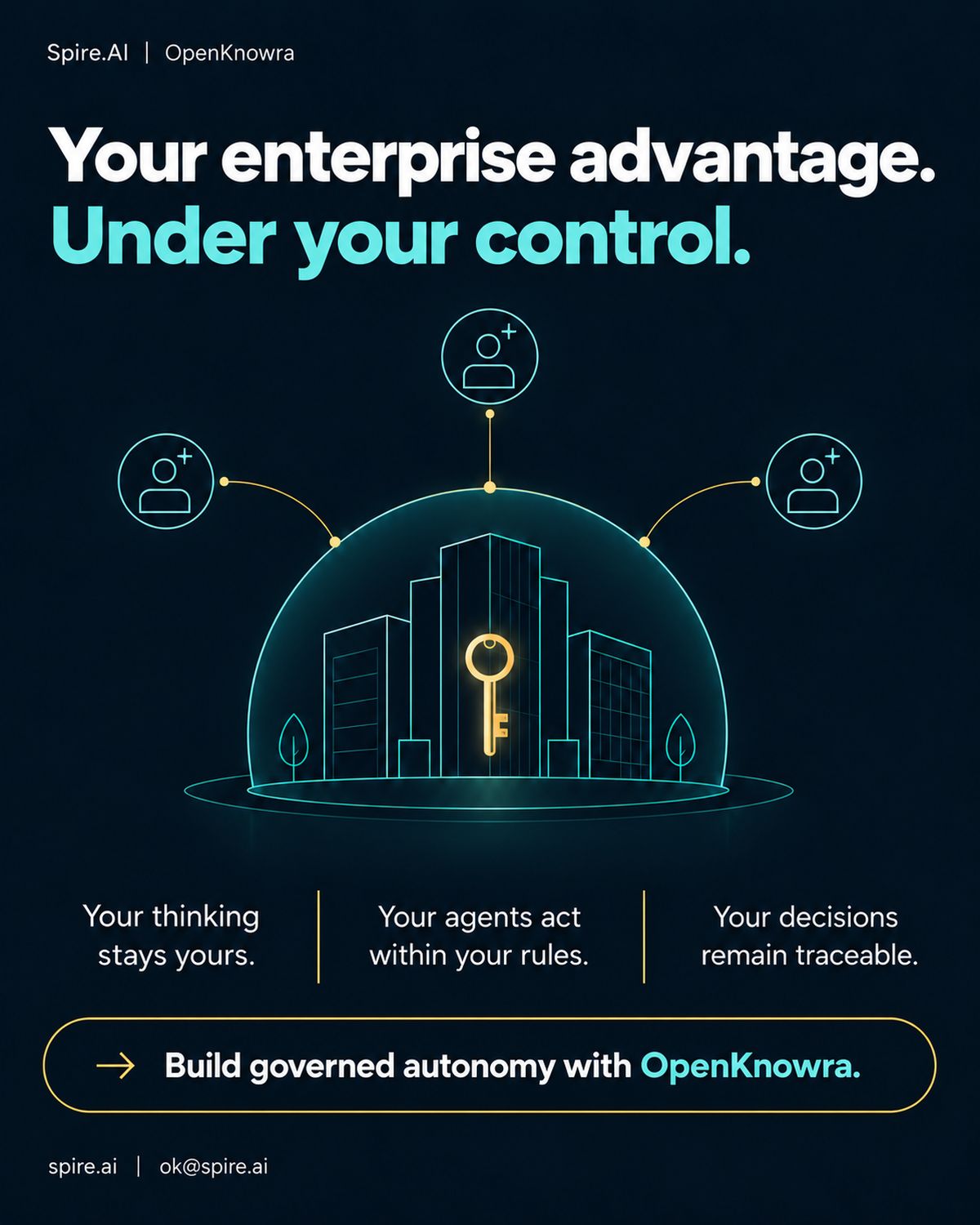
CONTROL. The biggest concern of ALL leaders - IT, Tech or Business. Over the last three days I have spoken with a number of enterprise leaders about AI. Their biggest concern was not model quality, cost or speed. It was control. How do we let agents act inside the business without handing over the way the business thinks, and without agents doing things nobody approved? A senior cybersecurity leader asked the same question from a different angle: how do we control the agents and the actions they take? And a cloud security and data governance leader said: everyone is building LLM-based agents, but the real risks are still hallucinations and unauthorised actions. Enterprise-grade AI cannot be a probabilistic black box. The rules have to live in a deterministic layer the enterprise owns, and every decision has to be traceable. That is exactly how OpenKnowra is built. Here is how the control works. Agents never hold ‘your’ logic. Your policies, constraints, thresholds and approval requirements sit in the Logic Controller, outside any model, prompt or agent. Decisions are made in your environment, where OpenKnowra runs for you. The agent receives the outcome to be achieved, but needs to operate within act, rules, and protocol defined by you, and cannot sway away without being caught. Agents act only inside boundaries. The Action Builder executes within what the Logic Controller permits: which actions, on which systems, up to which limits, and where a human must approve first. An agent that reaches the edge of its mandate stops. Agents are governed as a group. Autonomy Governance covers agent-to-agent operations, including third-party agents on the platform: what each may access, how they hand work to each other, and what they may ask of one another. The danger compounds otherwise. When one agent’s unsupported assumption becomes another’s instruction, a hallucination becomes an unauthorised business action. Most agent monitoring looks backwards at logs. OpenKnowra’s Autonomy Observability starts at the decision: before an action executes, you can see the context assembled, the rule that applied, the decision that resulted and whether approval is required. Agent Behaviour Control Logic (ABCL) enforces it at the point of action. Agent Orchestration makes every handoff between agents visible and permitted before it occurs. Decision lineage then records all of it. You can ask “why did this happen” for any outcome, or “what if I execute this”? Every increase in autonomy must be matched by the ability to govern it. We made that an architectural principle, because the enterprise must retain authority over its knowledge, its decision logic and its actions as agents multiply. Agents work for your enterprise. They do not get to run it. If this is the question on your table too, I would welcome the conversation. Discover OpenKnowra at spire.ai or connect with us at [email protected]. #EnterpriseAI #AgentGovernance #OpenKnowra #SpireAI
- LINKEDIN · IMAGESince 20 Oct 2026
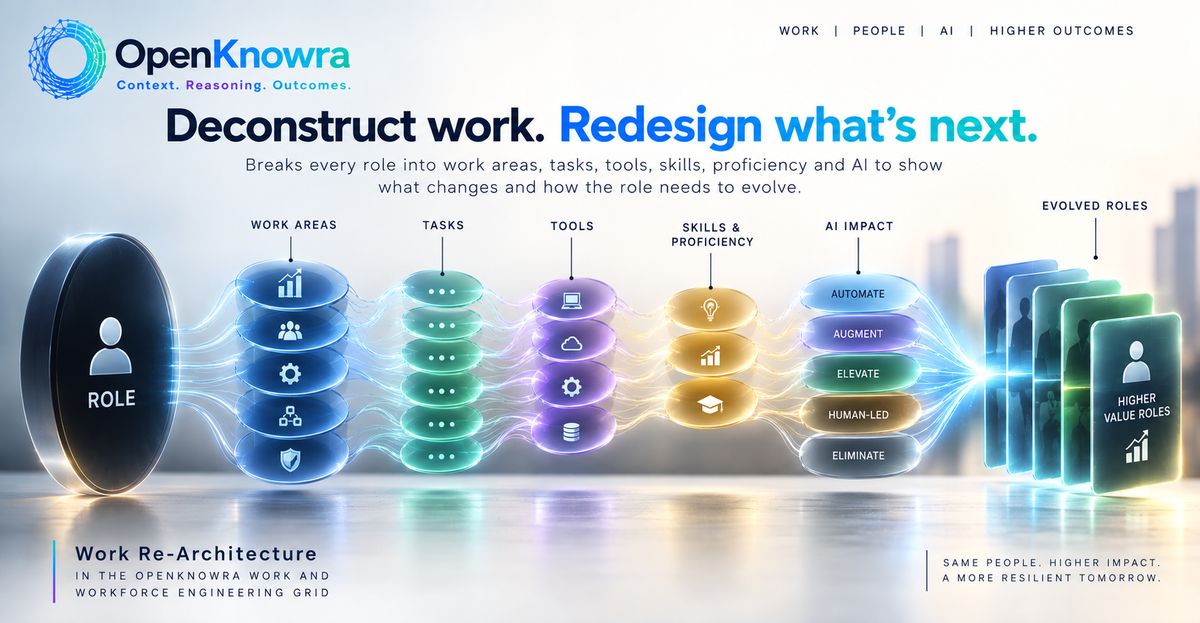
What if you could see, role by role, what AI will automate, what it will augment, what should remain human-led, and what the role needs to become next? Watch how OpenKnowra does it: https://lnkd.in/di7Jgk4W That is what the OpenKnowra Work and Workforce Engineering Grid, through its Work Re-Architecture cluster, is built to do. It connects job profiles, skills, proficiency, tasks, tools and AI to show how work is changing at the most fundamental level and what the enterprise needs to redesign in response. This goes far beyond traditional skills intelligence. Most skills systems can tell you what skills exist, where gaps are, and what proficiency may be required. But AI is changing something deeper. It is changing the tasks inside the role. Some tasks are being automated. Some are being augmented. Some are becoming autonomous. Some are being elevated. And some are disappearing altogether. Once that happens, the role itself starts to change. That is why the real questions are no longer just: What skills do we have? It is: Which roles should evolve? Which roles should converge? Which responsibilities should move upward? What new roles need to emerge? What should remain human-led? And what does all of this mean for career architecture, learning, workforce planning, deployment and the operating model? OpenKnowra brings this together using its underlying Skills Intelligence across 27 industries, approximately 680,000 role-defining skills and approximately 180,000 job profiles, and then contextualises that intelligence to the enterprise. That context is critical. The same role can evolve very differently depending on the organisation’s technology stack, AI investments, operating model, client requirements and the way work is actually delivered. So Work Re-Architecture cannot be a one-time taxonomy exercise. It has to be a continuously evolving understanding of the relationship between: work, tasks, skills, proficiency, tools, AI and people. That is what the OpenKnowra Work and Workforce Engineering Grid enables. Skills Intelligence shows what capability exists. Work Re-Architecture shows what the work needs to become. #OpenKnowra #WorkReArchitecture #SkillsIntelligence #WorkforceEngineering #EnterpriseAI #FutureOfWork #ContextEngineering
- LINKEDIN · IMAGESince 20 Oct 2026
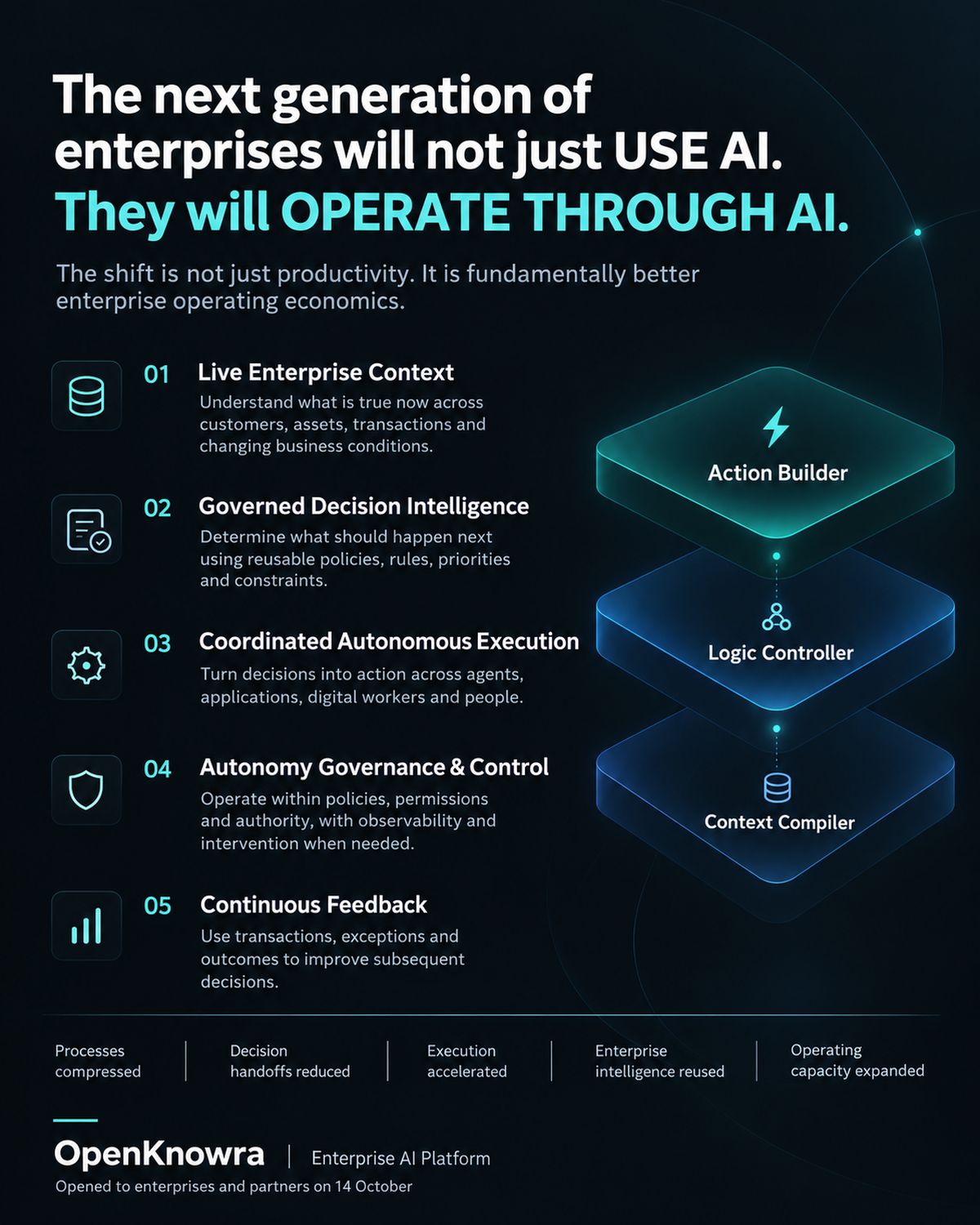
Enterprises are seeking solutions to OPERATE THROUGH AI. Not just use AI anymore as a topping on the cake. The difference could fundamentally change enterprise productivity, operating costs, decision velocity and the economics of growth. Today, enterprises are adding AI to existing processes. Copilots improve employee productivity. Agents automate tasks. Models generate predictions. But the enterprise still operates through fragmented systems, complex workflows, manual decisions and multiple handoffs. It is making existing processes faster without fundamentally changing how the enterprise operates. Operating THROUGH AI demands a different architecture. 1. Live Enterprise Context: AI continuously understands customers, assets, transactions, relationships and changing business conditions across systems. 2. Governed Decision Intelligence: Business policies, rules, priorities and constraints become reusable logic that determines what should happen next and why. 3. Coordinated Autonomous Execution: AI agents, digital workers, applications and people collaborate to execute decisions across business processes. 4. Autonomy Governance & Control: Every autonomous action operates within defined policies, permissions and authority, with observability, decision lineage and human intervention where required. 5. Continuous Feedback: Transactions, exceptions and business outcomes enrich enterprise context and improve subsequent decisions. Now consider the economic implications. AI-native operations. Processes compressed. Decision handoffs reduced. Execution accelerated. Enterprise intelligence reused. Operating capacity expanded without proportionately increasing costs. The opportunity is not simply greater employee productivity. It is fundamentally better enterprise operating economics. This is the thinking behind OpenKnowra, our Enterprise AI Platform, opened now for enterprises and partners to build on. Its three integrated layers, Context Compiler, Logic Controller and Action Builder, bring live context, governed decisions and coordinated execution into one continuously evolving architecture. Using AI makes existing work more efficient. Operating THROUGH AI changes how work gets done, how decisions are made and how enterprises scale. That is the transformation we are building towards. Explore: https://spire.ai/platform Watch the detailed 7-minute platform overview: https://lnkd.in/gtbtn7_R #EnterpriseAI #AgenticAI #AutonomousEnterprise #EnterpriseTransformation #AIGovernance #DecisionIntelligence #ContextEngineering #A2A
- LINKEDIN · VIDEOSince 17 Oct 2026
What if consulting, engineering, and professional services companies can serve more clients and deliver faster, without scaling engineering costs at the same rate? Today, every new client engagement often means rebuilding much of the same foundation. Connecting enterprise systems. Engineering business context. Translating policies into decision logic. Building agents. Establishing governance. What if your teams could engineer each client's unique enterprise context in minutes, while reusing decision logic, agents and workflows across engagements? That is the opportunity we have created with OpenKnowra. We have opened our self-service Enterprise AI Platform to consulting firms, systems integrators, technology services companies and AI builders. Three integrated platform layers make this possible: Context Compiler: Rapidly connect each client's enterprise data, systems and domain intelligence to build their own live, continuously evolving Enterprise Context Graph. Each enterprise retains its distinct business context. Logic Controller: Build reusable business processes, decision frameworks, policies and operating logic that can be adapted to each client's specific requirements. Action Builder: Create reusable AI agents, digital workers and workflows that can be configured and deployed across different enterprise environments. With Agent-to-Agent orchestration, autonomy governance, observability and control built into the platform. The commercial opportunity goes well beyond faster implementation. Your firm can develop proprietary industry-specific IP, create repeatable solutions, expand delivery capacity, differentiate its offerings and build recurring implementation and managed-services revenue opportunities. And as your portfolio of reusable solutions grows, the engineering effort required for each additional deployment can decrease. More clients. More proprietary IP. Faster delivery. Better unit economics. This is how consulting firms can move from delivering individual Enterprise AI projects to building scalable Enterprise AI businesses. OpenKnowra is now open for you to build on. Bring your industry expertise, enterprise relationships and business imagination. Build solutions that are yours. Create differentiation that is yours. Grow an Enterprise AI practice without having to grow engineering capacity at the same rate. The next opportunity for consulting firms is not simply delivering more AI projects. It is owning the intelligence and solutions they can take to market repeatedly, and without losing their moat to third party AI technologies. Explore https://spire.ai/platform #OpenKnowra #EnterpriseAI #AgenticAI #AITransformation #EnterpriseAutomation #AIConsulting #TechnologyConsulting #SystemIntegrators #ITServices #AIPartnerships #EnterpriseTechnology #DigitalTransformation #AIAgents #AIOrchestration #EnterpriseInnovation
6 of 1,234 adsSign up to see every Spire.AI ad, filter by format and date, and get alerts on new ones.
See all 1,234 adsWatch the companies you care about.
Filter every ad by industry, country, format and network, and get alerts when a company you watch starts running new ads.