On air · 2 of 3 networks
SnapLogic
- snaplogic.com
- US
- 303 employees
SnapLogic’s ads on LinkedIn, Meta and Google, recorded by adsrunning. Browse the latest here for free. Sign up free to see all 563. Watch SnapLogic with Starter to get each new one in your feed.
Watchlist with Starter · $49/mo
| Network | Status | Live ads | Nov 2025LinkedIn activity · 52 weeksOct 2026 | Checked | Next step |
|---|---|---|---|---|---|
| Running | 318 | Checked 29 Oct 2026 | See all 563 ads → | ||
| Meta | Running | 12 | Active ads on the Meta Ad Library, all countries | Checked 26 Oct 2026 | Collect them with the API → |
| Recently | 100+ | Ads on the Google Ads Transparency Center | Checked 10 Oct 2026 | Collect them with the API → |
SnapLogic has 318 live LinkedIn ads. Its Facebook page had 12 active ads on 26 Oct 2026, and we recorded 100+ Google ads on 10 Oct 2026.
Latest ads
- LINKEDIN · IMAGESince 23 Oct 2026
Your Legacy Modernization Strategy is a Lie. Your old systems aren't just sitting there gathering dust. They're a core part of your business, and while they may be reliable, they aren’t built for the speed of modern business or for today’s requirements, whether that’s a move to the cloud or the implementation of new AI capabilities. The old way of thinking about modernizing IT infrastructure—the "big bang" approach where you rip everything out and start from scratch—is risky and often fails. It's time to shift our mindset. I've been thinking a lot about the path to modernization. It's not a single, monumental project, but a series of strategic moves you can make one piece at a time, without disrupting your entire operation. The real challenge isn't just the technology; it's the overwhelming complexity of what has been built on top of it. For organizations on legacy middleware like Informatica and IBM DataStage, rebuilding on a new platform is daunting. These projects can cost tens of millions and take years due to thousands of undocumented workflows with intricate interdependencies. This isn’t just a matter of modernization; it’s about making sure you don't recreate old workflows that were designed for yesterday’s technology and business needs. A New Approach to Modernization SnapLogic’s approach is about making this transition not just possible, but practical. We've developed a new AI-powered solution that rewrites the rules by automating the entire modernization process, from initial assessment to final deployment. Instead of a "lift and shift" that just moves the problem to the cloud, our approach offers a strategic remodel. It provides three core capabilities: •AI-Powered Integration Mining: Instantly document legacy integrations, identifying opportunities for streamlining. •Automated Pipeline Generation: Build modern, high-performance pipelines based on the analysis of existing integrations. •Intelligent Testing & Documentation: Generate a comprehensive testing infrastructure to minimize errors and ensure a smooth, confident transition to an AI-enabled, future-proof platform. This allows organizations to quickly transition into agile, AI-driven enterprises. In initial pilot projects, we've seen an 80% reduction in implementation time and a 3-to-1 reduction in complexity (measured by the number of resulting pipelines). Our AI-powered solution allows our partners, including global system integrators like Cognizant and Infosys, to deliver faster, more efficient modernization services to our shared customers. Don't get stuck in a costly, multi-year migration. Discover a new path to modernization that dramatically cuts down on time and effort. Visit: https://lnkd.in/gnJEc2iT #LegacyModernization #Integration #SnapLogic
- LINKEDIN · IMAGESince 23 Oct 2026
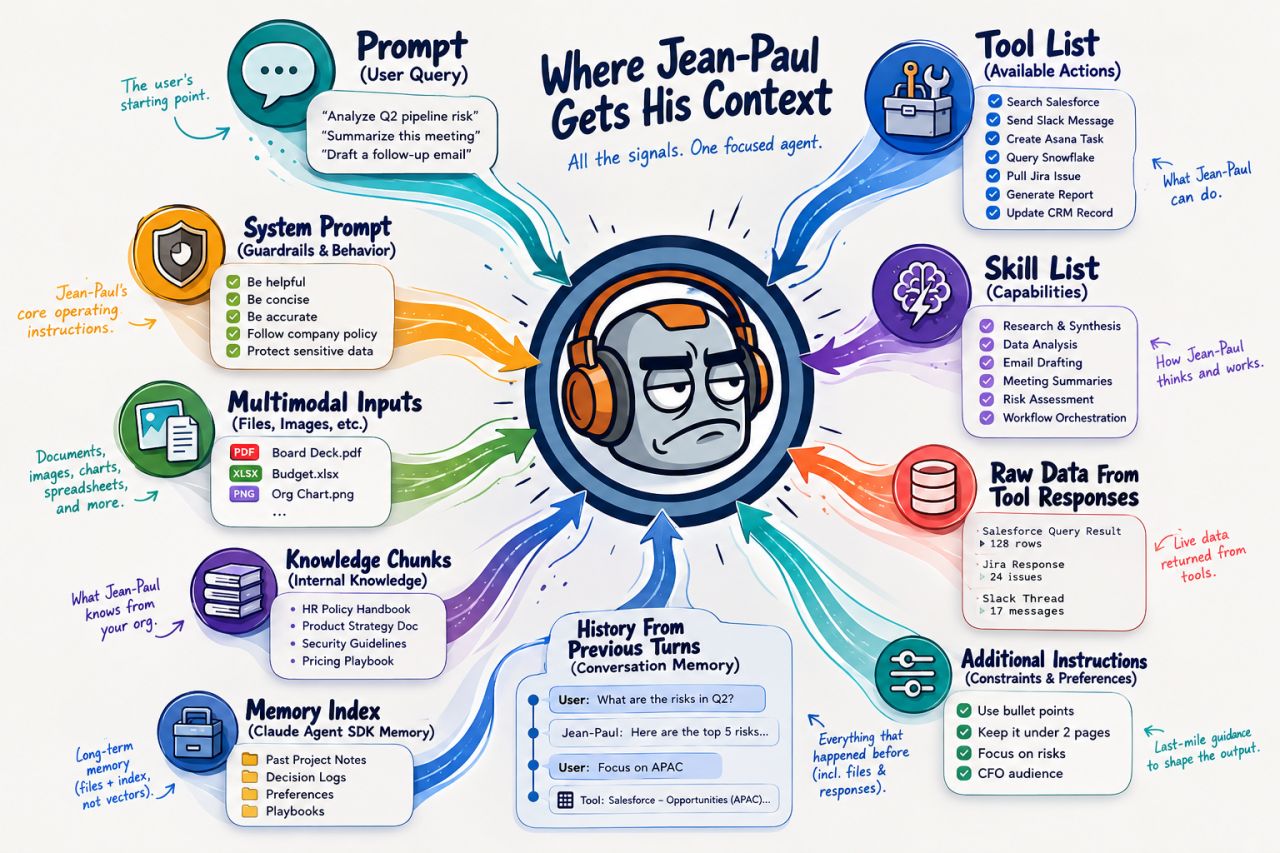
In September last year, I built Jean-Paul, an Agent that connected to as many of our business application as I could think of. At the time it was 37 tools: Salesforce, Bigquery, Box, Loopio... it felt like a lot! That was the experiment, models had evolved and could handle more than the 5 to 10 tools I used to give to mono-task agents. Not only did it work as a demo, it was immediately useful and I started relying on it for my day to day work. The premise of Jean-Paul as an application started there: a single agent for all my workflow, which very quickly became a single agent for all the enterprise. Today our version of Jean-Paul which serves our internal community has a library of 603 active tools. This is only one part of JP's context, and the role of the application is to manage it craftfully to give the user the outcome they require. Anyway, I'm still hyped.
- LINKEDIN · IMAGESince 23 Oct 2026
Most AI pilots don’t fail because the model isn’t smart enough. They fail because the enterprise architecture underneath them can’t scale. That was one of the big themes in our AgentFest panel conversation on what has changed in enterprise integration over the last 18 months. AI has raised the expectations for speed, agility, scale, and quality. But it has also exposed the limits of rigid, point-to-point connections and manually maintained integration architectures. As organizations move from AI pilots to production, integration has to evolve too. The shift is toward more adaptive, AI-orchestrated networks that can support rapidly changing data environments, connect across complex business processes, and provide the governance and control enterprises need. For integration leaders, the mandate is clear: integration is no longer just about connecting systems. It is becoming the foundation for scaling AI across the business. What do you think is the biggest blocker to moving AI from pilot to production? ----- Watch the full AgentFest panel session here: https://lnkd.in/gxF2By4s
- LINKEDIN · VIDEOSince 17 Sept 2026
AI shouldn’t be something employees wait for IT to build. I am so excited to share the work of Annette Rodriguez I’m a strong advocate for empowering every employee with AI. I created Jean-Paul rooted in the belief that the people doing the work are the ones who best understand the problems that need solving - not their managers, not IT experts. Everyone will absorb new technology at their own pace, and that’s fine. When they get there, it just works: watch Annette describe how she enables SnapLogic customers, approaching each situation without bias and intuitively spotting opportunities for breakthrough change. Brilliant intuition. There are more examples coming, keep an eye out. In the meantime, you can see more of what we’re building at snapLogic.com
- LINKEDIN · VIDEOSince 16 Sept 2026
How are enterprises actually using AI to drive measurable business value? A great example is Cambridge & Counties Bank, they used agentic workflows to transform a highly manual, high-touch process in their asset finance business. By introducing SnapLogic agentic workflows, they were able to increase operational capacity by 3x, enabling growth from 100M to 300M in asset financing without needing additional headcount. If you’d like to hear how others are operationalizing AI or discuss where agentic workflows could create similar value in your organization, let’s chat!. #AI #AgenticAI #AgenticWorkflows #Automation #DigitalTransformation
- LINKEDIN · VIDEOSince 16 Sept 2026
Most of today’s vendor-supplied MCP servers are garbage. What are we going to do about it? As I suggested in a prior post, the answer might lie in a 10 year old open-source project from Netflix. I’m serious. In 2015, Netflix pioneered a concept called experience-based APIs with a project named Nicobar. Today, this exact design pattern is the key to building high quality MCP servers for AI agents. Here is the problem we are facing right now: Most vendor-supplied MCP servers are just pass-through wrappers around low-level, granular APIs. They are completely blind to use-case specific complex business and integration logic. While this is resource efficient from a provider's perspective, it's kerosene on the fire of token burn. Why? If you expose low-level fine-grained API calls to an LLM via a poorly designed MCP server, you are going to hit two massive hurdles: 1 - Cost via Token Bloat: You flood the context window with expensive, confusing tokens. 2 - Errors via Context Overload: You force a non-deterministic model to guess at deterministic business logic with an overload of information, dramatically increasing the error surface of the task. Netflix faced a similar orchestration challenge a decade ago. They had to ensure their service ran perfectly across thousands of wildly diverse client devices ranging from iPads to smart TVs to set-top TV boxes. If they forced every device to handle the complex orchestration of backend microservices, the client community would have collapsed under the weight of client-specific data transformation and presentation logic. Their brilliant realization? Make building client applications dead-simple. Instead of 100 granular calls, each client device needed just a few highly contextual calls (e.g., one to log in, one to play content). A middle layer handled the heavy lifting: dynamically loading context-specific logic, orchestrating, and validating the granular backend APIs. This is exactly how we must architect enterprise MCP servers. Instead of handing an LLM an encyclopedic API dictionary, we should build domain-specific, experience-based MCP servers for unique business contexts like invoice reconciliation or supplier onboarding. By shifting the heavy integration logic out of the LLM’s reasoning window and down into a robust, deterministic service and orchestration layer (like SnapLogic), you give the LLM clean, high quality information to work with. The LLM handles the natural language at the top. Your integration and orchestration fabric delivers sophisticated business logic, strict data governance, process orchestration, and security at the bottom. Stop asking AI models to figure out low-level API spaghetti. Build the experience-based boundaries they need, and let your users accelerate their future. What is the most convoluted MCP server implementation you've seen so far? Let me know in the comments. #AI #MCP #AgenticCoding #SystemsThinking #SnapLogic


6 of 563 adsSign up to see every SnapLogic ad, filter by format and date, and get alerts on new ones.
See all 563 adsWatch the companies you care about.
Filter every ad by industry, country, format and network, and get alerts when a company you watch starts running new ads.