On air · 1 of 3 networks
Scrunch
- scrunch.com
- Technology, Information and Internet
- 85 employees
Scrunch’s ads on LinkedIn, Meta and Google, recorded by adsrunning. Browse the latest here for free. Sign up free to see all 355. Watch Scrunch on any plan to get each new one in your feed.
Watchlist included in every plan
| Network | Status | Live ads | Nov 2025LinkedIn activity · 52 weeksNov 2026 | Checked | Next step |
|---|---|---|---|---|---|
| None recorded | 0 | Checked 3 Nov 2026 | See all 355 ads → | ||
| Meta | Not checked | — | |||
| Running | 48 | Ads on the Google Ads Transparency Center | Checked 31 Oct 2026 | Collect them with the API → |
Scrunch has no live LinkedIn ads. We recorded 48 Google ads on 31 Oct 2026.
Latest ads
- LINKEDIN · VIDEORecorded 22 Sept 2026
✌️Questions everyone’s asking: What are my customers prompting? Is my brand showing up? We vibe-coded 🤙 a little app that answers both. Meet: Prompt Generator → https://lnkd.in/gqFDsuuQ Drop in your domain, and it’ll generate prompts you should be paying attention to AND show if your brand’s showing up in ChatGPT. HOW IT WORKS: 1️⃣ Authenticate with Search Console OR just drop in a URL 2️⃣ Choose what stages of the funnel to generate prompts for 3️⃣ Run any prompt through ChatGPT and see if your brand shows in results or citations That’s it. Simple. Helpful. Powerful. P.S. If you want to keep track of these prompts over time, keep tabs across more AI models, and grow share of voice, you can do it all in Scrunch (and for free at that with our 7-day trial).
- LINKEDIN · IMAGERecorded 22 Sept 2026
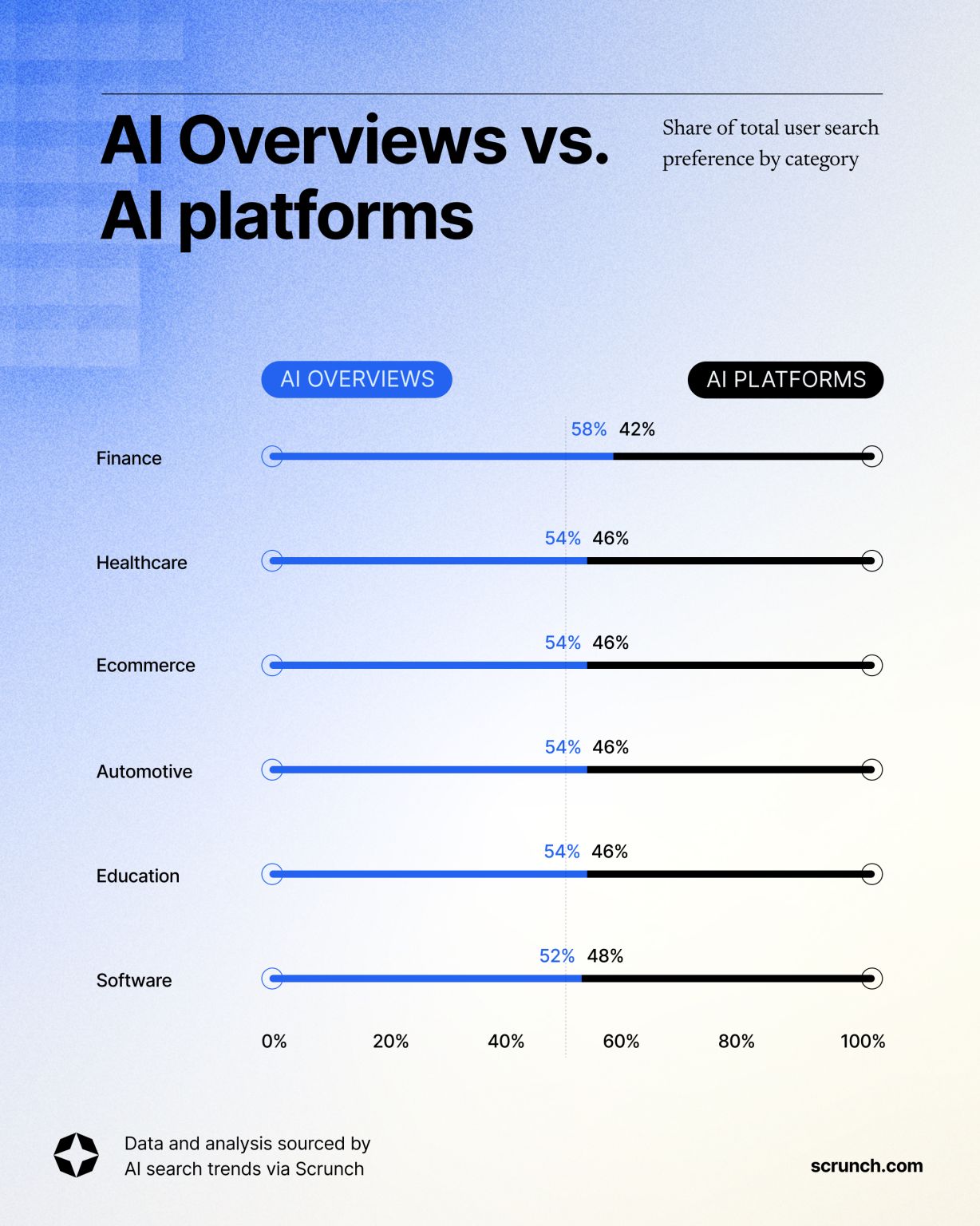
100K unique users, 7.6M search sessions, and 22M GenAI interactions later, it’s clear that the winning strategy for AI search is multi-channel 👇 There are 2 primary ways that AI is augmenting search: 1. Conversational agents: Think ChatGPT, Claude, Perplexity, Gemini, Grok, etc. 2. Generative overlays: Think Google AI Overviews. Each option presents a path for consumers to discover, learn about, and ultimately select your brand. The question is: Which path are people picking? We took a subset of our data and analyzed 100K unique users across 7.6M AI search sessions (including 11M prompts and 11M responses) related to 6 industry supercategories (finance, healthcare, ecommerce, automotive, education, and software) over 3 months. Our analysis shows that AI Overviews were slightly favored among dual-mode AI users (i.e., people who used both modes of AI search in a specific category), which isn’t terribly surprising when you factor in that Google has a global daily user base of 2B+ users. But there were notable divergences at the topic level. In general, it appeared that topics more aligned with shopping and comparison tended to lean more heavily toward AI Overviews while topics more aligned with exploratory research, tools, and workflows tended to give more ground to conversational agents. Our takeaway? You can’t assume that one channel will dominate the AI discovery path. Whether the intent behind the search is “tell me more” or “show me my options,” it pays to optimize for all major AI search channels. Our advice: 🕵️ Get visibility into how you’re showing up across all AI search channels. 🤖 Make sure LLMs can crawl and interpret your website. ✍️ Don’t sleep on SEO (core best practices influence AI retrieval agents, and AI Overviews are significantly based on performance in Google’s search index). Because if you’re only visible in one channel, you’re losing market share in others. See our full findings in the comments below ⬇️
- LINKEDIN · IMAGERecorded 22 Sept 2026
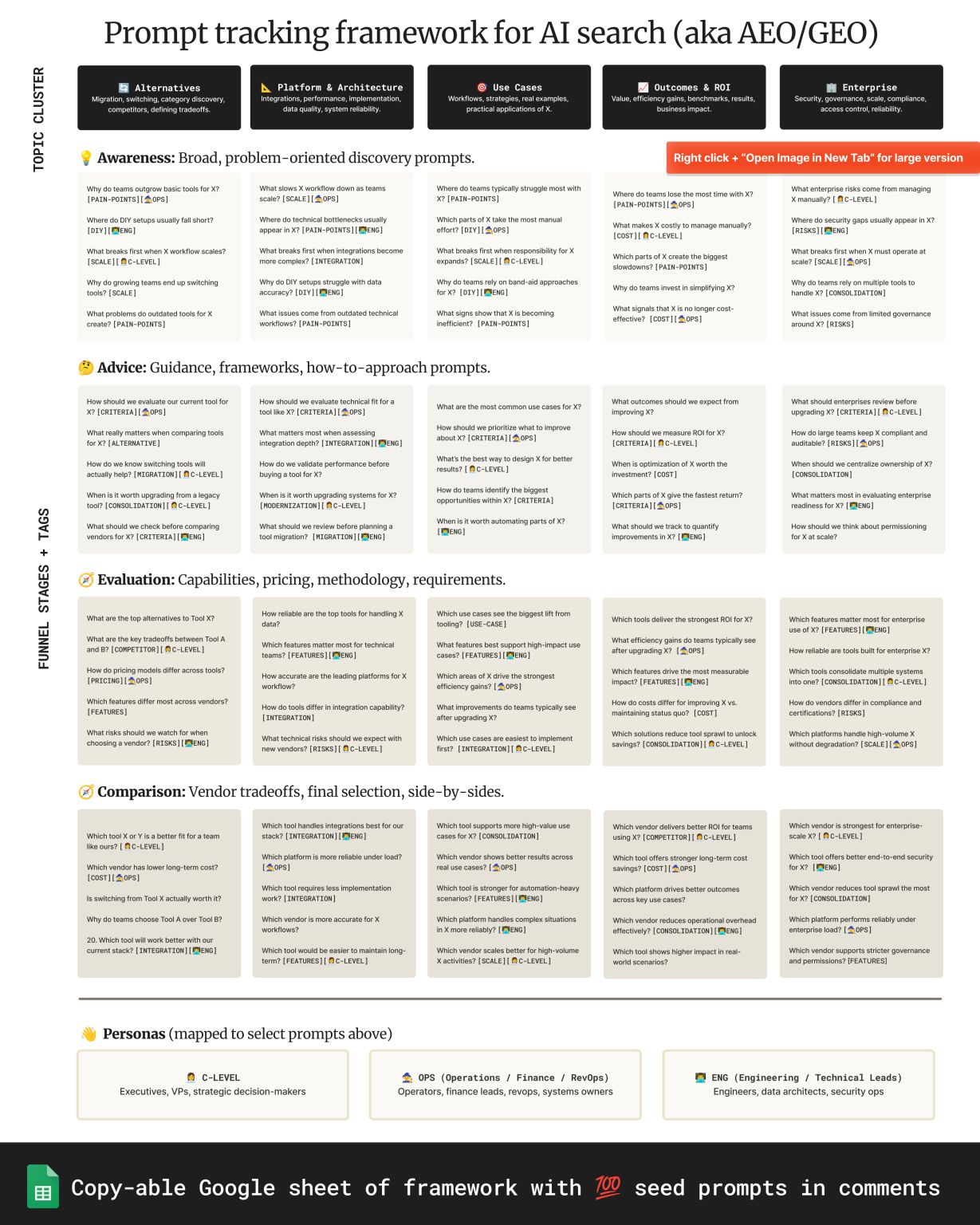
SEO has its keyword research frameworks. AI search (aka AEO)? Not so much. So, I created one. Here’s my: Prompt tracking framework for AI search 👇 Like any good framework, the goal with this one is to have a system for prompt tracking that’s repeatable, durable, scalable, and easy to grok. That way, any time you need to track a new prompt (or a whole batch for a campaign), it just slots right in. Here’s how it’s structured: ======= PROMPT CLUSTERS These are your high-level containers. I like to think of them like keyword groups in SEO. They’re a grouping of prompts with a common theme across the dimensions below. Examples of prompt clusters: Competitors & Alternatives, Use Cases, Outcomes & ROI. (These could also be campaign-based, product-based, or any other grouping that makes sense to you.) ––––––– FUNNEL STAGES Within each prompt cluster, prompts are mapped to funnel stages. I use the following four stages: → Awareness: pain, problems, friction → Advice: guidance, frameworks, how to think about X → Evaluation: exploring solutions, features, capabilities → Comparison: choosing between options This gives me a simple method to fill out prompts to track by the highest point in the funnel, and then map follow-up prompts to corresponding stages of the funnel. ––––––– PERSONAS Some prompts are particular to a persona within your ICP. When that’s the case, I append a persona (e.g., c-level, ops, engineering) to the prompt. More on this later, but this will allow us to inform our AI search strategy by isolating prompts to a specific persona. ––––––– TAGS I use tags to append custom metadata to prompts. This is especially helpful for time-bound prompts (think a brand campaign), bespoke designations (think an integration or partner), and as connective tissue across topic clusters (think “pricing” as a tag). ––––––– Bonus: REGION Operating at a Global scale? I’d apply this same framework to each region of focus. Regions will have their nuances—e.g., how a prompt is asked or the tags for regulations (think GDPR)—but, for the most part, should fit nicely into the framework. ======= With your prompts mapped to the dimensions above, you can then start to ask insightful questions to inform your AI search strategy, like: -- “Find citations for high-intent prompts that include competitors.” -- “What was our brand reach on LLMs for X campaign?” -- “Show me our brand presence at the C-level.” To grab a large version of the infographic: right-click, select “Open Image in New Tab”, and save it. === P.S. Be sure to grab the Google sheet template (see comments) if you want to grab an action-able version. And if you want to operationalize this framework, you can drop the template straight into Scrunch to start tracking, get insights, and take action to grow your AI search reach. Start a free 7-day trial at: scrunch.com
- LINKEDIN · IMAGERecorded 22 Sept 2026
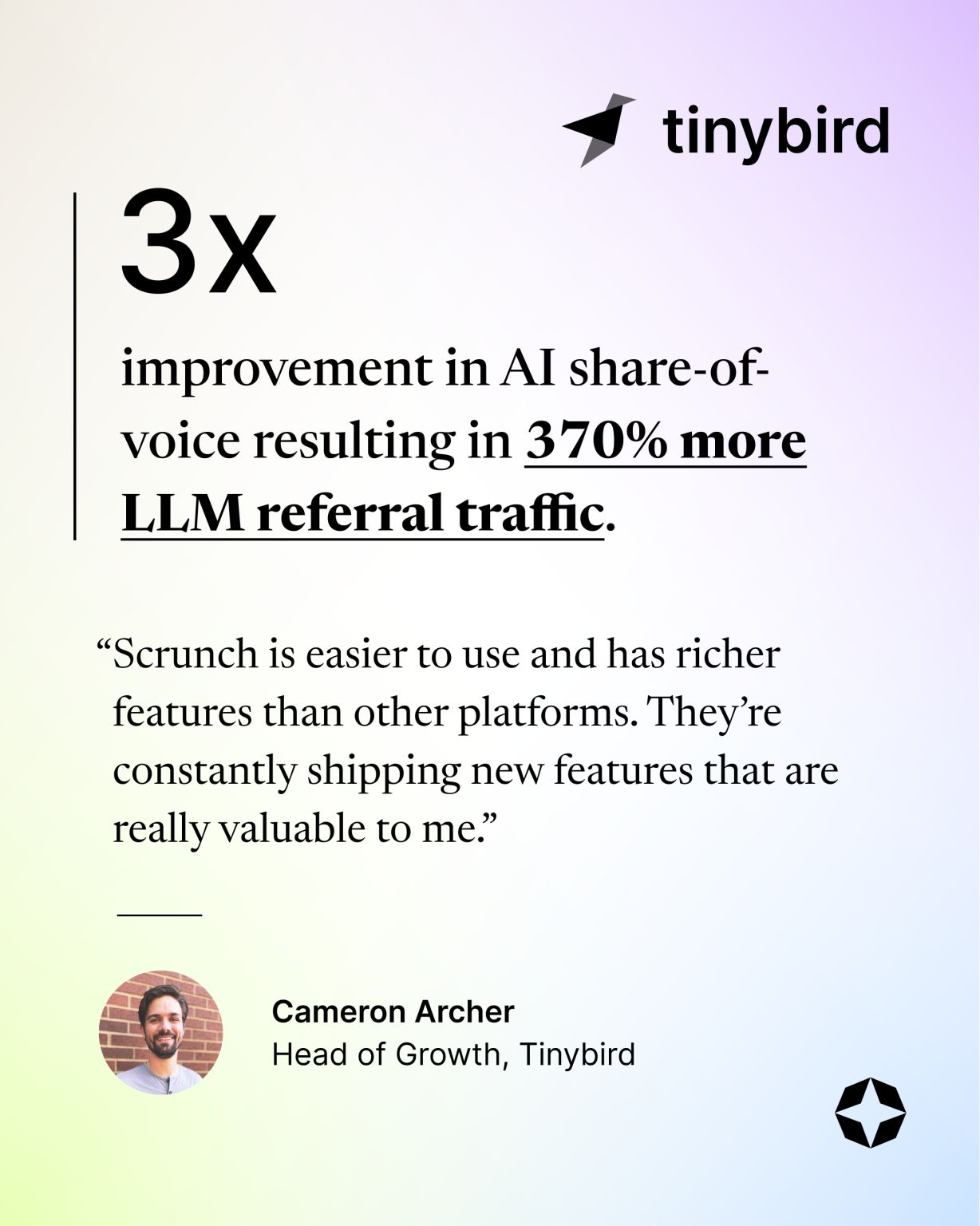
“Clicks from organic search are starting to take a nosedive and it's like, so what? That doesn't matter anymore. I care much more about my brand being mentioned.” That is Cameron Archer, Head of Growth at Tinybird, calling the shift clearly. The challenge was not just visibility. It was operational. How do you see where Tinybird appears in AI answers, understand why, and turn that into work your team can ship this week? Their solution: Scrunch. One place to track AI search performance, diagnose what models cite, and translate insights into content and distribution moves. Not just the “what,” but the “why,” and the “what to do next.” In practice that looked like: ⟡ Defining the high-intent prompt map ⟡ Knowing the key variants used by their actual buyers ⟡ Publishing content where models are already looking ⟡ Making on-site content easier for agents to consume ⟡ Tracking share of voice by model, persona, and region ⟡ Auditing cited domains and URLs to understand source influence Results speak for themselves: 📈 Share of voice up about 3x 📈 LLM-referred web sessions up a whopping 370% (both in the last 3 months) When teams can see the full path from prompt to citation to session, they can plan work that moves numbers. We are excited to partner with Cameron and the Tinybird team. Full customer story and playbook 👉 https://lnkd.in/g9tNYbbH
- LINKEDIN · IMAGERecorded 22 Sept 2026
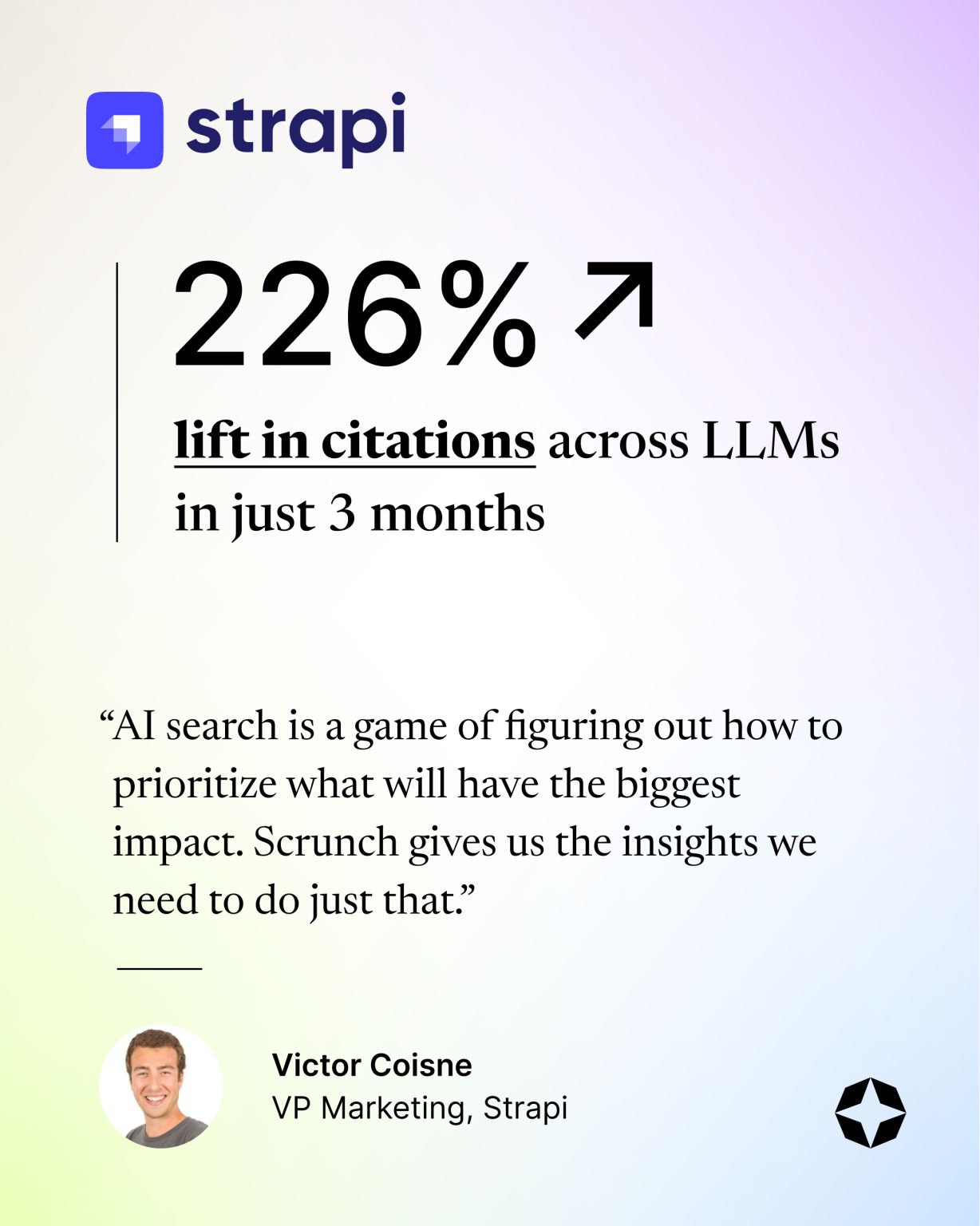
This is the 3-step playbook on how Victor C. at Strapi grew LLM citations by 226% in 3 months 👇 1️⃣ Benchmark the AI search landscape Identify where you show up across AI platforms and where competitors appear but you don’t. 2️⃣ Prioritize the prompts that matter Focus on the topics with real search volume, rising interest, and low brand presence. 3️⃣ Optimize your site for LLMs Fix access issues, metadata gaps, and formatting problems so AI systems can reliably cite your pages. That’s the framework Victor followed. And the results speak for themselves: 📈 +226% non-branded citations 📈 +31% brand presence across AI platforms Get the complete playbook over on the Scrunch blog 👉 https://lnkd.in/gtGXDw_E
- LINKEDIN · VIDEORecorded 22 Sept 2026
One of the signs you’re working at a #winning startup is product velocity. Last week, we launched AI Search Trends to show trending topics and prompt volumes across LLMs. Today (just a week later), we’ve shipped two big additions: brand sentiment and competitive stack rankings to show how your brand shows up in any one of our 1,500+ topics. Drill down into any AI Search Trend topic to see: 🤗 Brand Sentiment ⤷ Gives a breakdown of sentiment towards your brand in AI responses, with a simple positive, mixed, or negative score. Drill down even further to see brand sentiment for any specific prompt within the selected topic. ⚔️ Competitor Stack Ranking ⤷ Compare how often your brand appears vs. competitors across prompts within any selected topic (aggregated across 7 LLMs). View it in both a line chart and stacked bar chart for easy trend reporting. Demo 👇
6 of 355 adsSign up to see every Scrunch ad, filter by format and date, and get alerts on new ones.
See all 355 adsWatch the companies you care about.
Filter every ad by industry, country, format and network, and get alerts when a company you watch starts running new ads.